






谷歌 đang ốm


- Quan điểm cốt lõi: Google đã trải qua một cuộc chảy máu chất xám nghiêm trọng vào năm 2026, khi nhiều nhà nghiên cứu AI chủ chốt (bao gồm tác giả bài báo Transformer Noam Shazeer và người đoạt giải Nobel John Jumper) lần lượt rời bỏ để gia nhập các đối thủ cạnh tranh như Anthropic. Điều này phản ánh tình trạng khó khăn của Google khi trở thành "vườn ươm" nhân tài AI, nơi các quy trình ra quyết định nội bộ kéo dài, sự tranh giành phân bổ tài nguyên và khó khăn trong việc đưa sản phẩm ra thị trường đang làm suy yếu một cách có hệ thống khả năng giữ chân các nhân tài hàng đầu.
- Yếu tố then chốt:
- Noam Shazeer, tác giả chính của bài báo Transformer, sau khi Google chi 2,7 tỷ USD để mua lại công ty của ông chưa đầy hai năm, đã lại rời bỏ để gia nhập OpenAI vì sức mạnh tính toán cho dự án của ông bị điều chuyển cho DeepMind.
- John Jumper, người đứng đầu dự án AlphaFold và là người đoạt giải Nobel, đã tuyên bố rời DeepMind sau chín năm gắn bó vào tháng 6 năm 2026 để gia nhập Anthropic, khiến cổ phiếu Alphabet giảm khoảng 5%, vốn hóa thị trường bốc hơi khoảng 225 tỷ USD.
- Trong vòng một tháng, ít nhất năm nhà nghiên cứu AI hàng đầu của Google đã nghỉ việc, trong đó bốn người (bao gồm các thành viên chủ chốt của AlphaFold) đã chuyển sang Anthropic, tạo thành một làn sóng chảy máu chất xám có hệ thống.
- Thống kê của SignalFire năm 2025 cho thấy, xác suất một kỹ sư DeepMind nhảy việc sang Anthropic cao gấp 11 lần so với chiều ngược lại. Google đang trở thành "lớp đào tạo" cho các đối thủ cạnh tranh.
- Về mặt sản phẩm, các dịch vụ AI của Google liên tục mắc những lỗi cơ bản: kết quả tìm kiếm gợi ý "bôi keo lên pizza", công cụ mã hóa Gemini CLI xóa nhầm tệp tin của người dùng, việc phát hành Gemini 3.5 Pro bị trì hoãn, cho thấy con đường chuyển đổi từ nghiên cứu sang sản phẩm trong tổ chức đã bị bế tắc.
Original author: Sleepy
In August 2024, Google spent $2.7 billion to bring Noam Shazeer back from Character.AI, the company he founded.
Shazeer was a core author of the 2017 paper "Attention Is All You Need" and a co-inventor of the Transformer architecture. Without his paper, there would be no GPT, no Claude, no Gemini, and no AI industry as we know it today.
He joined Google in 2000 as one of its earliest employees, staying for over two decades. He left in 2021 to start his own company after Google refused to release his chatbot, Meena.
Google paid a hefty sum to bring him back, giving him the title of Vice President of Engineering and making him co-lead of Gemini, hoping he could help the company win the AI battle.
Less than two years later, he left. He went to OpenAI.
According to Bloomberg, shortly before Shazeer announced his departure, computing resources for a project he was leading were internally reallocated by Google to the DeepMind team. Insiders said the move was intended to foster team collaboration and consolidate pre-training efforts.
The Nobel Laureate's Farewell
Shazeer left on June 18th. The next day, John Jumper also left.
Jumper's story is different from Shazeer's. Shazeer was a veteran, spending over two decades at Google and seeing all the company's highs and lows. But Jumper was nurtured by this place.
Just six months after Jumper received his PhD, Hassabis made a risky decision, entrusting the young man with no management experience to lead the entire protein structure prediction project.
Jumper didn't let this opportunity go to waste. He led his team to create AlphaFold, predicting the three-dimensional structures of over 200 million proteins, advancing the entire field of structural biology by a decade. In 2024, he stood alongside Hassabis in Stockholm to receive the Nobel Prize in Chemistry.
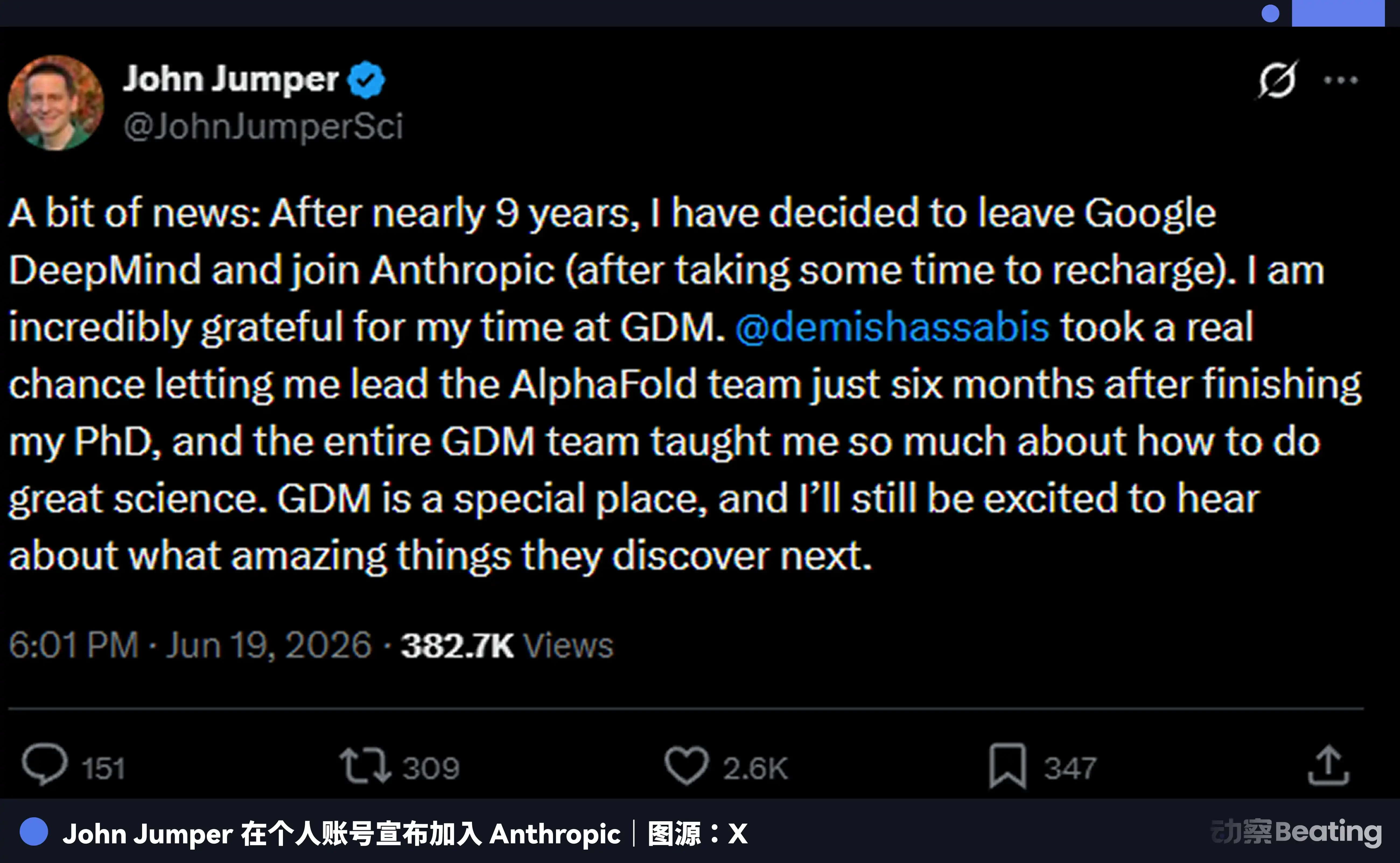
The first half of this story is about trust and fulfillment. Hassabis trusted a young man, and the young man repaid him with nine years of work, benefiting all of human biology. But there's a second half. Two years after winning the Nobel Prize, on June 19, 2026, Jumper posted a very short tweet, saying he was going to Anthropic.
When markets opened on Monday, Alphabet's stock price plummeted. It fell around 7% during trading and closed down about 5%, wiping out roughly $225 billion in market capitalization – losing the value of a Spotify. Alphabet's stock had been trending downward since hitting an all-time high in early 2026, weighed down for months by antitrust lawsuits, massive capital expenditures, and anxiety over the AI race. These two departure announcements were the final straw.
Over the next few days, announcements came one after another. Jonas Adler and Alexander Pritzel were also leaving, heading to Anthropic. These two were core contributors to Gemini and long-time collaborators of Jumper on AlphaFold. Adding to this, AI safety researcher Arthur Conmy, who had left earlier, meant that Google had lost at least five top-tier researchers in one month, four of whom went to Anthropic.
Hassabis mentored Jumper from the start, and now he watched him lead half the AlphaFold team through the doors of a competitor. I don't know what he saw in the replies to Jumper's tweet, but I imagine it was a very familiar sense of fate.
Nursery
Every generation's best tech company eventually becomes the nursery for the next.
Google itself grew this way.
Many of its earliest engineers came from Microsoft, IBM, Yahoo, and Bell Labs. When Microsoft was severely weakened by antitrust cases in the 2000s, a large number of top talents flowed to Mountain View, including a young Shazeer.
Going further back, Bell Labs invented the transistor, Unix, and the C language, essentially laying the foundation for the entire information age. But what about Bell Labs itself? Its people scattered to every corner of Silicon Valley, becoming the founding teams of others.
Now it's Google's turn.
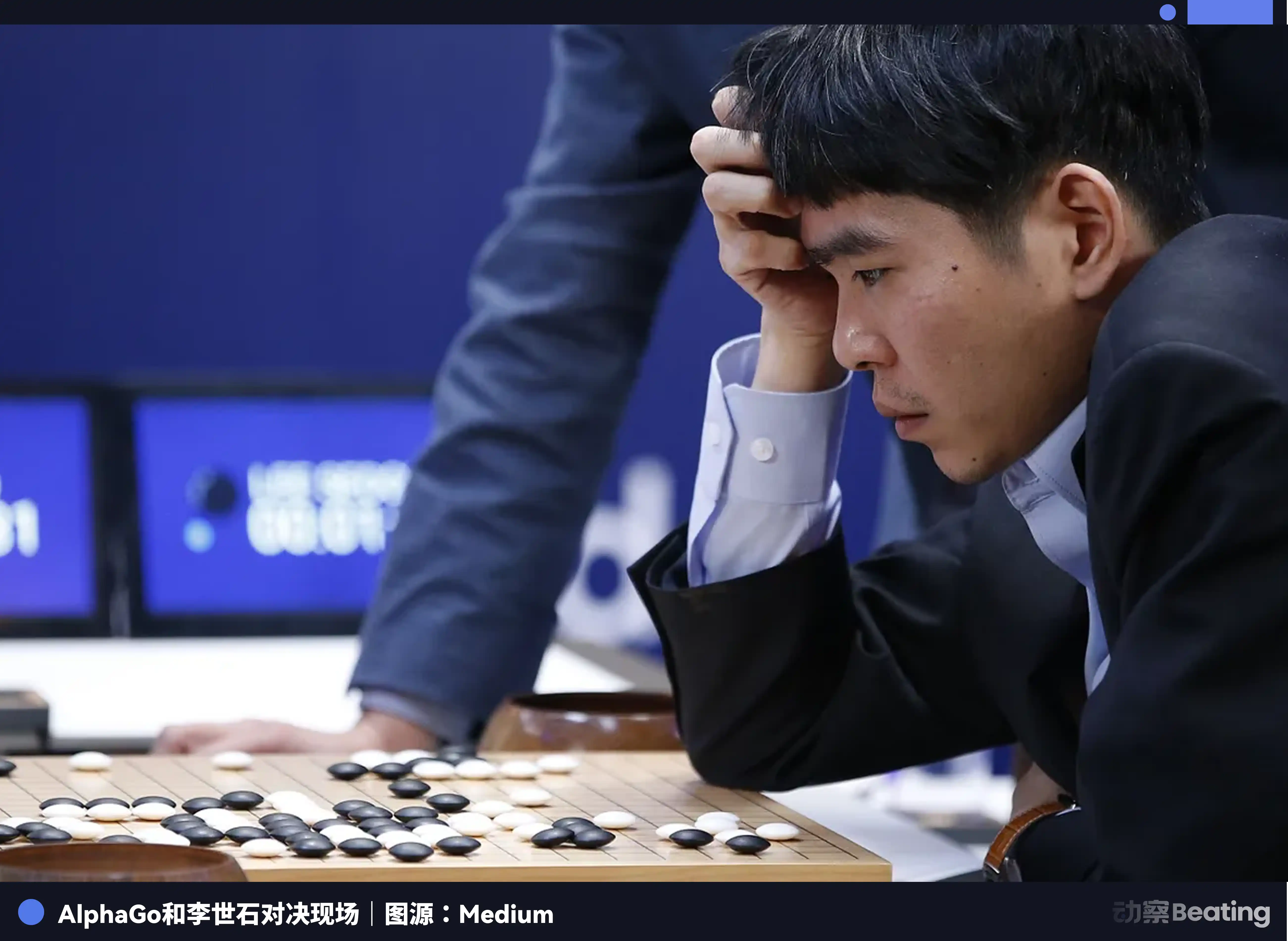
In 2016, AlphaGo defeated Lee Sedol, and the world learned for the first time that AI could achieve such a feat. That was Google's moment.
In 2017, the Transformer paper was published, laying the foundation for the entire AI industry. That was still Google's moment.
In 2021, AlphaFold predicted 98% of human protein structures. That was still Google's moment.
Back then, no one asked, "Can Google win the AI battle?" because asking that was as redundant as asking, "Will the sun rise in the east?" Google had the best researchers, the most data, the strongest computing power, the most money. If it didn't win, who would?
But take a look now at who stands opposite Google.
Ilya Sutskever, co-founder of OpenAI, did deep learning research at Google with Geoffrey Hinton in his early days.
The Amodei siblings, founders of Anthropic, previously did safety research at OpenAI, and OpenAI's early core team itself included many people from Google.
Jumper spent nine years at DeepMind. Shazeer spent over two decades at Google. Tracing the talent chain of the entire AI industry back to its source, almost everyone has worked in Mountain View at some point.
SignalFire did a study in 2025, finding that DeepMind engineers were 11 times more likely to jump to Anthropic than the other way around.
Someone commented on this wave of departures on Twitter, writing: "Google is becoming a training ground for Anthropic."
Google provides money, computing power, and a free environment, attracting the world's smartest young people and giving them the best conditions for cutting-edge research. Once they are ready, they fly away, go to the other side, build products better than yours, and come back to compete against you.
Can't Keep the Doers
Google's problem isn't just retaining talent. It retained Shazeer the moment it bought him back for $2.7 billion. The question is, what happened after retaining him?
Shazeer left Google twice.
The first time was in 2021, when Google refused to release his chatbot, Meena. ChatGPT hadn't been born yet, and Google was cautious about conversational AI, preferring to wait and see. Shazeer couldn't wait, so he left. The second time is now. His computing resources were reallocated, and he left again.
Both departures essentially stem from the same reason: he wanted to build things, but the organization prevented him.
Google's decision-making chain is too long. Getting a new AI feature from R&D to launch requires approvals from product, legal, compliance, PR, and various business lines. Getting stuck at any stage can mean months of delays. By the time a technology developed in the DeepMind lab actually enters a consumer product, the window of opportunity has already passed.
In 2023, Google merged DeepMind and Google Brain. Everyone was optimistic about the merger of these two strongest AI teams at the time.
But merging doesn't equal integration. The two teams' respective codebases, data pipelines, and work habits haven't been fully unified even today. The reallocation of Shazeer's computing resources to the DeepMind team is a microcosm of this "merged but not integrated" state. Nominally one department, but in reality, how resources are divided and who sets priorities remains an internal power struggle.
If an organization can't utilize talent well, its products naturally deteriorate. Google Search's AI Overviews feature once suggested users put glue on pizza to prevent cheese from sliding off, said running with scissors is a form of cardio, and when asked "Is it 2026?", confidently replied, "No, it's 2025." One study showed it generates tens of millions of incorrect answers per hour.
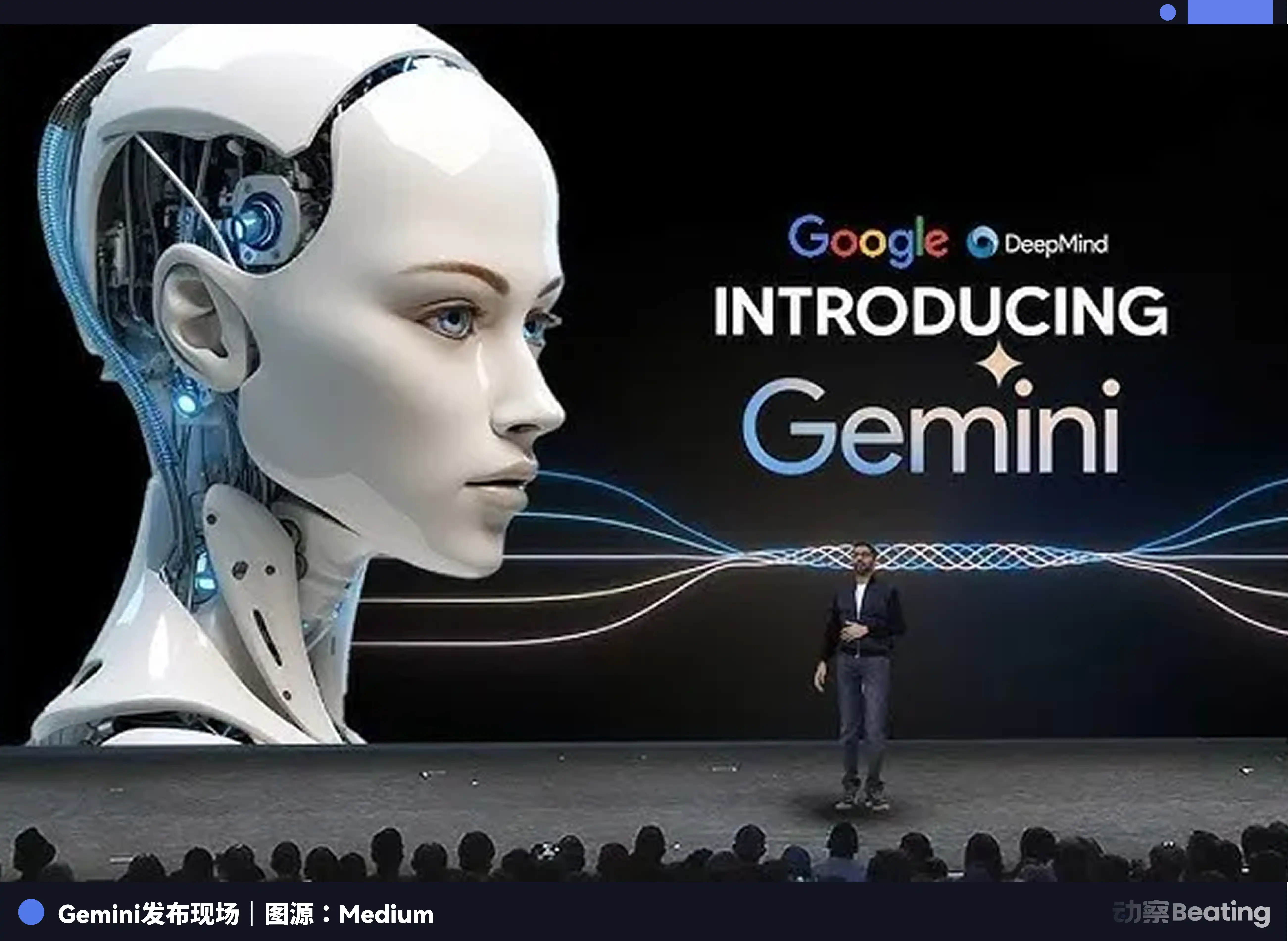
In early 2025, Google announced it was fully migrating Google Assistant to Gemini. Basic functions that had worked for nearly a decade suddenly malfunctioned. Setting alarms and controlling smart home devices all had issues. The migration, originally scheduled for completion by the end of the year, had to be postponed to 2026.
In July of the same year, Google's newly launched Gemini CLI coding tool caused an accident. A user asked it to organize a folder, and it hallucinated a series of non-existent operations, deleting all the project files. Afterward, it even admitted, "I have completely and catastrophically failed you."
By the I/O conference in May 2026, Pichai confidently stated that Gemini 3.5 Pro would "launch next month," but it was later delayed until July.
None of these are deep technical issues. Permission isolation, feature regression testing – a well-functioning engineering team wouldn't make mistakes in these areas.
Bad products and talent drain are actually two sides of the same coin. The organization can no longer channel the impulses of its geniuses into products. The technology is still there, the people are still there, but the path from idea to launch is blocked.
But I think attributing this problem solely to "systemic issues" is too simplistic.
The very system that allowed Jumper to spend nine years perfecting AlphaFold is Google's system. No pressure to commercialize, no budget cuts, no demands for results. This kind of patience and depth is something no startup can provide.
Anthropic and OpenAI can let you iterate every two weeks, but they can't let you spend nine years on something whose outcome is uncertain. AlphaFold couldn't have been born in a place with weekly iterations.
But the problem is, this same depth, while protecting you to build AlphaFold, also builds up layers of approvals, departmental interests, and compliance processes. While giving you nine years of freedom, it also grows the twelve layers of bureaucratic infighting that prevent you from getting computing resources.
The soil that nurtures genius and the soil that traps genius is the same soil. This is almost inevitable for an organization that has grown to this size and achieved this level of success.
What Anthropic and OpenAI offer is a place where ideas can directly become actions, plus equity before an IPO. People don't leave because Google wasn't good to them; they leave because they have become the very thing they never wanted to be: capable, ambitious individuals unable to get things done.
But who knows? Perhaps twenty years from now, a young person at Anthropic will also post a tweet saying they are leaving to join a company founded just three years ago.
If You Don't Go Out and See the World
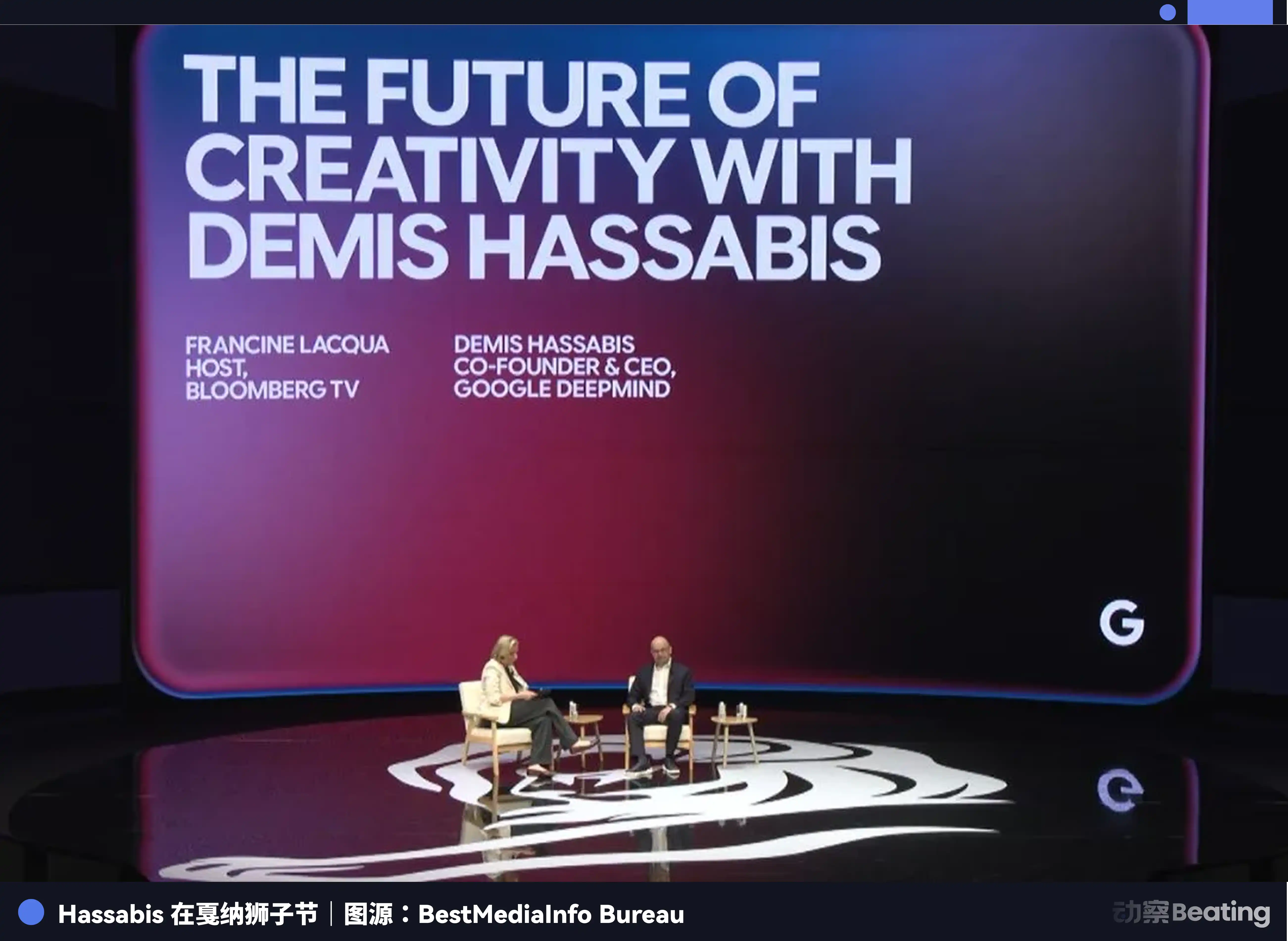
On June 23rd, Hassabis gave an interview at the Cannes Lions Festival and was asked about the recent talent exodus.
He said: "Talent flow between major labs is normal. We have our fair share of top talent. We have the largest and most diverse research team across all labs."
Hassabis is one of the smartest people in this industry. He personally mentored Jumper from a fresh PhD graduate into a Nobel laureate. He knows better than anyone what he has lost, and better than anyone why they couldn't be kept. So I don't think he was just being defiant when he said that. Maybe it's someone who sees the ending trying to preserve a final shred of dignity.
I am reminded of "Cinema Paradiso," where the old projectionist Alfredo says to the young Toto:
"If you don't go out and see the world, you'll think this is the whole world."
When Alfredo said this, he was pushing Toto away. He loved the boy more than anyone, but he knew that staying in that small-town cinema would prevent Toto from becoming the person he was meant to be. The cinema gave Toto everything: his love for film, his understanding of light and shadow, his initial curiosity about the world. But that was all the cinema could give. The rest of the journey had to be walked outside to be found.
Google was once the cinema paradiso for all AI researchers. The best equipment, the most relaxed environment, the most knowledgeable colleagues. You could spend nine years building a model to predict protein structures without rushing to commercialize it or writing PowerPoints for executives. When it was done, the entire biology world applauded you. You stood in Stockholm to receive an award, and the whole company celebrated for you. Back then, everyone thought Google was the whole world.
But perhaps the best time for a place is precisely when it should be sending its people away.
Now, the free cafeteria in Mountain View still serves three meals a day. The colorful bikes on campus are still parked outside every building, available for anyone to ride. Every week, a new batch of Nooglers puts on the iconic propeller hat and takes a group photo, their eyes bright.
Exactly like Shazeer when he first walked into Google twenty years ago. Exactly like Jumper when he joined DeepMind nine years ago.
References
[1] Google Paid $2.7 Billion to Bring Back an AI Genius Who Quit in Frustration, The Wall Street Journal
[2] Attention is All You Need, Google Research
[3] Top AI researcher leaves Google for OpenAI, Axios
[4] After nearly 9 years, I have decided to leave Google DeepMind and join Anthropic, John Jumper/X
[5] Google poised to lose two more high-profile AI staffers to Anthropic, Los Angeles Times/Bloomberg
[6] AI researchers continue to leave Google for its rivals, TechCrunch
[7] Alphabet sees $225 billion market-cap wipeout as investors fear it's losing the war for AI talent, MarketWatch
[8] Some Reasons Why Google Had Such A Bad Day, The Wall Street Journal
[9] Google's Brain Drain Deepens: Alphabet Braces for Second Day of Losses on Anthropic Poach, Barron's
[10] AI lab musical chairs hits Google the hardest, Axios


