






Hoa Kỳ và Nhật Bản tăng lãi suất, thị trường chứng khoán, trái phiếu, tiền tệ, loại nào nguy hiểm nhất?


- Quan điểm chính: Trong tuần này, tài sản rủi ro toàn cầu phải đối mặt với áp lực vĩ mô kép: Ngân hàng Trung ương Nhật Bản gần như chắc chắn sẽ tăng lãi suất 25 điểm cơ bản lên 1%, diễn ra cùng lúc với cuộc họp của Ủy ban Thị trường Mở Liên bang (FOMC) của Fed, làm dấy lên lo ngại về lãi suất tăng, sự đảo ngược của giao dịch carry trade và thanh khoản thắt chặt, có thể gây ra biến động thị trường, đặc biệt gây áp lực lên cổ phiếu tăng trưởng vốn hóa cao và tài sản tiền điện tử.
- Các yếu tố chính:
- CPI tháng 5 của Mỹ tăng lên 4,2% so với cùng kỳ, bảng lương phi nông nghiệp tăng thêm 172.000, lạm phát phục hồi và sức mạnh của thị trường lao động làm suy yếu lý do cắt giảm lãi suất, khả năng tăng lãi suất đang tích lũy; dữ liệu Polymarket cho thấy xác suất Fed không cắt giảm lãi suất vào năm 2026 là khoảng 70,35%.
- Ngân hàng Trung ương Nhật Bản họp vào ngày 15-16/6, Polymarket cho thấy xác suất tăng 25 điểm cơ bản lên tới 98,3%; nếu được thực hiện, lãi suất chính sách sẽ tăng lên mức cao nhất kể từ năm 1995 (1%), giao dịch carry trade đối mặt với rủi ro thanh lý.
- Kinh nghiệm lịch sử cho thấy, sau các đợt tăng lãi suất của Ngân hàng Trung ương Nhật Bản vào năm 2000, 2006-2007 và tháng 7 năm 2024, thị trường toàn cầu đều chao đảo, ví dụ như tháng 8 năm 2024, chỉ số Nikkei 225 giảm 12,4% trong một ngày, chỉ số Nasdaq giảm 3,4%.
- Lần này, Thống đốc Ngân hàng Trung ương Nhật Bản Kazuo Ueda vắng mặt vì ốm, không tham dự cuộc họp và cuộc họp báo, Phó Thống đốc Shinichi Uchida sẽ chủ trì cuộc họp, sự bất định trong phong cách truyền thông có thể khuếch đại biến động thị trường.
- Nếu Fed có quan điểm diều hâu trong tuần này (thừa nhận rủi ro lạm phát, nâng dự báo lãi suất hoặc loại bỏ các cụm từ nghiêng về cắt giảm lãi suất), lợi suất trái phiếu kho bạc kỳ hạn ngắn tăng, đồng đô la Mỹ mạnh lên, kết hợp với việc Nhật Bản tăng lãi suất sẽ tăng cường hiệu ứng thắt chặt toàn cầu.
- Thị trường tiền điện tử chịu áp lực rõ rệt: Bitcoin ở quanh mức 65.000 USD không vững, sau CPI đã giảm xuống 61.500 USD, thanh lý các vị thế mua trên chuỗi vượt quá 1,5 tỷ USD, dòng vốn ròng chảy ra khỏi quỹ ETF Bitcoin giao ngay trong tuần đạt 2,7 tỷ USD, các tài sản beta cao (như altcoin, memecoin) có mức độ dễ tổn thương cao.
This week's global market storyline revolves around Japan's interest rate hike and the Federal Reserve's meeting. For risk assets, this week is bound to be anything but calm.
Three months ago, Wall Street was still debating when interest rates would be cut. With Wash just taking office, the market was willing to give the new chairman some leeway. Inflation was trending down, the labor market was loosening, and a rate cut seemed like only a matter of time. But the financial world is fickle, and the scripts everyone had envisioned didn't pan out.
May's CPI rose to 4.2% year-on-year, with a monthly increase of 0.5%. Energy prices rose 3.9% month-on-month, while core CPI remained around 2.9% year-on-year. Employment data also gave the Fed no immediate reason to turn dovish. Non-farm payrolls added 172,000 in May, and the unemployment rate held steady at 4.3%. This means the Fed is now facing an awkward combination: inflation is re-emerging, employment hasn't collapsed, AI-related investments are still supporting economic resilience, the case for rate cuts is weakening, while conditions for rate hikes are slowly building.
Meanwhile, the Bank of Japan (BoJ) is holding its policy meeting on June 15-16, and the market has almost priced in a 25 basis point rate hike as the base case. Polymarket's "Bank of Japan Decision in June" market shows the probability of a 25bp hike at approximately 98.3%, the probability of no change at only about 1.45%, and a hike of 50bp or more at around 0.55%.
Many still remember that previous BoJ rate hikes had a significant impact on global financial markets. This time, with the BoJ rate hike on Tuesday and the Fed's FOMC meeting on Thursday, will the market decline?
Wash's "Debut," Rising Probability of Fed Hike
Let's look at the Fed first.
The possibility of a rate cut seems to have largely faded. On Polymarket, "No rate cut in 2026" sits at about 70.35%, "Rate cut before July" at about 2.35%, and "Rate cut before December" at only about 23%. Seven out of ten bettors are betting on no rate cut at all this year. For the year-end rate range, maintaining a 3.75% upper limit has about 37%, 4.00% has about 32.5%, 4.25% has about 11.25%, and 4.50% and above has about 3.35%. Combined, the probability of 4.00% and above is about 47%.
Market consensus on Wash is largely that he will likely not touch the rate hike trigger at his debut, this week's FOMC meeting. The risk of a rate hike is still mainly concentrated in the third quarter and beyond. Several markets on Polymarket clearly reflect this consensus:
"Fed rate hike in 2026?" shows the probability of a rate hike at any time in 2026 is about 34.5%; "Fed rate hike by...?" shows around 0.65% before June, around 6.15% before July, around 24.5% before September, and around 32% before October; in "Fed Decision in July," a 25bp hike in July is around 3.15%, a 50bp+ hike is around 0.3%, and no change is around 93.5%; in "What will the Fed rate be at the end of 2026?" the probability of the year-end rate ceiling falling at 3.75% is about 37%, 4.00% about 32.5%, 4.25% about 11.25%, and 4.50% and above about 3.35%.
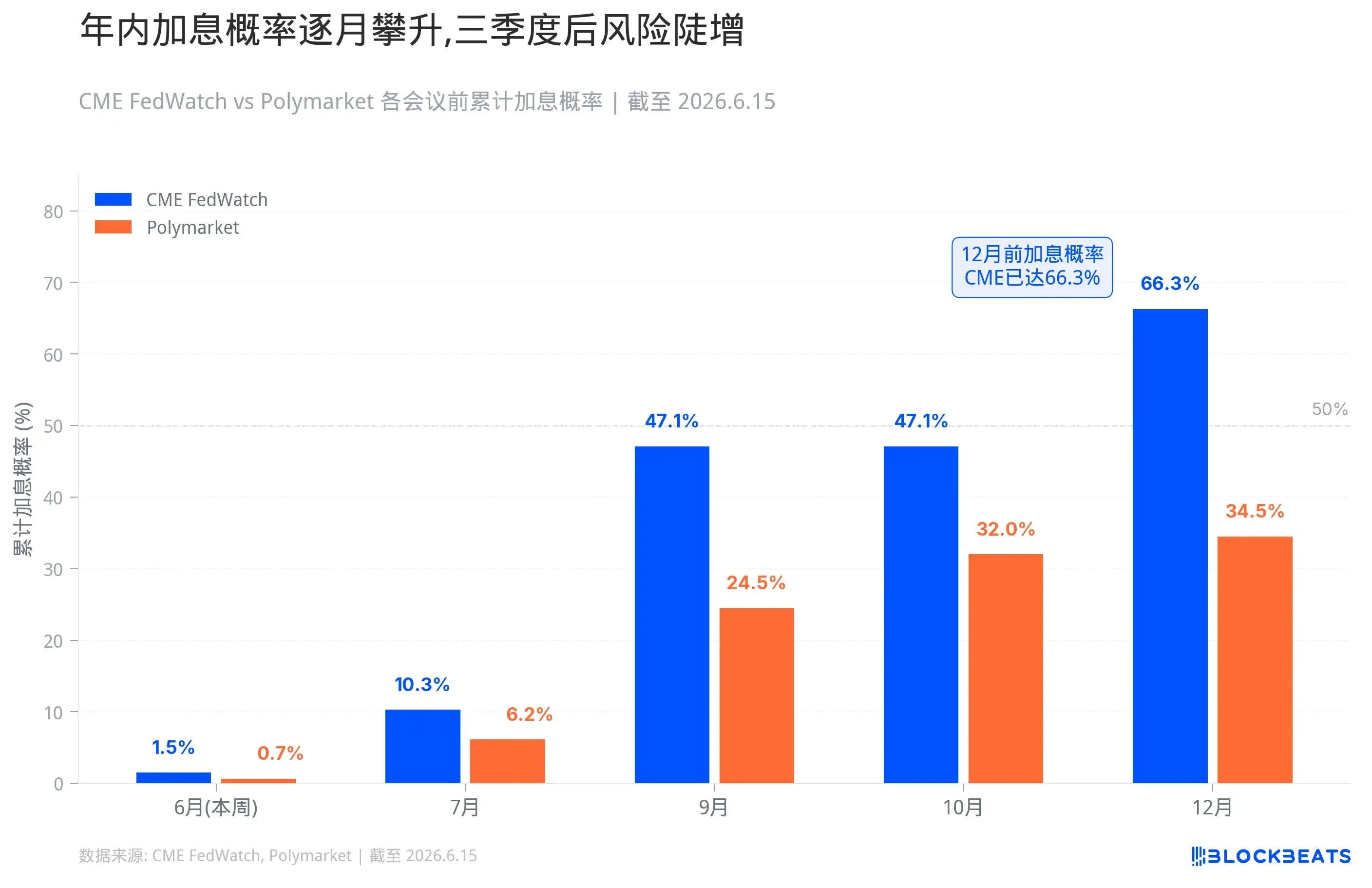
Looking at more granular probabilities and data: the probability of a rate hike before July 29 is about 10.3%, before October 28 about 47.1%, and before December 9 about 66.3%. Polymarket is more conservative, with "Fed rate hike in 2026?" at 34.5%, before September at about 24.5%, and before October at about 32%. For this month, CME FedWatch gives a 98.5% probability of no change, while Polymarket gives 99.55%.
The US is highly likely to stay put this week, but "staying put" and "not tightening" are two different things.
If Wash acknowledges at the press conference that inflation risks are again outweighing growth concerns, if the dot plot shifts the 2026 rate midpoint from a dovish direction to unchanged or even higher, or if the "easing bias" phrasing is removed from the statement, the market will effectively tighten policy for the Fed.
The first to react will be the short end of the US Treasury curve. 2-year and 1-year yields will directly follow the Fed's path. Once the market shifts from "cutting later" to "maybe hiking later," short-end yields will rise. The US dollar will also be supported, and a strong dollar itself represents a form of global tightening.
Within US equities, high-valuation growth stocks and AI long-duration assets are most sensitive. Higher interest rates make discounted future cash flows less valuable and financing more expensive, making the market less willing to pay a premium for unfulfilled narratives. Small caps, micro caps, and unprofitable tech stocks have a more fragile logic; these companies thrive on cheap money, and once money isn't cheap, their valuations are the first to collapse.
If a true tail event occurs, with the Fed directly hiking rates against the 98.5% probability of "no change," the impact would be severe. Short-end rates would jump, the dollar would surge, and leveraged positions would be forced to de-risk. This doesn't mean it will happen, but it means that if it does, no one will have time to react.
After all, the importance of Wash's "debut" is amplified by the market. A key factor is that he might change the Fed's communication style. Long-time Fed watchers like Timiraos have clearly articulated that for Wash, symbolic adjustments to the dot plot, statement language, and press conference rhythm can be made quickly. But fundamentally changing the Fed's communication system requires long-term persuasion and internal coordination. This week's meeting could be the first step.
Across the Pacific, the "Curse" of Japan's Rate Hike
Looking at Japan, the BoJ's rate decision on June 15-16 has a 98.3% probability of a 25bp hike on Polymarket. If implemented, the policy rate would rise from 0.75% to 1.00%, the highest level since 1995.
The logic forcing Japan into this corner is straightforward. Middle East conflicts have pushed up oil prices, and Japan is a typical energy importer. A weak yen amplifies these import costs. Wages are rising, service prices are rising, and inflation expectations are beginning to loosen. If rates remain low, the market will question whether the BoJ is serious about managing inflation.
The rate hike itself is not a surprise, but a key concern is: over the past few years, massive global capital has borrowed low-interest yen to convert into US dollars or other high-yielding assets, buying US Treasuries, stocks, and credit, some of which indirectly flowed into high-volatility risk assets. This structure rests on the premise that Japanese rates remain low, yen financing is cheap enough, and the central bank is slow enough. In other words, if the market perceives Japan's rate normalization as continuous, carry trades will become fragile, yen shorts will be squeezed, and global leveraged capital will begin to contract.
The market's fear of Japan's rate hike is not unfounded. Over the past two decades, almost every time the BoJ attempted to raise rates from near zero, global markets encountered trouble.
The first time was in August 2000. The BoJ raised rates from 0% to 0.25%, coinciding with the peak of the US internet bubble. Within three months of the hike, the Nasdaq fell 35%. Japan's own economy couldn't withstand it and quickly slipped back into recession, forcing the BoJ to cut rates back to zero in 2001.
The second time was from 2006 to 2007. The BoJ raised rates to 0.5% in two steps: first in July 2006, then in February 2007. This timeline perfectly aligned with the brewing of the US subprime mortgage crisis. In the summer of 2007, US subprime troubles began to surface, Lehman Brothers collapsed in 2008, and the global financial crisis erupted. The BoJ was once again forced to cut rates back to zero.
The third time was July 31, 2024. The BoJ raised rates from 0% to 0.25%, a small move, but the market reaction was extreme. On August 5, the Nikkei 225 plunged 12.4% in a single day, its biggest drop since Black Monday in 1987. The KOSPI triggered a circuit breaker, and the Nasdaq and S&P 500 fell 3.4% and 3% respectively. The VIX fear index surged above 65. The transmission mechanism of that crash was clear: the BoJ's rate hike triggered a sharp yen rally, forcing carry trades (borrowing yen to buy overseas assets) to unwind, selling stocks to repay yen, and a collective sell-off causing a stampede. To meet margin calls, fund managers sold everything, including "safe haven" assets like gold and BTC. Under a liquidity crisis, correlations between all assets approached 1. Your editor still vividly remembers the market's devastation that day.
So more importantly, tomorrow's press conference will reveal what kind of signal the Japanese government sends: how high will rates go?
US Stocks, US Bonds, Bitcoin: Who is Most at Risk This Week?
As mentioned earlier, global markets have mostly declined during the BoJ's past three rate hike cycles.
But in reality, a BoJ rate hike doesn't necessarily trigger a sell-off. A sell-off usually occurs when there are other fragile leverages present. For example, in 2000 and 2007, they coincided with larger bubbles in other countries. In August 2024, it was a surprise, and the market was too heavily positioned to react in time. However, in subsequent instances when the market was prepared, things didn't blow up.
This time, the 25bp hike is already priced in at 98.3%, leaving almost no room for surprises. Based on the experience of December 2024 and January 2025, a rate hike itself is likely to be absorbed smoothly. But there are two additional variables this time.
First, Governor Kazuo Ueda is hospitalized with an infectious liver cyst and is expected to miss the meeting and the post-meeting press conference. According to reports, Deputy Governor Ryozo Himino will act as acting chair for the meeting, while Deputy Governor Shinichi Uchida will host the post-meeting press conference. This arrangement likely won't change the direction of the rate hike. However, the market is less familiar with Uchida's communication style than Ueda's, which could amplify volatility in the interpretation of language. A statement like "future moves will depend on data" versus "there is still room for normalization" sounds similar but sends completely different signals to traders.
Second, the US is holding its meeting the same week. The BoJ and FOMC decisions are only one day apart. If the BoJ's rate hike is met with a mild market reaction, but Wash sounds hawkish at his press conference the next day, the dual pressure will compound. Conversely, if the market is already nervous after the BoJ hike, and Wash adds fuel to the fire, short-term sentiment could overreact. Two central banks delivering back-to-back results, this schedule itself amplifies volatility.
Let's analyze each asset:
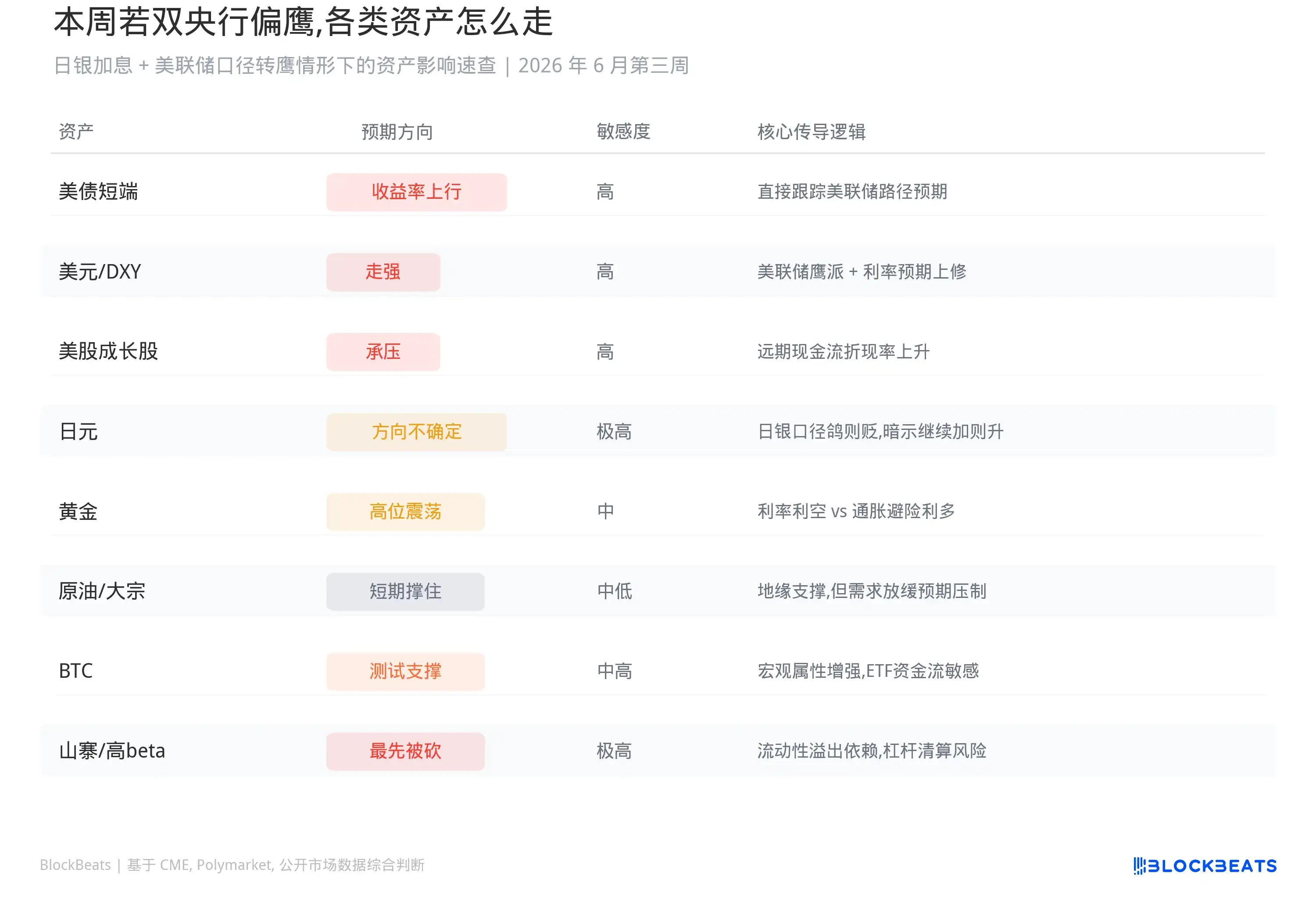
US Treasuries should be the first to react this week. Short-end yields move directly with the Fed's path, with 2-year and 1-year yields being most sensitive. If Wash's press conference is hawkish and the dot plot is revised upwards, short-end yields will rise, reflecting a market repricing of "later cuts" or even "a hike this year." The long end is more complex; the 10-year may not rally in tandem. If the market begins to worry that high rates will damage the economy, the yield curve could flatten further or even deepen its inversion. In Japan, if Uchida hints at further rate hikes, JGB yields will also be pushed higher. If Japan's $1.13 trillion US Treasury holdings show any marginal loosening, it could also impact the supply-demand dynamics in the US bond market.
The US Dollar is highly likely to be supported. A hawkish Fed tilt would push up expected returns on USD-denominated assets, strengthening the DXY. Theoretically, a BoJ rate hike is positive for the Yen and negative for the Dollar, but the actual outcome depends on the rhetoric: if the BoJ signals a dovish stance after the hike, the Yen might not rise and could even fall, making the Dollar Index stronger instead. With both central banks meeting the same week, the relative movement between the Dollar and Yen will be very sensitive, and FX market volatility will likely increase. Asian and emerging market currencies will come under pressure. A strong dollar itself is a form of global tightening, sucking USD liquidity away from overseas markets.
Divergence within US equities will be significant. High-valuation growth stocks, AI long-duration assets, small caps, micro caps, and unprofitable tech stocks are most vulnerable. Higher rates make future cash flows less valuable and financing more expensive, making the market less willing to pay a premium for unfulfilled stories. The Russell 2000 and companies that depend on cheap money will be hit first. Bank stocks will react in a complex way; short-term spreads might benefit, but if the curve remains inverted and credit risk rises, it's not necessarily positive. Defensive stocks are relatively resilient, but "bond-like assets" such as utilities and REITs will also have their valuations pressured by high rates. The S&P 500 closed near 7382 last Friday, and the Nikkei 225 at 66078. If both central banks sound hawkish this week, both US and Japanese stocks will be under pressure, especially indices with heavy tech weightings.
Japan's equity market is in a unique position. A BoJ rate hike is inherently bad news for Japanese exporters because a stronger yen erodes overseas profits. However, if the magnitude and pace of the hike are within expectations, Japanese stocks may not fall sharply, as the experiences of December 2024 and January 2025 demonstrated. The real risk remains in post-meeting communication. If Uchida hints at further normalization, the Nikkei might initially decline and then reassess.
Gold will be pulled by two opposing forces. Rising real interest rates and a stronger dollar are generally negative for gold. However, if the reason behind the rate hike is an energy shock, geopolitical risks, and runaway inflation, safe-haven demand will support the gold price. Gold is likely to oscillate within a high range this week, with direction depending on what the market fears more: rising rates or uncontrolled inflation. Crude oil is more sensitive to supply/demand and geopolitics. The Iran conflict is still brewing. If the rate hike is due to oil prices pushing up inflation, oil may not fall immediately. But if the market starts trading on expectations of slower demand, industrial metals and crude oil will face pressure later.
Credit bonds and real estate are slow-moving variables, but the direction is clear. High-yield bond spreads will widen, financing costs will rise, and assets sensitive to commercial real estate, REITs, and mortgages will face pressure. Emerging markets with high USD-denominated debt will also suffer, facing increased capital outflow pressure.
The crypto market will also be under pressure in this macro backdrop. BTC is currently around $65,000. It was near $72,000 at the start of June but fell all the way to around $61,500 after the CPI release, recovering only in the past few days. This level is inherently unstable. When it fell below $62,000 on June 5, on-chain long liquidations exceeded $1.5 billion, and spot Bitcoin ETFs saw a net outflow of $2.7 billion for the week. Although the price has recovered somewhat, the positioning structure is unhealthy. BTC has some macro asset characteristics; it won't necessarily collapse alongside rising rates, but it will also struggle to rally independently. ETH, SOL, altcoins, memecoins, and small-cap tokens are more fragile. These assets rely on liquidity overflow and risk appetite. Once the market starts comparing the yield attractiveness of cash, short-term bonds, and money market funds, high-beta assets are the first to be cut. Contract market funding rates have fallen, on-chain risk appetite is cooling, as seen in early June.


