






Copper, the gold of 2026


- Core Thesis: Driven by structural demand growth from AI data centers and the energy transition, coupled with supply-side constraints such as declining ore grades and long lead times for new mine development, copper is transforming from a traditional industrial metal into a scarce asset with strategic attributes. Its market logic and pricing mechanism are exhibiting a "gold-like" trend.
- Key Elements:
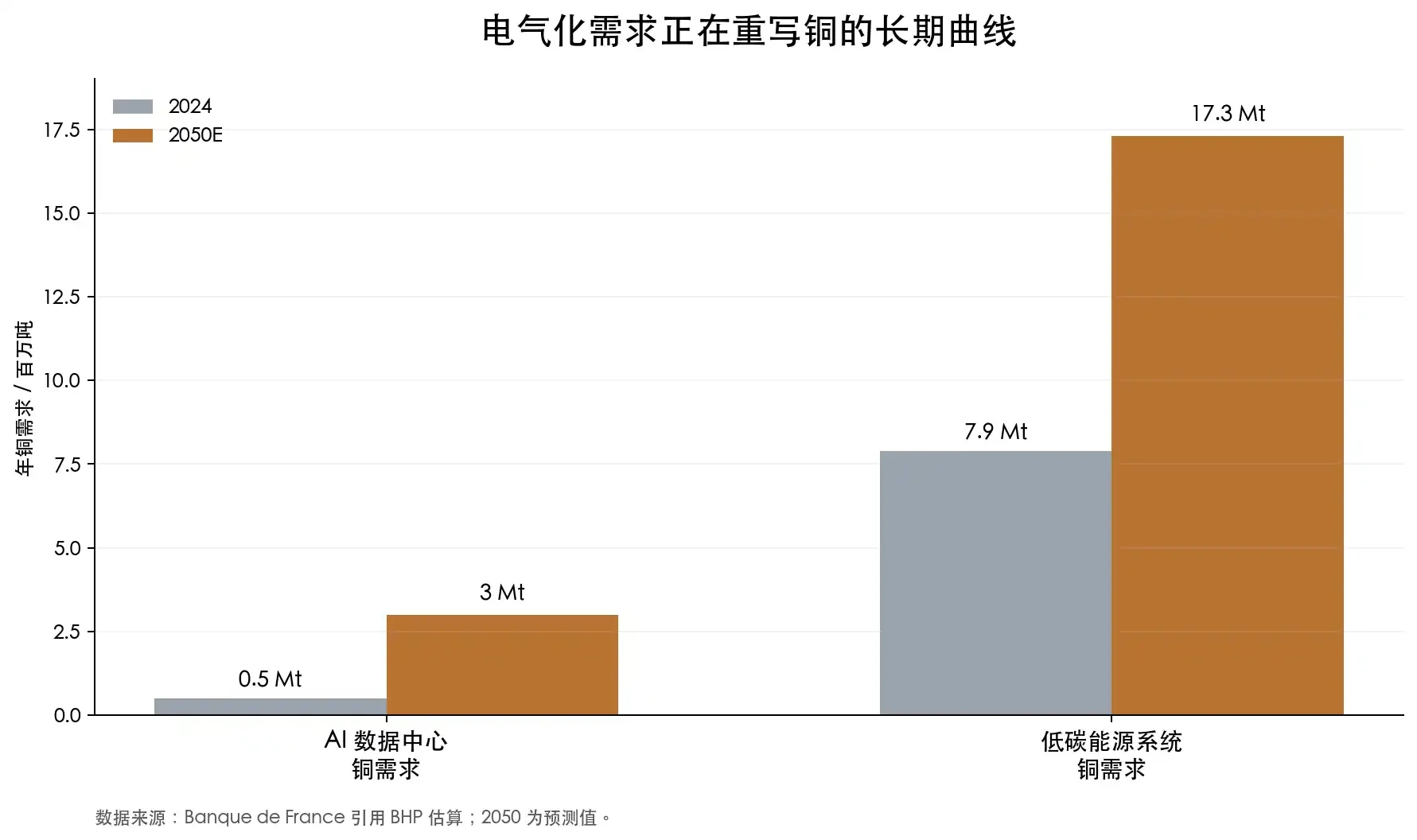
- AI data centers are a significant new variable for copper demand: BHP estimates copper demand from AI data centers could grow from 0.5 million tonnes in 2024 to 3 million tonnes by 2050; copper demand from low-carbon energy systems may rise from 7.9 million tonnes to 17.3 million tonnes.
- Copper mine supply faces long-term bottlenecks: It takes an average of about 17 years from discovery to production for a new copper mine; the average global copper ore grade has declined by approximately 40% since 1991, and only 5% of new deposits discovered in the past 35 years were found in the last decade.
- The upstream part of the supply chain is already showing tightness: Based on current project pipelines, the IEA estimates the copper market could face a 30% supply gap by 2035; copper concentrate treatment and refining charges (TC/RC) have fallen to historic lows and even turned negative, reflecting tight raw material supply.
- Macro capital is beginning to allocate to copper: Prominent macro investors like Stanley Druckenmiller have taken positions in copper, betting against the US dollar; hedge fund manager Pierre Andurand even predicts copper prices could rise to $40,000 per tonne in the future.
- Copper mining stocks exhibit high elasticity and high volatility: For example, A-share China Molybdenum (CMOC) gained approximately 129% over two years but also saw drawdowns exceeding 30%; US-listed mining stocks like FCX and SCCO are also leveraged expressions of the copper price thesis, but investors should be wary of cost inflation and risks in resource-rich countries.
Original Author: Jia Liu
Copper, will it become another form of gold in this era?
Over the past two years, the market has interpreted the AI infrastructure story as a chip narrative. NVIDIA's GPUs, TSMC's产能, HBM yield rates, CoWoS packaging bottlenecks—almost all discussions revolved around silicon wafers. However, an AI data center isn't something you can just plug GPUs into and start running. It also requires grid connections, transformers, busways, cables, liquid cooling systems, fiber optic interconnects, and a significant amount of metal.
In the previous article "The 'Great Famine' Moment for Fiber Optics and Copper in the AI Era," we briefly touched upon one thing: AI demand is cascading from chips down to fiber optics and copper.
This article delves deeper into the evolving narrative of copper over the past year. Why does the market increasingly see copper as similar to gold? Why are macro funds starting to buy copper? Why are mining companies and commodity traders all saying 'there's not enough copper'? Why is it no longer just the industrial metal used to gauge economic cycles?
Dr. Copper Is No Longer Just a Proxy for the Manufacturing Cycle
There's an old saying in English financial markets called 'Dr. Copper,' sometimes translated as 'Copper PhD' by Chinese financial media. The name implies that copper prices, like a doctor diagnosing the economy, can provide an early prognosis of global economic health.
This is because copper prices are inseparable from manufacturing. When China's real estate sector is booming and factories are restocking, driving demand for appliances, automobiles, cables, and pipes, copper prices rise. When the cycle turns down, copper follows. Essentially, copper prices were a proxy for China's real estate sector and the global manufacturing and trade cycle.
But today, copper demand has new influential variables: AI data centers, grid expansion, new energy vehicles, energy storage, military applications, and re-industrialization are all adding to structural demand for copper.
Anywhere electricity is used, copper is indispensable.
The Banque de France, in an analysis of AI data centers and the copper market, cited BHP's estimate: copper demand from AI data centers could grow from approximately 500,000 tons in 2024 to around 3 million tons by 2050. During the same period, copper demand from low-carbon energy systems could rise from 7.9 million tons to 17.3 million tons. The article also cited a specific case: the construction of Microsoft's Chicago data center consumed 2,177 tons of copper.
Looking at this number alone, it's not exceptionally large in the global copper market. But the point isn't how much copper a single data center uses; it's that behind AI data centers lies not a single point of demand, but a whole set of electricity infrastructure requirements. Denser GPUs mean higher rack power consumption, making data centers more like high-energy-consuming factories. Factories need electricity, and electricity requires grids, transformers, cables, busways, switchgear, and cooling systems.
Of course, we can't simply attribute every story about copper to AI.
Richard Holtum, CEO of global commodity trading giant Trafigura, reminded us during LME Week 2025 that while data centers and defense are indeed hot topics, the lion's share of copper demand over the next decade will still come from traditional infrastructure, construction, urbanization, and consumer goods. He also noted that air conditioners still consume more copper than data centers.
This perspective offers a new lens: the increase in copper demand isn't just propped up by AI alone. Its demand is growing because virtually all electricity-consuming scenarios are expanding simultaneously.
Copper's Biggest Bull Thesis: It Can't Be Mined Fast Enough
Many people's first impression of copper is that it's an 'industrial metal,' and they assume that if the price rises, mines can simply dig more, and supply will naturally follow. But that's not how it works.
It typically takes over a decade for a large copper mine to go from discovery, exploration, resource confirmation, feasibility study, financing, permitting, construction, to production. A report from the IEA shows that the average time from discovery to production for a new copper project is about 17 years. This means if the market suddenly realizes there's not enough copper in 2026, truly large-scale new supply might not appear until 2028 or 2029, with much of it waiting until the 2030s.
Robert Friedland, founder and Executive Co-Chairman of Canadian mining company Ivanhoe Mines, repeatedly emphasizes this issue. He is one of the most famous copper bulls in the global mining circle, possessing the world-class Kamoa-Kakula copper project in the DRC. His expressions are always radical: the world hasn't yet realized how much copper it actually needs. Over the past decade plus, the globe hasn't prepared enough new copper mines for the electrification era.
He's not alone in this judgment. Data from the IEA supports this direction.
The average grade of global copper mines has declined by about 40% since 1991. Declining grades mean that previously, mining one ton of ore yielded more copper; now, more ore, more electricity, more water, and more waste rock processing are needed to get the same ton of copper. The IEA also mentions that of the copper deposits discovered in the past 35 years, only 5% were found in the last decade. New discoveries are scarce, old mine grades are falling, project construction cycles are lengthening, and capital expenditure is rising. The IEA estimates that, based on the current project pipeline, the copper market could face a 30% supply gap by 2035.
Therefore, copper is not an asset in the typical commodity cycle where 'supply immediately appears once prices rise.' Copper mine projects are increasingly like large-scale infrastructure projects: you need to find the ore, obtain permits, handle community relations, address water resources, pass environmental reviews, and bear the brunt of changes in resource-rich countries' tax policies.
Chile, Peru, the DRC, Zambia, Indonesia, and Mongolia all have significant copper resources but also face various forms of political, tax, community, or operational risks. The more strategic copper becomes, the more incentive resource-rich countries have to demand a larger share; the higher the copper price, the more likely mining companies are to face tax increases and renegotiations.
The smelting side is also showing signs of strain.
Copper concentrate, once it enters a smelter, is processed into refined copper. The processing and refining fees that smelters charge mines are known in the industry as TC/RC (treatment charge and refining charge). Normally, when concentrate supply is ample, smelters have stronger bargaining power, and TC/RC is higher. When concentrate is tight, smelters compete for raw materials, causing TC/RC to fall.
An anomaly in 2026 is that while copper prices hit record highs, smelting processing fees fell to historic lows. The IEA states that the annual TC/RC benchmark for 2026 fell to $0 per ton, and spot TC/RC has been negative since 2024.
This is more critical than simply looking at exchange inventories. Because the bottleneck for copper isn't just in refined copper products; it's also in mines and concentrates. If upstream raw materials are tight, it doesn't matter how many smelters there are. China has massively expanded its copper smelting capacity over the past two decades. The IEA states that China accounts for over 90% of the growth in global copper smelting output since 2005 and will account for about half of global copper smelting output by 2025. While midstream capacity is strong, upstream mines are tight, amplifying the vulnerability of the supply chain.
Gold's scarcity comes from reserves, extraction costs, and its monetary属性. Copper is certainly not gold, but as its new supply becomes slower, its resources more concentrated, and its strategic attributes stronger, it too begins to possess a scarcity akin to gold.
Why Macro Funds Are Starting to Like Copper
Copper previously belonged mainly to commodity traders and mining analysts. Now, it's increasingly attracting macro funds.
Take Stanley Druckenmiller, for instance. One of America's most famous macro investors, he once managed the Quantum Fund with George Soros and later founded the Duquesne Family Office. Known for making big bets on major cycles with high conviction, the market pays close attention to his views on AI, the dollar, bonds, and commodities.
In a recent interview with Morgan Stanley, he mentioned that his portfolio was primarily driven by AI in previous years but has now shifted towards a more macro and geopolitical positioning. He mentioned holding copper, being bearish on the dollar, and holding gold as a geopolitical hedge.
His logic is: if the dollar weakens, dollar-denominated commodities benefit. Fiscal deficits are expanding, governments continue spending, geopolitical risks rise, creating buying pressure for gold; in the same environment, demand for physical assets from grids, military, AI data centers, energy systems, and manufacturing reshoring also increases, and copper sits at the intersection of these trends.
Druckenmiller represents the macro fund perspective, but there are even more radical voices in the commodity trading circle.
Pierre Andurand is the most typical example. A well-known European commodity hedge fund manager, he started in energy trading, co-founded BlueGold Capital, and later established Andurand Capital. In an interview with the Financial Times, he made a very aggressive forecast: copper prices could reach $40,000 per ton in the coming years.
Jeff Currie's views are also worth noting. A former long-time head of Commodities Research at Goldman Sachs who later joined Carlyle, Currie is one of the most influential voices on Wall Street for commodity research. He famously coined the phrase "copper is the new oil," suggesting that in the energy transition era, copper could play a foundational role similar to oil in the fossil fuel era. In 2024, he again called copper one of his highest-conviction trades.
Data also confirms that money is flowing in.
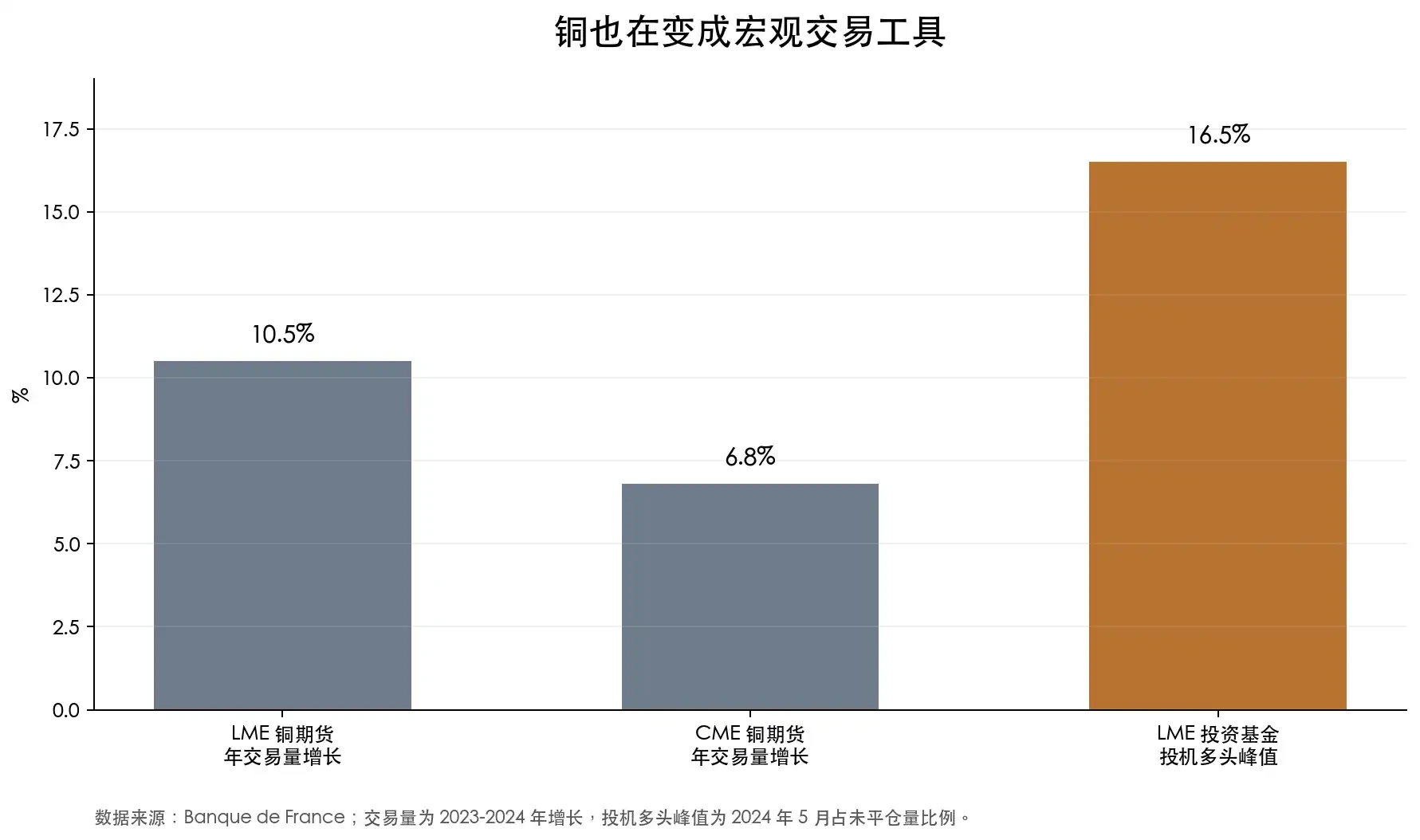
The Banque de France noted that between 2023 and 2024, annual trading volume in LME copper futures grew by 10.5%, and CME copper futures by 6.8%. For LME copper futures, speculative long positions held by investment funds reached 16.5% of open interest in May 2024. This isn't simple physical restocking; it's financial capital using copper as a macro trading tool.
Copper Mining Stocks: The Leverage on Copper
In a gold bull market, gold stocks typically amplify gold price movements. In a copper bull market, copper mining stocks also have a similar amplifier property.
When copper prices rise, it's a cost pressure for end-users, but for mining companies that already have production capacity, it can mean margin expansion. For example, if the copper price rises from $9,000 to $12,000 per ton, and the miner's cash costs don't rise simultaneously, a large portion of that additional $3,000 goes straight to the profit line. This is precisely why copper mining stocks naturally have operating leverage. If copper prices rise a certain amount, miner profits might rise much more; when copper prices fall, profits contract faster.
The market has been trading this leverage over the past two years.
Take A-shares as an example. From June 2024 to June 2026, CMOC Group Limited was the most typical high-beta name. Its core attraction is its copper-cobalt assets in the DRC, particularly Tenke Fungurume and KFM. Based on a rough calculation using adjusted closing prices, CMOC's price range increased by about 129% over this two-year period, with a peak gain of nearly 260%. This isn't the performance of a typical cyclical stock; it's the market re-pricing overseas copper resources.
Companies like Jiangxi Copper, Tongling Nonferrous Metals, and Yunnan Copper better illustrate the volatility resulting from the combination of copper prices and smelting attributes. Jiangxi Copper saw a range increase of about 82%, peaking at over 200%; Tongling Nonferrous Metals saw a range increase of about 77%, peaking at around 159%; Yunnan Copper's range increase was only about 29%, but still peaked at over 130%.
These stocks all exhibit another side of copper mining stocks: significant upside when the tide comes in, but equally severe drawdowns when the tide goes out.
Looking at drawdowns from highs makes the volatility clearer. Yunnan Copper corrected about 45% from its range high, Jiangxi Copper corrected about 41%, and CMOC, Northern Copper, and Zijin Mining all experienced corrections of over 30%. Copper mining stocks are not the copper price itself; they are the result of the interplay between copper prices, costs, inventories, TC/RC, project progress, country risk, and equity market sentiment.
In US stocks, the most typical representative is Freeport-McMoRan, ticker FCX. It's one of the most core copper producers in the US, with assets including Morenci in the US, Cerro Verde in Peru, and Grasberg in Indonesia. For global capital, FCX is almost one of the most common US stock tools for gaining exposure to copper prices. MarketWatch data shows FCX hit a 52-week high of $72.09 on June 2, 2026, but dropped 9.07% in a single day on June 5, correcting over 12% from its high within days.
Southern Copper, ticker SCCO, is another representative high-quality copper mining stock. Its assets are primarily in Peru and Mexico, offering high copper exposure and strong profitability. IBD mentioned earlier this year that SCCO was up 55% at one point during the year and hit an all-time high. Compared to FCX, SCCO appears as a purer, higher-quality copper mining asset, but it too cannot escape copper price and country risks.
If investors don't want to bet on a single company, they can also look at copper mining ETFs, such as the Global X Copper Miners ETF.
However, copper mining stocks are far more complex than copper itself.
A mining company's value depends not only on the copper price but also on mine grade, cash costs, reserve life, capital expenditure, host country, tax policies, labor relations, environmental permits, transportation conditions, and management execution. While copper prices can lift the entire sector's valuation, there will be significant divergence between individual companies.
Country risk is particularly important. Many high-quality copper mines are located in Chile, Peru, the DRC, Zambia, Mongolia, and Indonesia. Good resource endowments don't guarantee stable shareholder returns. The more valuable copper becomes, the more governments will recalculate their share; the larger the project, the harder it is to manage community, environmental, water, and infrastructure issues.
Cost inflation can also erode profits. When copper prices rise, costs for energy, equipment, labor, steel, and financing often rise together. A seemingly attractive development project might end up delivering little shareholder value due to capital expenditure overruns, delayed production, or permitting hurdles.
Early-stage copper companies carry higher risk. They trade on future reserves and future production, but every step from resources to reserves, feasibility to financing, permits to construction, can fail. The long-term bullish thesis for copper doesn't guarantee that every copper mining stock will pan out.
Therefore, copper mining stocks are better understood as leveraged expressions of the copper price thesis, rather than simple substitutes for copper itself. They can offer higher upside but also bring larger drawdowns. The companies truly worth studying are those with low costs, long mine lives, clear expansion paths, robust balance sheets, and manageable political risks.
This is also part of copper's 'goldification': the scarcity thesis for copper is not just confined to the spot and futures markets; it is being repackaged by stock markets, ETFs, and speculative capital. The rise in copper prices is one layer of trading, and the rise in copper stocks is another. The former reflects the commodity itself, the latter reflects how much imagination the market is willing to invest in this long-term shortage.
Copper's 'Goldification' Is Just Beginning
The world needs more electricity, and more electricity means more copper.
Of course, copper won't truly turn into gold. It doesn't possess gold's pure monetary attributes, nor can it escape economic cycles. A global economic slowdown, weaker manufacturing, or a downturn in risk assets will all suppress copper prices. Copper will remain volatile, potentially violently so.
But the change lies in the underlying logic for copper being different from the past.
Historically, sharp copper price drops often coincided with weakening demand coupled with oversupply. Today's supply side isn't that loose. Aging mines, declining grades, lengthening permitting cycles, competition for smelting raw materials, and resource-rich countries redistributing benefits—these factors make it increasingly difficult to simply label copper as an ordinary cyclical commodity.
It might still be an industrial metal, but it is no longer merely a proxy for the industrial cycle.
Copper's 'goldification' is just beginning.


