






Ray Dalio: China-led "Tribute System" Resurfaces; AI Industry Will Develop Like EV Sector


- Key Takeaway: Ray Dalio points out that declining US global credibility and rising Chinese influence are driving the formation of a new China-centered "tribute system." In AI, China treats it as a public good accessible to all, focusing on widespread application rather than short-term profit, mirroring the successful path of the electric vehicle industry.
- Key Points:
- Dalio argues that the growing perception that the US is unlikely to win a war is eroding its reliability as a global ally, while China strengthens its position through diplomacy and economic influence.
- China's economy is now 60%-70% the size of the US economy, having more than tripled in size over the past two decades. An increasing number of world leaders visiting China reflects a recognition of its power, reminiscent of historical "tribute systems."
- Dalio emphasizes that this geopolitical shift will increase market uncertainty, urging investors to maintain liquidity and diversify their assets, including investments in gold.
- In the US-China AI competition, China views AI as a public service tool aiming for broad普及. In contrast, US companies like OpenAI focus on subscription-based revenue and are preparing for IPOs.
- Dalio predicts China's AI industry will emulate its EV sector, achieving global dominance through cost control and large-scale deployment. BYD serves as a prime example of this success.
Original: Wall Street Week: Dalio's Warning & Ray Dalio on AI Development in China and the US
Compiled by Odaily Planet Daily (@OdailyChina)
Translator: Wenser (@wenser2010)
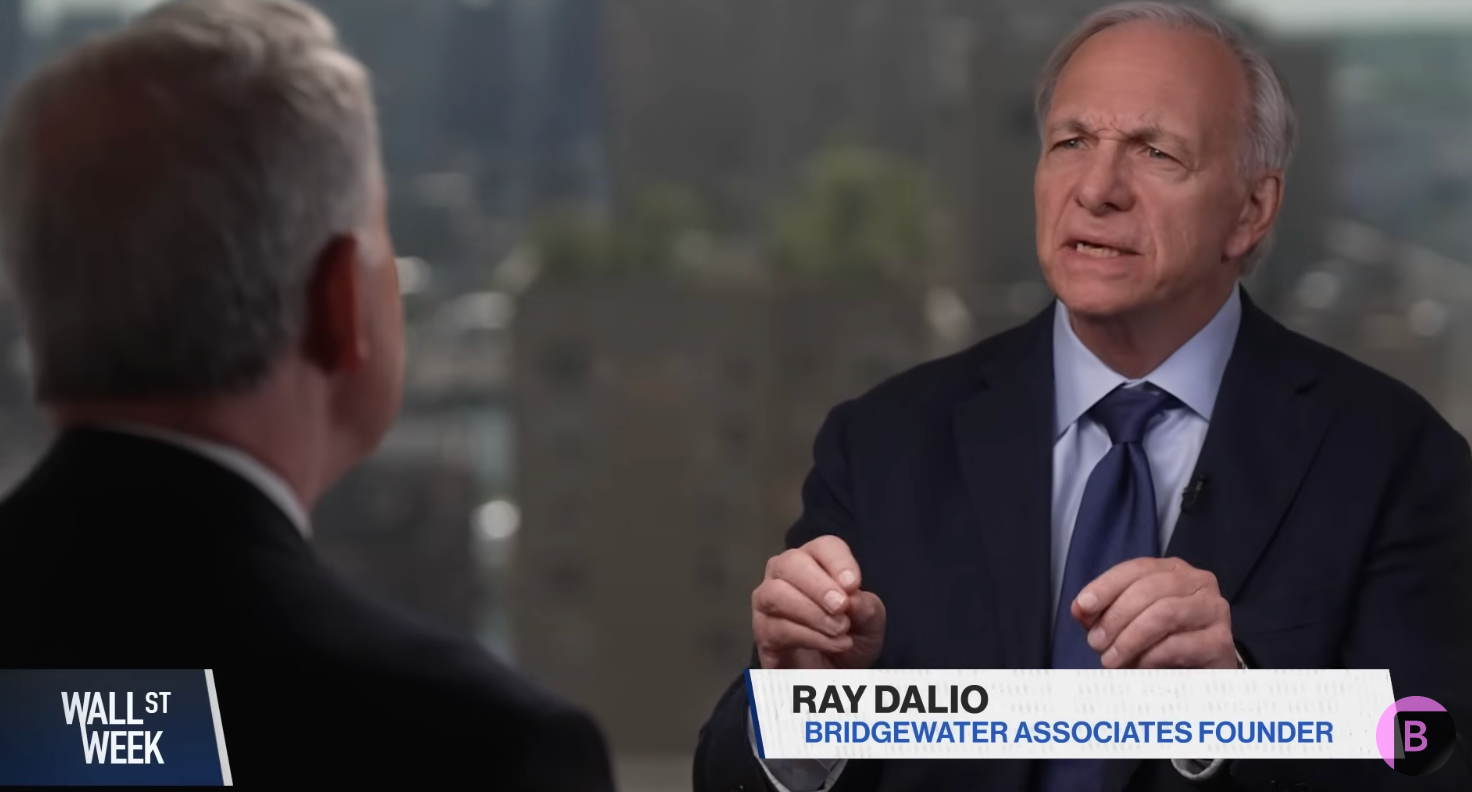
Editor's Note: As the founder of the world's largest hedge fund, Bridgewater Associates, Ray Dalio's views have always attracted significant attention across all sectors of society. His insights into the global macroeconomic situation and various industries are particularly widely discussed. Following the successive visits of leaders like US President Trump and Russian President Putin to China last month, Ray Dalio shared a new perspective: "The world order is changing, and a tribute system led by China is being established." Recently, he also offered his targeted views on the "AI giant competition" between China and the US. The following content has been compiled and translated by Odaily Planet Daily, with some details edited.
Ray Dalio on a "China-Led World": The Return of the Tribute System
Last month, after US President Trump and Russian President Putin visited China successively, Ray Dalio was interviewed by David Westin from Bloomberg's Wall Street Week.
During the program, Ray Dalio stated bluntly, "The credibility of the US as a global power willing to defend its interests is declining, while China is continuously accumulating its own global wealth and influence. This situation is fundamentally changing how other countries perceive these two nations."
"Currently, the US has approximately 750 military bases in over 80 countries worldwide, and has long been regarded as a trustworthy ally in the face of attack." However, after concluding a roughly month-long trip to Asia (which included about 10 days of meetings with multiple leaders in China), Dalio sensed a significant shift: A growing number of countries believe they "cannot count on the US to win a war."
Dalio's remarks further elaborated on his long-held view: "The power of the US is gradually weakening, while China's power is correspondingly strengthening." Thanks to Bridgewater Associates' extensive engagement with China under Dalio's leadership, this view has gained considerable recognition. Conversely, his relatively close relationship with Chinese leaders has also attracted criticism.
Dalio then noted that international recognition is very important to China. Currently, China's economy is about 60% to 70% the size of the US economy, a ratio that has more than tripled over the past 20 years. He said that while China does not seek to conquer or occupy other countries, it places great value on the recognition from political leaders of other nations. "You can see that leaders from many countries are visiting China one after another, which is akin to the historical 'tribute system' in Chinese history—nations came to acknowledge and respect China's formidable strength, but this system wasn't an oppressive or controlling system" (Odaily Planet Daily Note: original term was 'tribute system').
"So, this tribute system is actually a hierarchical system. When dealing with other countries, what matters is how this system will affect trade and national security between both sides. I believe that, from a political perspective, we are now entering a period where arrangements resembling a tribute system will form between China and various countries, and the relative power between nations will become the decisive factor in the world political landscape." During the discussion, Dalio also mentioned that it wasn't until the mid-17th century that Western societies gradually developed concepts like the nation-state and borders. Before that, the power structure in the West was formed by different royal families, which is fundamentally different from the historical concept of frontiers inherited in Chinese history.
He believes this change will directly impact global markets (including capital and finance). Investors must navigate this turbulent situation: currency values are at risk, and global uncertainty requires investors to maintain liquidity and diversify asset allocation, including investing in gold.
Ray Dalio on "US-China AI Competition": China's AI Industry Will Develop Like Its EV Sector
In June, Business Insider reported on Ray Dalio's views regarding the competition between China and the US in the AI sector, also highlighting the significant differences and potential impacts between the two.
Ray Dalio stated that China views artificial intelligence as an important tool that should be accessible to all workers. "It's like electricity and tap water, something everyone should be entitled to," he said.
As a prominent entrepreneur who first visited China in 1984, Dalio has long been very bullish on the country's development. He previously told attendees at a Forbes conference in New York: "China has generated substantial profits through exports, and these funds are being widely utilized in research and development in the AI field, thereby promoting economic growth by improving production efficiency."
Notably, Dalio emphasized that while US companies like OpenAI and Anthropic are adjusting their AI model subscription structures and striving to increase revenue in preparation for going public, Chinese companies are focused on making their models available to as many ordinary employees as possible. "It doesn't have to be expensive, and it doesn't even necessarily have to be profitable right now."
"To some extent," Dalio argued, "it mirrors the country's successful path in industries like electric vehicles – Chinese domestic companies like BYD are achieving rapid growth in markets like Europe."
During a panel discussion following Dalio's speech, JPMorgan executive Mary Callahan Erdoes pointed out that unlike the US social climate, which "treats employment issues as a political topic," executives and policymakers in China’s AI companies "do not have the fear of AI impacting employment" when discussing AI. Instead, the country focuses more on "using AI to drive various developments" and is committed to finding the next industry where it can achieve dominance. "The robotics sector can essentially be seen as China's 'next-generation electric vehicle industry'," she said.


