






HYPE Spot ETF Records 14 Consecutive Days of Inflows at 1%, Is $75 All-Time High Just the Beginning?


- Core Thesis: The HYPE token has been consistently setting new all-time highs. Its fundamentals are primarily supported by a triple pillar of sustained net inflows into spot ETFs, continuous token buybacks from protocol revenue, and aggressive accumulation by institutional investors. This has created strong incremental buying pressure, which is expected to offset the sell-side pressure from team token unlocks.
- Key Elements:
- Within two weeks of its launch, the HYPE spot ETF recorded net inflows exceeding $136 million for 14 consecutive days, absorbing approximately 0.9% of the market cap. On a proportional basis, this far surpasses the performance of BTC, ETH, and SOL spot ETFs in the same period.
- Among 12 U.S. crypto spot ETFs, HYPE has become the fifth-largest by cumulative net inflows. During the same period, BTC, ETH, and BNB spot ETFs all experienced significant net outflows.
- Hyperliquid's Assistance Fund mechanism allocates 99% of protocol fees to repurchase HYPE, accumulating over $1.1 billion in buybacks to date. This creates a dual buy-side support structure alongside the ETF.
- a16z is likely the largest external holder of HYPE, accumulating millions of HYPE across multiple addresses. Institutions like Galaxy Digital have also been consistently buying in recent periods.
- Hyperliquid Strategies, the HYPE DAT company, holds 22.3 million HYPE (valued at $1.6 billion). It has been included in the Russell 3000 index, potentially attracting passive allocation from large-scale index funds.
Original | Odaily Planet Daily (@OdailyChina)
Author | Golem (@web3_golem)
"HYPE should at least surpass SOL before the end of this bull cycle," BitMEX co-founder and staunchest "H-holder" Arthur Hayes first publicly voiced this expectation in late May. He had previously expressed multiple times that HYPE would rise to $150.
The reason Arthur Hayes is "praising one while criticizing the other" stems from Multicoin Capital co-founder and "S-holder" Kyle Samani, who first opened fire on Hyperliquid in the community. This sparked an uncontrollable back-and-forth between the two, ultimately culminating in a $100,000 bet that HYPE would outperform all top-10 tokens by market cap for the remainder of the year (For details on their feud, see: Solana and Hyperliquid's Most Loyal Defenders Got Into a Heated Argument).
In recent days, HYPE has been rallying steadily, hitting an all-time high of $75. Investors looking to get in are "afraid of heights," with some even attempting to short the token. This article from Odaily Planet Daily will analyze the changes in HYPE's fundamentals from a market buy-and-sell perspective for readers' reference.
The Strongest Altcoin ETF in History Debuts
There are currently two HYPE spot ETFs on the market. On May 12, 21Shares launched the first Hyperliquid ETF (THYP) on Nasdaq. On May 15, Bitwise also launched a Hyperliquid ETF (BHYP) on the New York Stock Exchange.
HYPE Spot ETF Records 14 Consecutive Days of Net Inflows
As of June 2, the HYPE spot ETF has recorded net inflows for 14 consecutive days since its launch, with cumulative net inflows exceeding $136 million. This has already absorbed approximately 0.9% of HYPE's total market cap. Among them, Bitwise's BHYP has seen net inflows of $82.96 million, making it the world's largest HYPE ETF.
The performance of the HYPE spot ETF since its launch demonstrates the fervent demand from traditional capital for Hyperliquid. Among the 12 U.S. crypto spot ETFs, in terms of cumulative total net inflows, the HYPE spot ETF has become the fifth-largest crypto spot ETF, trailing only BTC, ETH, XRP, and SOL spot ETFs. It has far surpassed other crypto spot ETFs that were launched earlier.
Comparing the performance of BTC and ETH spot ETFs since May also reveals a clear market divergence trend, with capital in crypto asset ETFs being reallocated.
The BTC spot ETF has seen net outflows for 12 consecutive days since May 15, with total outflows exceeding $2.43 billion in May, breaking the record of 8 consecutive days of net outflows set in early 2025. The ETH spot ETF has seen net outflows for 16 consecutive days since May 11, with total outflows exceeding $540 million in May. Meanwhile, VanEck's BNB ETF (VBNB), launched on Nasdaq on May 28, has even seen zero net inflows for four consecutive days.
In this cycle, the demand for exposure to ETFs like BTC and ETH from institutions and traditional capital has significantly cooled down, while HYPE's appeal to them has gradually strengthened. The level of FOMO is even higher than the data seen during the initial launches of BTC and ETH spot ETFs.
The HYPE spot ETF has absorbed nearly 1% of HYPE's market cap within two weeks of its launch. In terms of market cap percentage, this surpasses the initial performance of BTC and ETH spot ETFs. According to SoSoValue data, the BTC spot ETF saw net inflows of $1.46 billion in its first two weeks, absorbing only about 0.2% of BTC's market cap at the time. The ETH spot ETF even saw net outflows of approximately $400 million in its first two weeks. Similarly, the SOL spot ETF saw net inflows of about $380 million in its first two weeks, absorbing only about 0.47% of SOL's market cap at the time.
The sustained inflow into the HYPE spot ETF provides solid support for HYPE's price.
Dual Support for HYPE Buy-Side, Offsetting Unlock Selling Pressure
In addition to the ETF, Hyperliquid's protocol revenue is also a significant source of buy pressure for HYPE.
As early as the beginning of 2025, Hyperliquid introduced the Assistance Fund (AF) mechanism, which directs 97% of protocol transaction fees (perps + spot, etc.) to automatically flow into the AF system address and continuously repurchase HYPE. The fee percentage was later changed to 99%. This mechanism allows HYPE to effectively capture Hyperliquid's protocol value, while also providing crucial price support.
Hyperliquid's daily protocol revenue ranges between $1 million and $3 million. Since the AF mechanism was implemented, it has cumulatively repurchased over $1.1 billion worth of HYPE. Although the cumulative net inflows of the HYPE spot ETF haven't matched the AF's repurchases, its growth rate is rapid. In just half a month, the net inflow has reached one-tenth of the AF repurchase volume. The single-day peak net inflow on May 29 reached $31.62 million.
Now, the addition of the HYPE spot ETF will create a dual support system for HYPE, thereby offsetting the selling pressure from team token unlocks.
Since January 2026, official rules mandate that team token unlocks occur via a one-time monthly unlock, fixed on the 6th of each month. On June 6, tokens worth $38.7 million will be unlocked in a single batch, but this may not cause significant selling pressure in the market.
Another important characteristic of ETF buying is that the investors behind them may not understand tokenomics or have even directly operated DeFi protocols. They simply seek exposure to HYPE risk. Therefore, ETF investors are less sensitive to token unlocks. As long as the project's fundamentals do not drastically change, token unlocks are unlikely to suppress buy-side pressure.
Furthermore, more HYPE spot ETFs are expected to launch in the future. On June 2, Grayscale submitted an S-1 amendment for a Hyperliquid Staking ETF, providing approximately 2 million HYPE as seed capital investment. The Hyperliquid ETF will be coded as Grayscale Hyperliquid Staking ETF (HYPG) and is scheduled to officially begin trading on June 4.
HYPE is poised to welcome deeper liquidity, stronger institutional participation, and sustained incremental buy pressure.
Are Institutions More FOMO Than Retail Investors?
Institutional FOMO for HYPE is no less intense than that of retail investors. They are simultaneously publicly expressing bullish views on HYPE while using real money to fuel its rise.
a16z May Be the Largest External Holder of HYPE
Starting in August 2025, a16z began large-scale accumulation of HYPE. According to monitoring by crypto analyst @ai_9684xtpa, a16z may have become the sixth-largest on-chain holder of HYPE and the largest external holder. The top 5 addresses on the HYPE chain belong to Hyperliquid's own ecosystem projects (the fifth being the Kinetiq staking protocol), while the sixth address belongs to a16z. This address holds 3.095 million HYPE, worth over $223 million.
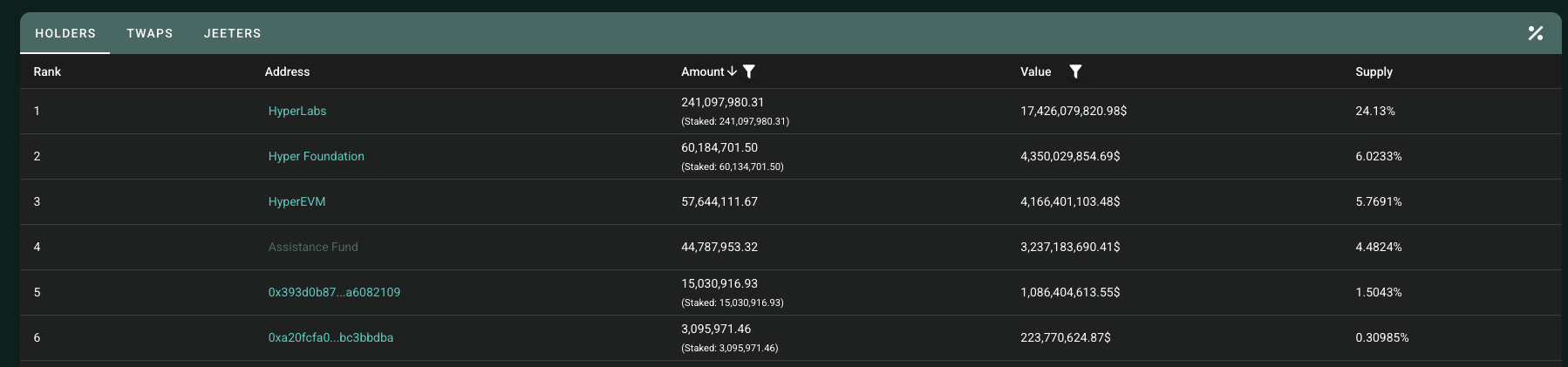
However, this is not a16z's only HYPE holding address. On-chain data shows a16z is also continuously buying and accumulating HYPE through multiple associated addresses.
On May 28, crypto analyst @ai_9684xtpa monitored that an address starting with 0x4c6, associated with a16z, withdrew a total of 253,947.43 HYPE from various exchanges and market maker addresses at an average withdrawal price of approximately $59.2. On May 30, Lookonchain tracked that another a16z-associated address starting with 0xb5E bought another 226,121 HYPE. Since April 14, this address has cumulatively purchased 3.9 million HYPE at an average price of about $49.4.
Besides a16z, Galaxy Digital is also accumulating HYPE. On June 3, according to Lookonchain monitoring, Galaxy Digital withdrew 179,000 HYPE from Coinbase, valued at approximately $12.62 million. Earlier, on May 21, another associated wallet had also purchased 158,100 HYPE, worth about $8.8 million.
Institutions no longer view HYPE as a mere speculative altcoin. Bitwise CIO Matt Hougan stated that HYPE is not just an altcoin but a "second-generation" cryptocurrency because it possesses real value capture, buybacks, and institutional demand.
Simultaneously, institutions have elevated Hyperliquid's positioning from a Perp DEX to a blockchain-based financial infrastructure platform. A Grayscale report stated that Hyperliquid could potentially challenge traditional derivatives trading and exchange systems in the future, growing into a "financial services giant."
HYPE DAT Company Added to Russell 3000 Index
As the U.S. stock market's DAT concept cools down and the sector leader Strategy also begins selling coins, companies betting on HYPE are seeing their holdings continue to appreciate alongside HYPE's price rise. (Related reading: DAT Failure? Company Betting on HYPE Reports $1.25 Billion Unrealized Profit)
One company worth highlighting is Hyperliquid Strategies (NASDAQ: PURR). According to official data, it currently holds 22.3 million HYPE, with a portfolio value of $1.617 billion. In its Q1 2026 earnings report released in early May, Hyperliquid Strategies disclosed allocating $10.5 million to repurchase approximately 3 million shares at an average cost of $3.42 per share.
On May 22, FTSE Russell published the preliminary list for the June 2026 Russell 3000 Index reconstitution. PURR appears on the addition list for the Russell 3000 Index, with the change expected to take effect on June 26.
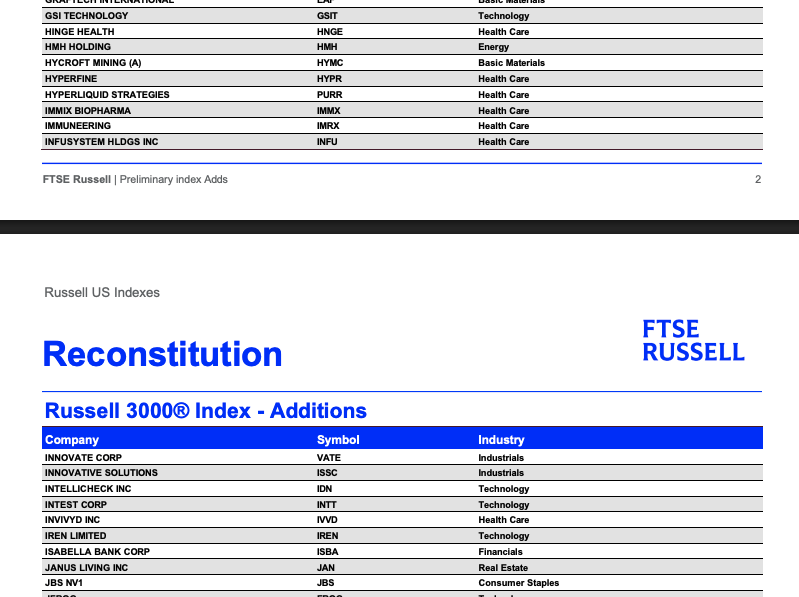
PURR appears on the addition list for the Russell 3000 Index
The Russell 3000 Index is one of the broadest stock indices in the U.S. stock market, covering the approximately 3,000 largest publicly traded companies in America—essentially encompassing the entire U.S. stock market. A major reconstitution occurs annually in June. Currently, a vast number of index funds, pension funds, and ETFs track this index. FTSE Russell states that approximately $10.6 trillion in assets are benchmarked to the Russell US Indices.
If PURR is indeed included in the Russell 3000 Index, it will not only benefit from passive fund allocations but also gain significantly increased visibility. To provide investors with more exposure to HYPE, they might also emulate Strategy's "borrow-to-buy" model in the future, thereby becoming another strong source of buy-side support for HYPE.


