






Từ hậu trường ra ánh sáng, JTX của Jito có thể định nghĩa lại giao dịch trên chuỗi?


- Quan điểm cốt lõi: Nhà cung cấp cơ sở hạ tầng Solana, Jito, ra mắt nền tảng giao dịch chuyên nghiệp tự quản lý JTX, nhằm chuyển đổi kiến thức giao dịch nền tảng tích lũy trong bốn năm thành trải nghiệm thực thi chất lượng cao cho người dùng cuối, tích hợp nhiều công cụ để thu hẹp khoảng cách trải nghiệm giữa giao dịch trên chuỗi và sàn tập trung.
- Các yếu tố chính:
- Các sản phẩm cốt lõi của Jito bao gồm Block Engine, JitoSOL (vốn hóa thị trường hơn 800 triệu USD) và BAM (gần một nửa số validator sử dụng), xây dựng cơ sở hạ tầng giao dịch lớp dưới cho Solana.
- JTX được định vị là một "công cụ giao dịch" tự quản lý, hỗ trợ spot, hợp đồng vĩnh viễn và thị trường dự đoán, người dùng giữ quyền kiểm soát tài sản mà không cần ký gửi cho tổ chức tập trung.
- Chất lượng thực thi là hào phòng thủ, tận dụng chuyên môn của Jito để giải quyết các vấn đề như chạy trước (front-running), giao dịch thất bại và phí ưu tiên, cung cấp các loại lệnh chuyên nghiệp như lệnh giới hạn, TWAP.
- 80% doanh thu giao thức của JTX được phân bổ cho người nắm giữ JTO, 20% còn lại được sử dụng cho phát triển sản phẩm, tiếp nối mô hình tokenomics hiện tại.
- Sự khác biệt so với Hyperliquid: Dựa trên hệ sinh thái Solana và nền tảng kỹ thuật của Jito, mục tiêu là trở thành một nền tảng giao dịch toàn diện bao phủ nhiều loại tài sản.
Original: Odaily Planet Daily (@OdailyChina)
Author: jk
Making a professional trade on Solana usually requires opening eight tabs at once.
Charts on Birdeye, orders on Jupiter, position management on Drift, yield strategies on another protocol, prediction markets somewhere else, logging into eight different websites for wallets. Each tool does one thing well, but none connects them together. The bigger problem is that even after assembling all of these, the execution quality still falls short of centralized exchanges (CEXs).
On-chain traders have long faced a dilemma: either accept inferior tools, or entrust your assets to someone else.
The reason this problem persists is actually quite simple: those capable of solving it have been busy doing other things.
Solana, JTO, and JTX
Four years ago, when Jito was still a startup with less than ten people, it chose the least visible path: delving deep into Solana's underlying infrastructure, focusing on building components that average users would never directly touch.
For those unfamiliar with Solana, one might ask: What is Jito?
Simply put, it is the "behind-the-scenes engine manufacturer" for the Solana blockchain. In the crypto world, before any on-chain transaction is packaged into a block, it goes through a complex process of ordering, bidding, and confirmation. Jito builds the core components of this mechanism.
Here's an analogy: Imagine Solana as a highway. Jito is the company responsible for designing and operating the toll booths, ramp metering systems, and road sensors. Drivers (users and traders) don't usually notice its presence, but without it, the entire road's traffic efficiency would be severely compromised.
Specifically, Jito currently has three core products. The Block Engine handles the majority of on-chain transaction ordering and MEV distribution, acting as the "dispatch center" before transactions enter a block; JitoSOL is a token that allows holders to stake SOL while maintaining asset liquidity, currently boasting a market cap exceeding $800 million; BAM (Block Assembly Mechanism) is the next-generation block assembly architecture, with nearly half of Solana validators now running this client, representing over 31% of staked network weight.
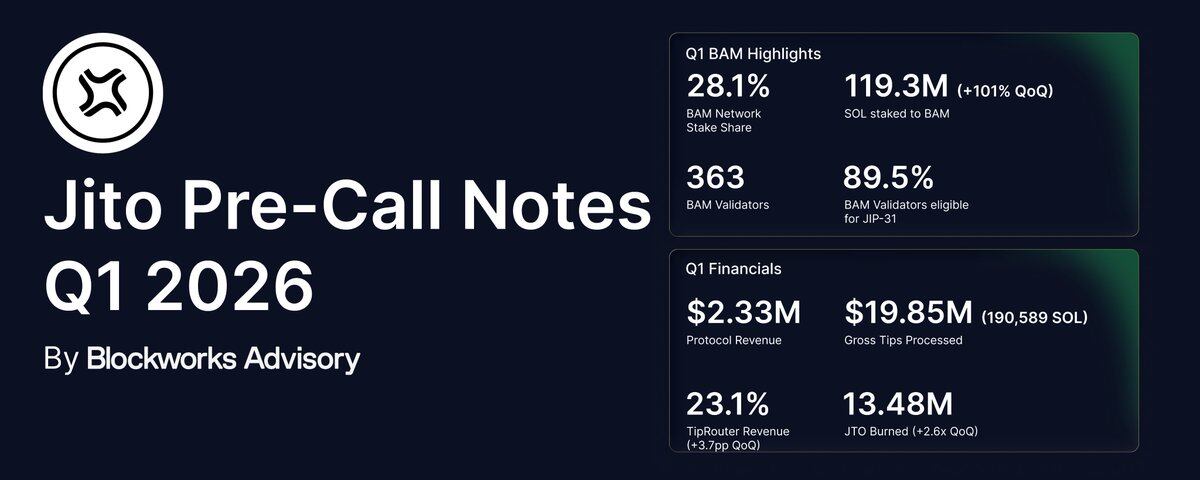
Jito's Q1 performance.
Today, Jito stands as one of the most important and foundational infrastructure providers in the entire Solana ecosystem.
In May 2026, Jito made a major announcement at the Solana Accelerate conference in Miami: launching a trading product for end-users, JTX, which is expected to officially launch in July this year.
So, what exactly is JTX?
It is a self-custodied, professional-grade on-chain trading platform. Users can enjoy a trading experience comparable to centralized exchanges (CEXs) without transferring their assets to any centralized institution, retaining full control over their funds. Chart analysis, multiple professional order types, spot trading, and future plans for perpetual contracts and prediction markets are all integrated into a single interface. Its target users are advanced traders who find simple swap interfaces inadequate but are unwilling to entrust their assets to centralized exchanges.
Why would a company that thrived in the background step into the spotlight? Why a trading product? With these questions, the Odaily team spoke with Marc Liew, Jito Foundation's lead for the Asia-Pacific region, to discuss Jito's next steps.
"We Didn't Pivot; We Just Built What Was Most Natural"
Upon seeing the news about JTX, the initial reaction from outsiders was that Jito was "pivoting."
Marc Liew, Jito Foundation's APAC lead, doesn't quite agree with that characterization. "It's more of a natural extension than a pivot," he says. "Jito spent four years building the underlying infrastructure that the Solana economy relies on – the Block Engine, JitoSOL, BAM. This work has given us a profoundly deep understanding of what happens between a transaction's intent and its settlement."
However, he believes this understanding has never been passed on to end users.
"At some point, you start asking: why isn't anyone telling users this?" Marc says. "Teams building trading products on Solana don't have this kind of deep execution-layer knowledge. And teams like Jito, who have this accumulated knowledge, have never actually built a trading product. JTX sits right at this intersection. We are extending the infrastructure directly to the person it was meant to serve."
To understand this logic, one must first grasp Jito's core competency. Its value lies not just in "building infrastructure" per se, but in the firsthand knowledge gained during that process about on-chain trading mechanics: why transactions fail, how priority fees affect queuing order, and how MEV is extracted during block production.
Jito's Block Engine is the central node handling this on-chain mechanism, giving it a depth of understanding of on-chain trading rules that other teams find hard to replicate. This knowledge is incredibly valuable for a product team aiming to build a high-quality trading experience.
"JTX is an attempt to productize this knowledge." Marc told Odaily.
"Solana's Infrastructure is Good Enough; the Problem is the Application Layer"
Discussing the rationale behind JTX, Marc's assessment is quite direct: "Solana has the best infrastructure in the world. It processes more daily transaction volume than all other public chains combined and has been through real, high-stress tests that no other chain has faced. The bottleneck for adoption isn't the chain itself; it's what's built on top of it."
Jito's motivation for building JTX stems from this belief: Solana is fast enough, but the application layer built upon it has yet to match the chain's inherent capabilities.
The gap between on-chain and off-chain trading experiences is a persistent industry problem discussed repeatedly but never systematically solved. For active traders, this gap is glaringly obvious. "Professional traders on Solana currently have to piece together five, six, sometimes eight different applications to complete what should be a single workflow," Marc describes. "Charting in one place, executing spot trades in another, portfolio management somewhere else, yield strategies on another protocol, perpetuals and prediction markets possibly on another chain. And even after all that piecing together, the execution quality doesn't match a CEX. So they face a choice: either give up self-custody for a better experience, or hold their assets and accept inferior tools."
This dilemma is precisely the problem JTX aims to solve.
Terminal, Aggregator, Broker – None of These Labels Fit
JTX's positioning defies easy categorization within the industry's existing lexicon.
Marc politely rejects several common labels. "'Terminal' has been claimed by a certain tier of products in crypto. We're not building at that level. 'Aggregator' implies we're just routing orders through others' infrastructure. 'Broker' suggests an intermediary standing between you and your assets. None of these are accurate."
The internal definition he offers is that JTX is a Trading Engine. "This is a professional workspace where serious traders execute, manage positions, and deploy capital. We aggregate all the best tools and overlay them with a layer of infrastructure knowledge that's hard to match on any other chain."
From a product perspective, JTX will launch with spot trading (including RWA assets), followed by the gradual integration of perpetual futures (via a partnership with Phoenix) and prediction markets (through a Solana-native protocol under development). Charting tools, order execution, portfolio management, and capital efficiency features are all completed within a single account and interface.
The advantage of self-custody needs no further explanation: on traditional centralized exchanges, assets deposited by users are effectively controlled by the platform. The collapse of FTX was the most extreme example of this risk. User assets existed on the books but were essentially misappropriated. JTX's self-custody model means assets always remain in the user's own wallet. JTX is merely an interface for executing trades; the platform itself has no power over user funds.
Regarding established Solana tools like Jupiter, Birdeye, Axiom, Photon, Drift, and Phoenix, Marc's stance is that JTX should be seen as the interface that brings them together, not as their competitor. "It allows a trader to access the best of the Solana ecosystem in one place, with institutional-grade execution quality."
The phrase "integration, not competition" sounds safe. But considering Jito's history of deep collaboration with Solana ecosystem partners over the past few years, this might very well be its consistent operational logic: build robust foundations, let others build on top, and when the time is right, directly take over the interface layer as well.
Execution Quality is Jito's True Moat
In all the narratives surrounding JTX, "execution quality" is the most frequently mentioned term.
This is backed by Jito's four years of real-world experience. "Every serious team building on Solana eventually comes to Jito to understand how transactions really work – how they land on-chain, where they fail, what determines success or failure," Marc says. "We've spent four years studying every scenario in Solana's trading channels. This knowledge is directly embedded into JTX's product design."
Translating this into specific trading pain points:
- Front-running is one of the most frustrating issues in on-chain trading. Since all pending transactions are publicly visible before being included in a block, "queue-jumping" bots can see your buy order, buy first with a higher priority fee, and then sell to you once your transaction executes at a higher price. BAM's next-generation block assembly architecture allows transactions to remain private before execution, structurally severing this pathway.
- Failed transactions increase significantly during Solana network congestion, and failures still incur fees, leaving traders often having "spent money and gotten nothing." JTX's design goal is "either execute at the price you see, or don't execute at all," fundamentally solving this silent failure problem.
- The priority fee issue. During peak times on Solana, traders often need to pay higher priority fees to have their transactions processed faster. Determining how much, when, and how much to pay requires a deep understanding of the underlying game theory. Jito's understanding of how Solana handles transactions under pressure is directly translated into JTX's execution quality management mechanism.
Regarding CEX-grade advanced order types, including limit orders, TWAP, stop-loss/take-profit, OCO, etc., Marc indicated that JTX will offer some of these at launch, with the rest rolling out gradually. He gave an honest explanation of the technical challenges in implementing these on-chain: "The challenge with implementing these order types on-chain stems from the execution reliability required, which most platforms can't provide because they are built on an infrastructure they don't deeply understand. Our team built the execution infrastructure that Solana runs on. This means when we design a stop-loss/take-profit order or an OCO, we're not praying the network cooperates. We know exactly how these orders interact with the underlying transaction pipeline, and we design the system architecture accordingly."
Comparison with Hyperliquid: Respect, but a Different Approach
JTX can hardly avoid comparison with Hyperliquid. The latter, leveraging its own L1, has achieved an annualized fee revenue exceeding $600 million, proving massive market demand exists for professional on-chain trading experiences.
Marc offered genuine praise for Hyperliquid: "I have a lot of respect for what they've built. They've proven there's huge demand for professional on-chain trading – on their own L1, without any of Solana's infrastructure advantages, they achieved over $600 million in annualized fees."
He sees JTX's differentiation on two fronts: firstly, Jito's deep engineering expertise and the overall support of the Solana ecosystem; secondly, a different product positioning. JTX aims to become the application where traders "can access any asset class," covering prediction markets, crypto assets, and the growing trend of RWA (Real World Assets) tokenization.
From this perspective, JTX represents the vertical integration of financial instruments across the entire Solana ecosystem. Compared to Hyperliquid's "one chain, one tool" philosophy, JTX will likely be more comprehensive in scope. However, whether its trading-specific design and experience can surpass Hyperliquid will be determined upon the product's official release.
"Many financial applications are evolving towards multi-asset-class platforms. In that dimension, JTX certainly has competitors. But we believe Jito's deep engineering expertise and the overall weight of the Solana ecosystem are our true differentiators."
The Key Question for Retail: What Do JTO Holders Get?
For unfamiliar readers, JTO is the governance token of the Jito ecosystem. Holder benefits aren't limited to participating in voting and governance; they also receive tangible economic rewards through protocol revenue distribution. A portion of the staking rewards generated by JitoSOL and the MEV revenue from the Block Engine accrues to JTO holders. This is the fundamental logic of Jito's tokenomics.
The launch of JTX adds a new, direct, consumer-facing revenue stream to this model. Following the JTX announcement, JTO surged 45%.
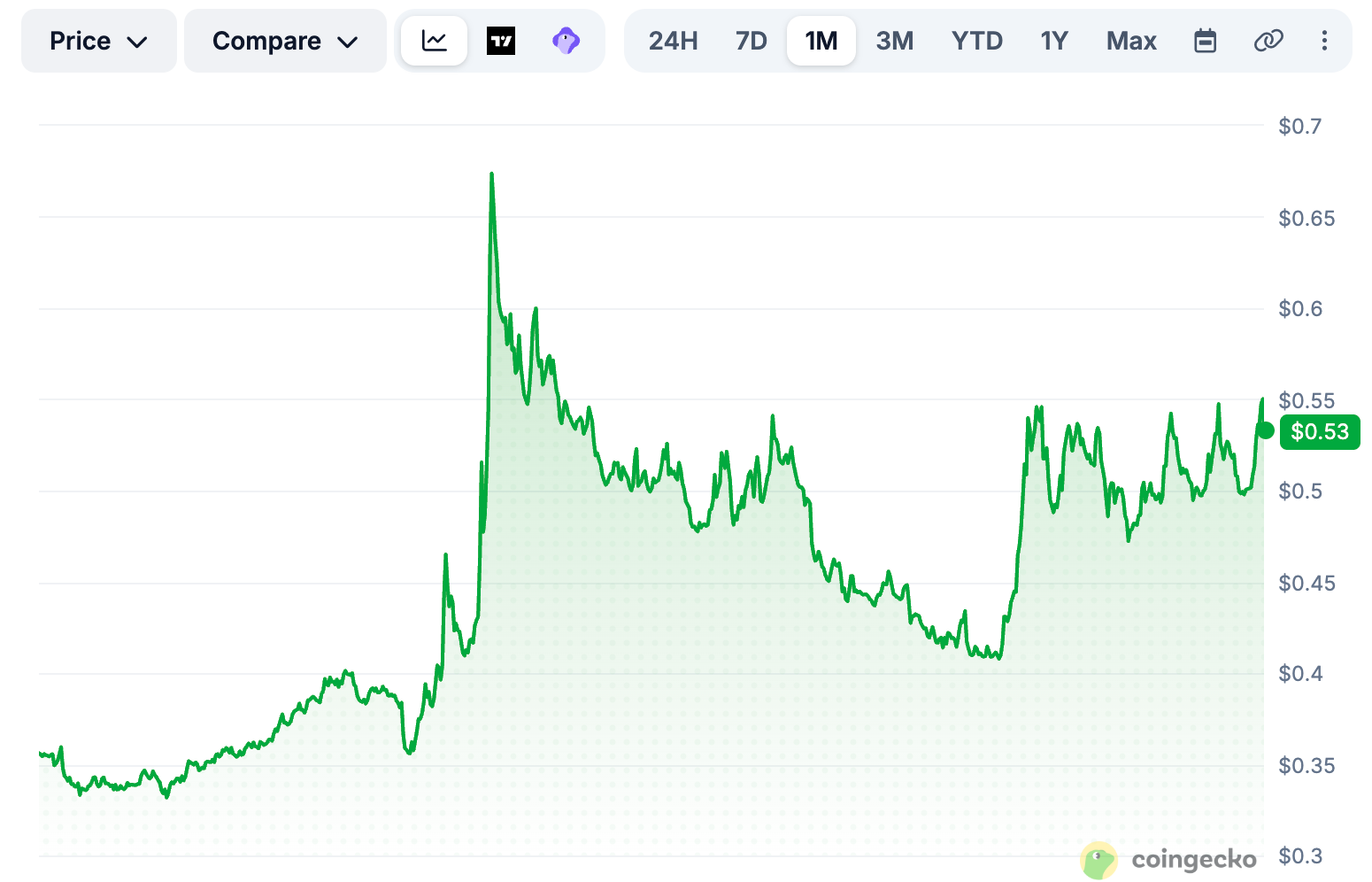
The revenue distribution structure is quite clear: 80% of JTX's protocol revenue flows to the Jito Protocol, ultimately accruing to JTO holders; the remaining 20% is reinvested into the product's continued growth and development.
Marc likened this model to the existing mechanisms of JitoSOL and the Jito network: "This continues the same model already running within JitoSOL and the entire Jito network. Fees generated at the protocol level accrue to JTO. JTX plugs into the Jito economic architecture, not as an independently operating product. Every transaction on JTX directly contributes to the ecosystem."
Marc also outlined the key metrics he believes JTO holders should watch: JTX's trading volume is the top of the revenue funnel; user retention determines revenue sustainability; and the expansion of asset classes and market types means a widening revenue base. "Spot goes live first, with perpetuals and prediction markets on the roadmap. Each new market type is a new revenue stream. JTO holders should view JTX like they view JitoSOL or BAM – as another pillar of the market layer, generating real economic activity and funneling its value back to the token."
In Three Years, the Distinction Between CEX and DEX May No Longer Matter
Discussing the future of on-chain trading over the next three years, Marc proposed a thought-provoking framework:
"'Becoming increasingly like a CEX' is actually the wrong perspective. What's really happening is that the best elements of centralized trading – speed, professional tools, execution quality – are being reconstructed on a foundation that centralized exchanges can never achieve: self-custody, transparency, and composability."
In his view, three years from now, the distinction between "CEX" and "DEX" will be meaningless for most traders. "They simply want the best execution, the best tools, and complete control over their assets. The product that makes this combination feel effortless will win. We believe the future of professional trading lives on-chain, on Solana, and JTX is our bet on this vision."
In terms of milestones, Marc highlighted the key events to track over the next 12 months: The official launch of JTX in July, supporting spot trading, professional order types, and self-custody; followed by an expansion to perpetual futures and prediction markets, making JTX potentially one of the most functionally complete on-chain trading venues. On the infrastructure side, the continued acceleration of BAM adoption, alongside institutional developments like the 21Shares JitoSOL ETP and the partnership with Korea's KODA.
Conclusion
From its debut at Solana Accelerate, to the July mainnet launch, and the subsequent expansion into perpetuals and prediction markets, JTX's timeline is clear and ambitious. Whether it can carve out its niche in a competitive landscape featuring Jupiter, Drift, Phoenix, and Hyperliquid ultimately hinges on one thing: Can Jito's four years of accumulated infrastructure insights translate into a tangible difference in execution quality as perceived by ordinary traders?
If the answer is yes, this will be a rare instance in the crypto industry of a complete vertical integration from the underlying foundation to the user-facing frontend. If not, it will still be a noteworthy attempt – a record of what happens when an infrastructure company steps into the limelight.
The answer will be revealed in July this year.


