






HYPE新高后,「HYPE版微策略」$PURR值得买吗?


- 核心观点:Hyperliquid Strategies(PURR)是一家无实际业务的“DAT”公司,仅通过持有和质押HYPE代币运营,其股价价值完全依赖HYPE价格表现。尽管近期因HYPE暴涨和机构介入而备受关注,但其资本效率对标微策略(Strategy)的论据存在误导性,且对投资者而言,PURR本质是传统金融获取HYPE敞口的合规通道,而非更优的投资标的。
- 关键要素:
- PURR业务模式仅为购买、质押和持有HYPE,目前持有约2000万枚HYPE及1.13亿美元现金,无实际业务,股价完全取决于HYPE价格。
- PURR前身为生物科技公司,由Paradigm和Atlas Merchant Capital等机构通过SPAC并购重组,管理层多为传统金融资深人士,包括巴克莱前CEO和纽交所前COO。
- HYPE年内涨幅超150%,从约25美元涨至62美元以上,是2025年最强加密资产之一,直接推动了PURR超100%的涨幅。
- 高盛、21Shares、Bitwise等机构近期披露持有PURR股份或推出HYPE现货ETF,叠加Cantor Fitzgerald上调目标价,形成市场利好催化剂。
- 所谓“资本效率超微策略”的对比具有误导性:PURR的HYPE持仓成本约7美元(涨近9倍),而微策略的BTC持仓成本约7.5万美元(几乎未涨),回报差异源于底层资产表现而非管理能力。
- PURR目前相对其持币价值(mNAV)存在约11%-23%的折价,但考虑新增发股票后可能转为溢价;稀释风险、收益传导不完整、交易时间限制和对手方风险是直接持币的主要劣势。
- 对有能力直接购买HYPE的投资者而言,PURR的股票包装层带来额外成本(如稀释、征税、交易摩擦),不提供超额收益,其核心价值仅在于为限制持币的传统账户(如IRA)提供合规渠道。
Author: TechFlow
On May 24, a tweet about Hyperliquid Strategies (NASDAQ: PURR) sparked considerable discussion on Crypto Twitter:
The company used approximately $220 million to buy HYPE, and its current unrealized profit has reached nearly $1 billion, even surpassing the profitability efficiency of Michael Saylor's Strategy (formerly MicroStrategy) in BTC.
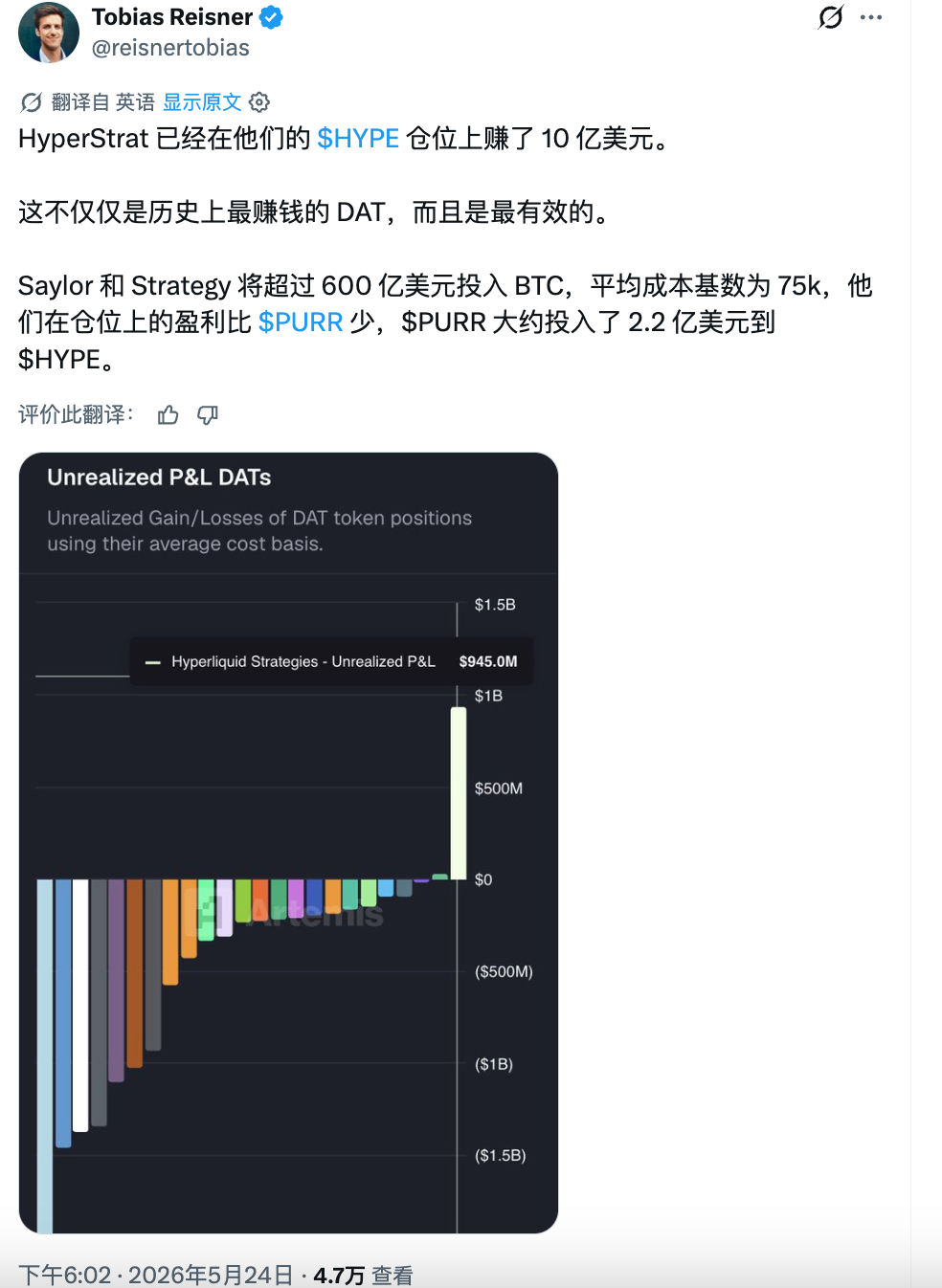
This topic is now gradually spreading to the Chinese-speaking community. HYPE recently hit a new all-time high above $62, with year-to-date gains exceeding 150%, making it one of the best-performing major crypto assets this year.
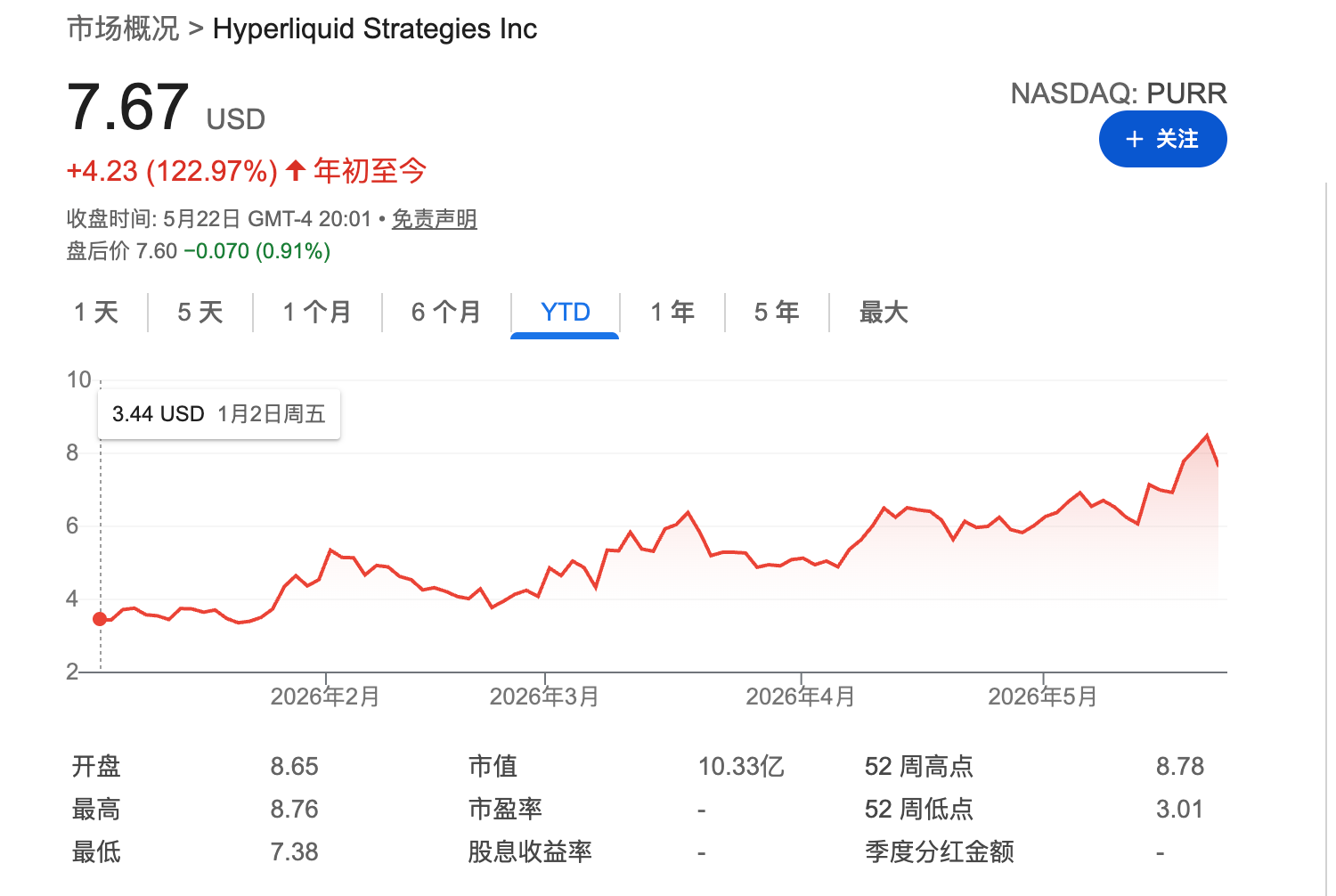
As the only listed HYPE proxy target in the US stock market, PURR has also risen over 100% year-to-date, naturally becoming a FOMO target for US stock research and investment.
However, before jumping on the bandwagon, several issues need to be clarified:
1. What exactly is this company?
2. What is the difference between it and buying HYPE directly?
3. Can the claim of "capital efficiency surpassing MicroStrategy" withstand scrutiny?
$PURR, a Pure DAT
First, the conclusion: PURR is not a company with actual business operations; it is equivalent to a pure $HYPE stock packaging product.
Its business model boils down to a single sentence: buy HYPE, stake HYPE, hold HYPE. As of April 2026, public information shows the company holds approximately 20 million HYPE, along with about $113 million in cash and zero debt.
This means the entire value of the stock depends on one thing: the price of HYPE.
Since there is no business to analyze, evaluating this type of company boils down to only two dimensions: the underlying asset itself and who is operating this shell.
The latter determines the capital operation capability – such as when to issue more shares to buy coins, when to buy back for price support, and how to manage the premium/discount relationship between the stock price and net asset value... It also determines whether institutional funds are willing to enter through this vehicle.
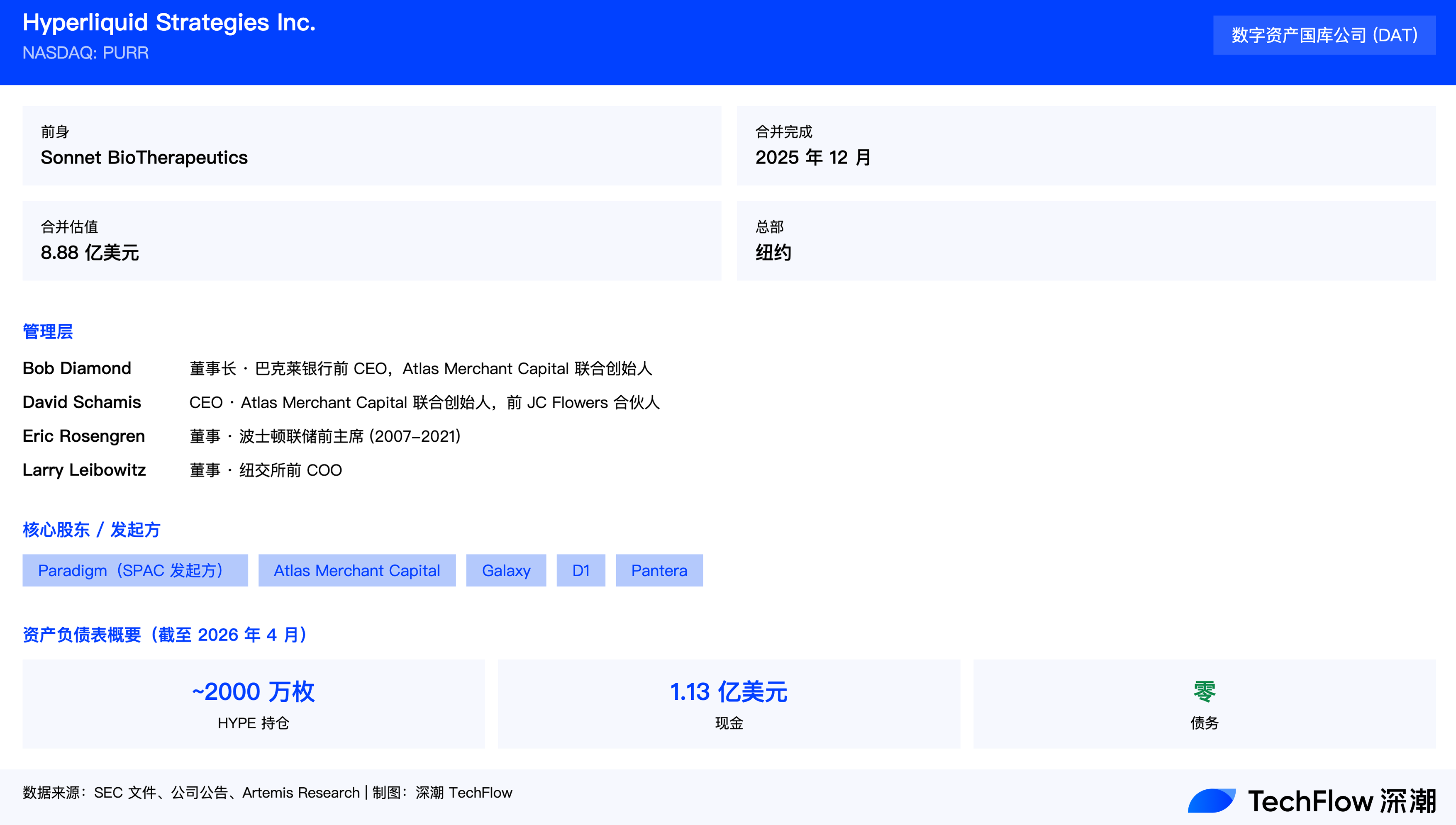
Historically, PURR was formerly Sonnet BioTherapeutics, a small-cap biotech company listed on NASDAQ. In July 2025, it announced a merger with Rorschach I, completing the transaction in December of the same year with an overall valuation of $888 million. It was renamed Hyperliquid Strategies, and its ticker changed to PURR.
Notably, the initiators of this transaction were Paradigm and Atlas Merchant Capital.
Paradigm is one of the top venture capital firms in the crypto industry, having backed projects like Uniswap, Blur, and Friend.tech. It has deep ties within the Hyperliquid ecosystem and directly participated in the formation of this SPAC.
Atlas Merchant Capital is a financial services investment firm based in New York and London. Its two founders secured key positions within PURR: Chairman Bob Diamond, former CEO of Barclays Bank, and CEO David Schamis, former partner at JC Flowers.
The board also includes Eric Rosengren, former President of the Boston Fed, and Larry Leibowitz, former COO of the NYSE. Other participants include Galaxy, D1, and Pantera, all first-tier institutions in the crypto and macro space.
While management teams of most DAT companies come from the crypto-native circle, PURR's leadership is almost entirely comprised of traditional finance veterans.
$HYPE Strong, $PURR Soars
PURR caught the attention of the Chinese-speaking community primarily due to the strength of HYPE itself.
HYPE has surged from around $25 at the beginning of the year, breaking through $62 in May to reach a new all-time high, achieving year-to-date gains of over 150%. Against a backdrop of a sideways BTC and lackluster performance from ETH and SOL this year, HYPE stands out as the brightest star among major crypto assets.
Our previous article has already dissected Hyperliquid's fundamental flywheel: roughly 70% market share in perp DEXs, weekly fee revenue exceeding $10 million, 97% of protocol fees used for buyback and burn of HYPE. This flywheel continues to accelerate.
(Reference: "Market Observation: From HYPE to ZEC, Grasping the 4 Narrative Lines Behind Recent Altcoin Hype")
When HYPE rises, PURR naturally follows suit.
As the only HYPE proxy target listed on US stock exchanges, PURR has gained over 100% year-to-date, moving from the $3 range to a recent high of $8.79.
For investors who only have US stock accounts and do not directly interact with the crypto market, PURR is almost the only option to gain HYPE exposure. However, what turned PURR from a "niche asset" into a "social media topic" were several institutional signals materializing since May.
Goldman Sachs disclosed buying approximately 650,000 shares of PURR in its Q1 13F filing. While the amount is not huge (around $3.3 million), the Goldman Sachs name itself serves as an endorsement. During the same period, HYPE spot ETFs from 21Shares and Bitwise were listed on Nasdaq and NYSE respectively, and Cantor Fitzgerald raised PURR's price target from $6 to $8.
These events, layered within the timeframe of HYPE hitting new highs, propelled PURR into the spotlight for a wider audience.
Then came the tweet mentioned at the beginning of the article: PURR used $220 million principal to buy HYPE, now boasts an unrealized profit of nearly $1 billion. In the short term, its capital efficiency certainly surpasses that of MicroStrategy.
Following such a significant surge, immense attention is inevitable. However, if you are considering trading this stock, caution is warranted.
The Most Capital Efficient DAT, Really?
Strategy (formerly MicroStrategy) invested over $60 billion to buy BTC at an average cost of around $75,000. PURR used only about $220 million to buy HYPE, yet its unrealized profit nearly matches or even exceeds that of Strategy. Conclusion: PURR's "capital efficiency" is far higher than MicroStrategy's?
This comparison holds numerically, but it is logically misleading.
PURR's early HYPE holdings have an average cost of around $7. The current price is $62, representing an increase of nearly 9 times. Strategy's average BTC cost is around $75,000, and BTC is currently near that price level, showing almost no gain.
Therefore, PURR's higher unrealized profit is not due to any smarter move by the company. It simply reflects that the price appreciation of the underlying assets is on an entirely different magnitude. Anyone buying HYPE spot directly with the same amount of money at the same time would have achieved the same return, without bearing the risk of equity dilution.
In other words, this is the victory of "picking the right coin." If PURR's establishment had been delayed by six months, entering when HYPE was at $40, this "capital efficiency" narrative would completely collapse.
For US stock investors just discovering PURR today, the more practical question is: Are you paying a premium or a discount for the HYPE value held by the company when buying PURR now?
This brings us to the core valuation metric for DAT companies – mNAV (Modified Net Asset Value per share).
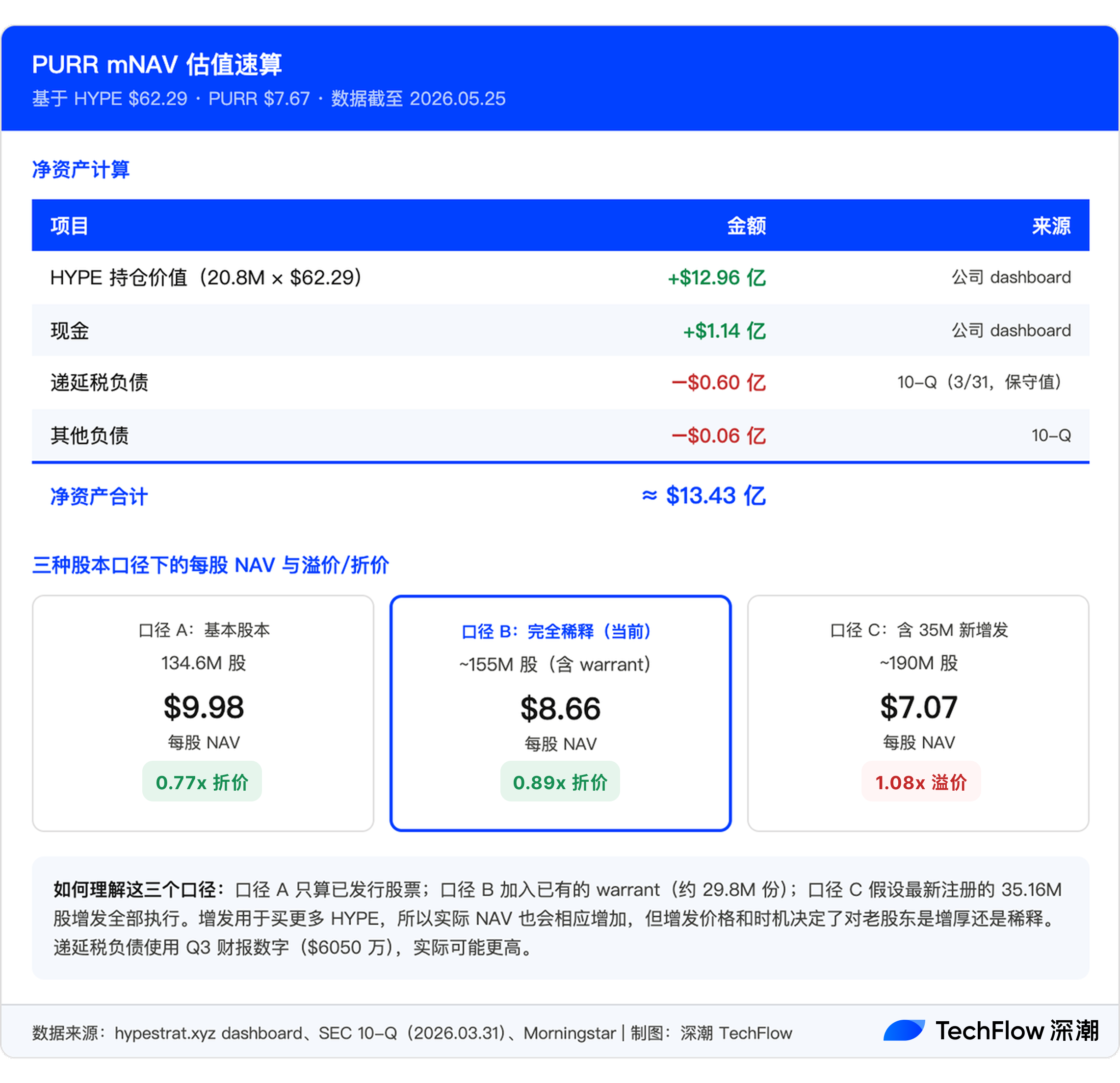
We pulled data from PURR's official dashboard and SEC filings to perform a simple mNAV calculation.
The company currently holds 20.8 million HYPE (approximately $1.296 billion at the current price). Adding $114 million in cash and deducting deferred tax liabilities and other obligations, the net asset value is approximately $1.34 billion.
Looking solely at the 134.6 million shares outstanding, the NAV per share is about $9.98. The current stock price of $7.67 represents a discount of roughly 23%. If we include the approximately 29.8 million warrants, the fully diluted share count reaches about 155 million, resulting in an NAV per share of about $8.66, a discount of roughly 11%. However, the company has just registered 35.16 million new shares for potential issuance. If all are executed, the denominator expands to about 190 million shares, reducing the NAV per share to $7.07. In this case, the stock price becomes a slight premium of 1.08 times.
Therefore, whether PURR is "cheap" or "expensive" depends on your assessment of future dilution.
Share issuance itself is not necessarily bad. If management issues shares during high premium periods and uses the proceeds to buy more HYPE, the per-share HYPE holding could increase. However, if equity is issued when market sentiment cools and the stock price falls below NAV, it dilutes existing shareholders.
The company has only been around for six months and has not yet experienced a complete downward cycle. There is no historical record to reference regarding how management would operate in extreme market conditions.
Another point to note: the calculation above uses the deferred tax liability of $60.5 million as of the Q3 earnings report cutoff date (March 31). However, HYPE has appreciated significantly from the end of March to now. The tax liability corresponding to the unrealized gains has likely increased further, meaning the actual NAV might be lower than our estimate.
Buying PURR vs. Buying HYPE Directly: What's the Difference?
This is the most practical question. Since PURR's entire value stems from HYPE, why not bypass the intermediary layer and buy HYPE directly?
The answer is simple: for some investors, they simply cannot. US retirement accounts (IRAs, 401ks), traditional brokerage accounts, and certain strictly regulated institutional funds cannot directly hold crypto assets.
Furthermore, the Hyperliquid platform explicitly restricts access for US residents via its frontend.
Thus, PURR provides a NASDAQ-listed stock wrapper, allowing these funds to gain HYPE exposure through standard stock trading. The shell constructed by Paradigm essentially sells this compliance channel.
If you fall into this category of investor, PURR is indeed currently the only viable option. While HYPE spot ETFs from 21Shares and Bitwise went live in mid-May, these products have been trading for an extremely short time. Their liquidity and tracking error require further observation.
However, if you have the ability to buy HYPE directly, then PURR's stock wrapper becomes a pure friction cost with negative implications. It cannot be considered a beta overlay on HYPE.
This cost manifests in several layers:
First, dilution risk. Holding HYPE directly means your share is not diluted by others. Holding PURR stock means the company can issue new shares at any time to buy more HYPE.
Second, incomplete income transmission. Holding HYPE directly allows you to stake it yourself for staking rewards. Future airdrops and ecosystem incentives are also credited directly. Holding through PURR means staking income first goes into the company's books. After deducting operating expenses and taxes, it is only indirectly reflected in the net asset value per share.
Third, trading time and pricing friction. HYPE trades 24/7. PURR only trades during US stock market hours. If HYPE experiences significant volatility over the weekend or during after-hours, PURR holders can only react when the market opens.
Fourth, counterparty risk. SEC filings disclose that PURR's entire HYPE holdings are stored with a single custodian. Holding through PURR makes your asset security dependent on this custodian's performance and the company's operational continuity.
My assessment is that PURR is more of a "channel product" than an "investment product." Its value lies in opening a channel from traditional financial accounts to HYPE, and nothing more. If you don't need this channel, every additional risk introduced by the intermediary layer is unnecessary.
Therefore, for crypto and US stock investors in the Chinese-speaking community, the conclusion is quite direct:
The judgment you need to make is whether you are bullish on HYPE, not whether you are bullish on the PURR shell.


