






Từ HYPE đến ZEC, phân tích bốn chủ đề chính của thị trường altcoin cục bộ


- Quan điểm cốt lõi: Thị trường tiền mã hóa hiện tại đang cho thấy sự luân chuyển cục bộ, với bốn loại câu chuyện độc lập (hợp đồng vĩnh viễn phi tập trung, blockchain AI, coin riêng tư, Meme coin) đồng thời thúc đẩy dòng vốn, trong đó các tài sản như HYPE, NEAR, ZEC nổi bật nhờ các chất xúc tác có độ xác nhận cao, trong khi WLD và GRASS bị hạn chế bởi áp lực nguồn cung.
- Các yếu tố chính:
- HYPE (Hyperliquid) chiếm khoảng 70% thị phần Perp DEX, doanh thu hàng tuần 14 triệu đô la, 97% phí được dùng để mua lại, kết hợp với việc các tổ chức tăng vị thế và niêm yết ETF, giá đạt mức cao nhất mọi thời đại, vốn hóa lọt vào top 10.
- LIT (Lighter) là vị trí thứ tư trong lĩnh vực Perp DEX, vốn hóa chỉ bằng 1/40 của HYPE, được thúc đẩy tăng giá nhờ sự công nhận công khai của Vitalik và ra mắt sản phẩm mới, nhưng khối lượng giao dịch có yếu tố giả tạo và có áp lực mở khóa đội ngũ vào cuối năm.
- NEAR AI ra mắt tính năng tự động loại bỏ thông tin nhạy cảm trong lời nhắc, kết hợp với việc OpenAI công bố mô hình tương tự cùng thời điểm, gây ra làn sóng đầu cơ về quyền riêng tư + AI, dẫn đầu mức tăng 30 ngày trong mảng AI (50%).
- ZEC được hưởng lợi từ ba chất xúc tác: kết thúc cuộc điều tra của SEC, Robinhood niêm yết giao dịch và kỳ vọng nộp đơn ETF, tăng gấp đôi trong 30 ngày, tăng 15 lần trong năm, trở thành đồng đầu ngành về quyền riêng tư.
- USELESS (Meme coin) nhờ có cổng vào CEX như Coinbase, ký ức cộng đồng và khả năng lan truyền tên gọi, tăng gần 70% trong 30 ngày, nhưng thiếu nền tảng cơ bản, rủi ro biến động nhiệt độ rất cao.
- Mặc dù WLD có các câu chuyện nâng cấp như tổ chức Eightco nắm giữ, mở rộng thị trường Mỹ, nhưng đội ngũ gửi số lượng lớn vào sàn giao dịch và áp lực mở khóa tiếp diễn đến tháng 7, hiệu suất giá yếu nhất (chỉ tăng 5%).
- GRASS mặc dù có khách hàng trả phí từ phòng thí nghiệm AI và cơ chế mua lại, nhưng Season 2 airdrop và mở khóa đội ngũ tổng cộng khoảng 170 triệu token tạo áp lực cung ngắn hạn, giá bị kìm hãm bởi cuộc chơi cung cầu.
Original author: David, TechFlow
The crypto market this week clearly has localized momentum.
Although BTC dominance is still hovering around 60% and the Altcoin Season Index is only 35, far from the 75 threshold for confirming altcoin season, if you browse English Crypto Twitter, you'll notice that capital isn't waiting for macro signals anymore.
Over the past week, at least four independent narratives have been running simultaneously:
1. Perpetual DEXs (perp DEXs) are hitting new highs,
2. AI-focused L1s are rotating,
3. Privacy coins are being repriced,
4. Meme coins are reigniting.
The seven coins frequently mentioned recently – HYPE, LIT, NEAR, GRASS, WLD, ZEC, USELESS – are prime examples, corresponding to these four areas of market attention.
Let's first look at their performance trends in a table:
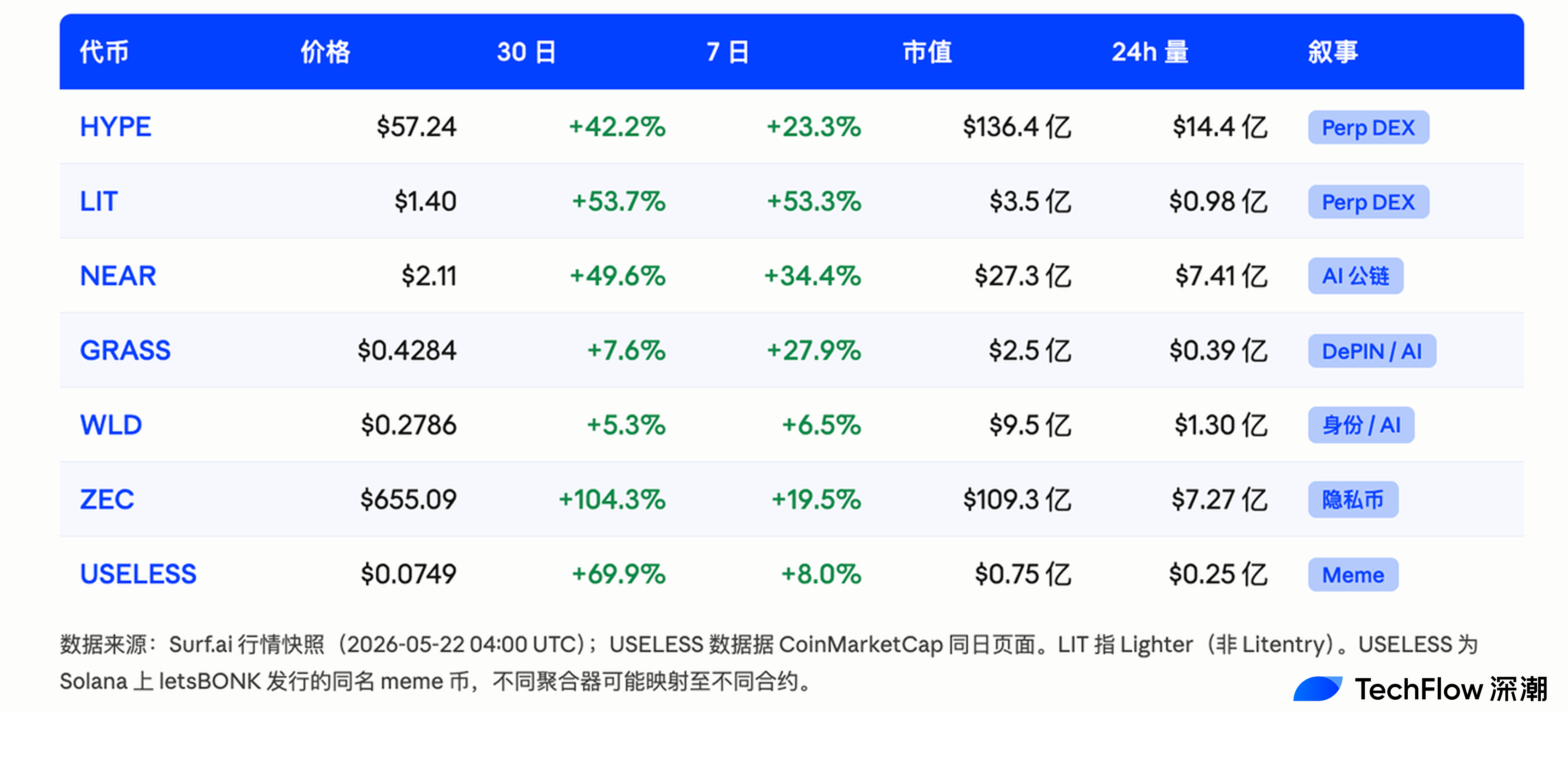
Several insights emerge from the table.
First, ZEC and HYPE show the strongest 30-day gains and volume, indicating the most substantial capital confirmation within their respective narratives. LIT leads in 7-day gains, but its market cap is only 1/40 of HYPE's, offering high potential returns but also significant downside.
USELESS has quietly risen nearly 70% over 30 days, yet its market cap is only $75 million, an entirely different league from ZEC's tens of billions. WLD has barely moved, showing the weakest price confirmation in this group, despite still generating significant discussion on English Crypto Twitter.
Below, we break down the logic behind each narrative.
1. Perp DEX Narrative: HYPE Hits New Highs, LIT Plays Catch-Up
The perp DEX narrative has the most complete capital flow chain in this altcoin cycle. For HYPE, three key factors – protocol revenue, institutional holdings, and ETF structure – have materialized simultaneously within the same month.
HYPE's foundation is its revenue. Hyperliquid commands roughly 70% of the open interest in perp DEXs, generating $14 million in weekly fee revenue, translating to an annualized figure exceeding $600 million. A full 97% of these protocol fees are automatically used to buy back HYPE.
This flywheel has been spinning since the token launched in late 2024, and by May of this year, millions of tokens from circulation had been cumulatively burned. Arthur Hayes' Maelstrom fund publicly stated it was selling holdings like ENA and PENDLE to increase its HYPE position, setting a $150 price target based on this revenue-buyback model.
Institutions are also following suit.
On-chain analyst @ai_9684xtpa tracked a wallet allegedly linked to a16z, which accumulated approximately 9.18 million HYPE (around $356 million) starting mid-April (though a16z has not confirmed this). On May 12 and 15, two spot ETFs for HYPE, from 21Shares and Bitwise, were listed on Nasdaq and NYSE respectively, attracting over $5.6 million in net inflows in their first week combined.
BHYPE's first-day trading volume set a record for altcoin ETF listings in 2026. Bitwise also uses an additional 10% of its management fees for buybacks. On May 21, HYPE reached an all-time high of $62.14, propelling it into the top ten cryptocurrencies by market cap.
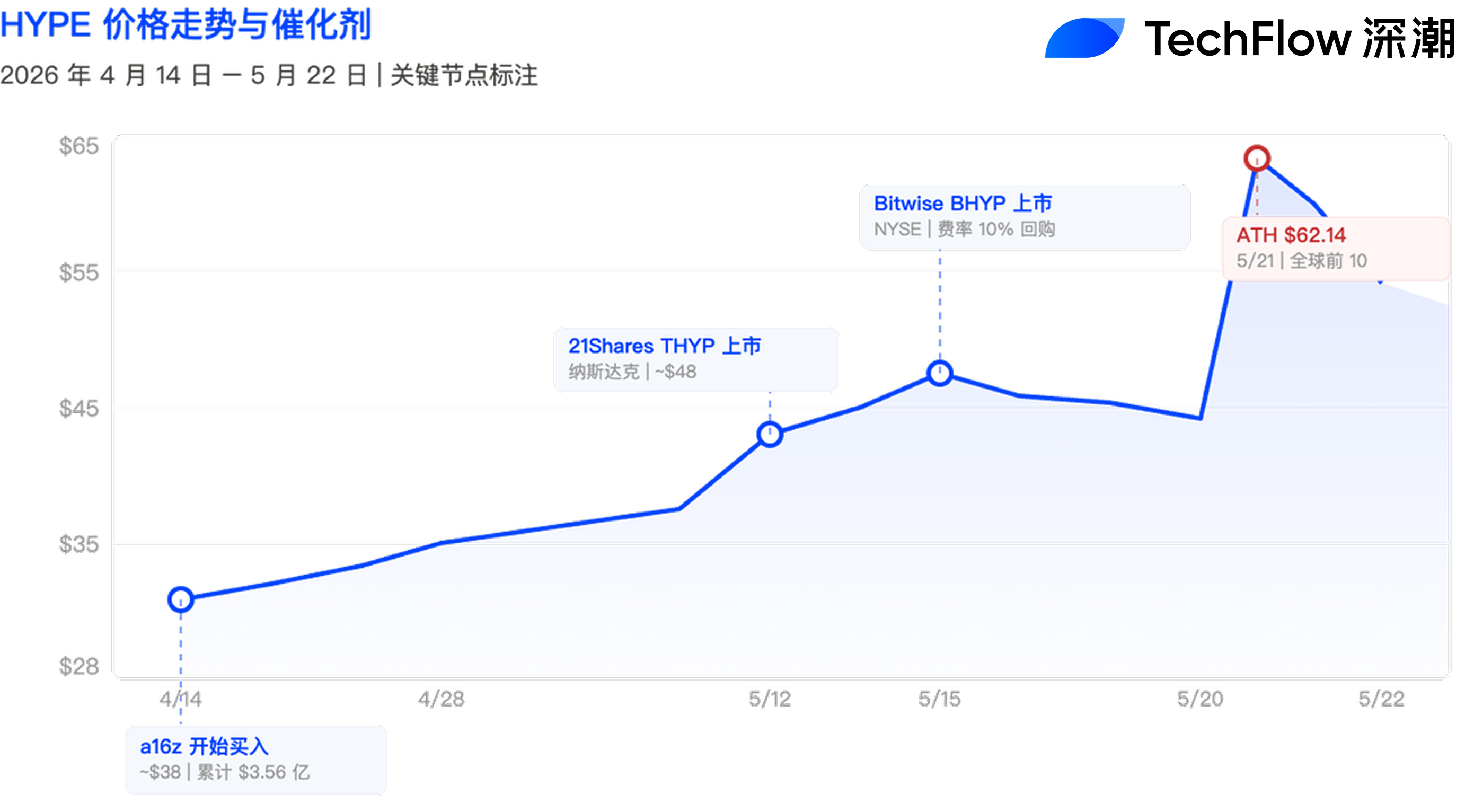
Revenue = Foundation, Institutions = Amplifier, ETF = On-ramp. Having all three layers converge simultaneously is indeed rare among altcoins.
The logic of this heat spilling over to similar projects within the same sector is straightforward. Lighter is the fourth-largest player in the perp DEX space, holding about a 10% market share, yet its market cap is just 1/40 of HYPE's. When HYPE hits an all-time high and enters the top ten by market cap, traders naturally look for more elastic targets within the same narrative.
On May 18, Vitalik mentioned Lighter in a public dialogue as a "relatively successful new project" within the Ethereum ecosystem, providing a celebrity endorsement for this catch-up logic. LIT subsequently surged 30% over the following three days. Lighter also has its own catalysts: it launched a SpaceX pre-IPO perpetual contract, integrated with the Tealstreet trading terminal, generates an annualized revenue of approximately $26.3 million, and also has an automatic buyback mechanism.
However, LIT's risks are also more defined compared to HYPE's.
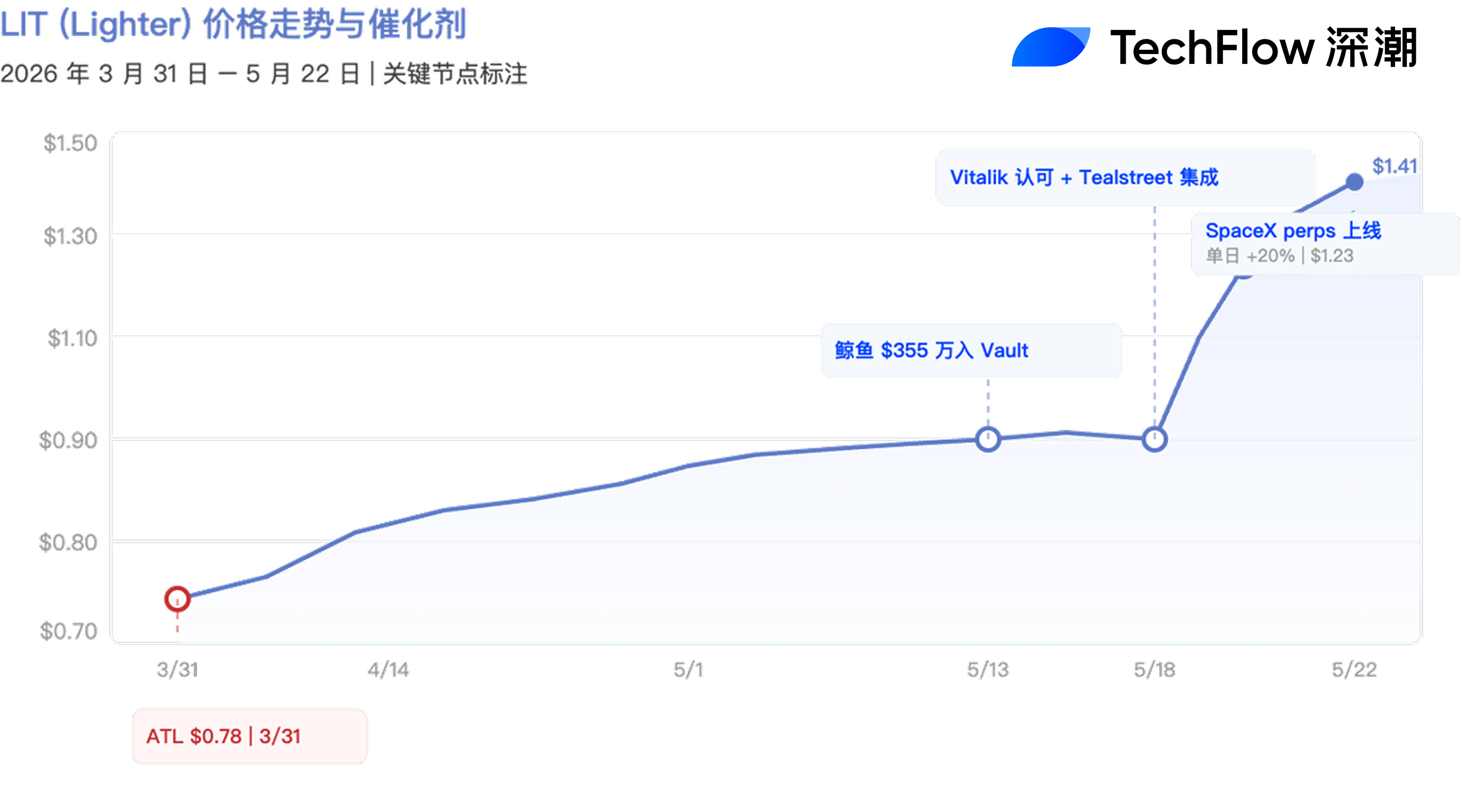
Lighter's previous high trading volumes were partly fueled by incentive programs and zero-fee designs. Market analysis suggests its Volume-to-Open-Interest ratio is high, meaning the extent of wash trading remains to be seen. LIT's circulating supply is only 25% of its total, with team and investor tokens starting to unlock at the end of the year at a rate of approximately 13.5 million per month.
The flip side of catch-up potential is that if the main HYPE narrative cools down, LIT's pullback is likely to be faster and deeper.
In my view, this main narrative is likely to continue attracting attention and capital in the short to medium term. Key points to monitor:
1. Whether ETF inflows for HYPE can reach another magnitude.
2. Whether Hyperliquid's protocol revenue can open new growth avenues through synthetic trading of traditional assets (e.g., crude oil, stock perps like SPCX).
If both are realized, the perp DEX narrative has more room to run. If ETF inflows stagnate and revenue growth slows, the pressure from long-short position turnover near HYPE's ATH could quickly transmit to LIT.
2. AI Narrative: NEAR Leads the Pack, GRASS and WLD Face Hurdles
The AI narrative isn't new in crypto, but the market's approach this cycle has shifted.
NEAR is up 50% in 30 days, GRASS is up 8%, and WLD is up 5%. All three carry the "AI" label, yet their price performance differs tenfold. The market is no longer buying indiscriminately; it's starting to differentiate between novel developments and catalyst-driven sentiment.
$NEAR: Privacy + AI Narrative
NEAR's leading position is directly linked to its密集 product activity over the past two months.
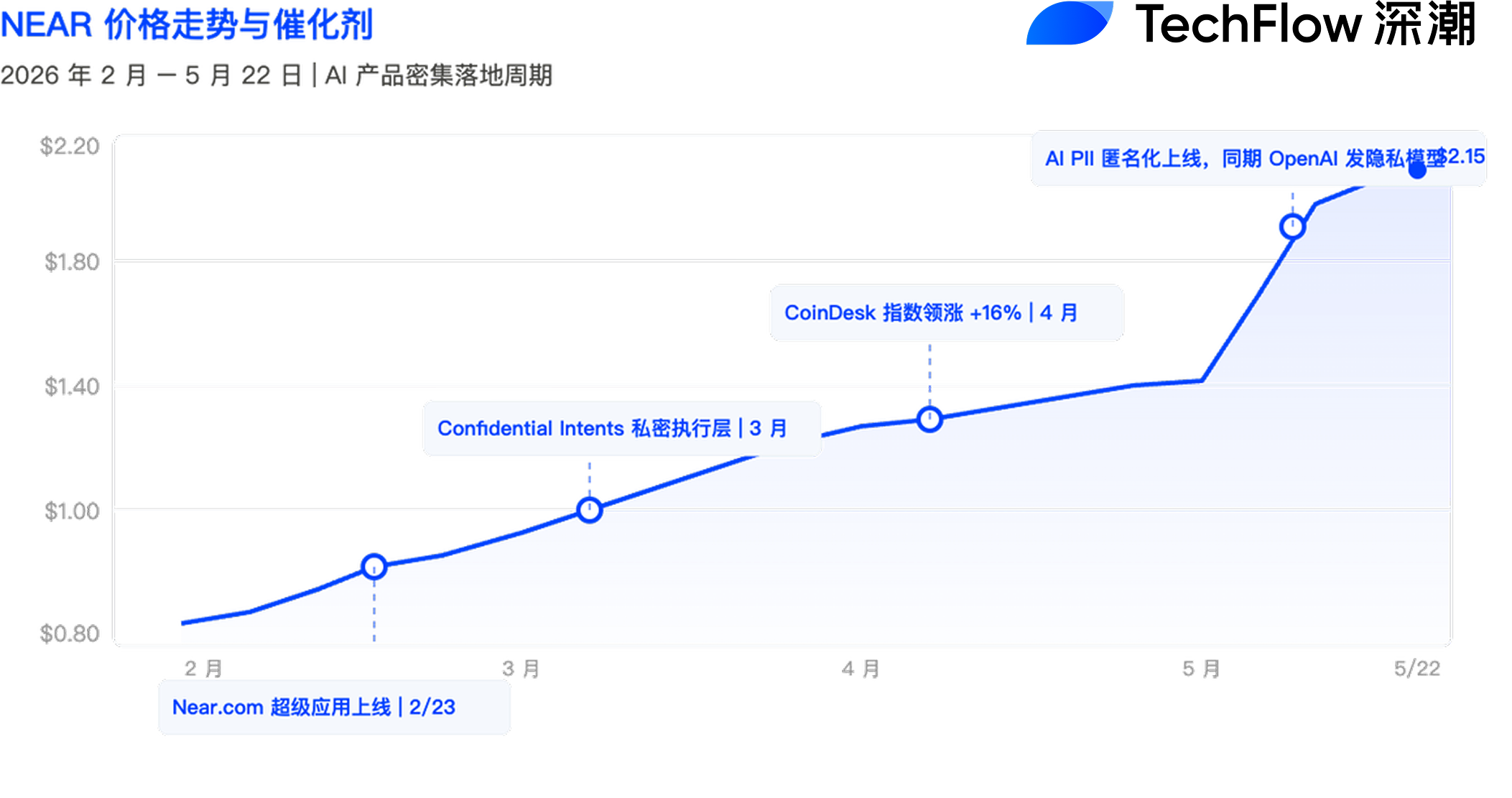
On May 19, NEAR AI launched a framework-level privacy feature:
When users send prompts to external models like ChatGPT or Claude, the system automatically strips out passwords, API keys, and personal information. Developers can enable it with just one line of header code.
This creates a narrative around AI privacy identity, which is relatively practical. The overseas tech scene highly values privacy and rights, so this feature taps into both AI excitement and privacy-centric sentiment.
The timing also synergizes with broader AI industry heat. OpenAI launched its own Privacy Filter model in late April, and Microsoft introduced PII Shield around the same time.
NEAR is essentially doing the same thing but on-chain, giving capital a reason to speculate.
Looking further back, the super app Near.com, launched in February, integrates wallets, cross-chain swaps, and confidential transactions. In March, they introduced the Confidential Intents private execution layer. These products all converge on a single narrative:
Enabling AI agents to trade and coordinate on-chain while protecting their privacy.
$GRASS: Has product-market fit, but faces supply headwinds
GRASS's situation is somewhat different.
On the product side, it's one of the few projects in the DePIN sector with real, paying customers. One such client includes an AI lab with a "seven-figure" contract, according to Blockworks. A portion of this revenue is used for GRASS buybacks.
On April 24, OKX listed trading pairs, improving liquidity access to some extent, leading to a 28% gain over 7 days.
In my view, the main drag on its price performance is supply-side unlock pressure. The Season 2 airdrop is currently distributing approximately 170 million GRASS tokens. Combined with team and investor unlocks, this short-term supply overhang has been suppressing the price. Community discussions also focus heavily on this point. Grass's business is running, but the token is currently more in a state of supply-demand game rather than a trending bullish market.
$WLD: Identity + AI Narrative
WLD is perhaps the most easily misunderstood asset in this group.
Many people simply classify WLD as a "Sam Altman shadow trade" and move on, but the foundation for its narrative has actually been changing in recent months:
As AI becomes more pervasive, proving you are human becomes more valuable. Several new variables around this logic have emerged intensively in recent months.
1. Eightco Holdings (ticker: ORBS), a Nasdaq-listed company, holds 283 million WLD, representing 8.3% of its circulating supply, making it the largest publicly disclosed institutional holder globally.
2. Eightco simultaneously holds an indirect stake of $90 million in OpenAI, with total assets of approximately $337 million. It has effectively positioned itself as a bundle exposure to "AI + Identity + Creator Economy."
3. On May 1, World officially entered the US market, planning to deploy 7,500 Orb scanning devices within 12 months, a multiple of its current global deployment.
The problem, however, also lies on the supply side. WLD has a total supply of 10 billion tokens, with roughly 3.4 billion currently in circulation. The team has been frequently depositing large amounts of tokens to Coinbase and Bybit. After July 24, the unlock rate is set to decrease by 43%, which could be a potential turning point. But until then, supply pressure remains significant.
3. Privacy Narrative: English Crypto Twitter Re-FOMOs on Privacy Coins, ZEC Doubles in 30 Days
ZEC needs little introduction here; you can refer to our previous article: "Doubled in 30 Days, Up 15x This Year: Why Is English Crypto Twitter FOMOing on $ZEC Again?"
Besides HYPE, ZEC is plastered all over English Crypto Twitter.
Naval Ravikant calls ZEC "insurance hedging against Bitcoin." Arthur Hayes at Consensus set a long-term target of "10% of BTC's price." Multicoin Capital publicly disclosed a heavy position, reversing its own 2019 assessment that "privacy isn't worth paying for." Behind this wave of calls, several hard catalysts are simultaneously materializing:
· The SEC confirmed it has closed its three-year investigation into the Zcash Foundation, recommending no enforcement action.
· Robinhood listed ZEC for trading across the US on April 23, opening a retail on-ramp. Grayscale's ZEC Trust is also applying to convert into a spot ETF (ticker ZCSH). If approved, it would be the first privacy coin ETF in the US.
AI and privacy are nearly omnipresent narratives on English Crypto Twitter, with ZEC as the clear leader.
4. Meme Narrative: USELESS Doesn't Need Fundamentals, But Needs Liquidity
USELESS has surged nearly 70% in 30 days, second only to ZEC.
Last summer, during the Solana launchpad wars (pump.fun, letsBONK, BelieveApp all fighting for traffic), USELESS emerged as one of the few survivors from letsBONK. The name itself is the hook: "I am completely useless, and I don't pretend to be useful."
This revival has nothing to do with fundamentals – meme coins never did. The key variable is the CEX on-ramp: Coinbase, Bybit, and Crypto.com have all listed the token, with a 24-hour trading volume of around $25 million, providing sufficient liquidity for short-term trading. When meme capital rotates on Solana, an old meme with a CEX listing, community memory, and a self-propagating name is easily pulled back into the spotlight.
However, the risks of meme coins need no elaboration. Their hype cycles are faster than any other asset class, acting as an amplifier for market sentiment.
The all-time high of $0.43 is still far from the current price. The token's vesting structure and past significant drawdowns warrant attention. Also, a word of caution: USELESS, being a common meme name, is prone to symbol mapping issues across different aggregators. Always verify the contract address before trading.
In summary, these seven coins correspond to four narratives, with vast differences in their source of heat and degree of confirmation.
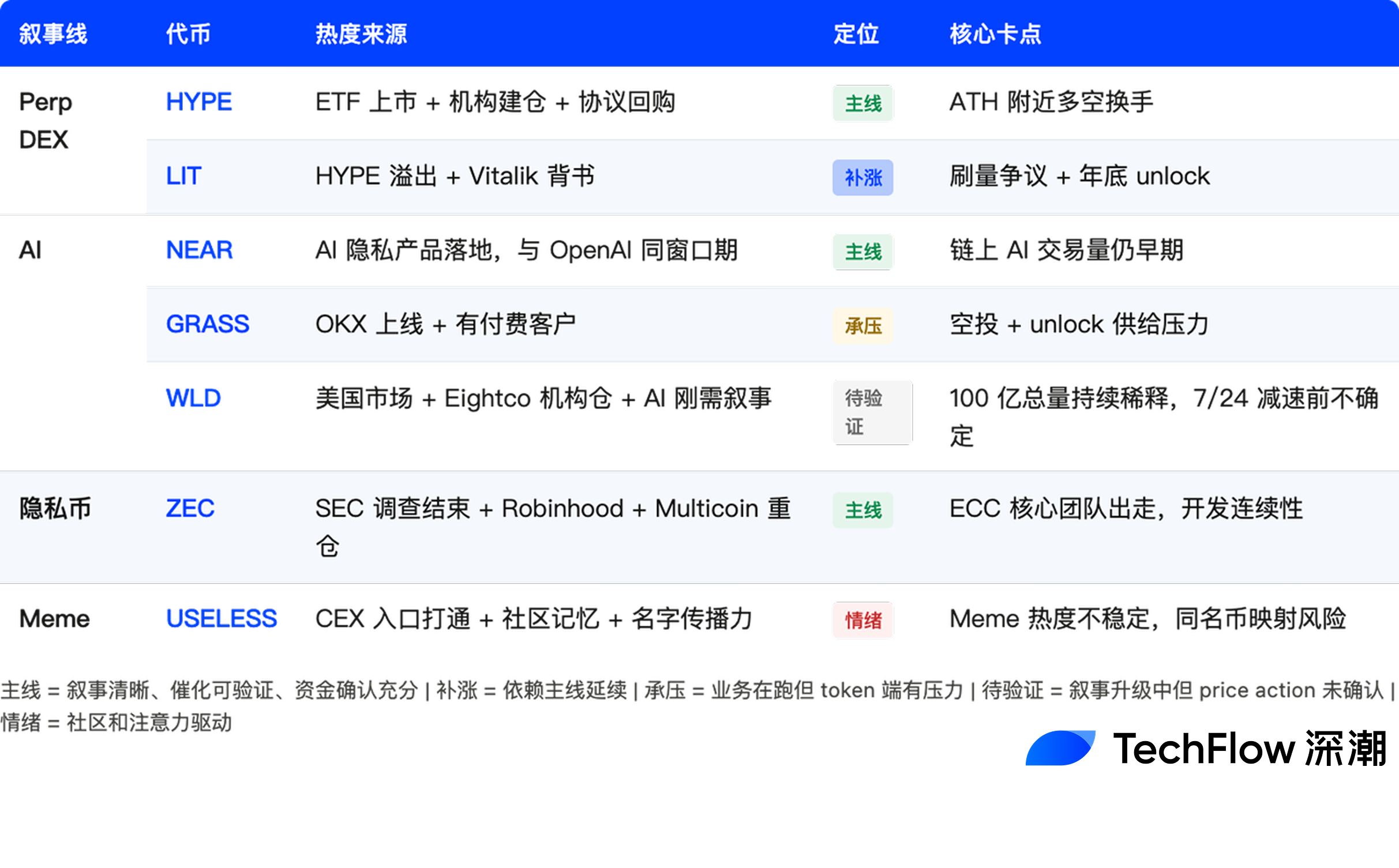
· HYPE, NEAR, and ZEC are the most confirmed assets within their respective narratives. Their catalysts are verifiable, and capital flows are traceable.
· LIT and GRASS are more dependent on the continuation of the main trend and the digestion of supply pressure. They offer higher elasticity but lower certainty.
· WLD's demand-side narrative is evolving, but the token supply pressure persists until July, still needing further direction. USELESS is pure attention and sentiment trading, unsuitable for a fundamental framework.
For spot investors, understanding the general contours of these narrative lines is essential. The crypto market currently has only a limited number of hotspots; prices may correct, but the main trends are unlikely to change in the short to medium term.
For derivatives traders, timing is even more critical. A deeper examination of shorter timeframes (e.g., 1-2 day) changes in Open Interest and funding rates is necessary.
Finally, the market still holds structural opportunities. Researching when an asset is out of favor remains a good way to seek returns.


