龙头倒下,加密ATM告别扩张时代


- Quan điểm cốt lõi: Ông lớn Bitcoin ATM là Bitcoin Depot đã nộp đơn xin phá sản do quản lý chặt chẽ, gian lận tràn lan và mô hình lợi nhuận sụp đổ, phơi bày những khiếm khuyết cố hữu của ngành như phí cao và chi phí tuân thủ cao, đang trở thành một kênh biên chỉ phục vụ các giao dịch tiền mặt nhỏ lẻ.
- Các yếu tố chính:
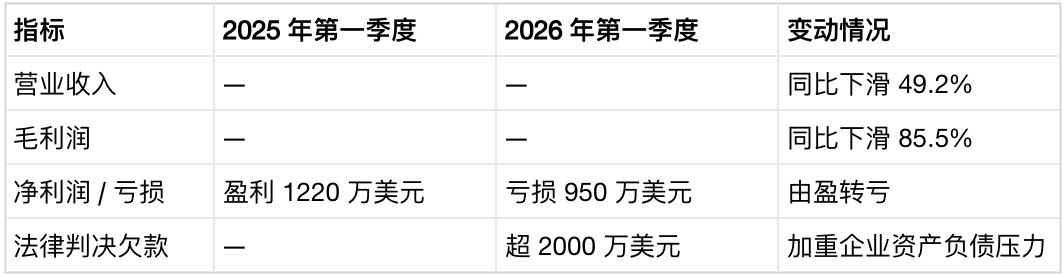
- Bitcoin Depot nộp đơn xin phá sản theo Chương 11, doanh thu quý 1 năm 2026 giảm 49,2% so với cùng kỳ, lỗ ròng 9,5 triệu đô la, trong khi cùng kỳ năm trước có lãi 12,2 triệu đô la.
- Cục Điều tra Liên bang Mỹ năm 2025 nhận được 13.000 khiếu nại liên quan đến ATM tiền điện tử, tổng thiệt hại 389 triệu đô la, tăng 58% so với cùng kỳ, trong đó thiệt hại của người cao tuổi chiếm 257,5 triệu đô la.
- Nhiều bang của Mỹ ban hành lệnh cấm hoặc phạt nặng, như Indiana cấm hoàn toàn, Tennessee coi là tội nhẹ cấp A, thúc đẩy đàn áp quản lý.
- Năm 2025, số lượng Bitcoin ATM toàn cầu tăng lên 39.000 máy, nhưng Mỹ chỉ tăng 1,65% gần như đình trệ; tốc độ tăng trưởng của Úc đạt 43%, thái độ quản lý thoáng hơn.
- Mạng lưới Thực thi Tội phạm Tài chính Mỹ quy định phí ATM từ 7% đến 20%, cao hơn nhiều so với các sàn giao dịch trực tuyến, và chi phí tuân thủ như KYC đã xóa sạch hoàn toàn lợi thế về lợi nhuận.
Original author: Gino Matos
Original translation compiled by: Saoirse, Foresight News
On May 18, 2026, Bitcoin Depot, a leading Bitcoin ATM operator, filed for Chapter 11 bankruptcy protection in the U.S. District Court for the Southern District of Texas, announcing a full shutdown of operations and disposal of its assets. Its global network of over 9,000 machines, as of August 2025, ceased operations on the same day.
Financial data disclosed by the U.S. Securities and Exchange Commission on May 12 showed the company's Q1 2026 revenue plummeted 49.2% year-over-year, with gross profit plunging 85.5%. Management stated there was significant uncertainty regarding the company's ability to continue as a going concern. The company posted a net profit of $12.2 million in the same period last year, but suffered a direct loss of $9.5 million in Q1 this year.
Bitcoin Depot attributed the operational deterioration to restrictive policies enacted by various state and local governments, reduced platform transaction limits, tightened user KYC standards, numerous legal lawsuits, and cumulative legal judgment payouts exceeding $20 million.
This series of operational failures ultimately forced the company into bankruptcy, vividly illustrating how increasingly stringent compliance regulations have completely dismantled the original profit logic of Bitcoin ATMs.

The Original Positioning of Bitcoin ATMs
Bitcoin ATMs allow users to exchange cash for cryptocurrency without needing a bank account, catering to those who prefer cash transactions, lack access to formal banking services, or wish to conduct cryptocurrency trades offline rather than through online exchanges.
However, this business model had structural flaws from its inception. The U.S. Financial Crimes Enforcement Network (FinCEN) stipulates that cryptocurrency ATM transaction fees range from 7% to 20%, far higher than the fee structures of mainstream online cryptocurrency exchanges.
Such high fees only support niche needs like emergency transactions or one-time small cash conversions, fundamentally preventing large-scale adoption. These offline machines were always a high-cost entry point for cryptocurrency, making it inherently impossible to achieve profitability through low-cost, high-frequency user transactions.
According to the U.S. Federal Trade Commission, in the first half of 2024, reported losses from Bitcoin ATM-related scams nationwide exceeded $65 million, with an average loss of $10,000 per scam incident. FBI statistics for 2025 showed 13,460 complaints related to offline crypto machines, with total losses reaching $389 million, a 58% increase year-over-year.
Of this, total losses for victims aged 60 and older amounted to approximately $257.5 million. The large elderly victim base has provided strong public and policy support for regulatory crackdowns, far exceeding standard anti-money laundering enforcement actions.
Several U.S. states have already enacted strict control measures: Indiana has banned all virtual currency kiosk operations entirely; Tennessee has classified installing or operating such machines as a Class A misdemeanor; Minnesota has also passed a relevant ban, set to take effect in 2026.
Strict user identity verification has drastically reduced machine transaction volume. Fraud risk warnings and lower transaction limits further squeezed per-machine revenue, exacerbating the company's existing $20 million legal debt burden—a core reason for Bitcoin Depot's bankruptcy.
The very compliance measures intended to regulate the industry and reduce transaction risks ultimately erased the remaining profit advantage of the high-fee model.
Aggregate data from industry research firm shows that the global number of Bitcoin ATMs increased from 37,722 to 39,158 in 2025, an average daily addition of about 4 machines.
By the end of 2025, the number of crypto ATMs in the U.S. reached 30,617, accounting for 78% of the global total. However, compared to 30,119 machines at the beginning of the year, the annual growth rate was only 1.65%, indicating a nearly stagnant market.
In contrast, other overseas markets showed distinctly different trends: Australia added 601 new crypto ATMs throughout the year, a growth rate of 43%; Canada's market grew by 8.4%; Europe's market grew by 6.5%. The core reason these regions continue to deploy crypto ATMs is that local regulators view them as convenient tools for enhancing financial inclusion, without adopting a harshly repressive stance.
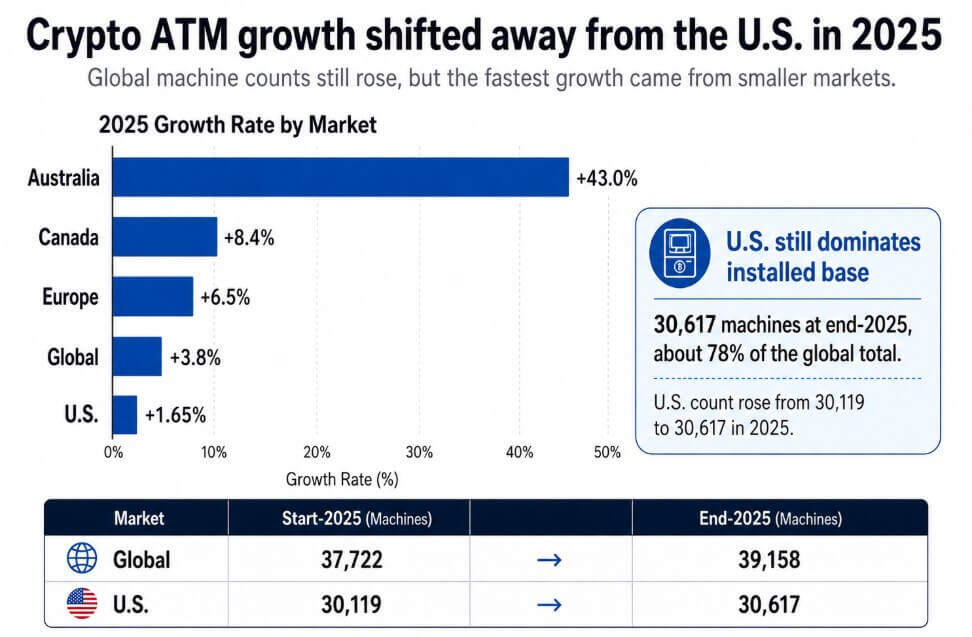
In 2025, the number of global cryptocurrency ATMs grew by 3.8% to 39,158, with Australia surging 43% while the U.S. grew only 1.65%.
Two Future Development Paths for the Crypto ATM Industry
Optimistic Development Path
A capital firm acquires Bitcoin Depot's high-quality assets, gradually restarting offline machine operations in U.S. states without bans, allowing the global crypto ATM market to continue its steady expansion.
New operators proactively absorb the high costs of compliance, transforming offline machines into regulated, legitimate cash exchange channels. Although transaction volumes shrink and profit margins are significantly compressed, stable operations remain possible.
Industry-wide profits continue to decline, but crypto ATMs persist in the market, serving niche users who cannot or prefer not to use online crypto exchanges, becoming a compliant cash-to-crypto channel within a specific segment.
Bitcoin Depot has also stated its plan to orderly dispose of all its assets, suggesting its large inventory of offline machines could potentially re-enter the market under new ownership.
Under this model, crypto ATMs will function like brick-and-mortar currency exchange shops, characterized by high fees and low transaction volumes, surviving on a fixed niche demand. This path is only suitable for operators accepting a thin-profit business model.
Pessimistic Decline Path
If the strict regulatory bans in Indiana, Tennessee, and Minnesota become the dominant trend across the U.S. market, rather than isolated regional cases, the U.S. crypto ATM market will likely contract significantly.
The nearly 80% global market share held by the 30,617 crypto ATMs in the U.S. means widespread state-level bans would directly eliminate a vast number of machines. Bitcoin Depot's nearly 9,000 offline machine locations, representing 23% of the global market share by end-2025, would severely impact global installation totals if permanently shut down, even before new state regulations take effect.
Even without explicit operational bans, strict KYC rules, transaction limits, liability for transaction fraud, and endless legal disputes will strip high-fee crypto ATMs of any remaining profitability, leading to a gradual, voluntary market exit of the machines.

A Cash Transaction Channel Struggling to Scale
Today, channels for cryptocurrency adoption extend far beyond offline kiosks. According to blockchain data analytics firms, fiat currency inflows into mainstream online crypto exchanges alone exceeded $1.2 trillion between July 2024 and June 2025.
Cryptocurrency spot ETFs, mobile digital wallets, stablecoins, and various institutional compliant trading channels have become the core drivers of crypto adoption. In the 2025 crypto adoption index, countries like India, the U.S., Pakistan, Vietnam, and Brazil ranked high, all primarily leveraging online exchanges, mobile trading, and institutional compliance channels.
Initially, Bitcoin ATMs provided an offline trading channel for cash users, bringing cryptocurrency into physical consumer scenarios and filling a market gap for offline crypto transactions.
However, the vast fee disparity between offline machines and online exchanges destined them to never enter the mainstream market. Meanwhile, the lucrative offline transaction scenarios spawned scams involving hundreds of millions of dollars.
Looking ahead, only compliant crypto ATMs in regions with lenient regulatory policies are likely to survive, serving niche populations with a genuine need for offline cash transactions.
Looking back at the industry's development, it's clear that crypto ATMs were always a high-cost entry point for crypto. While they demonstrated the possibility of offline crypto transactions, they consistently failed to achieve low cost, high security, and high convenience, ultimately missing the opportunity to become mainstream transactional infrastructure.