Circle phát hành sách trắng về Arc Network: Liệu cơ chế kinh tế mới có thể thúc đẩy nó trở thành "lớp thanh toán trung gian" cho thanh toán stablecoin ở cấp độ tổ chức?


- Quan điểm cốt lõi: Layer1 blockchain Arc do Circle ra mắt, nhằm trở thành cơ sở hạ tầng thanh toán stablecoin cấp doanh nghiệp. Thông qua các thiết kế như sử dụng USDC làm native Gas, cơ chế đồng thuận hiệu suất cao và quyền riêng tư tùy chọn, nó thúc đẩy stablecoin chuyển đổi từ phương tiện trao đổi sang trung tâm tài chính on-chain. Vai trò của token gốc ARC như một tài sản điều phối vẫn đang trong giai đoạn thảo luận, và mạng lưới đang đối mặt với các thách thức về tập trung hóa và tuân thủ.
- Các yếu tố chính:
- Arc sử dụng USDC làm native Gas token, điều chỉnh phí một cách linh hoạt thông qua phương pháp đường trung bình động lũy thừa (EWMA), loại bỏ tác động của biến động giá đối với dự đoán thanh toán, và hỗ trợ trao đổi tự động nhiều loại tiền tệ.
- Sử dụng cơ chế đồng thuận Malachite (dựa trên Tendermint BFT), giao dịch được xác nhận ngay lập tức sau khi có 2/3 số người xác thực xác nhận, không thể đảo ngược. Người xác thực là các tổ chức có uy tín để đáp ứng yêu cầu tuân thủ.
- Giới thiệu token ARC làm tài sản điều phối gốc, trong tương lai có thể được sử dụng cho bỏ phiếu quản trị, thanh toán phần thưởng và đốt, nhưng trong giai đoạn đầu, Circle và các tổ chức được chỉ định vẫn chịu trách nhiệm về các quyết định quan trọng như bảo mật và tuân thủ.
- Arc cung cấp khả năng bảo mật tùy chọn, có kế hoạch tích hợp tính toán đa bên an toàn và mã hóa đồng cấu để bảo vệ thông tin kinh doanh của doanh nghiệp, đồng thời hỗ trợ các tính năng như sổ lệnh riêng tư.
- Việc mở rộng các trường hợp thanh toán stablecoin đã chuyển trọng tâm cạnh tranh cơ sở hạ tầng Web3 sang thanh khoản, tuân thủ và khả năng mở rộng hệ sinh thái, thay vì chỉ hiệu suất và phí.
Original Author: ShirleyLi, Researcher at Web3Caff Research
How to easily grasp the market hotspots, technological trends, ecosystem developments, and governance dynamics currently unfolding in the Web3 industry? The "Market Pulse Analysis" column by Web3Caff Research delves into the frontline to explore and select current hot events, providing value interpretation, commentary, and principle analysis. See the essence through the phenomenon and follow us now to quickly capture the pulse of the Web3 frontline market.
Compliance Note: Stablecoins are virtual currencies (Tokens), and you should be aware that issuing or investing in Tokens is subject to varying degrees of stringent regulatory requirements and restrictions in different countries and regions. Specifically, issuing Tokens in Mainland China constitutes "illegal issuance of securities", and providing cryptocurrency trading-related services such as Token transaction matching is also considered "illegal financial activity". (Readers in Mainland China are strongly advised to read "Compilation and Key Points of Laws and Regulations Related to Blockchain and Virtual Currencies in Mainland China"). The following content is solely an objective analysis of Arc Network's progress and market feasibility strategies, intended to explore and analyze how application scenarios based on blockchain technology are developing responsibly within the global regulatory environment. Therefore, please do not use this information for any decision-making, and strictly comply with the laws and regulations of your country or region, refraining from any illegal financial activities.
Stablecoins have always been a crucial component of the on-chain financial economic system. Recently, with the rapid development of scenarios like RWA and cross-border payments, their role is evolving from a simple on-chain medium of exchange into a significant value carrier connecting traditional finance with the on-chain economy in some countries and regions globally. Consequently, stablecoin payments are becoming a new form of financial infrastructure.
Last May, Circle announced the launch of Arc, a Layer 1 public chain specifically designed for payment stablecoins and their underlying ecosystem, aiming to provide enterprises with a high-performance, predictable, and compliant enterprise-grade stablecoin gateway. The emergence of Arc also promises to transform Circle's native stablecoin, USDC, from a single-function payment token into a utility token for the public chain. Previously, Circle released the Arc Litepaper, outlining the blockchain's operational logic at the product level, which Web3Caff Research also analyzed in detail:
As an L1 public chain, Arc introduces the following innovations primarily for enterprise users:
- USDC as Native Gas Token: Arc first introduces USDC as the native Gas Token for the public chain, eliminating the impact of token price volatility and making cost prediction directly linked to the base fee per unit of Gas. To further reduce volatility, Arc dynamically adjusts the current base fee using an Exponentially Weighted Moving Average (EWMA) of historical block utilization, preventing sudden sharp increases in fees due to network congestion. Additionally, when users pay with other stablecoins, Arc utilizes Circle Paymaster to automatically pay the interaction fee with its native stablecoin and deducts the equivalent value in other stablecoins from the user's account. This offers flexibility for multinational corporations and users in non-USD regions, potentially making Arc a global, multi-currency financial settlement public chain.
- High-Performance Consensus Design: In an on-chain context, because transaction finality requires time, enterprises cannot immediately initiate order processing, as subsequent automatic processing in financial/business systems might need reversal, incurring additional handling costs – unacceptable in real business operations. To address this, Arc employs the Malachite consensus mechanism (a Tendermint Byzantine Fault Tolerance mechanism). Under this mechanism, once a payment is confirmed and submitted by two-thirds of the validators, it is instantly finalized and irreversible. Furthermore, Arc validators are not anonymous staking nodes but a selected group of reputable institutions capable of meeting compliance requirements across different global regulatory systems. In the future, Arc will also introduce Multi-proposer, allowing multiple validators to generate block proposals in parallel within the same time window, aggregated into a single block during the consensus phase, further enhancing payment system throughput and reducing latency in financial processing.
- Enterprise-Grade Privacy: To protect core business confidential information, Arc offers optional privacy capabilities for enterprises, implemented in stages. As secure technologies like multi-party computation and homomorphic encryption mature, Arc will introduce more complex on-chain privacy settings, such as private order books and private financial strategies, operating automatically via confidential on-chain contracts.
For a deeper understanding of Arc blockchain's operational logic, we recommend reading: "Market Pulse Analysis: Circle Ventures into the Public Chain Arena – Can its L1 Network Arc Become the First Compliant Chain for Payment Stablecoins?".
Fast forward to May this year, six months after the Arc testnet launch, Circle released the Arc blockchain Whitepaper. It elaborates on the design logic of the ARC Token as Arc network's native coordination asset and hints that the Arc mainnet is expected to go live this summer.
As mentioned earlier, Arc currently uses a PoA (Proof of Authority) mechanism, where a selected set of reputable institutional nodes handle network validation and block production. However, this model carries centralization risks, making it more suitable for early project stages. As network adoption grows, Arc will likely transition to a PoS mechanism, but USDC, being a stablecoin, is unsuitable for staking. Hence, Circle is considering introducing a new token system – the ARC Token – as Arc's native coordination asset, responsible for aligning the interests and behaviors of various network participants (validators, developers, users, institutions, etc.).
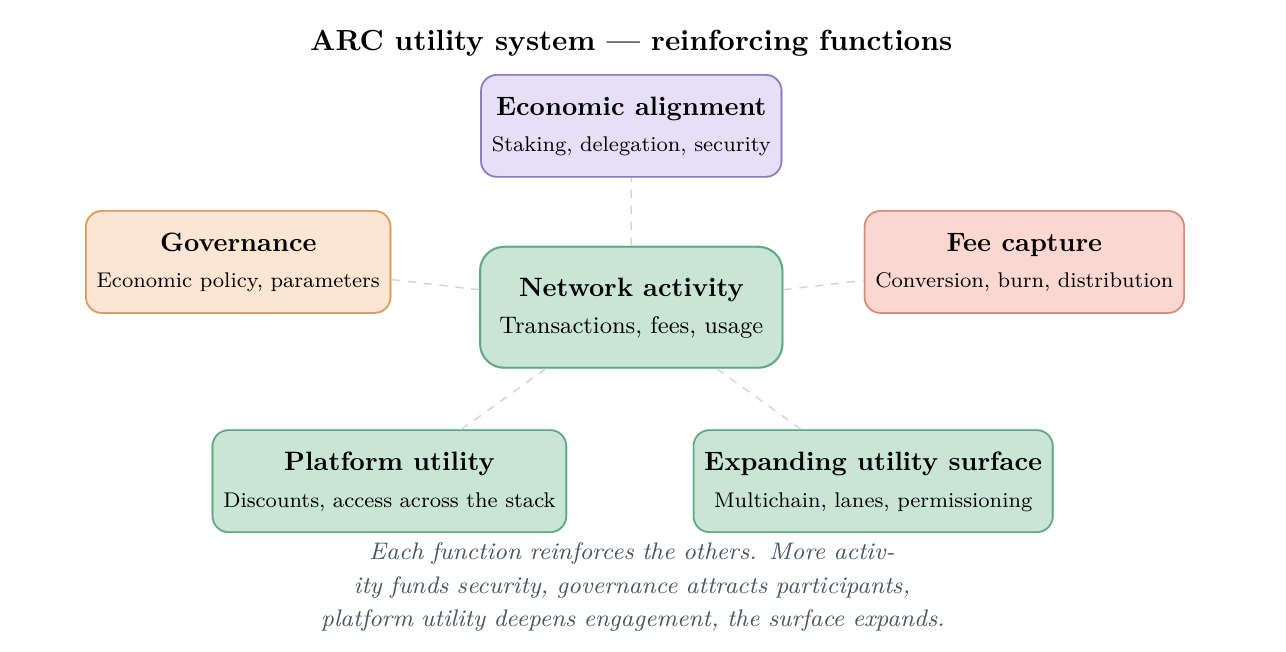
According to the whitepaper, ARC holders can participate in network governance voting based on their staked weight, deciding on network fee rates, inflation rates, and burn logic. They may also gain future权益s regarding protocol access and interaction. However, the whitepaper clarifies that Arc's governance model won't be entirely DAO-based but will retain institutional coordination mechanisms. In the network's early stages, highly sensitive matters like security responses, compliance, validator onboarding, and protocol upgrades will primarily be handled by Circle and designated institutions.
Meanwhile, transaction fees paid by users using stablecoins on the Arc network will be automatically converted to ARC Tokens. A portion will be distributed as rewards to validators and stakers, while another part will be burned. Compared to traditional public chains requiring users to hold native Gas Tokens directly, this design may better align with the usage habits of institutions and enterprises.
For the Arc network, the application scope of the ARC Token could further expand in the future. For instance, it could be used to build dedicated transaction channels; coordinate and manage asset flow and data interoperability between different blockchains; and support Circle Paymaster's multi-asset Gas scenarios, enabling users to pay network fees with various stablecoins.
Source: ARC: The Native Asset of the Economic OS
However, it's important to note that the ARC Token system is currently under discussion and design phase and may undergo significant changes. Circle has repeatedly emphasized that ARC itself is neither a security nor an investment product and does not represent any equity or income rights.
On a specialized blockchain like Arc Network, focused on stablecoin payments, large-scale economic activity typically originates from banks, payment institutions, corporate users, and capital markets. As laws and regulations concerning stablecoins, on-chain assets, and on-chain financial activities are established and refined globally, the path for these institutions to participate in building on-chain infrastructure is becoming clearer. This trend is also changing the competitive logic of Web3 infrastructure. The race based solely on network performance and transaction fees is becoming a thing of the past; liquidity, compliance, stability, sustainability, and ecosystem scalability are becoming the new competitive battlegrounds.
Of course, this shift won't happen overnight, and Arc's future development faces several potential challenges.
For example, Arc's overall architecture still carries a relatively strong centralized aspect. While Circle attempts to establish a longer-term economic coordination and governance mechanism through the ARC Token and gradually steer the network towards PoS, this system is still under discussion and not yet implemented. Its specific governance structure and economic model remain highly uncertain. Furthermore, the ARC Token mechanism itself introduces additional governance and security risks for the Arc network. For instance, can the economic model's design match actual network demand? Could large node concentration in staking lead to governance power centralization again? These questions await further official discussion and optimization.
Additionally, although stablecoin regulatory frameworks are gradually improving, significant differences exist across countries and regions. This means Arc Network must continuously adapt to evolving compliance requirements in the future.
Currently, established public chains like Ethereum, Base, and Solana are aggressively expanding towards on-chain financial infrastructure, stablecoin payments, and institutional-grade applications. This is a significant signal that leading Web3 institutions, including Circle, are seeking change. However, it remains to be seen which will ultimately build the next-generation global on-chain financial infrastructure.
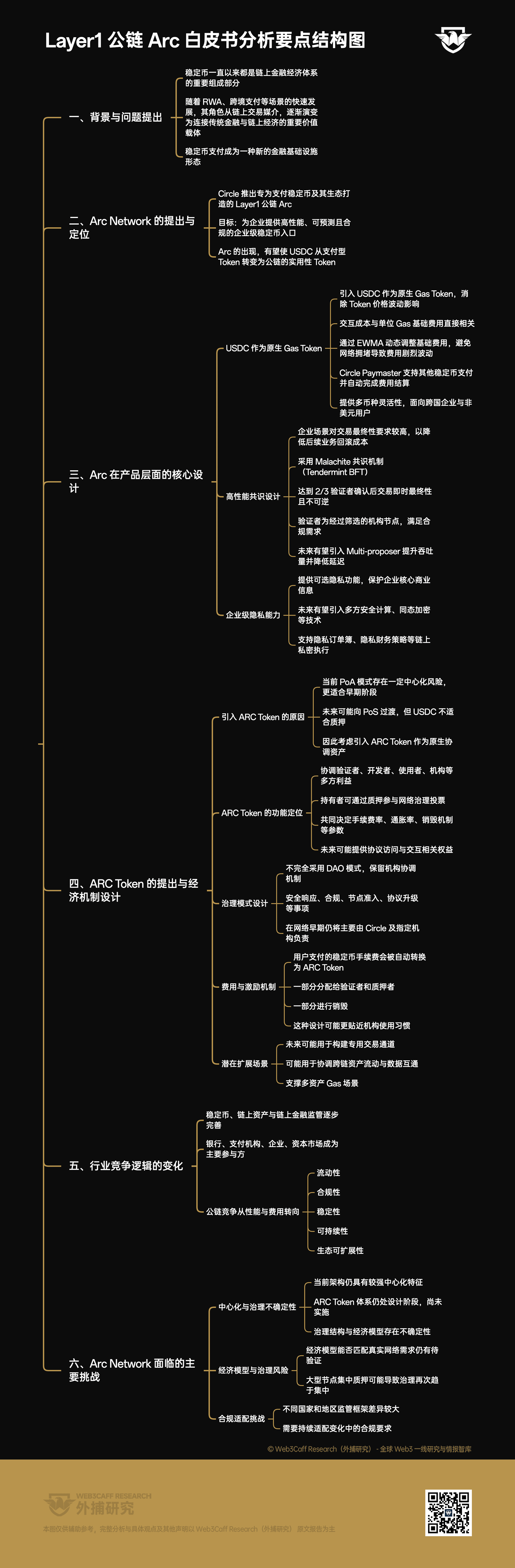
Key Points Structure Diagram:
References:
[1] Introducing the ARC Whitepaper: Exploring Arc’s Native Coordination Asset
Disclaimer: This report is prepared by Web3Caff Research. The information contained herein is for informational purposes only and does not constitute any prediction, investment advice, proposal, or solicitation. Investors should not rely on such information to buy or sell any securities, cryptocurrencies, or adopt any investment strategy. The terminology and expressions of views used in this report are intended to help understand industry trends and promote the responsible development of Web3, including the blockchain industry, and should not be construed as definitive legal opinions or the views of Web3Caff Research. The views expressed in this report reflect the personal opinions of the author as of the date stated and are independent of the position of Web3Caff Research, and may change with subsequent circumstances. The information and opinions contained in this report are derived from proprietary and non-proprietary sources deemed reliable by Web3Caff Research but do not necessarily encompass all data, and their accuracy is not guaranteed. Therefore, Web3Caff Research makes no warranty, express or implied, regarding its accuracy or reliability and assumes no liability for errors or omissions arising in any other way (including liability to any person due to negligence). This report may contain "forward-looking" information, which may include predictions and forecasts, and this document does not constitute a guarantee of any forecast. Whether to rely on the information contained in this report is entirely at the reader's own discretion. This report is for informational purposes only and does not constitute investment advice, proposal, or solicitation to buy or sell any securities, cryptocurrencies, or adopt any investment strategy. Please strictly comply with the relevant laws and regulations of your country or region.