






Phỏng vấn Michael Saylor: Tôi đã nói sẽ bán bitcoin, nhưng tuyệt đối không phải là bán ròng


- Quan điểm cốt lõi: Michael Saylor, Chủ tịch điều hành của Strategy, làm rõ rằng việc công ty "chuẩn bị bán bitcoin để trả cổ tức" không phải là thay đổi niềm tin, mà là có kế hoạch bán một lượng nhỏ bitcoin đã tăng giá để trả cổ tức STRC, đồng thời tận dụng đặc tính tăng giá cao của "vốn kỹ thuật số" bitcoin để kinh doanh chênh lệch giá, đảm bảo công ty luôn là người mua ròng bitcoin.
- Các yếu tố chính:
- Bản chất chiến lược: Bán bitcoin để trả cổ tức chỉ là một hình thức "hiện thực hóa lợi nhuận vốn", công ty khi bán 1 bitcoin sẽ đồng thời mua vào 10-20 bitcoin, duy trì vị thế là người mua ròng.
- Dữ liệu hỗ trợ: STRC huy động được 3,2 tỷ USD để mua bitcoin, trong khi cổ tức tương ứng chỉ 80-90 triệu USD, tỷ lệ hòa vốn của công ty là 2,3%, nghĩa là nếu bitcoin tăng giá hàng năm vượt quá tỷ lệ này thì có thể trả cổ tức vĩnh viễn.
- Sự đổi mới công cụ tín dụng: STRC hoạt động như một công cụ "tín dụng kỹ thuật số", với tỷ lệ Sharpe lên tới 3,0, vượt xa Nvidia (1,7) và S&P 500 (0,9), cung cấp tỷ lệ cổ tức cao 11%-12%.
- Độ sâu thị trường: Saylor nhấn mạnh thanh khoản thị trường bitcoin vô cùng dồi dào; công ty từng mua 200-300 triệu USD bitcoin trong một giờ mà không ảnh hưởng đến giá thị trường.
- Xu hướng vĩ mô: Bitcoin chịu tác động từ các yếu tố vĩ mô như chiến tranh thương mại, chính sách tiền tệ, nhưng nguồn cung mới hàng năm từ thợ đào chỉ khoảng 10-12 tỷ USD, trong khi dòng vốn đổ vào (như ETF và công cụ tín dụng) liên tục thúc đẩy sự tăng trưởng của nó.
Source: David Lin
Compiled by Odaily (@OdailyChina); Translator: Azuma (@azuma_eth)
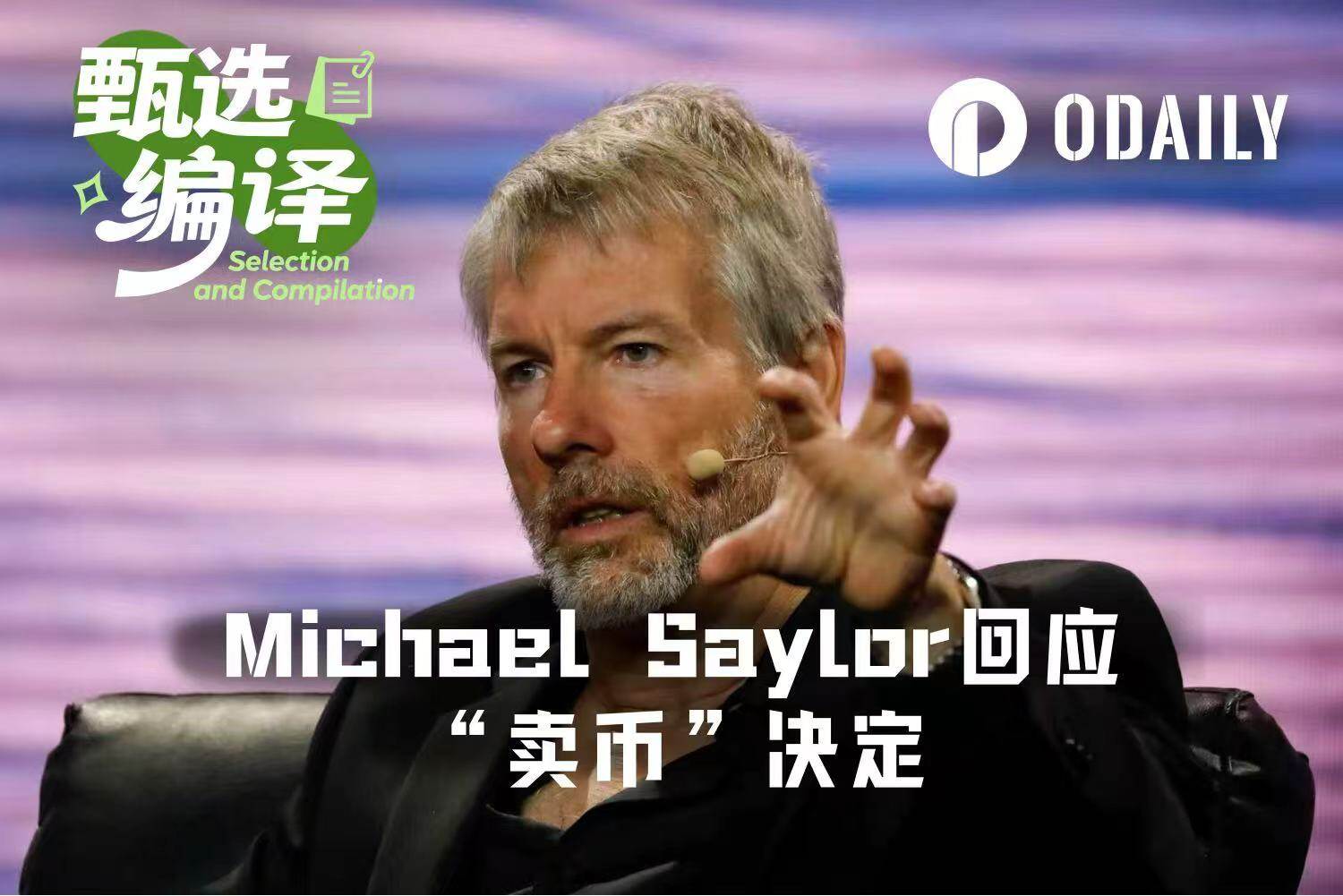
Editor's Note: During last Monday's earnings call, Strategy mentioned for the first time that it was "prepared to sell Bitcoin if necessary to pay dividends," a statement that quickly sparked heated market debate about an alleged "betrayal of its principles."
In response, Strategy Executive Chairman Michael Saylor recently provided an in-depth explanation of the underlying logic behind this decision during an appearance on David Lin's podcast. He emphasized that he merely stated the company "would sell," not that it would be a "net seller." Saylor also noted that Strategy is leveraging Bitcoin's extremely high appreciation potential as "digital capital" by issuing digital credit instruments (such as STRC) to arbitrage, thereby ensuring continuous net growth of its holdings. The following is the full transcript of the podcast (with edits), compiled by Odaily.
Podcast Interview
David Lin (Host A): I am truly honored to co-host this exciting interview with Michael Saylor, Executive Chairman of Strategy, alongside Bonnie Chang. We'll start with Strategy's recent announcements and Michael Saylor's social media posts. Bonnie, let's begin.
Bonnie Chang (Host B): Last week, you made an announcement that shocked everyone.
Michael Saylor: Uh, I assume you're referring to our statement during the earnings call — that we are prepared to sell Bitcoin to pay STRC dividends if necessary.
Bonnie Chang: I believe that was a carefully considered decision. What was the thinking behind it?
Michael Saylor: The most important point is that we want the market to understand that Bitcoin's capital gains can be used to fund credit dividends. When we sell $1 million worth of STRC credit products, we turn around and buy $1 million worth of Bitcoin. Our expectation for Bitcoin is an annual appreciation of around 30%, and in reality, it's been appreciating closer to 40% annually. We can strip out the initial 11% of that capital gain and use it to pay dividends.
The market has been confused about what we would use to pay dividends. For most of our history, we paid them by selling common stock (MSTR equity). MSTR equity is a derivative of Bitcoin, typically trading at a premium to Bitcoin. So we were selling Bitcoin derivatives, but some were worried we wouldn't be able to sell equity in the future.
Then came bearish narratives saying we *had* to sell equity, and others saying the company would never sell its Bitcoin. This morphed into, "Well, if they aren't going to sell Bitcoin, then Bitcoin must have no value, and they can never sell it. If they can't sell it, we can't count it as a balance sheet asset."
It's not good when you own something worth $65 billion and people want to value it at zero, right? We don't want credit rating agencies to think the company has zero assets. We want them to think we have $65 billion in assets. Additionally, there are constant complaints from "haters" online calling it a Ponzi scheme because we fund preferred stock dividends by selling equity.
What we want to do is strengthen this business model: sell credit to invest in Bitcoin; over time, the investment appreciates faster than the dividends accrue; then we realize the capital gains and pay the dividends.
We believe the best way to clarify this is to state clearly that "the company never needs to sell common stock," we can simply sell the significantly appreciated Bitcoin to pay dividends. This is essentially using capital gains to pay credit dividends.
I think of it like a real estate development company. They raise funds through credit instruments, buy land at $10,000 an acre, develop it until it's worth $100,000 an acre, and then realize that capital appreciation. You can sell the land at $100,000 an acre, lease it after full development, or refinance it. Nobody questions a real estate development company making capital investments with credit income. We're doing the same thing with Bitcoin, and we want to ensure the market understands this.
I am famous for saying, "Never sell your Bitcoin," which is why the internet exploded when it heard we were selling. But if I were more precise, I should say, "Never be a net seller of Bitcoin." It's just that "never be a net seller" doesn't sound as catchy or roll off the tongue as easily.
I think during these periods, even if we sell 1 Bitcoin, we'll buy 10 or 20 more. So, you're really talking about a situation of "buy 10, sell 1, net buy 9." Once people understand this, it shouldn't be a problem anymore, but for now, it's still a controversial topic.
Bonnie Chang: Can you explain how it's possible to sell 1 Bitcoin while buying 10?
Michael Saylor: Sure. Strategy's primary Bitcoin acquisition engine is STRC. We sold $3.2 billion worth of STRC in April, so we bought $3.2 billion worth of Bitcoin. The dividend was around $80 to $90 million. So, in a month where we raised $3 billion, we only need to pay out $80 or $90 million in dividends. Essentially, you're buying 30 Bitcoins while selling 1.
Our "break-even rate" is roughly 2.3%. This means if the credit debt we issue equals 2.3% of our Bitcoin holdings, even selling Bitcoin to pay dividends, we will always be a net buyer of Bitcoin. Another point is, if Bitcoin appreciates by 2.3% annually, we can permanently pay dividends and continuously create value without selling any common stock.
In the first four months of this year, we've sold about $5 billion worth of STRC. At this rate, the issuance rate for the year will be 15% to 20%. As long as the company is growing, it will buy more Bitcoin than it sells. I anticipate that in every month and every quarter in the future, we will be a net buyer of Bitcoin.
Bonnie Chang: One more question. Many investors follow the almost religious advice of "never sell your Bitcoin." Do you think they should still follow this advice?
Michael Saylor: Yes, I think you should be a "net accumulator" of Bitcoin. When I say "never sell your Bitcoin," I mean, if you are going to spend it to buy something, make sure you also replenish it as you spend it.
There are many crypto or Bitcoin believers who say they want to buy things with Bitcoin. I'd tell them to replenish the amount they spend. Don't be a net seller of Bitcoin, because Bitcoin is capital. At the end of every year, you should have more Bitcoin than you started with.
For example, if Google spends $1 billion building a data center and earns $10 billion from it, they've netted $9 billion. This doesn't cause the dollar market to crash, right? Nobody exclaims, "Google sold dollars to buy a data center!" The dollar is fine, and it doesn't shake Google's business model. They spent $1 billion to invest in a business, which is normal and rational. Sometimes you spend money to make more money.
So, if you spend 1 Bitcoin to earn 10 Bitcoins, I think it's good for Bitcoin and good for the company... When the equity capital market is less liquid than the Bitcoin market, we want to be able to utilize the Bitcoin market.
Whenever a company deprives itself of options, saying "we will absolutely never do X," whatever it is, the final outcome is usually regret. For example, if we said we would "never, ever buy back our own stock, only sell it," then shorts would hammer our stock all the way down to $1. If the stock trades at a huge discount to Net Asset Value (NAV) and we *can* buy it back, those shorts will lose a lot. By exploiting their irrationality, we can make a lot of money.
So, what we really expressed on the earnings call is: We will exchange STRC for MSTR, exchange BTC for MSTR, use BTC or MSTR to pay dividends, and do whatever is in the company's best interest. But over time, we expect to be a net accumulator of Bitcoin. This doesn't change how we trade assets daily. Whether we sell credit debt, sell equity, or sell Bitcoin capital gains will depend on market conditions and pricing errors.
Another thing we mentioned yesterday is that we are ready to buy back our bonds. Currently, our corporate bonds are trading cheaply and are undervalued, so buying them back makes sense, while selling them doesn't. We won't sell undervalued assets; we will buy undervalued assets and arbitrage any opaque inefficiencies. If the market knows we will do this, it will give all these assets a fair valuation. This benefits investors in all these instruments, and ultimately, it's our fiduciary duty.
David Lin: One of your biggest critics, Peter Schiff, wrote this morning: "Yesterday, Saylor admitted MicroStrategy would sell Bitcoin if needed to pay STRC dividends. I think this promise is meant to keep the so-called Ponzi scheme going longer. But I suspect when that moment arrives, he'll choose to suspend the dividend and let STRC collapse, rather than let Bitcoin collapse." What is your response to that?
Michael Saylor: Peter thinks Bitcoin is a Ponzi scheme. Peter doesn't really like anything in this space. Bitcoin is "digital capital," and we are creating a digital financial company by selling equity and credit instruments to purchase this capital. I think Bitcoin will endure because it represents global economic wealth in tokenized form with complete property rights.
On top of that, we built a credit instrument, STRC, which simply strips out volatility, lowers risk, and extracts or "distills" yields from digital capital. If you don't recognize Bitcoin as legitimate, you'll never recognize any derivative built upon it as legitimate. But for those who believe Bitcoin can store economic wealth in tokenized form, what we are doing is very straightforward.
STRC uses an over-collateralized model: for every $5 of Bitcoin, we sell $1 of credit debt, and that $1 of credit debt has a clear yield. There are many people who believe Bitcoin is a legitimate asset but can't stand its volatility. They don't want to invest their child's tuition money for the fall into Bitcoin because they need to pay the bill in 12 weeks. For them, digital credit makes perfect sense because the principal is protected and more stable. Moreover, they can get 3 to 4 times the yield of the money market through STRC. This is precisely the trait of Bitcoin being superior to other capital assets, enabling us to pay this high dividend yield.
David Lin: Here's a theory I'd like your take on, and then I'll hand it back to Bonnie. Some traders have noticed that whenever STRC pays a dividend, the ex-dividend price trades below par for a period (maybe a day or two). Once it gets back to par, that's when Strategy goes to buy Bitcoin. So, they are starting to "front-run" this by buying Bitcoin before STRC reaches par, betting that you and Strategy will buy Bitcoin when it does. Can you comment on this?
Michael Saylor: What happens around the dividend date is there is massive demand for STRC because there's roughly 90 cents in dividends after the record date. So, there are billions, tens of billions in STRC trades before the record date. The day after the record date, it trades down 60 or 70 cents, and then gradually recovers to par over the next week or two.
So that's normal. Those people are arbitrageurs. Their idea is simply to deploy capital for about 12 days a year to capture roughly a 42% annualized yield. They have their own calculations. That's fine, and it's good for us because it creates liquidity and engagement. This situation will continue.
As for the second idea, can you "front-run" the Bitcoin market? The Bitcoin derivatives market trades $50 billion daily. So, I don't think anyone has enough capital to move that market.
My view is this: Bitcoin is somewhat like "tech capital squared." The factors driving the Bitcoin market are trade wars, hot wars, foreign policy, national situations, the situation in Iran and the Strait of Hormuz, and then currency wars — like whether we expect SOFR to drop to 200 basis points or if the yield curve is being distorted. You can see we are in a relatively tight monetary environment right now. So these macro factors are the main drivers of Bitcoin.
I can tell you a fact: We've bought $100 million worth of Bitcoin within an hour, and it didn't move the price. We've bought $200 million worth of Bitcoin within an hour, and it didn't move the price. We've bought $200 or $300 million in an hour and stopped, and the price went up instead.
So, no one has enough power to push the price performance of Bitcoin... Well, maybe if you planned to dump $30 billion into the market in an afternoon. But I've spent a lot of money. We've bought more Bitcoin than anyone I know. We've probably purchased around $62 billion worth of Bitcoin. I believe this is a global market with its own momentum.
So, claims that we can influence the price are actually flattering us, but I don't believe it.
Bonnie Chang: Why do you say the price doesn't move if you've bought so much Bitcoin?
Michael Saylor: Because the market is incredibly liquid. Suppose I want to buy $1 billion today. Even that is only 1/50th of the $50 billion trading volume.
If you ask traders, they'll tell you the spot market's daily volume is sometimes $20 billion, and the derivatives market can be as high as $80 billion. In such a deep and liquid market, what's $100 million? That's what makes it special. On a weekend, if you want to take a $1 billion position with 20x leverage, you can absolutely do it in the Bitcoin market. If you want to get $1 billion in credit within an hour, you can do it in the Bitcoin market.
I do believe macro factors drive Bitcoin, and sometimes Bitcoin has its own life force. Micro factors also drive it. I mean industry factors like the formation of digital credit, the formation of bank credit, and investor sentiment towards Bitcoin assets all drive the market. But I think Bitcoin is more powerful than all of us combined, and this is precisely why we are confident in it — because no single participant can support it or hinder it.
David Lin: If the Strait of Hormuz remains closed for the foreseeable future, several forces will converge. First, some say inflationary pressures will persist. Second, the Fed may ultimately need to cut rates because they are trapped by high inflation. So, what ultimately happens to liquidity? What happens to Bitcoin if the Fed remains trapped?
Michael Saylor: I think when you face tight monetary policy, heightened tension in global trade, and high geopolitical tension due to foreign policy or war (whether in Ukraine or Iran), all these are constraining to some degree; they are headwinds. I believe when these factors reverse, they will become tailwinds.
But regardless, Bitcoin will grind up. This is because the miners' organic annual supply is only about $10 to $12 billion, only 450 Bitcoins per day. You can do the math yourself. Then, every time we raise another $10 billion in capital, we buy the entire annual supply. So, if a bank creates $10 billion in credit, that's "one turn of the wheel." If we sell $10 billion in STRC digital credit, that's "the second turn of the wheel." When $10 billion flows into IBIT (BlackRock's Bitcoin spot ETF), that's "the third turn of the wheel."
So, capital flows, digital credit, digital capital packaging instruments, and bank credit are all driving the market fundamentals, and they are all positive. Regardless of macro factors, you will see continuous adoption. The macro wind only determines whether, when we should grind up 30%, a tailwind causes us to surge 50%, and a headwind slows us down to some degree.
David Lin: Has your logic regarding Bitcoin changed?
Michael Saylor: No change. But I will say, it's now clear that Bitcoin is "digital capital," and one thing has become very clear over the past 12 months: One of Bitcoin's killer applications is digital credit.
A lot of people are wondering, what is the killer app for a $1.5 trillion asset class that trades hundreds of billions daily? The answer is serving as collateral for credit. Since digital capital is the best-performing capital asset (and it truly is), outperforming the S&P 500 by two to three times, it logically follows that we can create the best-performing credit assets on top of this capital asset.
What we've seen


