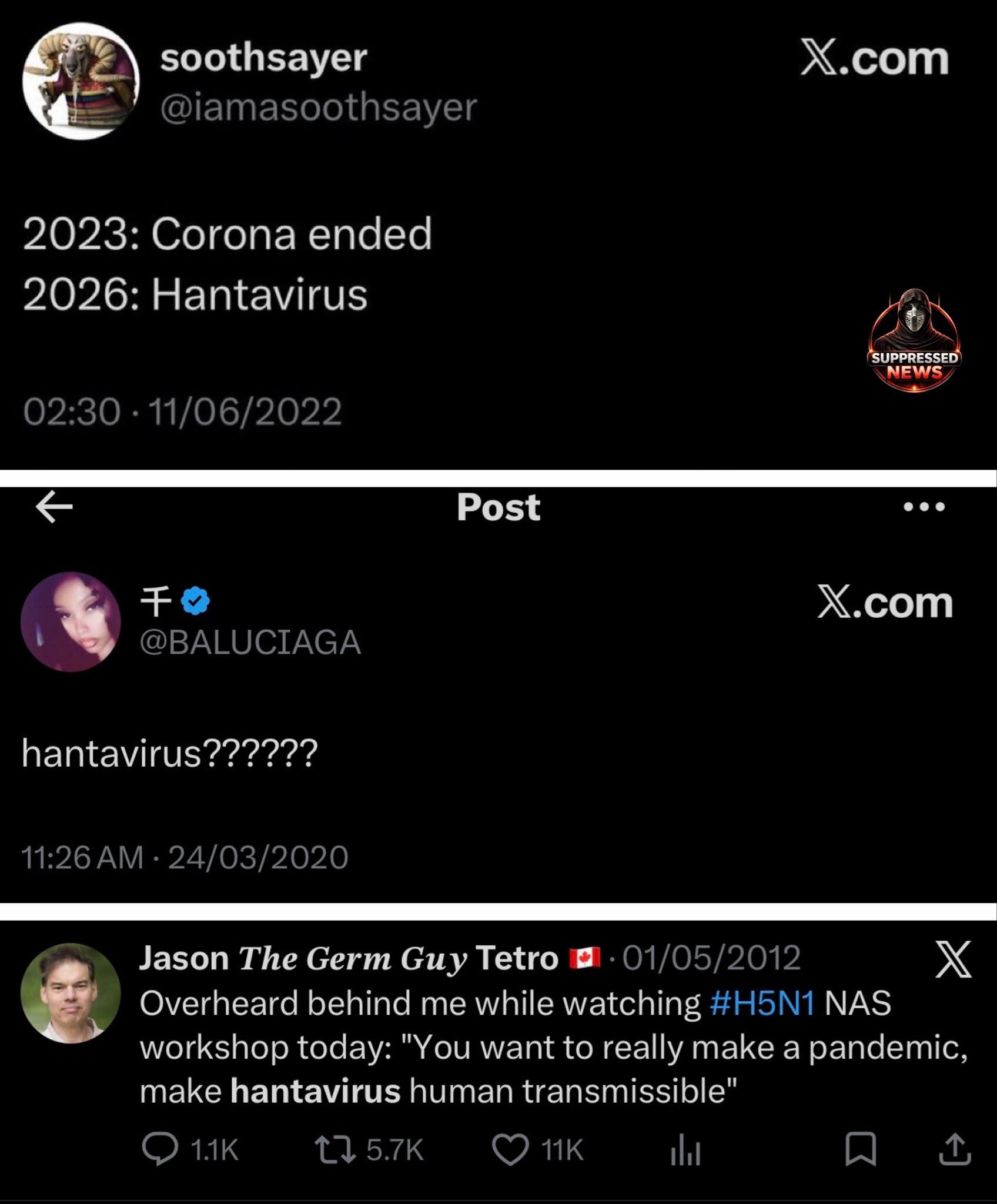
Người xem bói dự đoán virus Hanta trước 4 năm, "nhà tiên tri" của thị trường dự đoán có thực sự nằm trong dân gian?


- Quan điểm chính: Một dòng tweet cũ từ năm 2022 đã dự đoán chính xác sự bùng phát của virus Hanta, gây ra sự hoảng loạn trong công chúng và đầu cơ trên thị trường tiền điện tử. Meme coin và các thị trường dự đoán nhanh chóng biến sự chú ý và lo lắng này thành công cụ giao dịch, cho thấy khả năng nắm bắt cảm xúc và định giá hiệu quả của thị trường tiền điện tử.
- Các yếu tố chính:
- Vào tháng 6 năm 2022, tài khoản X "@soothsayer" đã đăng một dòng tweet tiên tri về virus Hanta, và dịch bệnh thực sự bùng phát sau năm 2023. Tài khoản này chỉ đăng 5 dòng tweet rồi biến mất, làm tăng thêm vẻ bí ẩn cho sự kiện.
- Vào tháng 4 năm 2025, một đợt bùng phát virus Hanta Andes xảy ra trên du thuyền "Hondius", tính đến ngày 6 tháng 5 đã khiến 3 người tử vong và 8 người nhiễm bệnh. Sự kiện gây hoảng loạn vì có loại virus lây từ người sang người.
- Meme coin "HANTA" được ra mắt vào ngày 4 tháng 5, với vốn hóa thị trường tạm thời ở mức 12 triệu đô la Mỹ, trở thành công cụ đầu cơ chính trong sự kiện này.
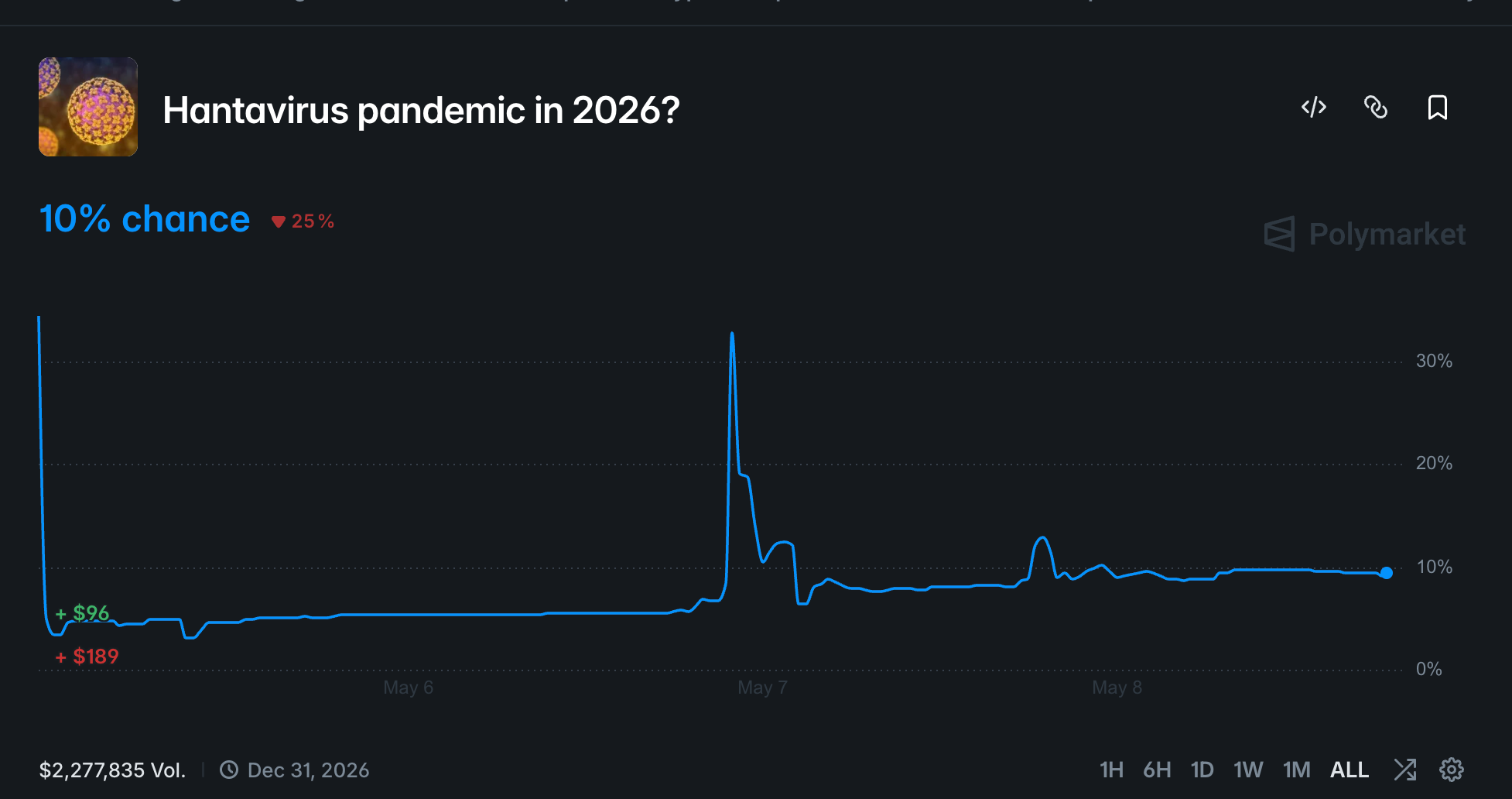
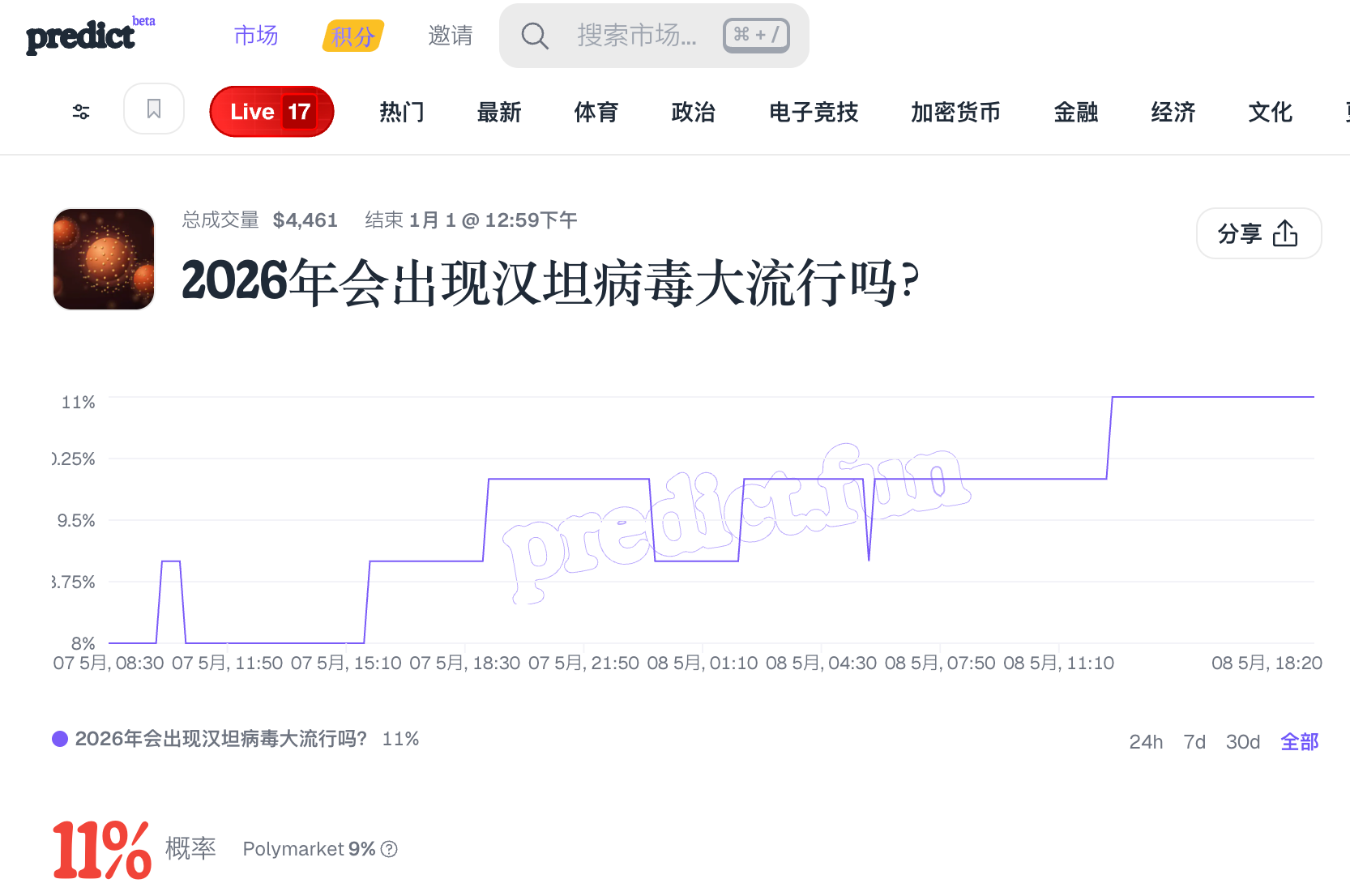
- Trên thị trường dự đoán Polymarket, xác suất của sự kiện "Đại dịch virus Hanta năm 2026" tạm thời ở mức 10%, với số tiền đặt cược lên tới 2,27 triệu đô la Mỹ; trên nền tảng Predict.fun, xác suất sự kiện này là 11%, với số tiền đặt cược khoảng 4.400 đô la Mỹ.
- Bài báo chỉ ra rằng bản chất của thị trường dự đoán là thương mại hóa trực tiếp sự lo lắng, tò mò và ham muốn của con người đối với những điều chưa biết. Chủ đề virus Hanta là một ví dụ khác về khả năng định giá cảm xúc của thị trường tiền điện tử.
Original|Odaily Planet Daily (@OdailyChina)
Author|Wenser (@wenser2010)
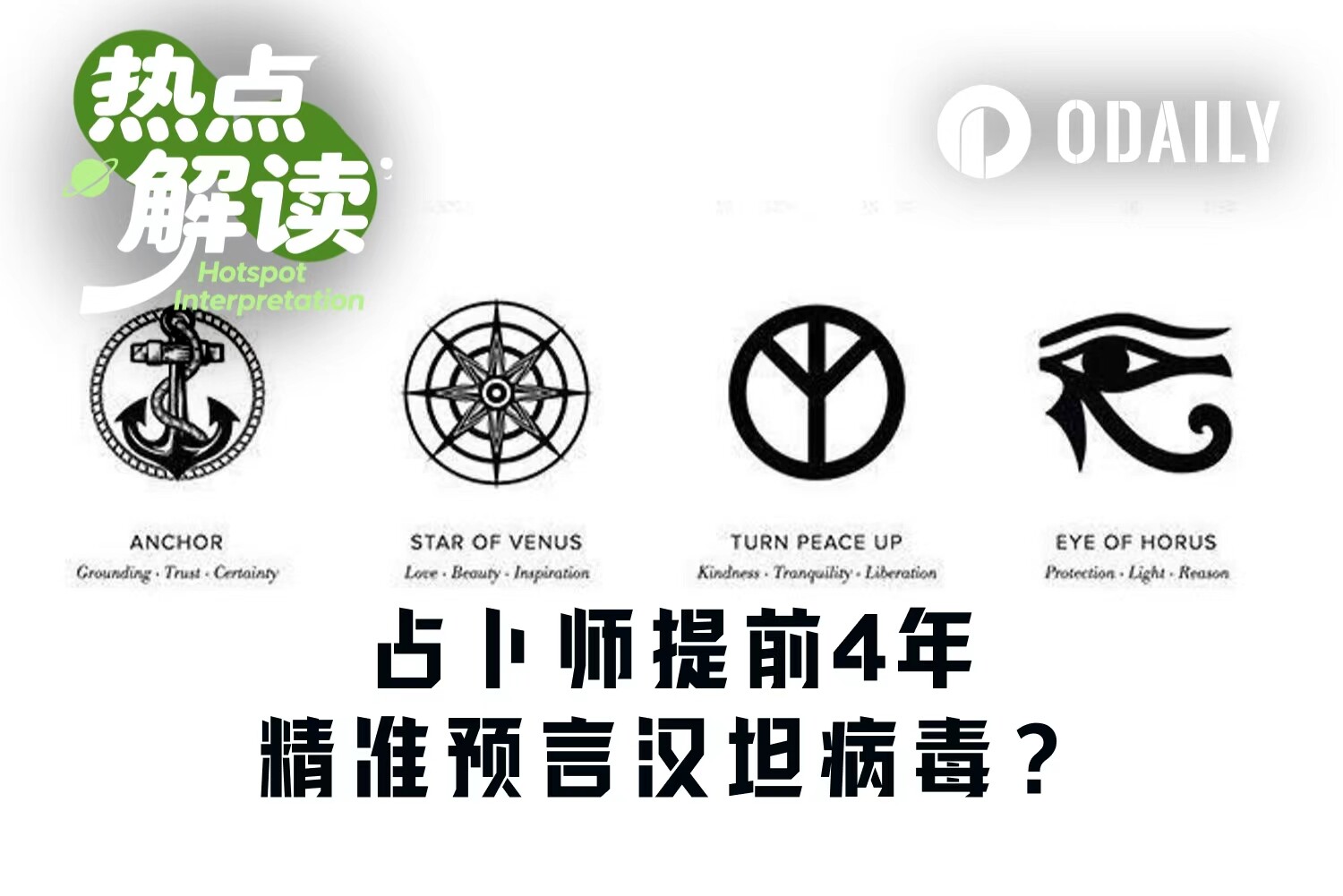
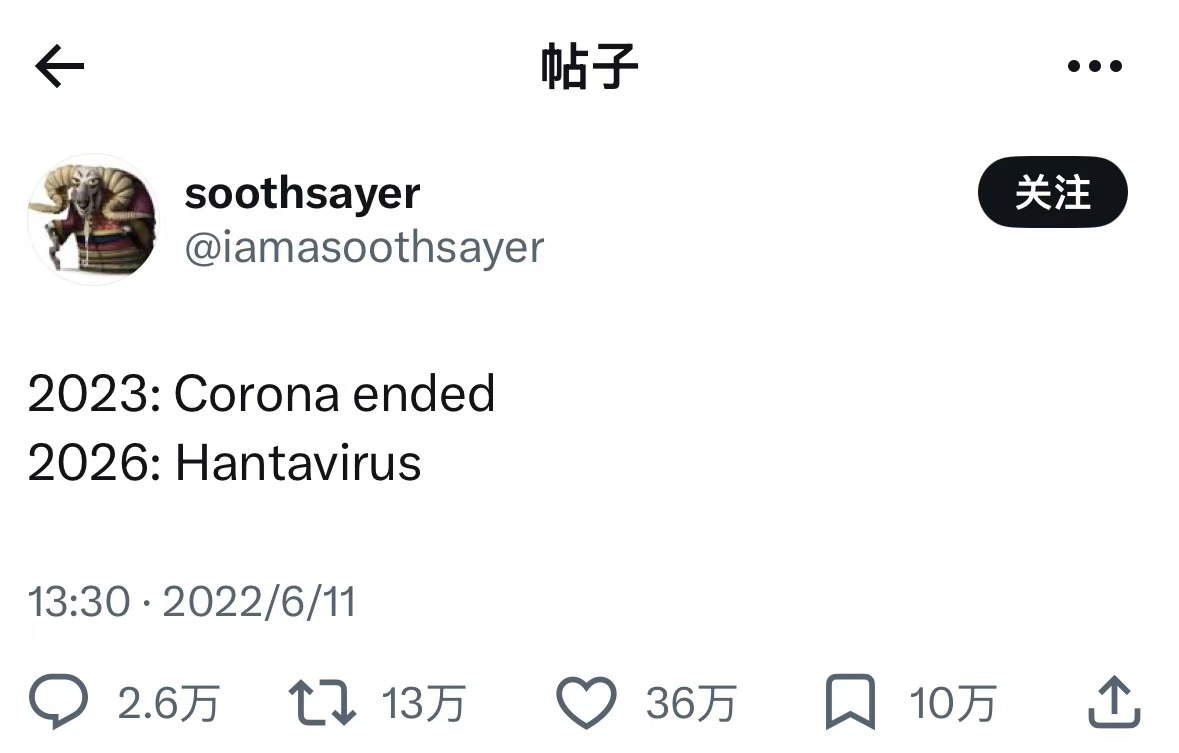
Last night, an old tweet from June 11, 2022, exploded onto the X platform like a nuclear bomb, igniting public discourse. The tweet, from a fortune teller claiming to "read the future," not only predicted the end of COVID-19 in 2023 but also accurately forecast the recent outbreak of the Hantavirus like a prophet.
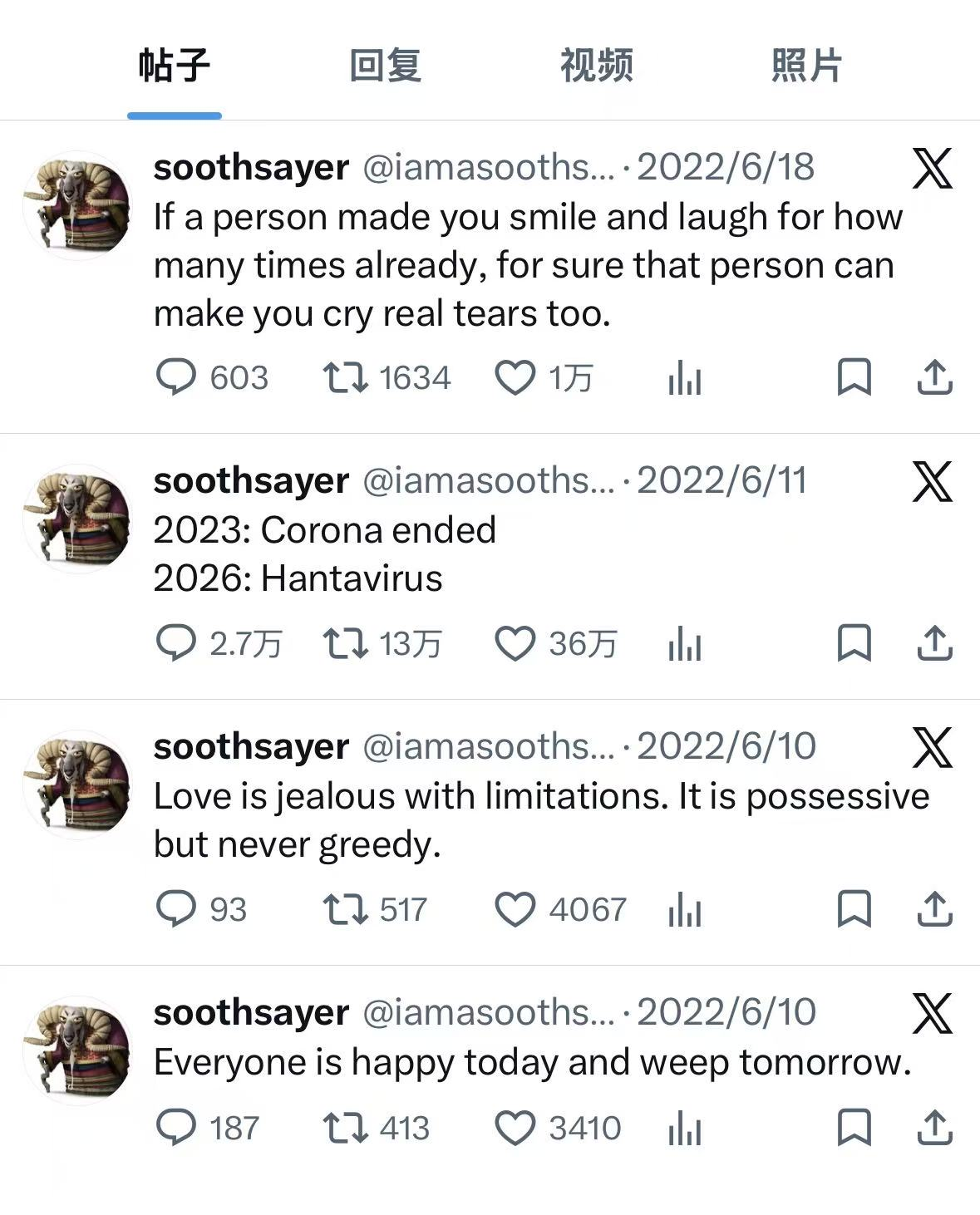
In an instant, countless people flocked to the post, leaving various comments, but the account vanished after just five tweets, disappearing without a trace, adding a layer of urban legend mystique to the whole affair.
Amid the lingering uncertainty of the post-pandemic era, discussions about the Hantavirus quickly spilled over from public health issues, becoming emotional amplifiers on social media. The crypto market rapidly absorbed this as a new trading narrative, from Meme coins to prediction markets, as speculative capital always finds the emotional epicenter first.
In the resonance between the hard-to-verify information flow and group sentiment, the crypto market once again demonstrated its instinct: quickly converting attention, anxiety, and expectations into tradeable products and prices.
Mysterious Tweet from 4 Years Ago Tied to Cruise Ship Virus That Killed 3
The story begins with an account named @soothsayer.
This account, which only posted five tweets, had previously garnered little attention. Ignoring the "Hantavirus prophecy" tweet, you might think it was just another ordinary account on X platform, sending out "chicken soup for the soul" and "inspirational quotes."
However, as discussions about the Hantavirus intensified in recent days, this old tweet took on a "cyber-mystical" quality.
In April this year, a cruise ship named "洪迪厄斯" (Hondius) departed from Argentina in South America, originally planning to cross the entire Atlantic Ocean to the Canary Islands in Spain. However, during the voyage, a Dutch man suddenly died on board, later confirmed to be caused by the Hantavirus. As of May 6, the death toll has increased to 3, with the number of infected rising to 8, including tourists from the Netherlands, the UK, Germany, and other countries. Currently, the cruise ship has been temporarily denied docking due to the Hantavirus, and the WHO is closely monitoring the situation. Notably, about 30 passengers had disembarked in the two weeks prior without any tracking program, spreading across 12 countries.
Therefore, although the WHO has clarified that the virus has not shown large-scale transmission, it inevitably causes public anxiety, with many exclaiming, "It reminds me of the fear of COVID-19."
It's worth noting that according to test results from the South African National Institute for Communicable Diseases and the Geneva University Hospital in Switzerland, the virus type in this outbreak has been confirmed as the Andes Hantavirus.
Most Hantaviruses do not transmit from person to person, but the Andes virus is the only exception, with transmission typically occurring among close family members or healthcare workers. Additionally, Hantaviruses mainly infect humans through "rodent-borne" routes, primarily in three ways: respiratory infection (inhaling aerosols contaminated by rodent excreta), contact infection (direct contact of broken skin or mucous membranes with infected rodent excreta), and digestive tract infection (consuming food contaminated by rodent excreta).
As for concerns about whether this virus will spread to China, reliable sources indicate that in China, the disease caused by Hantavirus is known as "Hemorrhagic Fever with Renal Syndrome." China has achieved significant results in preventing and treating this virus, with no risk of large-scale outbreak currently. The Chinese Embassy in Cape Verde previously issued a notice confirming that there were no Chinese citizens on board.
Looking back at the fortune teller's tweet, it not only directly mentioned "Hantavirus" but was also posted four years ago, making it highly topical.
Hantavirus in Crypto: Meme Coins and Prediction Markets
Following the emergence of the Hantavirus, the crypto market was also shaken, with Meme coins and prediction markets quickly joining the fray.
A group member dug up a Meme coin named HANTA (Hantavirus), created a year ago and officially launched externally on May 4 (token address: 2tXpgu2DLTsPUf9zFmuZmA4xrYxXKBTpVq9wAM7hzs9y). Its market cap is currently reported at $12 million, making it a true "OG play."
Additionally, in prediction markets, Polymarket and Predict.fun have both listed betting events related to the Hantavirus.
On Polymarket, the probability of the "Hantavirus Pandemic in 2026" event is currently around 10%, after briefly rising to nearly 35%. The betting volume is currently around $2.27 million. Its resolution criteria state: "This market will resolve to 'Yes' if the World Health Organization (WHO), in an official public communication from market creation until December 31, 2026, at 11:59 PM ET, explicitly characterizes Hantavirus, Hantavirus Pulmonary Syndrome (HPS), Hemorrhagic Fever with Renal Syndrome (HFRS), or an outbreak associated with Hantavirus as a 'pandemic.' Explicit characterization includes official WHO statements, reports, press conferences, or publications that clearly describe the situation as a 'pandemic.' A declaration of a Public Health Emergency of International Concern (PHEIC) alone does not qualify unless it is also described as a pandemic. The primary settlement source will be official WHO communications. A consensus of credible reporting may also be used."
On the Predict.fun platform, the identically named betting event has a probability of around 11%, slightly higher than Polymarket's data; the betting volume is much smaller, at only about $4,400. Its resolution rules are similar to Polymarket's, also relying on official WHO announcements.
For many, betting real money on the future is inherently addictive. The rising popularity of prediction markets is fundamentally because they directly convert humanity's anxiety, curiosity, and desires about the unknown into tradeable commodities.
At the end of the article, let's shift our focus back to the X platform. It is still littered with numerous old posts about the "Hantavirus," some from 2020, others dating back even to 2012. Some people dig up fragments and call them "divine prophecies," others piece together blurry screenshots into complete stories, and some firmly believe everything was written in advance.
Truth doesn't matter; what's truly captivating is the internet's ability to mix coincidences, fear, emotion, and imagination into something between reality and urban legend, making you want to click and take a look.
As the fortune teller @soothsayer once left behind: "Laugh today, cry tomorrow."