






Ray Dalio: Nợ nần, chia rẽ và hỗn loạn, liệu nước Mỹ có thể thoát khỏi sự suy tàn?


- Quan điểm cốt lõi: Hiện tại, nước Mỹ không phải đối mặt với một cuộc khủng hoảng thị trường đơn lẻ, mà là một chu kỳ thay đổi lớn khi bốn biến số cấu trúc bao gồm nợ nần, chia rẽ chính trị, trật tự quốc tế và thay đổi công nghệ đồng thời bước vào giai đoạn định giá lại. Nhà sáng lập Bridgewater Associates, Ray Dalio, cho rằng nước Mỹ đang tiến tới "kỷ nguyên hỗn loạn hơn", và thách thức cốt lõi của nó là làm thế nào để cân bằng xung đột nội bộ và những ràng buộc tài khóa trong "sự biến dạng thời gian" này.
- Các yếu tố then chốt:
- Chu kỳ nợ đang hạn chế khả năng hành động của quốc gia. Chi tiêu hàng năm (khoảng 7 nghìn tỷ USD) cao hơn khoảng 40% so với thu nhập (khoảng 5 nghìn tỷ USD), thâm hụt liên tục đã tích lũy khoản nợ gấp 6 lần thu nhập, làm suy giảm nghiêm trọng không gian tài khóa.
- Sự chia rẽ chính trị trong nước có gốc rễ sâu xa từ sự mất cân bằng trong phân phối của cải và lợi ích. Bất kỳ kế hoạch cắt giảm thâm hụt nào cũng sẽ chạm đến vấn đề "ai nộp thuế nhiều hơn, ai nhận phúc lợi ít hơn", biến điều chỉnh tài khóa từ một vấn đề kỹ thuật thành một vấn đề về tính hợp pháp chính trị.
- Trật tự quốc tế đang quay trở lại từ "dựa trên luật lệ" sang "dựa trên sức mạnh". Hệ thống đa phương do Mỹ lãnh đạo sau chiến tranh thiếu cơ chế thực thi hiệu quả, các xung đột địa chính trị (ví dụ như Iran, eo biển Hormuz) một lần nữa trở thành thước đo cho uy tín và an ninh của các cường quốc.
- Áp lực lên đồng đô la không đồng nghĩa với việc nhân dân tệ sẽ trực tiếp tiếp quản vị thế. Nhân dân tệ có thể đóng vai trò phương tiện trao đổi trong nhiều bối cảnh thương mại hơn, nhưng nợ của Trung Quốc không phải là công cụ lưu trữ của cải lý tưởng, và vàng, do "không còn lựa chọn nào khác", đang trở lại là tài sản dự trữ quan trọng của các ngân hàng trung ương.
- Công nghệ (AI) là con dao hai lưỡi, vừa có thể nâng cao năng suất để giảm bớt gánh nặng nợ nần, vừa có thể làm gia tăng khoảng cách giàu nghèo, thay thế việc làm và rủi ro an ninh địa chính trị, tác động tổng hợp của nó khó có thể dự đoán trước.
Original Title: A Legendary Investor on How to Prevent America's Coming 'Heart Attack'
Original Author: Emily Holzknecht and Sophia Alvarez Boyd, The New York Times
Original Compiled by: Peggy, BlockBeats
Editor's Note: Against the backdrop of high U.S. fiscal deficits, escalating geopolitical tensions, and renewed scrutiny of the dollar's creditworthiness, the discussion about America is shifting from "Is it still the world's strongest economy?" to "Are the institutions, debt, and international order underpinning U.S. hegemony still stable?"
But when "America is still strong" and "America is falling into disarray" are both true, a more critical question emerges: Is America facing a normal cyclical adjustment, or the loosening of a long-term order?
This article is compiled from an interview with Ray Dalio on *The New York Times* podcast *Interesting Times*. Dalio, the founder of Bridgewater Associates, has long observed macro-order changes through the lens of debt cycles, reserve currencies, and the rise and fall of empires.
In this conversation, Dalio breaks down America's problems into a set of fundamental structural variables: how debt accumulates, how politics become divided, how the international order breaks down, and whether technology can still provide a new outlet for productivity.
First, the debt cycle is changing national capacity. In the past, the U.S. relied on strong fiscal credibility and the dollar's reserve currency status to finance itself at a low cost for a long time, sustaining military spending, welfare, and global commitments. But now, spending has long exceeded revenue, and the burden of debt and interest payments is rising, continuously squeezing fiscal space. This means debt is no longer just a number on a balance sheet; it gradually translates into constraints on national capacity: the ability to protect allies, maintain welfare, and bear the costs of war will all be limited by fiscal reality.
Second, domestic political division is becoming tied to the issue of wealth distribution. In the past, U.S. political divisions could be partially absorbed through growth, taxes, and welfare expansion; different groups, though conflicting in interests, still shared a set of institutional trust. Now, wealth gaps, value conflicts, and left-right antagonism are overlapping. Any plan to reduce deficits inevitably touches on the question, "Who pays more taxes and who gets fewer benefits?" This means fiscal adjustment is no longer just a technical issue but a question of political legitimacy. The more reform is needed, the harder it is to build consensus.
Third, the international order is shifting from rules back to power. After 1945, the U.S. established a world order centered on multilateral institutions, a rules-based system, and dollar credit. In the past, even amidst the Cold War, America held overwhelming advantages in finance and institutions. But now, geopolitical conflicts, bloc realignments, and supply chain security issues are undermining this order's stability. Analogies to Iran, the Strait of Hormuz, and even the Suez crisis all point to the same problem: when rules cannot be enforced, the market will ultimately reassess the relationship between power, credit, and security.
Fourth, the pressure on the dollar does not mean the renminbi will directly take over. Dalio's assessment is more nuanced: the renminbi may become a medium of exchange in more trade scenarios, but this does not mean Chinese debt will become the world's most important store of wealth. The real question is, when all fiat currencies face depreciation pressure, where will capital seek safe assets? Gold's resurgence as a key central bank reserve asset is a manifestation of this uncertainty.
Fifth, AI could either mitigate the crisis or amplify it. In the past, technological progress was often seen as a key outlet for the U.S. to fix its debt and growth problems. If AI can significantly boost productivity, it could indeed improve income, growth, and debt-servicing capacity. But now, AI is also creating new wealth concentration, job displacement, and security risks. It could be a buffer for fiscal pressure, or it could become a new amplifier of social division and geopolitical competition.
If we compress this conversation into one judgment, it is this: America's problem is not a single crisis, but a simultaneous revaluation of debt, politics, the international order, and technological variables.
In this sense, the subject of this article is no longer just whether America is declining, but a larger structural question: when the old order can still function, but its underlying conditions are loosening, how should markets, nations, and individuals re-understand "safety" and "credit."
The following is the original content (edited for clarity and readability):
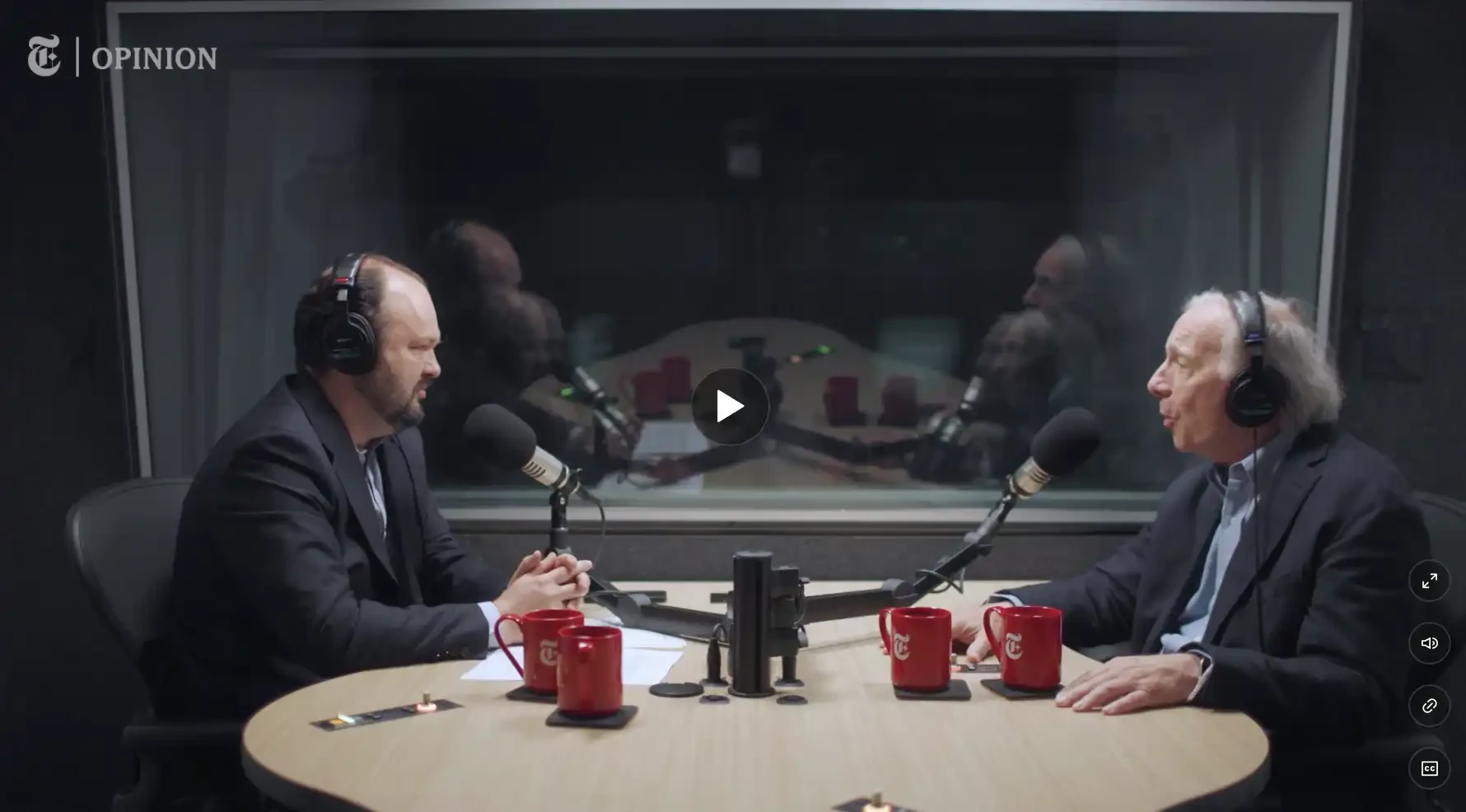
Image Source: The New York Times
TL;DR
·Dalio’s core judgment is that America is not in a short-term decline, but entering the downward phase of a major cycle.
·America's real risk isn't a lack of money, but too much debt, which will slowly hollow out national capacity.
·Deficits are the hardest to solve because they ultimately become a political conflict over "who pays and who concedes."
·The root cause of American political division isn't just values, but an imbalance in wealth and interest distribution.
·The post-war rules-based order led by the U.S. is failing, and the world is returning to power politics.
·The dollar won't be immediately replaced by the renminbi, but the world will place more importance on safe-haven assets like gold.
·AI could save growth, but it could also further tear employment, wealth, and security order apart.
·Whether America can fix itself depends not on the market, but on education, social order, and avoiding war.
Original Content
I feel that recently, we seem to be at a moment of "the end of the American Empire."
Partly it’s the stalemate in the Iran war; partly it’s Donald Trump putting pressure on America’s alliances; and partly, I think, it’s a growing sense that America’s biggest competitor, China, is watching coldly, biding its time, waiting for its collapse.
Our guest this week has been thinking about this for a long time. He has a grand historical theory predicting America's decline. In a way, he's an atypical Cassandra figure — constantly warning, but not always taken seriously.
Ray Dalio founded Bridgewater Associates, one of the world's largest hedge funds, from scratch. But now, what he most wants to talk about is no longer just markets and investing, but the decline of the American empire, and whether we can pull the "American Empire" back from the brink.
Below is an edited transcript of an episode of *Interesting Times*. For the full effect, we recommend listening to the original audio. You can listen via the player above, or on the *New York Times* app, Apple Podcasts, Spotify, Amazon Music, YouTube, iHeartRadio, and other podcast platforms.
The Cyclical Logic of the American Crisis
Ross Douthat (Host): Ray Dalio, welcome to *Interesting Times*.
Ray Dalio (Founder of Bridgewater Associates): Thank you. It's interesting to be on *Interesting Times* in "interesting times."
Douthat: That’s what everyone says. You’ve had a career of placing bets, and quite a few of your judgments have paid off over the past few decades. Lately, you’ve been saying that the United States of America, right now, might not be a particularly good bet.
So, for someone observing America, trying to decide whether to bet on the "American Empire" maintaining its dominance in the 21st century, what are the important forces or key factors they should be watching?
How Debt Drains National Capacity
Dalio: Let me correct that framing. I'm not saying America is a bad bet or a good bet. I'm simply describing what is happening.
One thing I've learned in about 50 years of investing is that many events very important to me never happened in my lifetime, but have happened many times in history.
So, I started studying the last 500 years of history to figure out the causes of the rise and decline of reserve currencies and the empires behind them. You see a certain pattern repeatedly. There is indeed a "big cycle," and it begins with the formation of a new order.
There are three types of orders: the monetary order, the domestic political order, and the international world order. These are three constantly evolving, important forces.
Let’s look at the first force, the monetary order. Within this is a debt cycle. When debt rises relative to income, and debt service payments rise relative to income, it squeezes other spending, whether it's a country, an individual —
Douthat: Or an empire.
Dalio: Any entity!
Douthat: Yes.
Behind the Political Division is Money Distribution
Dalio: This squeezes out other expenditures. That's the problem. For instance, the U.S. now spends about $7 trillion a year and takes in about $5 trillion, meaning spending exceeds income by about 40%. This deficit has been running for some time, so the U.S. has accumulated debt about six times its income — and by income, I mean the actual money the government takes in.
Right. But the result of this is that the currency itself gets devalued. That's the mechanics of it. That's why there are long-term debt cycles, short-term debt cycles, monetary cycles, and economic cycles — driving the economy from recession to overheating to the next recession.
Linked to this is the domestic political and social cycle, which is intimately connected to monetary issues. When a society faces huge wealth gaps and value differences —
Douthat: You mean between rich and poor?
Dalio: Between rich and poor, and between people with different values. When these differences become irreconcilable, you get political conflicts, and these conflicts become severe enough to risk the entire system.
So, I think the first cycle is happening. I also think the second cycle is happening — the irreconcilable differences between the political left and right. We can unpack these later.
The World Order is Returning to Power Politics
Douthat: How do the international factors play in?
Dalio: It's the same logic internationally. After a war ends, a dominant power emerges, and that dominant power establishes a new world order. An order is a system. This current order started in 1945.
Douthat: For us, yes. America was the dominant power setting up that system.
Dalio: Correct. America established a system that was largely a template of itself because it was intended to be representative. The United Nations, for instance, was a multilateral world order. Different countries could operate within it, and there was supposed to be a rules-based system.
But the problem is, if there's no enforcement mechanism, that system doesn't really work. It was an idealistic system, and a beautiful one while it lasted. But now, we no longer have a truly multilateral, rules-based system.
We're reverting to the state that existed before 1945 and for most of history: geopolitical differences keep arising, like what's happening now with Iran.
How are these differences resolved? You don't take it to the International Court of Justice, get a judgment, and have it enforced. Ultimately, what matters is power.
Douthat: Right. But even at the height of what we understood as the "rules-based international order," for most of that history, America was in a conflict with the Soviet Union.
Dalio: Yes.
Douthat: So the Cold War was ongoing. The window when the system operated free from great power conflict was actually relatively short. And even then, American power was ultimately the decisive factor, right?
Dalio: Of course. Because the Soviet Union didn't have real strength. It had military strength, but at the end of WWII, America had roughly 80% of the world's monetary wealth, half the world's GDP, and was the dominant military power. So we had the capacity to provide funds, and those who received them valued them. The Soviet system was a very small part of that. Financially, it was nearly bankrupt and hardly an important force.
Douthat: So the military balance of power was real, but in the financial balance of power, it was basically America calling the shots.
Dalio: Yes. Luckily, under the structure of "mutually assured destruction," we didn't actually use that military power. Still, I remember the Cuban Missile Crisis — I was a kid watching it, and we didn't know if there'd be a nuclear exchange. But it didn't come to that, and eventually the Soviet Union collapsed.
Douthat: In your cyclical view of history, what role do contingent events play?
Dalio: All events happen in succession. I think the key question is: will they cause disputes? And in a world without a court system to resolve disputes, both domestically and internationally, how will those disputes be resolved?
Take what's happening in the Middle East, especially with Iran. There are conflicts, and they escalate into war because there's no other way to resolve them. The whole world is now watching: Can America win this war, or will it lose?
We look at this in almost binary terms: Who will control the Strait of Hormuz? Who will control nuclear materials? Can America win this war?
We should also see the alliances behind this. Russia and Iran tend to support each other more, just as there are respective supporting powers on the other side.
Douthat: Again, compared to past decades, is the most distinctive thing about this moment that the power on the other side is stronger?
Dalio: It's the relative power change and the breakdown of the existing order. Plus, large creditor-debtor relationships are involved. When America runs large deficits for a long time, it has to borrow. This becomes very dangerous in conflict times. Interdependence is like that too.
In other words, in a higher-risk world, you need to be self-sufficient. Because history shows you can be cut off at any time. Either side can be cut off.
Douthat: Yes. I'm interested in how these factors interlock. Suppose the Iran issue ends with people feeling America lost the war, or at least didn't achieve its goals. Maybe the Strait of Hormuz remains open, but the Iranian regime remains in power, and the impression forms that America tried something and failed. Would that impression, in your view, feed back into the perception of America's creditworthiness for paying its debts?
Dalio: I just spent about a month in Asia, meeting with leaders and people from different countries. The impact of this is huge, very similar to the impact when Britain lost the Suez Canal — because Egypt controlled it. That was seen as the end of the British Empire. So it's a very big deal.
Douthat: Right, that was in the 1950s.
Dalio: Yes. And that was also when people stopped wanting to hold British debt, among other things. Now, the question different countries are considering is: Will America still protect us? Or, does America no longer have the capacity to protect us? Because the American public doesn't want a long, drawn-out war, so the war has to be quick, affordable, and —
Douthat: And popular, right?
Dalio: And popular.
Douthat: And our wars aren't usually very popular nowadays. But I want to linger on the Suez analogy because I think it's interesting. I hear many people using it. In the Suez crisis, Britain, France, and Israel essentially tried to retake the Suez Canal after Egypt nationalized it.
So the parallel to Iran is obvious: a key chokepoint for global trade, and a conflict between Western powers and a regional power. But it seems to me the key to the Suez event was that Dwight Eisenhower and America basically told Britain: No, you can't do this.
So part of the crisis of confidence in the British Empire, the pound sterling, and everything else, came from the recognition that, as you said, this was now the post-WWII order, and America was the dominant power.
Does that mean a similar role is needed from China now? Does there need to be a similar moment for people to truly lose confidence in America? Do people need to see a new hegemon appear before they abandon the old one?
Dalio: By the way, I don't think China will end up being that kind of traditional hegemon. We can discuss that later.
Douthat: I'm very interested in that.
Dalio: But what I'm saying is that it was the combination of British debt problems and its apparent loss of power. Britain's decline had already started before Suez, because people realized America was not only a world power but in a better fiscal position.
Douthat: So, if the analogy holds, what is the parallel today? If people conclude America is no longer as trustworthy as we thought, less likely to repay its debts, etc. — and this also relates to your point about China and whether it will become the new hegemon — would they turn to China? Would they abandon the dollar as a reserve currency? Where does the money go if people lose confidence in America?
Dalio: I'll share my view. But I also want to say that this is typical in every cycle. For example, when the UK replaced the Netherlands, it was a similar process. The UK was financially stronger and had more comprehensive capabilities. The Netherlands lost, so there was a transfer from the Dutch Empire to the British Empire; and the Dutch had the reserve currency and debt at the time. Similar things happen repeatedly in the same way.
So, you don't necessarily need a specific


