剧烈反弹!美股「科技动量股」创史上最大单日涨幅,但暴跌结束了吗?


- 核心观点:周二美股科技动量股出现罕见暴力反弹,高贝塔动量指数创下2000年互联网泡沫以来最大单日涨幅,本质上是空头逼仓引发的技术性反弹,但市场内部结构不佳,反弹持续性存疑。
- 关键要素:
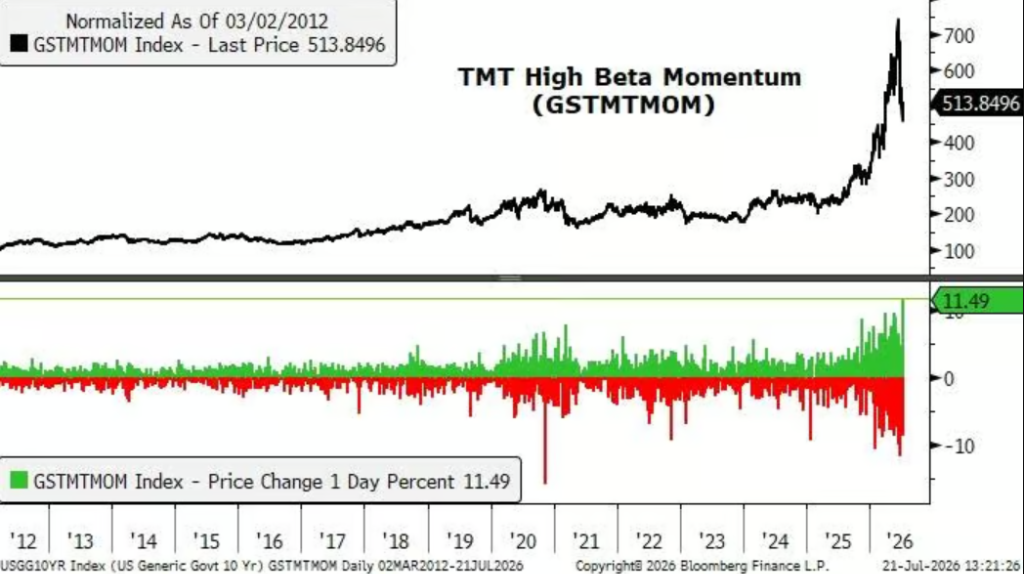
- 高盛高贝塔动量多空指数单日上涨9.5%,为2021年以来最强;摩根士丹利TMT动量因子单日涨幅超12%,创历史记录。
- 本轮反弹源于此前动量股累计暴跌33%后的空头逼仓,韩国和日本追涨杀跌型交易者被迫平仓回补引发上涨螺旋。
- 反弹质量较低:成交量较20日均值低20-30%,标普500上涨但下跌个股多于上涨个股,市场活跃度仅3分(满分10分)。
- 机构观点分歧明显:BTIG建议逢高减仓,认为反弹触及730-750强阻力区间;高盛和瑞银则认为动量抛售接近尾声,建议逐步加仓。
- 本周财报季(113家标普500成分股)和AI资本开支指引将是关键变量,尤其是Alphabet的财报数据。
- 债券市场发出警告:长端收益率升至两个月高位,超大规模科技公司信用利差创新高,能源价格上涨推升利率。
Original Author: Long Yue
Original Source: Wall Street News
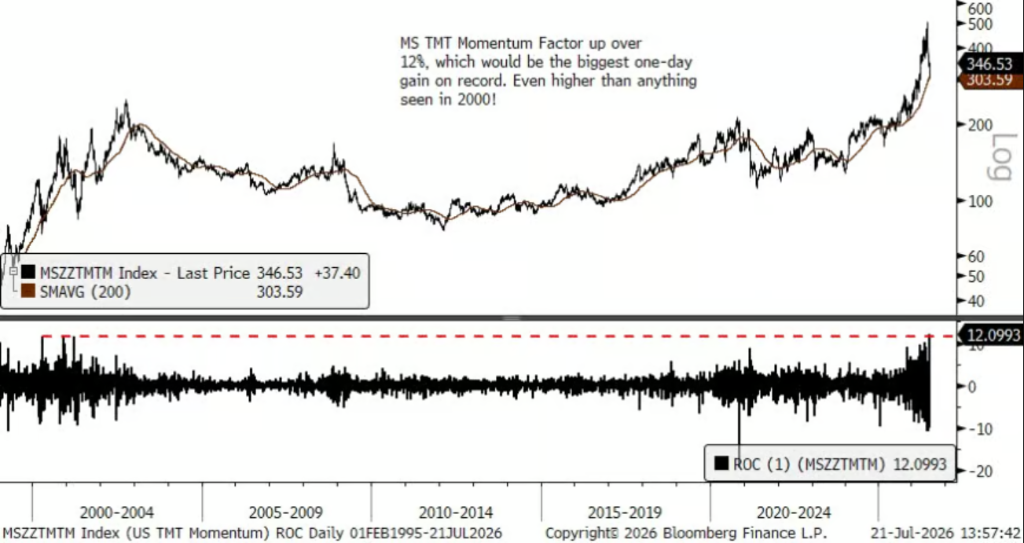
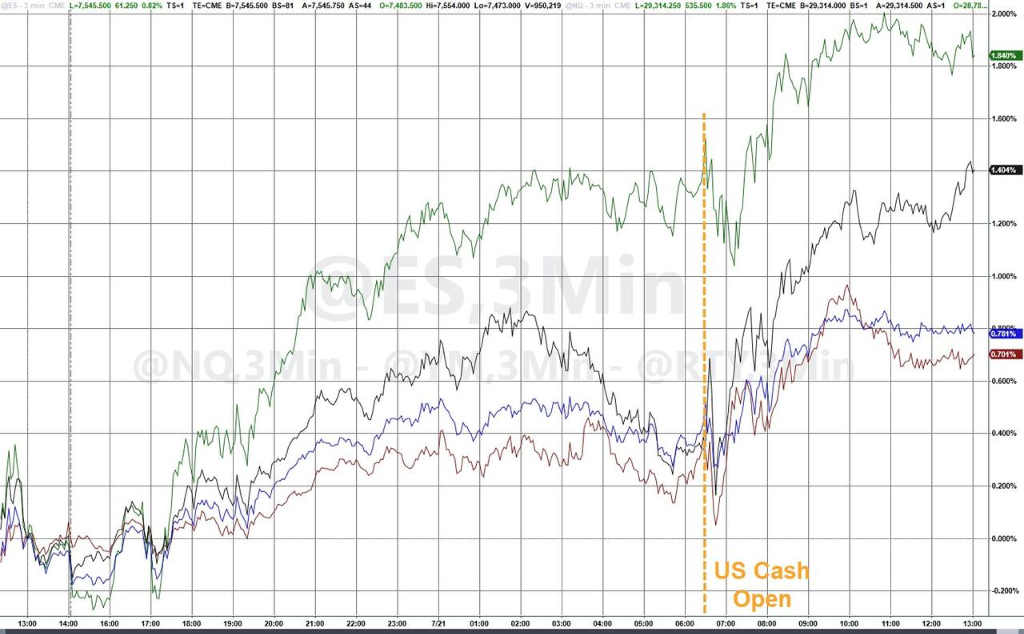
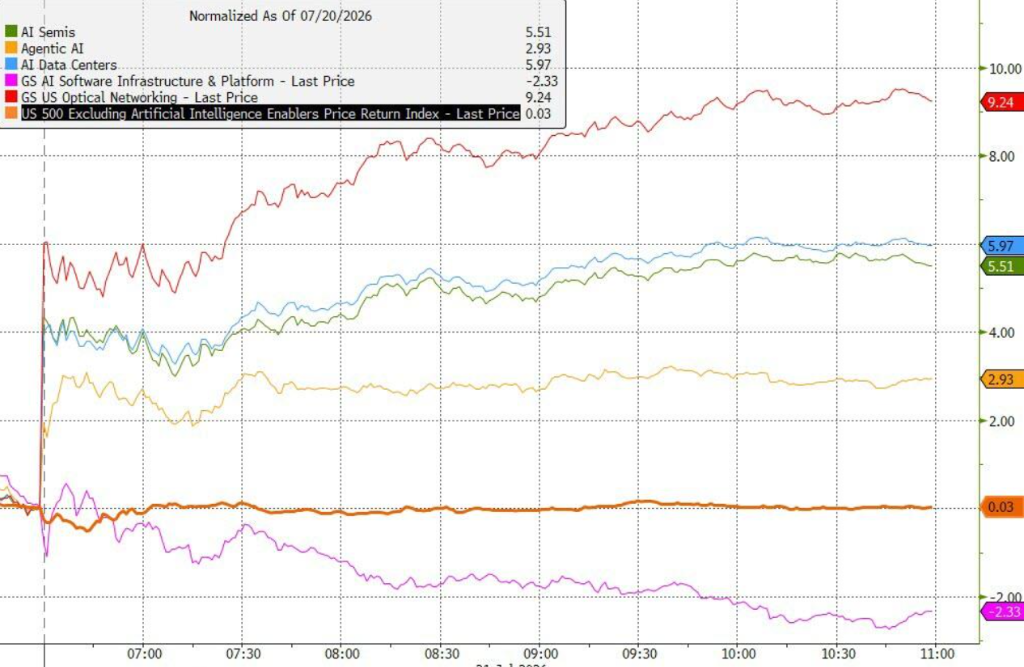
US tech momentum stocks staged a sharp rebound on Tuesday (July 21). Morgan Stanley's TMT momentum factor surged over 12% in a single day, setting a record for its largest daily gain ever, even surpassing any single-day performance during the 2000 internet bubble. Goldman Sachs' High Beta Momentum Long Index (GSCBHMOM) rose approximately 8.5% in a single day, its strongest performance since April 2025; the Long/Short High Beta Momentum Index (GSPRHIMO) surged 9.5%, its strongest since 2021 and approaching its highest historical levels since 2003.
The Nasdaq Composite Index rose about 1.3% on the day, leading the three major indices. The semiconductor sector was the biggest driver—the Philadelphia Semiconductor Index jumped 4.6%, and the VanEck Semiconductor ETF rose about 4.5%. Micron Technology gained over 10%, Intel rose about 8.6%, SanDisk climbed roughly 14%, Cerebras Systems soared about 18%, and Cipher Mining surged over 11%.
This rebound came after three consecutive days of decline and followed a cumulative 33% plunge in momentum stocks.
Why This Rebound? Short Squeeze
To understand this rebound, one must first grasp the depth of the preceding decline.
Goldman Sachs data shows that high-beta momentum stocks fell 33% cumulatively in just a few trading sessions, one of the harshest pullbacks since the bursting of the internet bubble. The Goldman Sachs High Beta Momentum Index briefly dipped below its 200-day moving average, hitting its lowest point since January this year, with oversold conditions being the most severe since August last year.
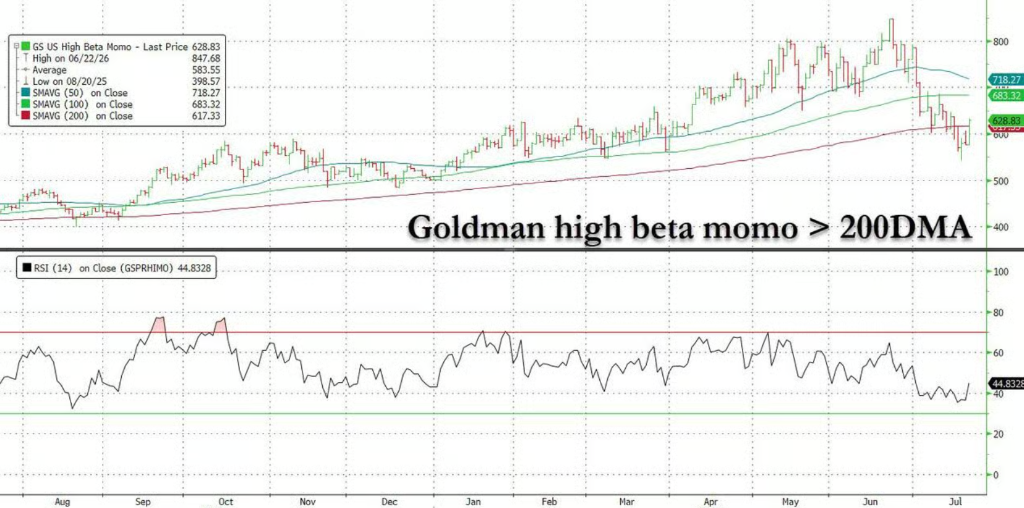
The deeper the fall, the greater the rebound potential—this is a basic market logic.
This rebound was, to a large extent, a "short squeeze" event. A large number of investors shorting momentum stocks, particularly momentum-chasing traders in South Korea and Japan, suffered heavy losses over the past two weeks. The South Korean market even experienced large-scale margin calls, significantly impacting local retail investors. When these shorts are forced to cover, buying pressure creates a self-reinforcing upward spiral.
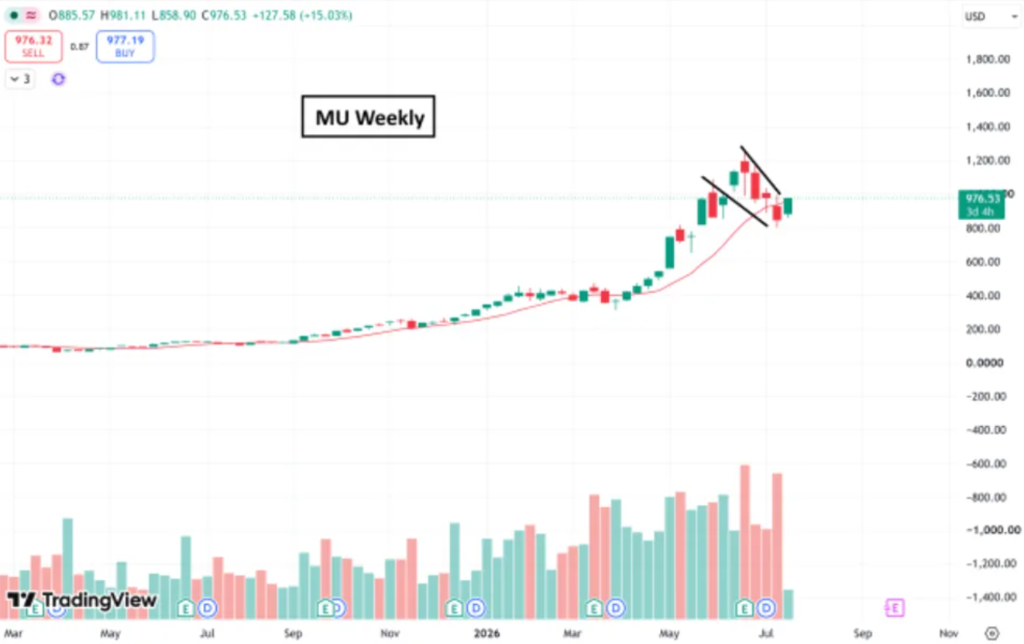
Zacks Investment Research noted that Micron Technology had previously broken below the "head and shoulders" neckline on its daily chart, a bearish technical signal. However, the stock surged over 10% on Tuesday, reclaiming the neckline. "False breakdowns often lead to violent reversals in the opposite direction, as late-to-the-party bears and short sellers get trapped."
Market Breadth Remains Weak, Rebound Quality Questioned
While the rebound numbers look impressive, the internal structure is unhealthy.
BTIG strategist Jonathan Krinsky analyzed that overall trading volume on Tuesday was low, with SPY, QQQ, and S&P 500 spot volume all 20% to 30% below their 20-day averages. Meanwhile, despite the S&P 500 rising nearly 1%, declining stocks still outnumbered advancing ones. This year has seen the most instances of price-breadth divergence, and Tuesday marked another occurrence.
Goldman Sachs trader data showed that overall exchange volume was roughly 17% below the 20-day average, market maker book liquidity was only $6.83 million, and market activity scored only 3 out of 10.
In other words, this rebound appears to be a concentrated burst in a few heavily weighted stocks, rather than a broad-based recovery.
Bloomberg macro strategist Michael Ball commented, "It's still too early to declare the correction over." Demand for put options on semiconductor ETFs and previously popular AI stocks remains high. The negative gamma exposure in the Nasdaq, semiconductor ETFs, and related stocks means market makers will amplify both upward and downward moves rather than dampening volatility.
BTIG Warns: Rebound Hits Key Resistance, Advises Selling into Strength
Not everyone is optimistic about this rebound.
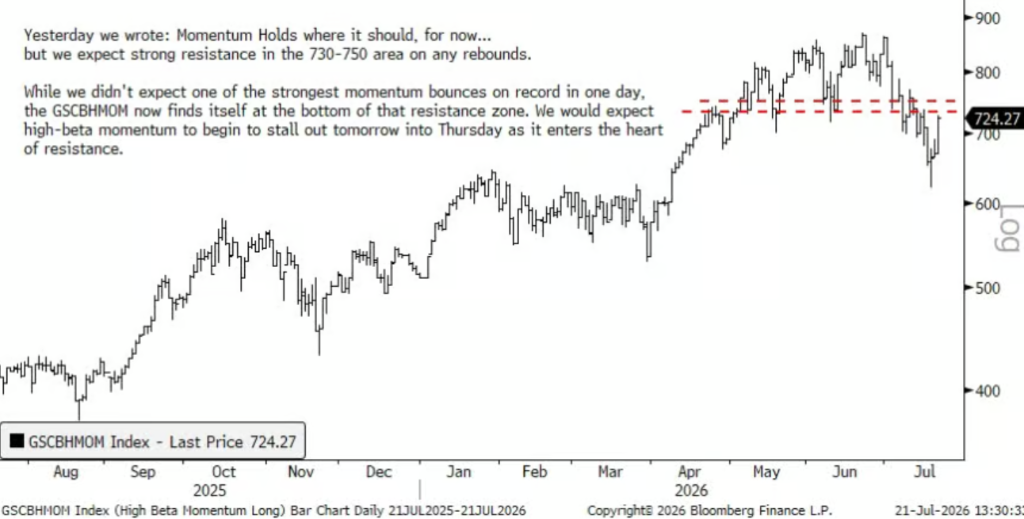
BTIG's Jonathan Krinsky explicitly warned, advising to "fade" the rally. He had previously predicted that the momentum stock rebound would encounter strong resistance in the 730-750 range, and Tuesday's rally precisely pushed the GSCBHMOM to the lower end of that resistance zone.
Krinsky stated: "Extreme volatility, coupled with historical stock dispersion, signals that the market is undergoing a full-scale correction." He expects high-beta momentum stocks to enter the core of the resistance zone and begin stalling from Wednesday through Thursday.
Historically, since 1999, the High Beta Momentum Long Index has experienced a single-day gain of over 7% above its 200-day moving average only ten times. Three occurred this year, three in early 2021, and three in early 2000. Krinsky noted that this data "underscores both the rarity of this move and the fact that we continue to see statistical characteristics echoing the 1999-2000 period."
Goldman Sachs & UBS: Momentum Selling Nears End, Recommend Gradual Buying
In contrast to BTIG's cautious stance, Goldman Sachs and UBS believe the momentum sell-off is nearing its end and advise investors to seize the opportunity.
Goldman Sachs' Julia Mensch noted in a report that the bank had flagged last week that the momentum sell-off was "in its later stages." She wrote: "With positioning having been significantly cleaned up (Goldman Sachs prime brokerage data shows momentum exposure is at the 64th percentile over the past year and the 93rd percentile over the past five years), and with no new fundamental catalyst behind this sell-off, we believe there is room for momentum to revert to long-term trends. This sell-off could be a good opportunity to increase momentum exposure or buy AI stocks on the dip."
UBS Head of Equity Derivatives Sales for Hedge Funds, Michael Romano, expressed a similar view in a client note, arguing that improving AI fundamentals are a buy signal. However, he also advised investors to "build positions gradually rather than going all in at once."
Romano wrote: "Momentum de-risking was and remains a compelling thesis. Phasing into positions is a prudent approach." He expects the momentum sell-off to bottom out by the end of July (if it hasn't already) and stated: "Once the tide turns, I anticipate liquidity will drive prices to overshoot to the upside."
However, Goldman Sachs also maintained some reservation—given the extremely high recent volatility and the dense earnings season ahead, they advised investors to gain exposure through "limited-loss structures" rather than direct long positions.
Earnings Season is the Next Key Variable
The sustainability of this rebound largely depends on this week's earnings reports.
According to Reuters, 113 S&P 500 component companies (representing about 18% of the index's market cap) are reporting earnings this week. Among them, Alphabet's (GOOGL) report is considered "the most important data point of the week." The market will focus on its full-year 2026 capital expenditure guidance—which is widely expected to be raised—providing crucial clues about the direction of AI spending.
LPL Financial Chief Technical Strategist Adam Turnquist stated: "The spotlight is not just on total CapEx; the next focus will be on ROI and spending quality. We believe this will become a core theme in the second half of the year."
He also noted: "We expect continued volatility in the semiconductor sector as overbought conditions need to be digested, profit-taking pressures emerge, and crowded positions need to be cleared. Fundamentally, we don't see any substantial changes."
According to Reuters, 66 S&P 500 companies have reported earnings so far, with approximately 88% beating analyst expectations. 3M surged over 9% in a single day, and General Motors rose about 5%, both driven by better-than-expected results.
Bonds and Macroeconomics: Another Concern
While stocks celebrated, the bond market was flashing warning signs.
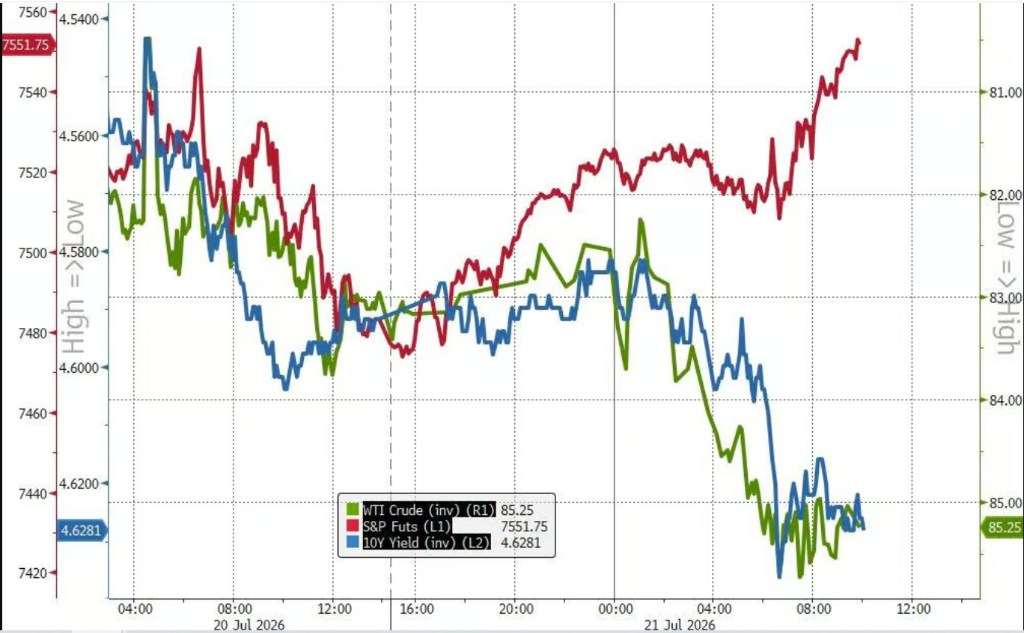
Treasury yields rose across the board on Tuesday. The short-end 2-year yield increased by 5 basis points, the 30-year yield rose by 2 basis points, and long-end yields climbed to two-month highs, erasing the gains from last week's lower-than-expected inflation data.
Oil prices were one of the drivers. Brent crude futures closed back above $90 per barrel for the first time since June 11. Tensions in the Middle East continue to escalate—Yemen's Houthi group announced a blockade of the southern entrance to the Red Sea, and two oil tankers carrying Saudi crude turned back in the Red Sea. Kpler's MarineTraffic data shows that cargo loadings through the Bab el-Mandeb Strait had already decreased by 34% over the past two weeks even before the blockade announcement.
RBC Capital Markets rates strategist Izaac Brook commented: "Today's market movement is primarily a result of continued energy price increases. Rate volatility was amplified by the breach of closely watched technical levels—the 2-year yield at 4.20% and the 10-year yield at 4.60%—coupled with typically thin summer trading conditions."
Bloomberg's Cameron Crise warned that long-end bond yields are at a critical point where 5% is transitioning from resistance to support. The next obvious target is 5.5%—"which would impact stocks, especially if upside economic surprises push yields higher and negatively affect equities."
Goldman Sachs IG credit head Kevin Boova also warned that credit spreads for mega-cap tech companies have hit new highs, stating that the "hyperscale cloud/AI/data center space feels somewhat fragile again."