






TRON TRON Industry Weekly: June CPI Benefits Inflation Cooling, Detailed Explanation of Synthetic Dollar Protocol Axis Driven by Cross-Asset Arbitrage Yields


- Core Viewpoint: This week (July 13-19, 2026), the crypto market was boosted by lower-than-expected US CPI. Bitcoin rebounded from $62,500 to $65,000 but then retreated due to geopolitical risks. Overall, capital preference concentrated on fundamentally driven sectors like RWA, AI, and PayFi, leading to intensified structural divergence.
- Key Elements:
- Macro & Market: The US June CPI was lower than expected, reinforcing expectations that the Federal Reserve will maintain its current interest rates at the end of July; rising Middle East tensions pushed oil prices higher, heightening market risk aversion. Bitcoin recorded a weekly gain of approximately 2%, oscillating within the $62,000-$65,000 range.
- Sector Hotspots: Capital shifted from Memes lacking fundamentals towards sectors with real revenue and institutional adoption, such as RWA, stablecoin payments (PayFi), AI infrastructure, and decentralized perpetual contracts (Perp DEX), indicating a preference for structural opportunities.
- Potential Projects: Houdini Swap (a cross-chain privacy aggregator) uses a two-stage "Private Swap" route to sever on-chain transaction links, having processed over $1.5 billion in trading volume and raised a cumulative $18 million. Axis Protocol (a synthetic dollar protocol) employs a three-layer architecture to issue the yield-bearing synthetic dollar USDx, generating returns through cross-asset arbitrage, and has raised $5 million.
- Policy Dynamics: The US and UK jointly issued a stablecoin statement, supporting cross-border business and reducing regulatory friction; the EU selected 36 institutions to participate in the digital euro pilot, with plans to launch operational tests in the second half of 2027.
- Next Week Forecast: If US economic data continues to weaken, Bitcoin may challenge the resistance level of $65,000-$66,000; if risk aversion intensifies, it could retest support levels of $62,000-$63,000.
1. Outlook
1. Macro-Level Summary and Future Predictions
This Week's Macro Summary (July 13 – July 19, 2026)
This week, global macro markets revolved around three main themes: cooling US inflation, adjustments in major central bank monetary policy expectations, and geopolitical risks. The US June CPI and Core CPI both came in below market expectations, further reinforcing expectations that the Fed will hold rates steady at its July meeting. The US Dollar Index traded at elevated levels, US Treasury yields fell, and sentiment towards global risk assets improved somewhat. Meanwhile, economic data like US retail sales and employment continued to show a resilient economy. China released its Q2 GDP and June economic data, which showed a continued trend of moderate recovery, further consolidating the market expectation of a global economy that is "slowing but not recessionary." However, ongoing tensions in the Middle East pushed international oil prices higher, and the market remains concerned that a rebound in energy prices could reignite global inflationary pressures, leading to a slight uptick in risk aversion.
Forecast for the Coming Week (July 20 – July 26, 2026)
Next week, market focus will be on the US July Manufacturing and Services PMI flash estimates, Initial Jobless Claims, Leading Economic Indicators (LEI), and New Home Sales. This data will further influence market judgments regarding the Fed's late-July meeting and its policy path for the rest of the year. If US economic data continues to show resilience, the market may re-price the expectation of "higher interest rates for longer," potentially strengthening US Treasury yields and the US dollar. Conversely, if economic data continues to slow, it could further improve global liquidity expectations, benefiting risk assets. Concurrently, the situation in the Middle East, international oil price trends, and signals from the European Central Bank will remain key variables affecting global markets. It is expected that the macro environment in the coming week will continue to be characterized by "marginal improvement in inflation, cautious monetary policy, and persistent geopolitical risk disturbances."
2. Crypto Industry Market Changes and Warnings
This Week's Crypto Industry Market Summary (July 13 – July 19, 2026)
This week, the crypto market showed a pattern of initial decline followed by a rally, then consolidating at highs. On the macro front, the lower-than-expected US June CPI improved market expectations regarding Fed policy, lifting risk asset sentiment. This drove Bitcoin from around $62,500 at the start of the week to a rapid rally, peaking mid-week near $65,000. However, risk appetite dipped later due to geopolitical tensions in the Middle East, causing Bitcoin to pull back and consolidate in the $63,000–$64,000 range, ending the week with a gain of approximately 2%. Ethereum followed Bitcoin's lead with a rally and subsequent pullback, trading within the $3,500–$3,650 range. ETF flows turned back to net inflows, stablecoin market cap continued to grow, and institutional risk appetite improved compared to the previous week. Sectors like AI Agent, PayFi, and RWA showed relative resilience, while high-beta Meme coins and altcoins generally underperformed compared to BTC.
Market Forecast for the Coming Week (July 20 – July 26, 2026)
Next week, the market is expected to continue its tug-of-war centered on macro data, ETF flows, and geopolitical risks. If expectations for cooling US inflation strengthen and spot ETF inflows remain positive, Bitcoin could challenge the $65,000–$66,000 resistance zone again. A successful breakout could lead to a test of the $67,000 level. Conversely, if risk aversion increases or fund flows turn negative again, Bitcoin may retest support in the $62,000–$63,000 area. Ethereum is expected to consolidate within the $3,450–$3,700 range. Capital will likely continue to prioritize BTC and sectors with fundamental catalysts. Projects related to RWA, stablecoin infrastructure, PayFi, and AI are expected to maintain relatively high attention, while smaller-cap altcoins with weaker liquidity still face the risk of supplementary declines.
3. Industry and Sector Hotspots
This week's crypto market hotspots continued to revolve around Real World Assets (RWA) tokenization, stablecoin payments (PayFi), AI Agents, AI infrastructure, and on-chain derivatives (Perp DEX). RWA, driven by sustained institutional capital inflows and the expansion of products like tokenized securities and on-chain treasuries, remains the long-term sector most closely watched by institutions. Interest in stablecoin payments and PayFi grew further, with increasing discussion around cross-border payments, automatic AI Agent payments, and on-chain settlement infrastructure. The AI sector is progressively shifting from the pure AI Agent concept towards AI payments, AI infrastructure, and Agent Economy with real application scenarios, with the market focusing more on commercial viability. Concurrently, decentralized perpetual contracts (Perp DEX) continue to attract high interest due to growing trading volume and protocol revenue. Market capital continues to shift from short-term narratives like Meme coins lacking fundamental value towards sectors with real revenue, institutional adoption, and infrastructure attributes. This indicates a further tilt in capital preference this week towards structurally sound, "fundamentals-driven" opportunities.
2. Market Hot Sectors and Potential Projects of the Week
1. Potential Project Overview
1.1. Deep Dive: Total Funding of $18 Million Led by Solana Strategies – Building a Seamless Cross-Chain Privacy Network for Anonymous Asset Transfers: Houdini Swap
Introduction
Houdini is a non-custodial cross-chain swap aggregator.
It works by integrating multiple liquidity sources, including:
- Decentralized exchanges (DEXs)
- Cross-chain solver networks
- Non-custodial swap service partners
Automatically finding and coordinating the optimal execution path for each transaction, enabling more efficient asset swaps.
Houdini itself does not operate an exchange and never holds user funds.
Specifically:
- It does not hold user assets.
- It does not maintain pool balances.
- It does not act as a counterparty.
All swap transactions are actually executed by the underlying protocols or liquidity providers involved in the route.
Depending on the routing mode selected by the user, the system can prioritize different objectives, including:
- Lower cost
- Faster execution speed
- Enhanced on-chain privacy
Protocol Mechanism Brief
Private Swap
Private Swap is Houdini's flagship routing solution, designed for users who demand the highest level of transaction privacy.
It is a privacy-first, non-custodial cross-chain swap mechanism aimed at completely severing the traceability of on-chain transactions.
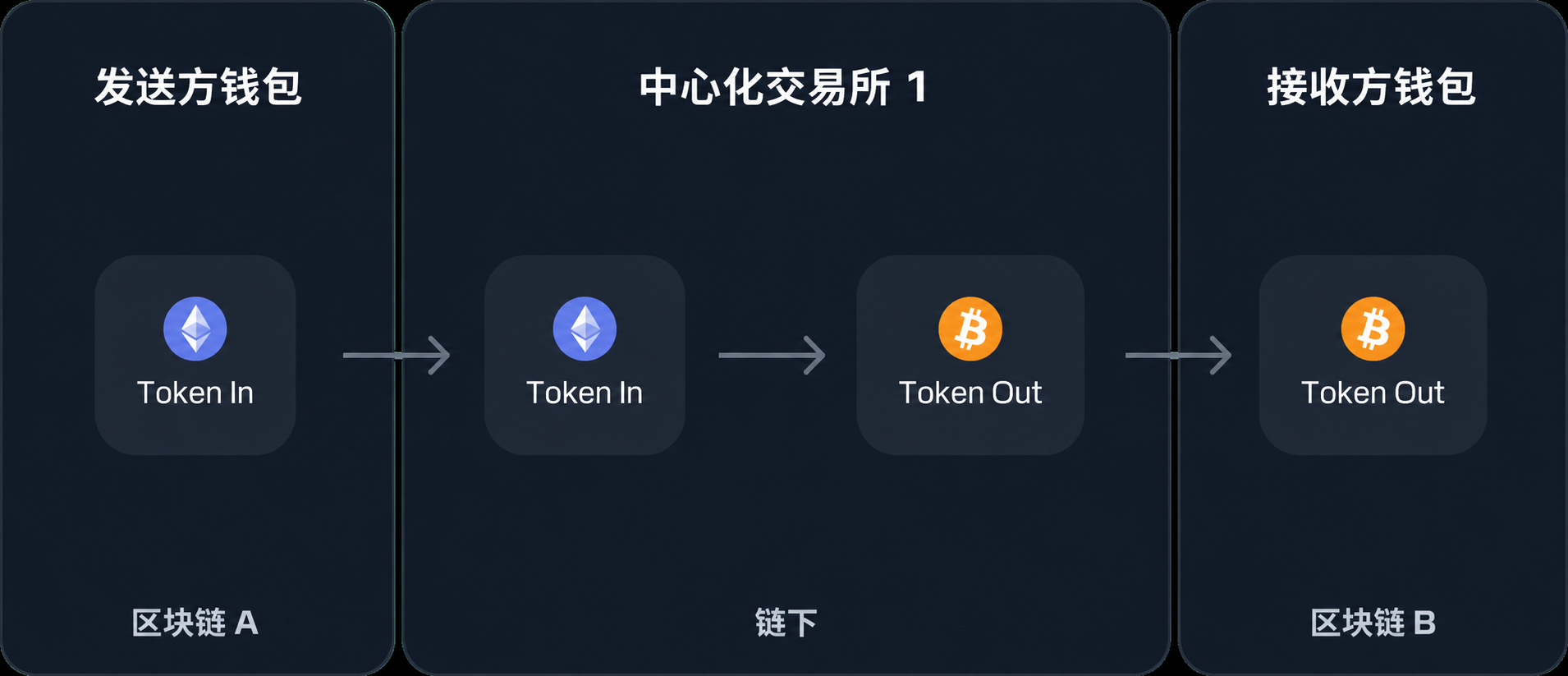
Unlike standard cross-chain swaps, Private Swap routes the transaction through two independent non-custodial swap services and introduces a temporary Layer 1 intermediate asset as a buffer layer. This breaks the on-chain link between the sender and the receiver.
To date, Houdini has processed over $1.5 billion in Private Swap volume, making it one of the most widely used compliant privacy tools in the crypto industry.
Core Features
Highest Level of Privacy Protection
The sending address and the receiving address are never directly linked on-chain. This is Houdini's core privacy capability.
Non-Custodial
Houdini never touches user assets. All swaps are executed automatically by the underlying protocols.
Supports Same-Chain Privacy Swaps
For example:
- USDC (Ethereum) → USDC (Ethereum)
Hides the transaction path while keeping the asset and chain identical.
Supports Cross-Chain Privacy Swaps
For example:
- USDT (TRC20) → BTC
Enables privacy swaps between any assets on any chain.
Market Verified
Since its launch, Private Swap has processed cumulative transaction volume exceeding $1.5 billion.
How It Works
Private Swap splits a single transaction into two independent steps.
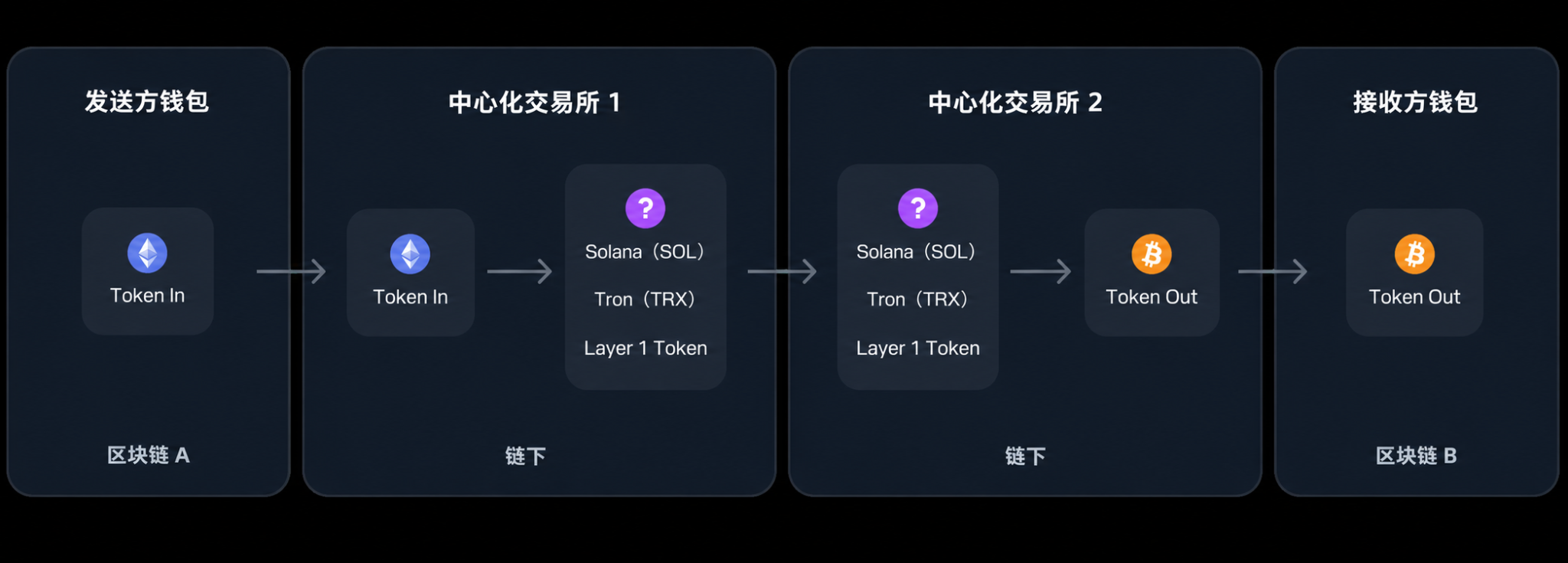
Phase 1 (Source Chain)
The user sends Token A from their wallet. The asset first enters a non-custodial swap platform and is swapped into a temporary privacy-focused Layer 1 intermediate asset.
Intermediate Buffer Layer
This temporary asset acts as a "buffer."
Its function is to:
- Disconnect from the original source of funds
- Break the on-chain transaction path
- Eliminate direct traceability
Phase 2 (Destination Chain)
The intermediate asset is then sent to a second, completely independent non-custodial swap platform.
The system swaps it into the desired target asset, Token B, and sends it to the receiving address.
The ultimate effect is:
By the time the funds reach the destination wallet, there is no verifiable on-chain link between the original sending address and the final receiving address.
Why Is It Private?
1. No Direct On-Chain Link
The sender and receiver never appear in the same transaction or transaction path at the same time.
An observer cannot directly establish a connection between them.
2. No Identifiable Transaction Markers
The on-chain activity does not show:
- "Houdini Swap"
- Specific routing labels
- Fixed-format data
Each transaction phase appears as an ordinary transaction.
To an external observer:
The first phase transaction has ended, and the second phase looks like a completely unrelated transaction.
Therefore, it is impossible to prove that the two transactions belong to the same swap.
3. Infinite Anonymity Set
Even if an observer suspects a transaction came from Houdini, they still cannot determine the final destination.
Because:
- The second phase could occur on any public chain
- The asset could be swapped into any token
- It spans over 100 blockchains
- Supports thousands of assets
Therefore, the anonymity set practically extends to the entire Web3 network.
No Wallet Connect Swap
No Wallet Connect Swap is a mode offered by Houdini that allows asset swapping without connecting a wallet.
Users do not need to go through the traditional "Connect Wallet" process, nor do they need to sign any on-chain messages or authorize transactions. Swaps are completed by transferring assets to a one-time, temporary deposit address generated by the system.
Core Features
More Secure
No need for:
- Wallet Connect
- Approve
- Sign
Since wallet approvals and signatures are commonly cited as significant security risks in crypto, this mode substantially reduces the user's risk of malicious authorization or phishing attacks.
Middle-Ground Privacy Protection
Compared to a standard on-chain swap:
- It does not directly expose the interaction between the wallet and the contract
- Offers higher privacy protection
However, because it lacks the dual-layer anonymous routing structure of Private Swap, its anonymity is less than Private Swap.
Think of it as: Standard Swap < No Wallet Connect < Private Swap
Higher Execution Efficiency
Due to the single-path routing mechanism, it bypasses the dual swap process of Private Swap, resulting in:
- Faster transaction speeds
- Simpler routing
- Generally lower costs
How It Works
1. Initiate Swap
The user submits a swap request:
- Any token
- Any chain
The system then generates a unique, one-time deposit address.
2. Deposit
The user sends assets to this address from any source, including:
- Hardware wallets
- Exchange accounts
- Mobile wallets
- Other on-chain addresses
No wallet connection is needed.
3. Swap
Once the system receives the funds, it completes the asset swap through its partner liquidity providers or swap services.
For example:
Token A → Token B
4. Send
After the swap is complete, the target asset, Token B, is sent directly to the user's specified receiving address.
On-chain DEX / Bridge
On-chain Swap is one of Houdini's fastest and lowest-cost modes, focused on executing asset swaps in a fully decentralized manner.
While Houdini is known for privacy swaps, this mode emphasizes:
- Speed
- Best price
- Transparent on-chain execution
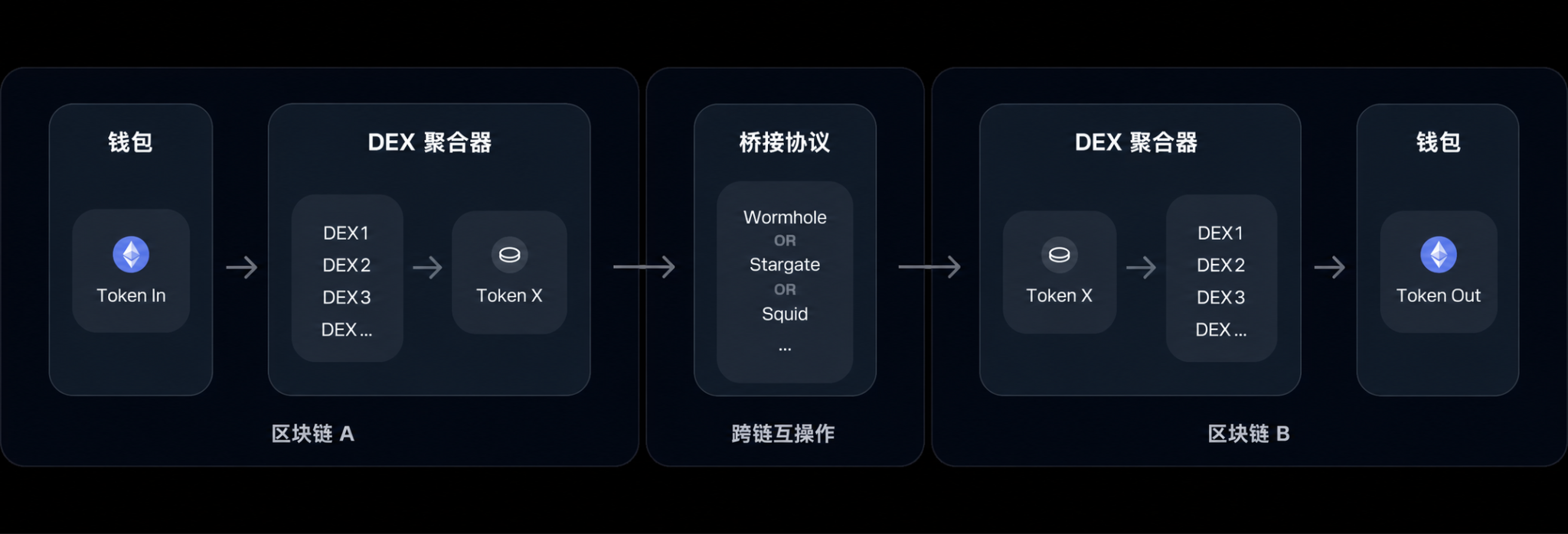
Houdini aggregates multiple liquidity sources, including DEXs, bridges, cross-chain swap protocols, and intent routing networks, to automatically find the best trade path for the user.
Core Features
Best Market Rates
Houdini can simultaneously query over 20 major protocols and aggregators, including:
- Uniswap
- Jupiter
- SushiSwap
- Mayan
- ChainFlip
- CowSwap, and others
By comparing different routes, it finds the best current quote for the user.
In many cases, its prices can be even better than using a single DEX or aggregator alone.
Fully Decentralized
All transactions are executed by smart contracts and verified on-chain.
Houdini:
- Does not custody user assets
- Does not hold funds
- Does not act as a counterparty
Assets are always directly swapped via the user interacting with the underlying liquidity protocols.
Fee Transparency
All fees are included in the final quote presented before transaction confirmation, including:
- Protocol fees
- Bridge fees
- Routing fees
- Other potential costs
Users can see the final amount they will receive before signing, with no hidden charges.
How It Works
1. Get Quote
The user inputs:
- The assets to swap
- The amount
The system scans thousands of on-chain routes in real-time and calculates the best swap plan.
2. Connect Wallet
The user completes the following actions via their wallet:
- Approve
- Sign
Confirming the transaction.
3. Execute Swap
The system automatically selects the optimal on-chain path.
Token A is routed through smart contracts and swapped for Token B.
4. Asset Received
After the swap is complete, Token B is sent directly to the user's specified wallet address.
Odaily's Take
Houdini Swap's advantage lies in its focus on solving the privacy issue stemming from transparent on-chain transactions. Through its anonymous swap and cross-chain asset transfer mechanism, it helps users hide their funding source, transaction path, and destination address when transferring assets between different chains, thereby enhancing asset privacy and security. Furthermore, its operational process is relatively simple, allowing users to achieve good anonymity without needing to master complex privacy tools. This makes it highly attractive for protecting personal financial privacy, preventing on-chain behavior from being tracked, and improving asset fungibility.
On the other hand, its disadvantage is that the privacy sector inherently faces high regulatory pressure, with some jurisdictions potentially subjecting anonymous transaction tools to stricter scrutiny. Additionally, the protocol's privacy effectiveness depends on the overall liquidity scale, user activity, and anonymity pool depth. If the network size is insufficient, the anonymity set is smaller, and the privacy protection capability may be affected. Privacy protocols also generally face challenges such as transaction costs, cross-chain complexity, and high security audit requirements.
2. Key Project Detail of the Week
2.1. Deep Dive: Total Funding of $5 Million Led by Steakhouse Financial, Serotonin, and Galaxy, with Participation from OKX, GSR, and FalconX – Axis: A Synthetic Dollar Protocol Driving Yields via Cross-Asset Arbitrage
Introduction
Axis Protocol is a synthetic dollar protocol. It allows


