Binance Leads, Bitget Perpetual Contracts Stand Out: A Look at the Weekly Trading Volume of US Stocks on Five Major CEXs


- Core Insight: Based on API data from five major CEXs over the past seven days (July 8 to 14, 2026), competition in tokenized US equity exposure products is intense. Binance leads in both spot and perpetual contract trading volume. The overall trading volume of stock perpetual contracts far exceeds that of tokenized spots, reflecting traders' preference for leverage and capital-efficient instruments.
- Key Elements:
- Data Scope: The statistics are limited to trading volume clearly attributable to CEX order books via public exchange APIs. This excludes on-chain aggregation, wallets, and third-party liquidity to ensure data comparability.
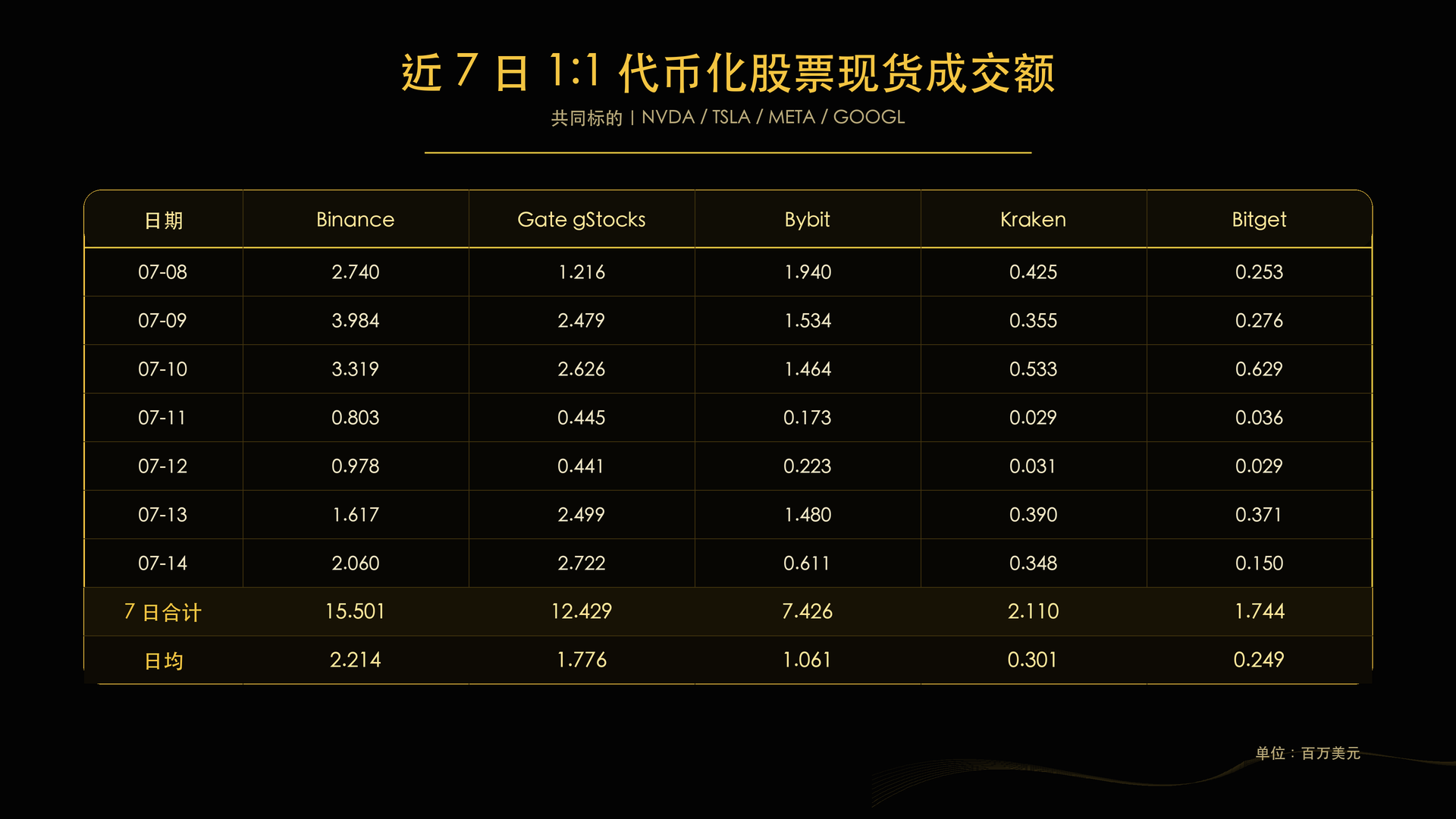
- Market Ranking: Spot trading volume ranking for tokenized stocks (NVDA/TSLA/META/GOOGL): Binance ($15.5M) > Gate ($12.43M) > Bybit ($7.43M) > Kraken ($2.11M) > Bitget ($1.74M).
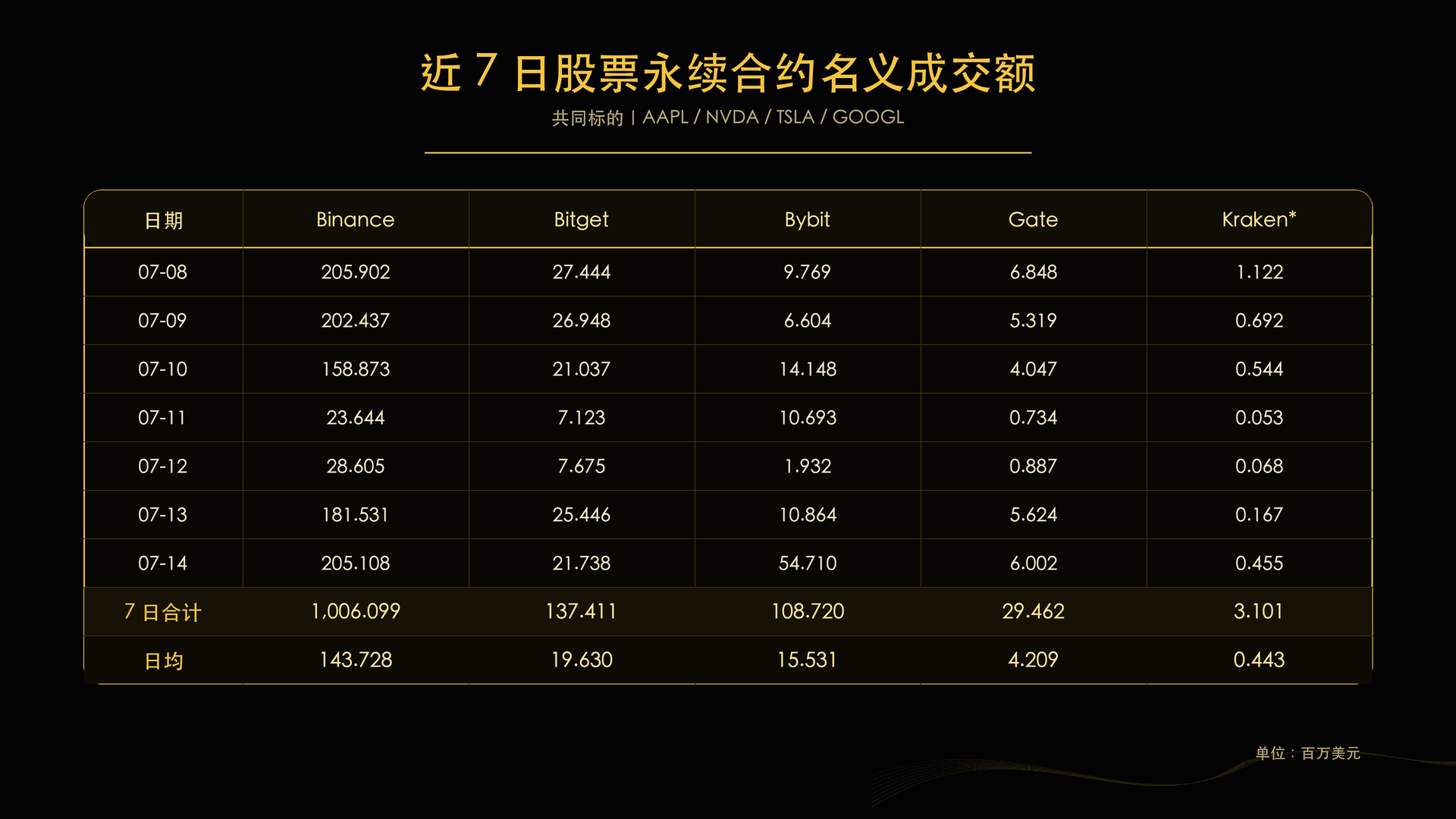
- Perpetual Contract Dominance: Notional trading volume ranking for stock perpetual contracts (AAPL/NVDA/TSLA/GOOGL): Binance ($1.006B) far exceeds others, with Bitget ($137M) and Bybit ($109M) following closely behind. The total volume of perpetual contracts is approximately 32.8 times that of tokenized spots.
- Segmentation Differences: Gate's platform hosts three distinct product lines for tokenized stock spots (gStocks, xStocks, Ondo). The main ranking only includes its branded product, gStocks, at $12.43M. If all three lines are combined, the total is approximately $19.1M.
- Behavioral Characteristics: Although tokenized products support 24/7 trading, weekend trading volume drops significantly. This indicates that liquidity remains highly dependent on traditional US stock trading hours, underlying price discovery, and market maker activity.
US stocks have become a battleground for CEXs. As market competition intensifies, I roughly tallied the order book trading volume of mainstream platforms' US stock asset exposure products over the past 7 days. The sample includes five exchanges: Binance, Bybit, Gate, Kraken, and Bitget.
The data is based on the actual trading volume that can be clearly attributed to the CEX order books from the public APIs of each platform (statistical period: July 8, 2026, to July 14, 2026, UTC full calendar days).
To improve comparability, I selected several common underlying assets:
- 1:1 Tokenized Stock Spot: NVDA, TSLA, META, GOOGL
- Stock Perpetual Contracts: AAPL, NVDA, TSLA, GOOGL
The volume for perpetuals is notional turnover, not representing net buys, open interest, or platform revenue.
1. Binance
Last 7 days:
- 1:1 Tokenized Stock Spot: Approximately $15.5013 million
- Stock Perpetual Contracts: Approximately $1.006 billion
Among these five platforms, Binance has the highest trading volume for both tokenized spot and stock perpetuals.
For the stats, spot volume includes CEX order book turnover for the four common underlying assets (NVDA, TSLA, META, GOOGL) within Binance bStocks; perpetual volume counts the order books for the four stock perpetuals (AAPL, NVDA, TSLA, GOOGL).
Volume generated by Binance Wallet or on-chain aggregation trading is not included here.
2. Bybit
Last 7 days:
- 1:1 Tokenized Stock Spot: Approximately $7.4257 million
- Stock Perpetual Contracts: Approximately $109 million
Bybit's spot volume counts the order book turnover for the four common underlying assets in its xStocks product line, while the perpetual volume is the notional turnover of the corresponding stock perpetual order books.
Again, Bybit Wallet, on-chain DEX, or other third-party liquidity sources are not included in the platform volume.
3. Kraken
Last 7 days:
- 1:1 Tokenized Stock Spot: Approximately $2.1096 million
- Stock Perpetual Contracts: Approximately $3.101 million
Kraken's spot volume counts the common underlying assets in the xStocks order book.
It's important to note that some of Kraken's public candlestick data only returns volume in the base asset, without directly returning turnover in USD. Therefore, I estimated it by multiplying the daily VWAP or OHLC average price by the base asset volume.
So, while Kraken's data is in the same USD notional volume dimension as other platforms, its precision may be slightly lower than platforms that directly provide quote turnover.
4. Bitget
Last 7 days:
- 1:1 Tokenized Stock Spot: Approximately $1.7438 million
- Stock Perpetual Contracts: Approximately $137 million
Bitget's spot volume only counts NVDAON, TSLAON, METAON, and GOOGLON from the Ondo Stock Token product line, excluding rTokens issued by Reality Protocol.
Why exclude rTokens?
Because the trading volume shown in Bitget's public market data for rTokens is closer to the liquidity of the underlying US stocks or direct broker connections, and cannot be clearly attributed to actual trades executed by Bitget clients on the CEX.
For example, the 24-hour volume for rNVDA once exceeded $25 billion, approaching the magnitude of the entire market for NVIDIA's underlying stock. Counting this number directly as Bitget's platform volume would significantly overestimate Bitget's actual business scale.
Therefore, for Bitget, I only counted the Ondo spot order book and the platform's stock perpetual order book that can be confirmed from the public API.
5. Gate
Last 7 days:
- gStocks Spot: Approximately $12.429 million
- Stock Perpetual Contracts: Approximately $29.4617 million
Gate's situation is quite unique.
Gate operates three sets of tokenized stock spot order books simultaneously:
- gStocks: Approximately $12.429 million
- xStocks: Approximately $2.1444 million
- Ondo: Approximately $4.5283 million
The total for the three spot product lines is approximately $19.1017 million.
However, to maintain a horizontal comparison standard of selecting one representative spot product line per platform, the main ranking only includes Gate's branded product, gStocks, without stacking all three order books and comparing them against a single product line from other platforms.
If we look at all visible spot order books for these four underlying assets on Gate, the spot volume would be approximately $19.1017 million; adding the stock perpetuals brings the total to around $48.5634 million.
Gate's perpetual volume counts the order book turnover for the four USDT-margined stock perpetual contracts: AAPLX, NVDAX, TSLAX, and GOOGLX.
Summary
This statistic measures the actual trading volume that can be clearly attributed to CEX order books from the platforms' public APIs.
It does not include:
- Trading volume of the entire underlying US stock market
- Aggregated wallet trading that cannot be attributed to a specific platform
- On-chain token trading volume within the broader DeFi ecosystem
- Client trading volume executed through broker channels but not reported by the platform
- Market data that cannot be separated from the platform's client execution volume
Therefore, based on the main ranking of one representative spot product line per platform, the top 5 for tokenized stock spot volume in the last 7 days are:
- Binance: Approximately $15.5 million
- Gate (gStocks): Approximately $12.43 million
- Bybit: Approximately $7.43 million
- Kraken: Approximately $2.11 million
- Bitget: Approximately $1.74 million
The ranking for stock perpetuals is:
- Binance: Approximately $1.006 billion
- Bitget: Approximately $137 million
- Bybit: Approximately $109 million
- Gate: Approximately $29.46 million
- Kraken: Approximately $3.1 million
Similarly, within this set of five platforms and the current common underlying assets, the trading volume for stock perpetuals is approximately 32.8 times that of tokenized stock spots. This shows that when CEX users trade US stock asset exposure, the primary demand is still concentrated on perpetual contracts, not 1:1 tokenized stock spots. After all, perpetuals allow for both long and short positions with leverage, offering higher capital efficiency and aligning more closely with the existing trading habits of crypto users.
Another observable phenomenon is that although many tokenized stocks and stock perpetuals advertise 24/7 trading, weekend trading volume still drops significantly.
This indicates that a product's ability to trade around the clock does not mean its liquidity is already completely decoupled from the US stock market. At this stage, US stock market trading hours, underlying market price discovery, and market maker activity times still significantly impact the liquidity of stock products on CEXs.