






เหตุการณ์สัญญาเล่นยังไง? เปรียบเทียบประสบการณ์ 4 แพลตฟอร์มยอดนิยม


- มุมมองหลัก: สัญญาเหตุการณ์เป็นอนุพันธ์ทางการเงินที่อนุญาตให้ผู้เข้าร่วมซื้อขายผลลัพธ์ของเหตุการณ์เฉพาะ โดยมีโครงสร้างหลักรวมถึงคำจำกัดความของปัญหา ตัวเลือกผลลัพธ์ และเงื่อนไขการชำระบัญชี บทความนี้จะวิเคราะห์กลไกการทำงาน ตรรกะการกำหนดราคา (เช่น 70 เซนต์ หมายถึงความน่าจะเป็น 70%) อย่างละเอียด และเปรียบเทียบความแตกต่างหลักของแพลตฟอร์มทั้งสี่แห่ง ได้แก่ Polymarket, Kalshi, Robinhood และ TurboFlow ในด้านการออกแบบผลิตภัณฑ์ การสร้างราคา กลไกการออก และวิธีการชำระบัญชี
- ปัจจัยสำคัญ:
- วัตถุประสงค์การซื้อขายของสัญญาเหตุการณ์คือผลลัพธ์ของสัญญา ซึ่งโดยทั่วไปจะออกแบบตามโครงสร้าง "ใช่/ไม่ใช่", "สูงกว่า/ต่ำกว่า", "แบบเกณฑ์" หรือ "แบบหลายผลลัพธ์" โดยราคาอยู่ระหว่าง 0-1 ดอลลาร์ แสดงถึงความน่าจะเป็นโดยนัยของตลาด
- รายละเอียดสำคัญของการชำระบัญชีรวมถึง: แหล่งข้อมูล สัญลักษณ์เปรียบเทียบ (มากกว่าอย่างเคร่งครัดหรือรวมถึงเท่ากับ) เขตเวลา การจัดการกรณีพิเศษ (เลื่อน/ยกเลิก) และกระบวนการโต้แย้ง ซึ่งส่งผลโดยตรงต่อการตัดสินผลลัพธ์
- Polymarket และ Kalshi ใช้สมุดคำสั่งซื้อเพื่อสร้างราคา และอนุญาตให้ออกก่อนกำหนดเมื่อมีสภาพคล่องเพียงพอ ในขณะที่ TurboFlow ใช้ผู้ดูแลสภาพคล่องอัตโนมัติ (propAMM) ในการเสนอราคา รองรับสัญญาแบบรอบระยะเวลาคงที่ที่สั้นที่สุด 30 วินาที และถือจนกว่าจะชำระบัญชีอัตโนมัติ
- Robinhood ในฐานะช่องทางเข้า ราคาเสนอและการชำระบัญชีที่แท้จริงจะถูกกำหนดโดยการแลกเปลี่ยนพันธมิตร (เช่น KalshiEX) ผู้ใช้ต้องใส่ใจถึงผู้ให้บริการสัญญาที่แท้จริง ในด้านค่าธรรมเนียม แพลตฟอร์มที่แตกต่างกันอาจเรียกเก็บค่าธรรมเนียมการซื้อขาย ค่าธรรมเนียมการวางคำสั่ง หรือค่าธรรมเนียมบนเชน
- ความเสี่ยงหลักรวมถึงการสูญเสียเงินต้น การตีความกฎผิด (เช่น ค่าขอบเขต) การเลื่อนราคาจากสภาพคล่องไม่เพียงพอ ความล่าช้าของข้อมูลหรือข้อพิพาทของ Oracle รวมถึงข้อจำกัดด้านเทคนิคและการปฏิบัติตามกฎระเบียบ
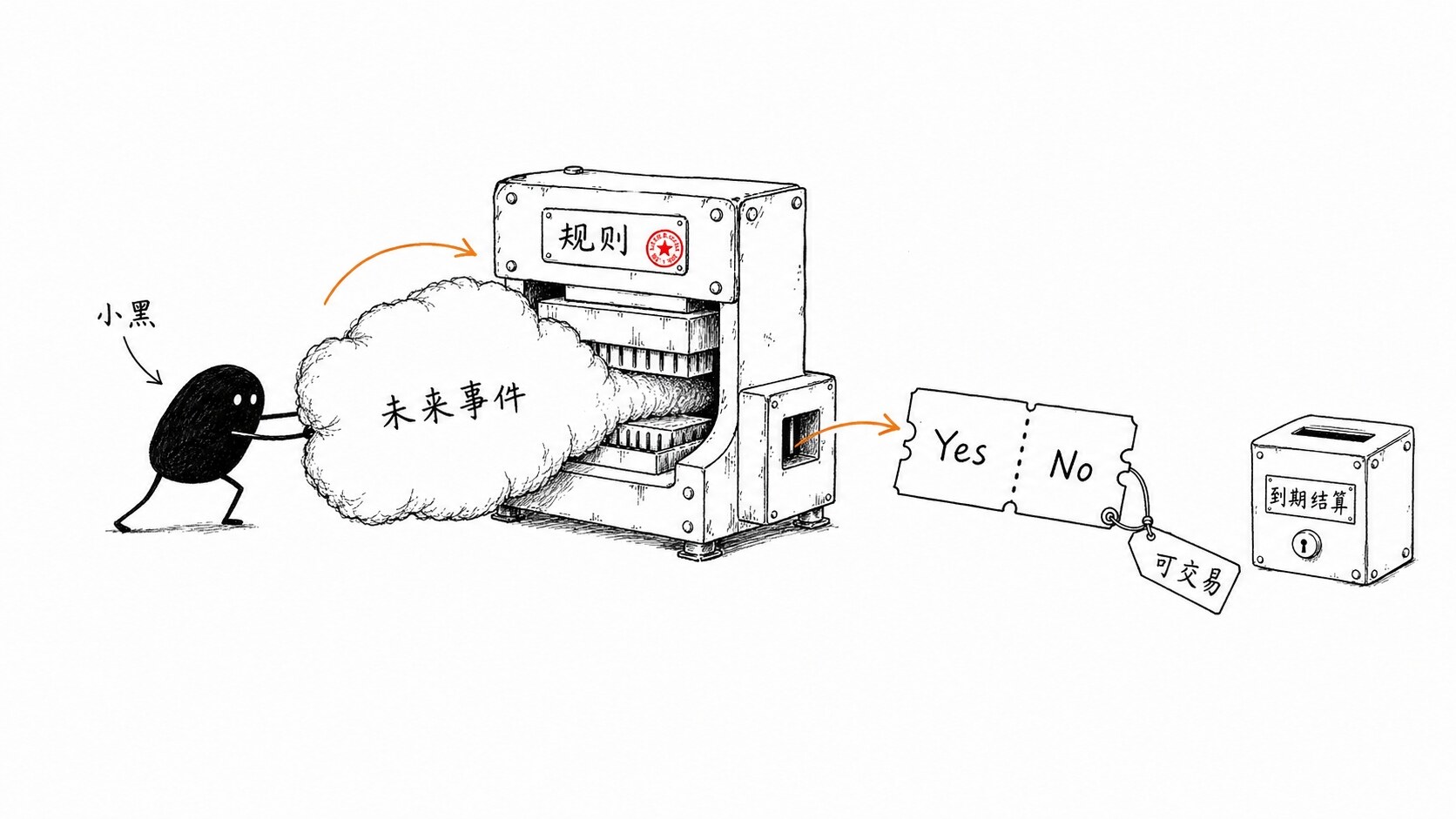
What is an Event Contract?
An event contract proposes a verifiable question and pre-defines the outcome options and settlement conditions. Common structures include:
- Yes/No: e.g., "Whether a specific indicator will reach a target by a specified date."
- Higher/Lower: Determining if the price at expiration is higher or lower than the entry price.
- Threshold: Determining if the final value is above, below, or not below a specific number.
- Multi-Outcome: Multiple mutually exclusive results for the same event, each priced separately.
Participants trade on the contract's outcome. Contract terms usually specify the market question, deadline, time zone, official data source, boundary values, handling of canceled or postponed events, and the payout amount for winning contracts. Markets with similar titles may still use different rules.
How Do Event Contracts Work?
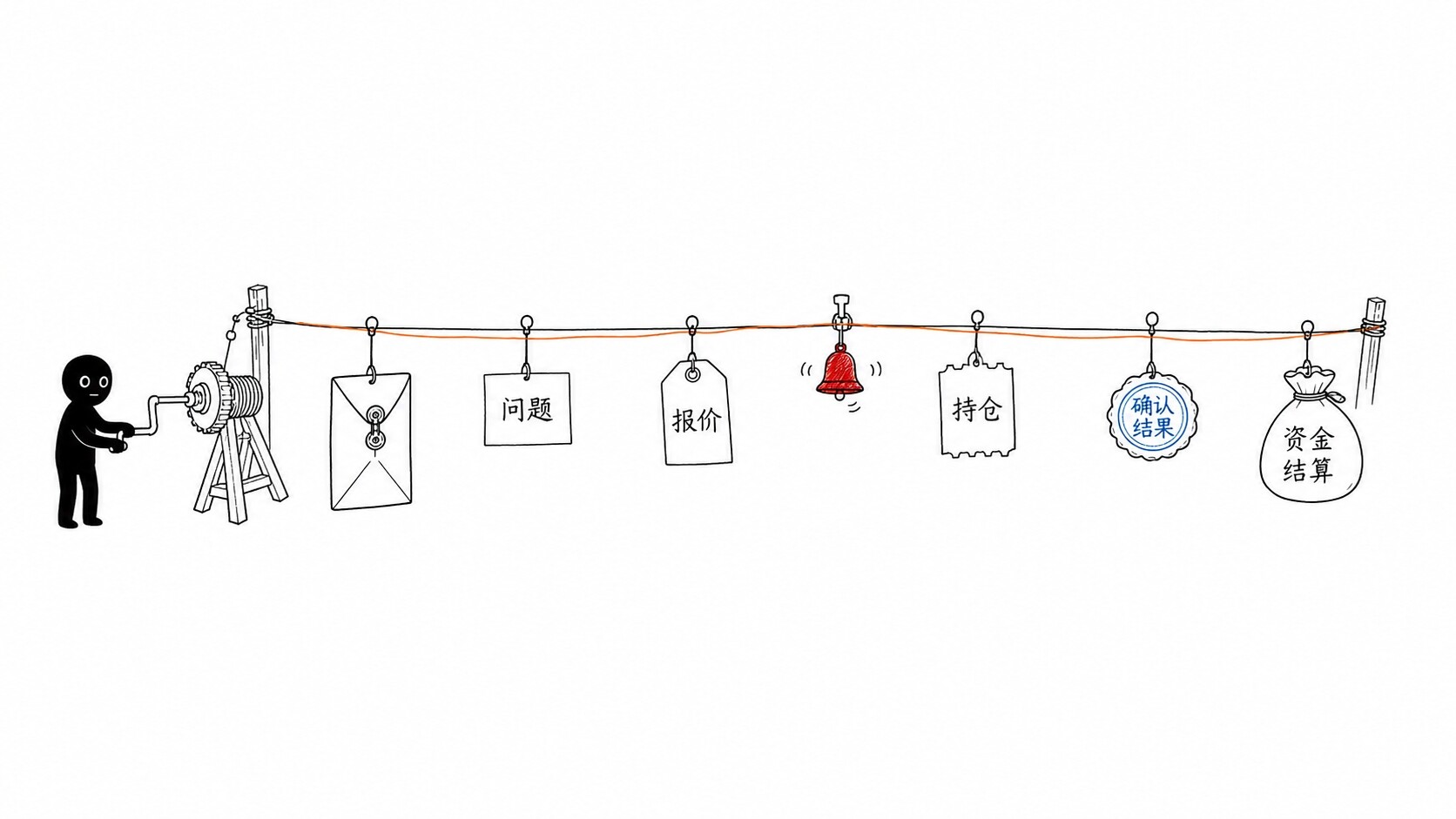
- 1. Create Market: The platform defines the question, outcomes, trading deadline, and settlement source.
- 2. Price Formation: On order book platforms, prices come from buyer and seller quotes; in products using automated market makers, prices are formed by the market-making model, showing the participation amount and return information before confirmation.
- 3. Establish Position: After an order fills, the participant holds a direction of an outcome. Some platforms allow selling before the market closes, subject to liquidity.
- 4. Stop Trading: The market stops accepting trades upon reaching the deadline, the start of the event, or other conditions defined by the platform.
- 5. Confirm Outcome: The platform, exchange, or a pre-designated oracle confirms the outcome based on the contract terms and data source.
- 6. Complete Settlement: Binary contracts typically settle winning outcomes at $1 per share and losing outcomes at $0; fixed-return products calculate returns based on the locked rules at the time of confirmation.
Pricing: What Does 70 Cents Represent?
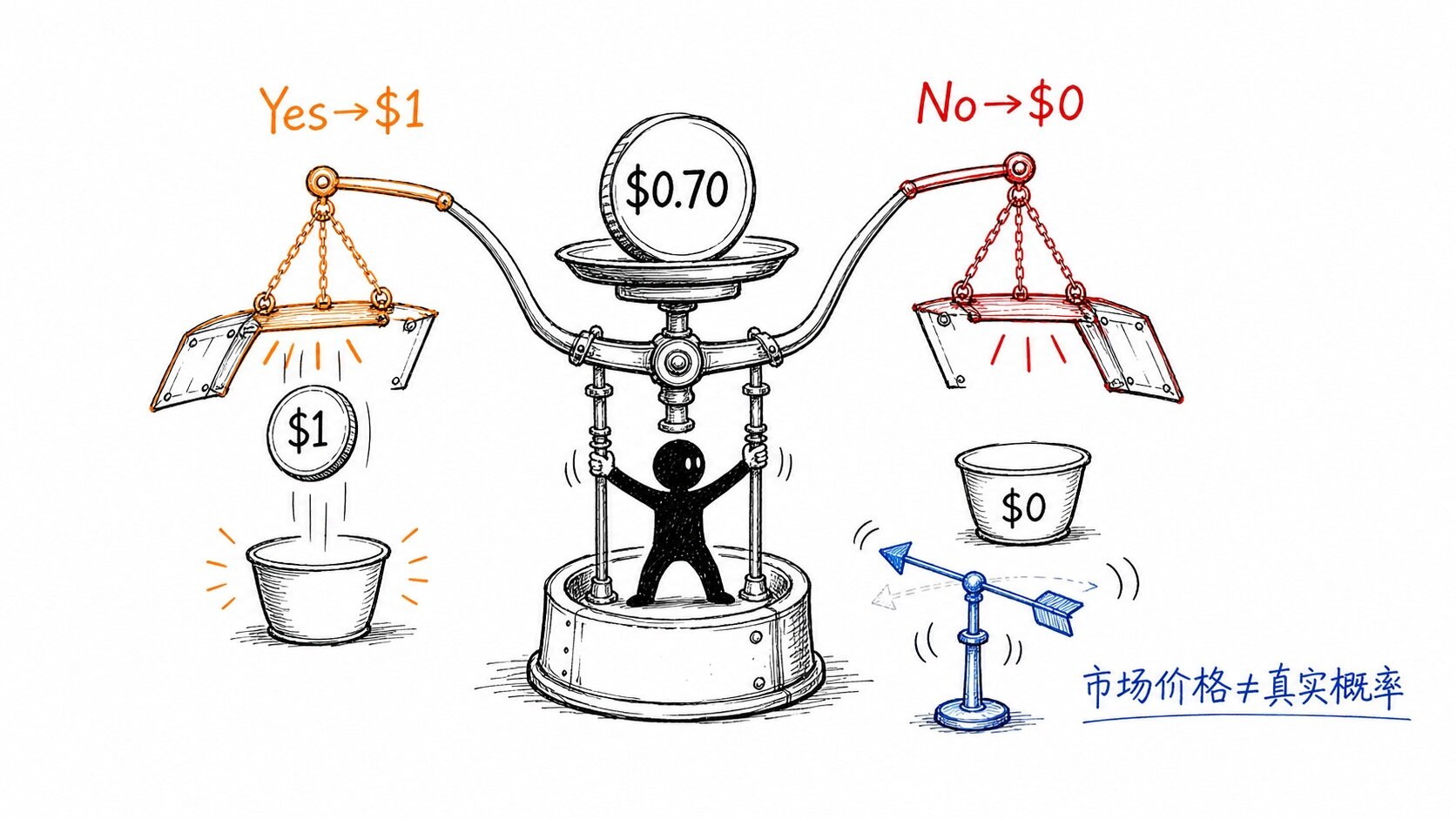
In a binary contract priced between $0 and $1, the price is often understood as the market's implied probability. A "Yes" contract priced at $0.70 suggests the market currently prices in roughly a 70% probability of occurrence.
If the final outcome is "Yes," each share typically pays out $1, yielding a gross profit of $0.30 (excluding fees and spreads); if the outcome is "No," the share's value goes to zero, with a maximum loss of the $0.70 invested.
Prices are influenced by new information, order book depth, bid-ask spreads, and participant supply and demand. A displayed 70% merely reflects the current market price and does not guarantee the true probability is 70%. Fixed-return products using automated market makers also incorporate duration, volatility, and risk parameters to form prices and display returns. Participants should simultaneously review the principal, projected return, and maximum potential loss.
What Settlement Rules Should You Check?
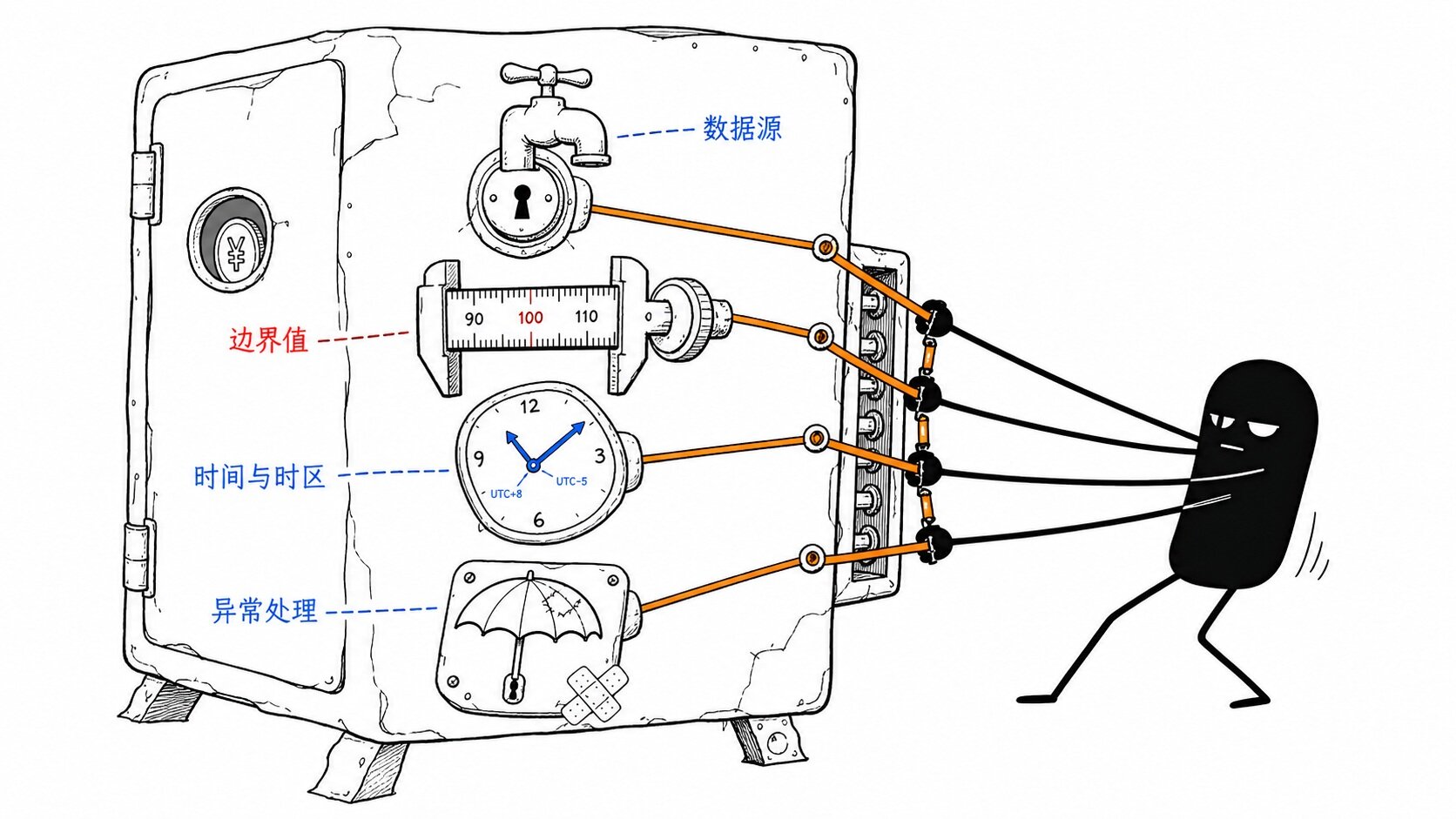
- Settlement Data Source: Government agencies, event organizers, price indices, exchange data, or oracles can serve as the final basis.
- Comparison Symbols: "Above 100" typically requires strictly greater than 100; "100 or above" includes values equal to 100.
- Time and Time Zone: Which time point and time zone are used for settlement, and whether the price sample is an instantaneous value, closing value, or average over a period.
- Exception Handling: How are events handled if postponed, canceled, data is corrected, price feeds are interrupted, or the outcome remains undetermined for an extended period?
- Dispute Process: Who can challenge the outcome, what is the objection period, and who makes the final decision?
- Fees and Payouts: Trading fees, platform commissions, on-chain gas fees, and withdrawal costs all affect actual returns.
Platform Product Reviews
Polymarket: Continuously Traded Event Markets
Polymarket is a prediction market for continuous trading on event probabilities, using an order book for price formation and the UMA oracle for outcome confirmation.
- Specific Products: Primarily yes/no outcome shares, covering categories like politics, macroeconomics, sports, crypto assets, and cultural events; markets typically run until the event occurs and settles.
- Quotes: Uses an order book. The page probability usually shows the mid-price between the best bid and best ask; when the bid-ask spread exceeds $0.10, the page switches to the last traded price. Matching quotes for "Yes" and "No" sum to $1.
- Trading and Exit: While a market is open and has a counterparty, you can buy or sell outcome shares via the order book. Limit orders allow price control; insufficient liquidity may prevent exiting at the desired price.
- Settlement: Handled by the UMA optimistic oracle according to the market's pre-announced rules. There is a challenge period after an outcome is proposed; winning shares pay $1 each, losing shares go to zero.
- Fees: Current official documentation states fees are charged to takers in some markets, with makers not charged; parameters vary by market category. Check the latest rates before entering.
Review: Suitable for users who want to continuously trade event probabilities, use limit orders, and monitor market depth. Key points to check include rule phrasing, bid-ask spread, on-chain wallet, oracle dispute process, and regional availability.
Official Resources: Polymarket Pricing Rules|Polymarket Settlement Rules|Polymarket Fee Rules
Kalshi: Standardized Yes/No Event Contracts
Kalshi is an event market centered on standardized yes/no contracts, clear market rules, and order book trading.
- Specific Products: Primarily yes/no contracts and threshold contracts, with each market listing a clear rule summary, expiration conditions, and result verification source.
- Quotes: Uses an order book; contract prices are quoted in cents. A "Yes" contract at 70 cents and a "No" contract at 30 cents sum to $1; the best bid, best ask, and available quantity directly affect execution.
- Trading and Exit: Positions can be opened via the order book and exited by selling if the market is still open and liquid. Unfilled orders can be canceled.
- Settlement: Each contract's terms specify the information and sources used. After expiration, Kalshi confirms the outcome based on these terms; official documentation states settlement confirmation may take between one hour and over twelve hours after market close, depending on the data source.
- Fees: Trading fees are calculated based on factors like expected profit; some markets may also charge maker fees. Canceling unfilled orders is free. Check the actual fees on the market page before confirming an order.
Review: Product terms and verification sources are displayed relatively clearly, suitable for users who value standardized rules, order books, and the ability to exit early. The fee formula, market liquidity, and regional eligibility need separate verification.
Official Resources: Kalshi Pricing Rules|Kalshi Market Rules|Kalshi Fee Rules
Robinhood: Accessing Partner Exchanges via a Familiar Interface
Robinhood serves as an entry point to event contracts on partner exchanges through a familiar interface. The actual quotes, settlement, and special rules are determined by the exchange hosting the contract.
- Specific Products: Robinhood's derivatives business offers event contracts via KalshiEX, ForecastEX, or Rothera Exchange and Clearing, commonly including single yes/no, threshold contracts, and combined outcomes.
- Quotes and Payouts: Unit prices typically range from $0.01 to $0.99; correct outcomes settle at $1 cash, incorrect outcomes at $0. The price and applicable fees are shown before placing an order.
- Trading and Exit: Unfilled orders can be canceled; filled orders cannot be reversed. While the market is open and has buyers, positions can be sold at the current market price; otherwise, they must be held until settlement.
- Settlement: The final outcome is determined by the corresponding partner exchange based on the official data sources and terms specified in the contract. Robinhood cannot alter the exchange's settlement decision.
- Fees: May involve both exchange fees and Robinhood commissions; the specific amounts are displayed on the order confirmation page.
Review: Suitable for users already using Robinhood who value a unified interface. When reading terms, you must identify the exchange actually hosting the contract, as settlement, fees, and special event rules are governed by that specific contract.
- Official Resources: Robinhood Operating Rules|Robinhood Exit Rules
TurboFlow: On-Chain Trading Ecosystem for Retail Investors
TurboFlow is an on-chain trading ecosystem for global retail investors, merging prediction markets with perpetual contracts. It offers perpetual contracts, event contracts, and prediction markets on one platform, lowering the entry barrier for ordinary users through transparent execution and professional liquidity.
- Specific Products: This review focuses on TurboFlow's event contracts, specifically "Higher/Lower" contracts within a fixed time window. Users select the market, participation amount, duration, and direction. The minimum participation amount is $2, with rounds as fast as 30 seconds. Live parameters are on the product page.
- Quotes and Participation: An automated market maker (propAMM) forms quotes based on market, duration, and risk parameters. Before confirmation, the entry price, participation amount, duration, direction, projected return, and expected outcome are displayed. Once the order is confirmed, the return rate for that contract is locked.
- Settlement: The entry price is the price at order acceptance; the settlement price is the price used at contract expiration. For "Higher," the settlement price must be above the entry price; for "Lower," the opposite is true. If they are equal, the principal is returned per official rules.
- Position Management: Automatic settlement occurs after the countdown. No management of margin, funding rates, or liquidations is needed during the holding period; this mechanism differs from the platform's perpetual contract products.
Review: TurboFlow targets retail investors, lowering the entry barrier for event contracts with a minimum of $2 and rounds as fast as 30 seconds, integrating perpetual contracts and prediction markets on one platform. Short-duration "Higher/Lower" contracts are more sensitive to entry timing, market volatility, and price data.
- Official Resources: TurboFlow Event Contracts
Key Differences
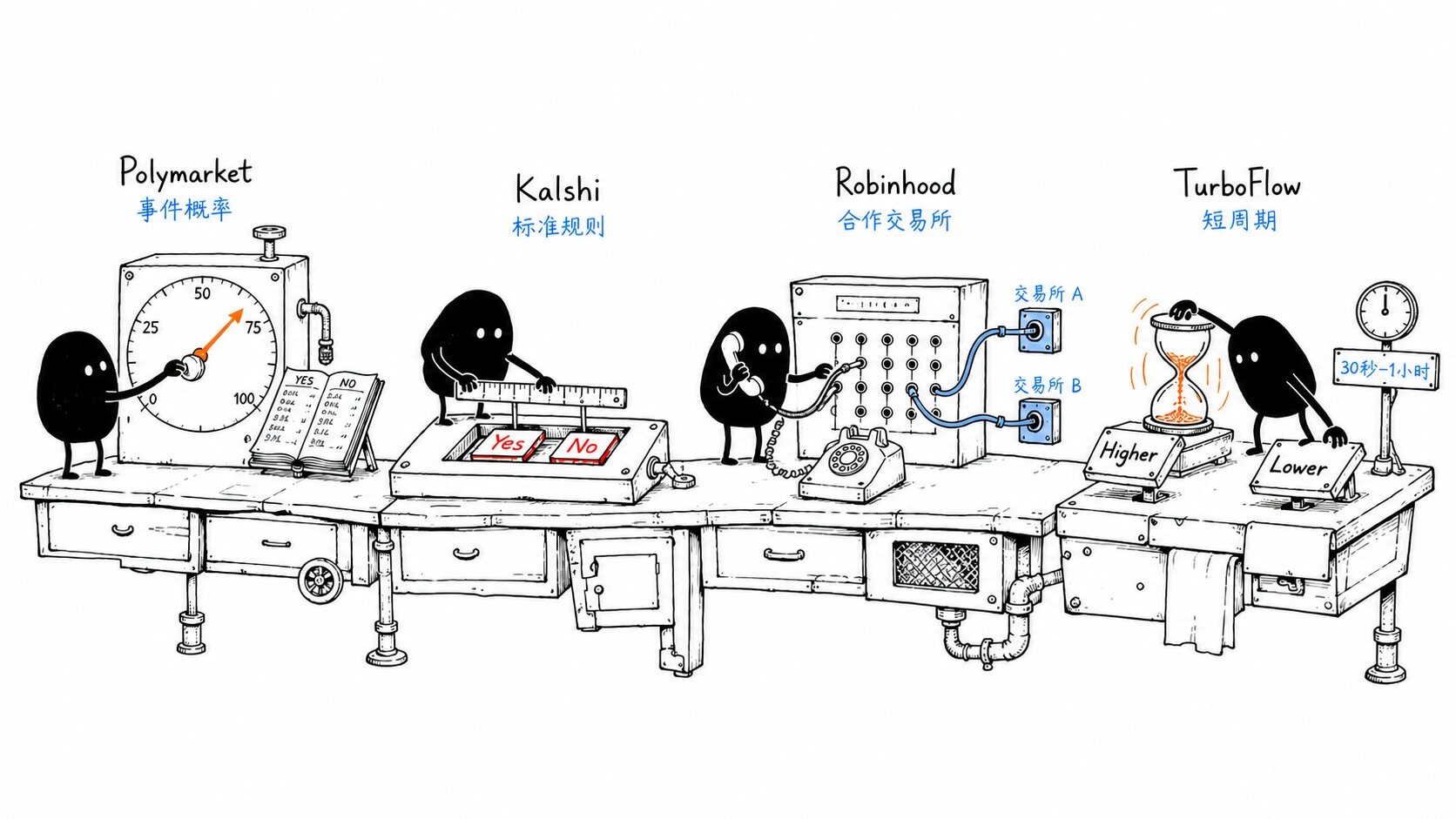
- Price Formation: Polymarket and Kalshi primarily rely on order books; Robinhood displays market quotes from partner exchanges; TurboFlow event contracts use an automated market maker (propAMM) to form quotes, displaying entry price, participation amount, duration, direction, and locked return before confirmation.
- Time Span: Polymarket, Kalshi, and Robinhood contracts typically run around an event's deadline; TurboFlow event contracts use a fixed time window, with rounds as fast as 30 seconds.
- Early Exit: The first three product types generally allow selling positions while the market is open and liquid; TurboFlow event contracts' public process focuses on holding until the countdown ends for automatic settlement.
- Settlement Body: Polymarket uses the UMA oracle; Kalshi confirms outcomes based on its own market terms and specified sources; Robinhood relies on the decision of partner exchanges; TurboFlow event contracts settle automatically according to pre-disclosed contract rules, using trusted market data sources and entry/settlement prices generated by multiple oracles.
- Applicable Scenarios: Focus on Polymarket for continuously evolving event probabilities; research Kalshi for standardized market rules; check partner exchange contracts via Robinhood's unified interface; research TurboFlow event contracts for low-barrier participation in short-duration "Higher/Lower" contracts.
Major Risks
- Loss of Principal: A single contract can go to zero if the direction is wrong; fixed-return products may also result in a loss of the participation amount.
- Rule Risk: Ignoring boundary values, time zones, data sources, or exception clauses can lead to incorrect expectations about the settlement outcome.
- Liquidity and Spreads: The page probability, executable price, and early exit price may differ significantly.
- Settlement and Data Risk: Official data delays, corrections, oracle disputes, or price feed anomalies can prolong settlement and trigger special rules.
- Fee Risk: Trading fees, commissions, on-chain network fees, and deposit/withdrawal costs reduce actual returns.
- Technical and Compliance Risk: Account security, smart contracts, platform operations, and regional restrictions can all affect product usability.
Summary
To understand event contracts, examine the five steps: "Question Definition—Price Formation—Trading and Exit—Outcome Confirmation—Fund Settlement." Polymarket, Kalshi, Robinhood, and TurboFlow event contracts follow different product paths. TurboFlow itself is an on-chain trading ecosystem merging prediction markets and perpetual contracts; this review covers only its event contract product. Platform names cannot substitute for verifying the terms of individual contracts. What ultimately determines the outcome are the time, data source, boundary conditions, and exception handling rules written in the contract.


