






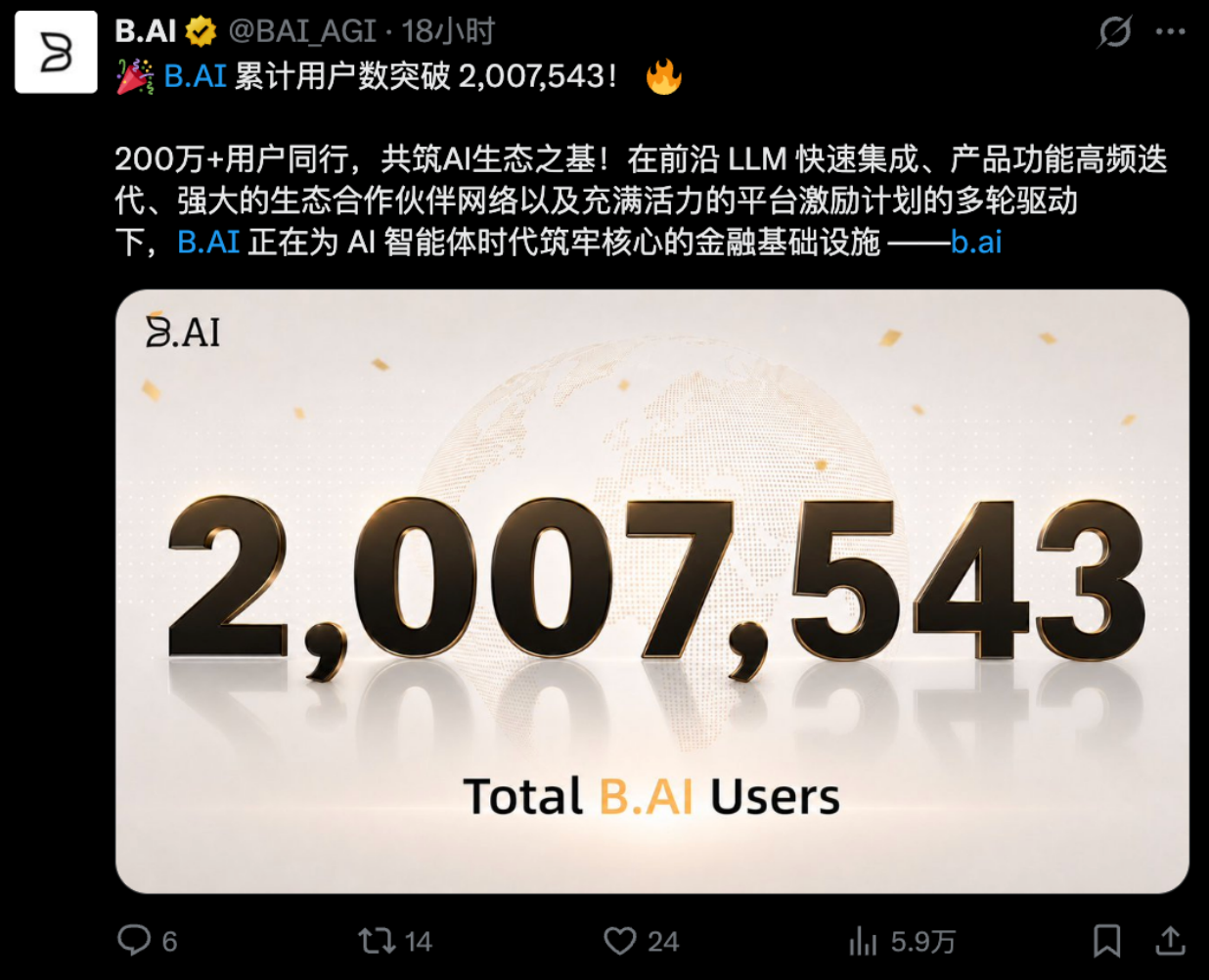
白B.AI ผู้ใช้ทะลุ 2 ล้านราย แพลตฟอร์มรวมโมเดลหลายรูปแบบเข้าสู่ขั้นตอนการให้บริการแบบละเอียด


- มุมมองหลัก: แพลตฟอร์มรวมโมเดล AI 白B.AI มีผู้ใช้ทะลุ 2 ล้านราย ปริมาณการรับส่งข้อมูล Token ต่อวันสูงถึง 18,690 ล้านครั้ง สัดส่วนการเรียกใช้ API สูงสุดเพิ่มขึ้นเป็น 99.7% แกนหลักของการเติบโตกำลังเปลี่ยนจากการสนทนาไปสู่การเรียกใช้ของนักพัฒนาและการทำงานของ Agent โดยผ่านการแบ่งชั้นบริการ การชำระเงินที่หลากหลาย และ API แบบรวมศูนย์ เพื่อสร้างโครงสร้างพื้นฐานบริการ AI ที่มุ่งสู่สถานการณ์การผลิตที่มีความถี่สูง
- ปัจจัยสำคัญ:
- การเติบโตของผู้ใช้และข้อมูล: ผู้ใช้แพลตฟอร์มทะลุ 2 ล้านราย ปริมาณการรับส่งข้อมูล Token ต่อวันสูงถึง 18,690 ล้านครั้ง สัดส่วนการเรียกใช้ API สูงสุดเพิ่มขึ้นเป็น 99.7% ซึ่งบ่งชี้ว่าการใช้งานได้เจาะลึกไปถึงสถานการณ์ของนักพัฒนาและระบบระดับองค์กร
- รูปแบบการแบ่งชั้นบริการ: ให้บริการทั้งโหมดเชื่อมต่ออย่างเป็นทางการและโหมดเลือกผู้ให้บริการเอง โดยโหมดหลังจะจัดกลุ่มส่วนลดเช่น 40% และ 60% ครอบคลุมโมเดลอย่าง Claude, GPT เพื่อตอบสนองความต้องการในด้านความเสถียรและต้นทุนสำหรับงานที่แตกต่างกัน
- ระบบการชำระเงินที่หลากหลาย: รองรับ WeChat Pay, Alipay, บัตรธนาคาร, Visa/Mastercard และการชำระเงินด้วยสินทรัพย์เข้ารหัสหลายเชน เพื่อลดอุปสรรคในการแปลงผู้ใช้และผู้เรียกใช้ความถี่สูงในภูมิภาคต่างๆ
- การเสริมความลึกของสถานการณ์นักพัฒนา: สัดส่วน API ที่สูงแสดงให้เห็นว่าผู้ใช้กำลังเปลี่ยนจากการสนทนาส่วนหน้าไปสู่การเรียกใช้แบ็กเอนด์ เวิร์กโฟลว์ AI Agent และขั้นตอนการทำงานอัตโนมัติ โครงสร้างการใช้งานมีความเป็นมืออาชีพและมีความถี่สูงมากขึ้น
- ตำแหน่งทางระบบนิเวศและแนวโน้ม: แพลตฟอร์มพัฒนาจาก "ทางเข้าแบบรวมศูนย์" ไปสู่โครงสร้างพื้นฐานในยุค AI Agent โดยมีเป้าหมายเพื่อเชื่อมต่อความสามารถของโมเดล การบริโภคบริการ วิธีการชำระเงิน และระบบนิเวศของนักพัฒนา ให้เหมาะกับการบริโภคการเรียกใช้โมเดลที่ต่อเนื่องและมีความถี่สูง
Recently, the AI model aggregation platform Bai B.AI has reached a new growth milestone. According to the latest disclosure on its official X account, the platform's user base has exceeded 2 million. At the same time, the platform's actual usage data is also rising: Bai B.AI's recent single-day token throughput has reached a high of 18.69 billion, with API call share peaking at 99.7%, primarily supporting large-scale AI agents, automated workflows, and enterprise-level core system applications. This indicates that BaiB.AI's growth is no longer confined to front-end conversational scenarios but is penetrating high-frequency use cases such as developer API calls, agent operations, and production-grade system integration, generating more sustainable real-world consumption.
Over the past year, the competitive focus of the global AI industry has shifted. With the rapid iteration of large language model (LLM) capabilities, users and developers are no longer solely concerned with whether a single model is powerful enough, but rather how to efficiently choose between different models, control token costs, and stably integrate AI capabilities into real business processes. The continued attention on model aggregation and routing platforms like OpenRouter demonstrates that multi-model coexistence has become a key direction for AI application development. Bai B.AI's growth further points to another trend: AI model aggregation platforms are moving from being a "unified entrance" towards more refined service layering. Platforms must not only provide model inference capabilities but also offer users greater flexibility in terms of stability, pricing, payment habits, and use cases.
Towards Refined Multi-Model Calling: Bai B.AI Enhances Service Layering
Against the backdrop of the rapidly expanding LLM ecosystem, complex reasoning, code generation, long-text processing, multimodal tasks, and low-cost, high-frequency calls often require different model capabilities. For regular users, switching accounts, subscriptions, and payments across multiple platforms is inefficient. For developers and enterprises, integrating with different model interfaces separately also brings additional engineering costs, billing complexities, and stability challenges.
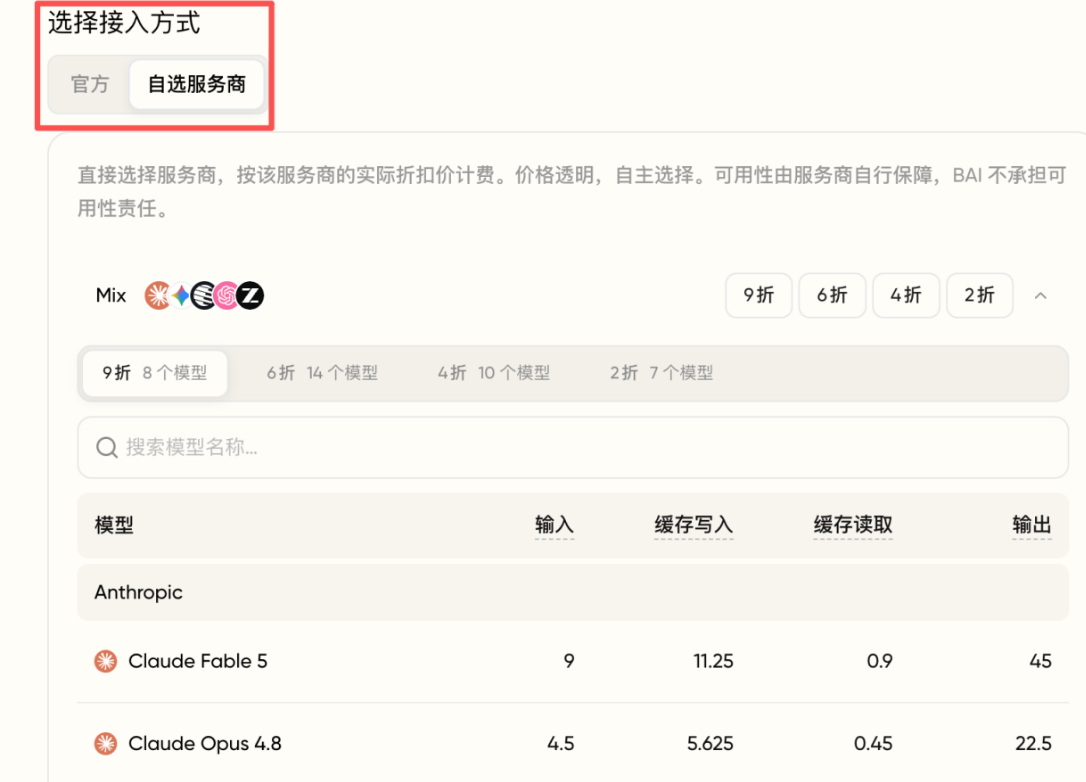
Bai B.AI directly addresses this pain point. As an AI model aggregation platform, Bai B.AI provides a unified entry point to access multiple mainstream LLMs and offers API services compatible with standard calling methods, allowing users and developers to manage model selection, calls, and costs on a single platform. Compared to single-model interfaces, Bai B.AI emphasizes using AI services based on the specific scenario: for production-grade applications requiring high stability, users can opt for standardized official access; for cost-sensitive scenarios like testing, exploration, AI agents, and batch calls, users can choose more flexible pricing plans through self-selected service providers.
This design further clarifies Bai B.AI's differentiation. According to information from Bai B.AI's official X account, the self-selected service provider model currently offers discount tiers of 10%, 40%, 60%, and 80%, covering mainstream model series such as Claude, Gemini, GPT, Kimi, and GLM, and these can be combined with top-up bonus promotions. In other words, Bai B.AI does not simply offer a fixed-price model entry; rather, it segments AI services into different consumption levels: core production tasks prioritize availability, while testing environments and high-frequency scenarios emphasize cost efficiency. For developers, the value of this model lies not in having "more models," but in being able to choose the most appropriate service path based on task importance, call frequency, and budget constraints.
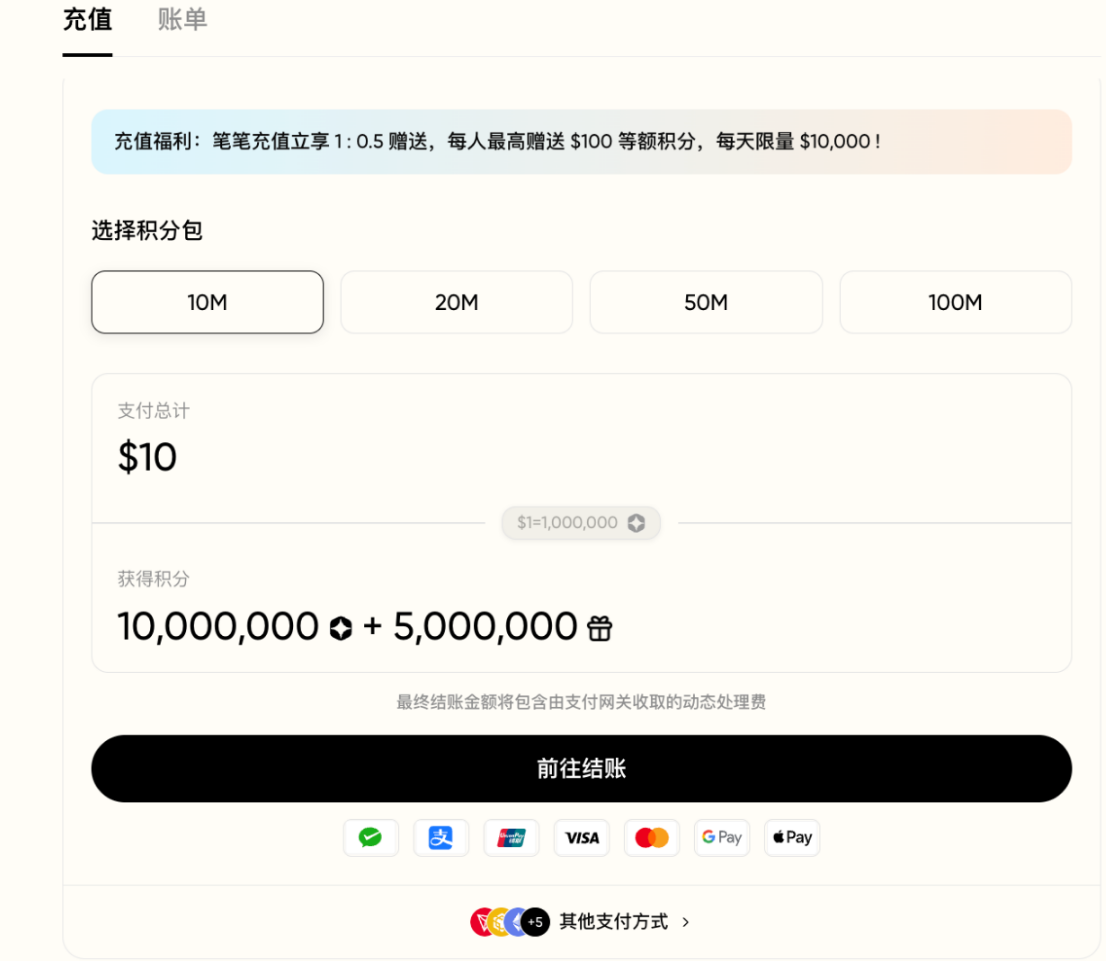
The diversification of payment methods also serves this logic. Bai B.AI currently supports common fiat payment methods like WeChat Pay, Alipay, bank cards, UnionPay, Visa, Mastercard, Google Pay, and Apple Pay, while also supporting multi-chain, multi-currency crypto asset payments. Compared to a single payment method, this arrangement is better suited to cover users from different regions and with varying habits, and helps lower the barrier for developers and high-frequency callers to transition from testing to continuous use. Previously disclosed data showed that Stripe payments accounted for 69.0% of the platform's core paying user base. Combined with the increase in API call share, this also indirectly reflects the growing stickiness of traditional developers and production-grade users.
Behind the High API Share: Bai B.AI is Entering Deeper Developer Scenarios
Looking at the usage structure, Bai B.AI's recent API call share has reached as high as 99.7%, with platform consumption increasingly driven by developer APIs, automated tasks, AI agent workflows, and enterprise-level system calls. Previously disclosed data also showed that the DeepSeek-V4 series once contributed nearly 60% of token consumption. Combined with the recent surge in call activity for models like MiniMax M3, the user usage structure of BaiB.AI reveals two characteristics.
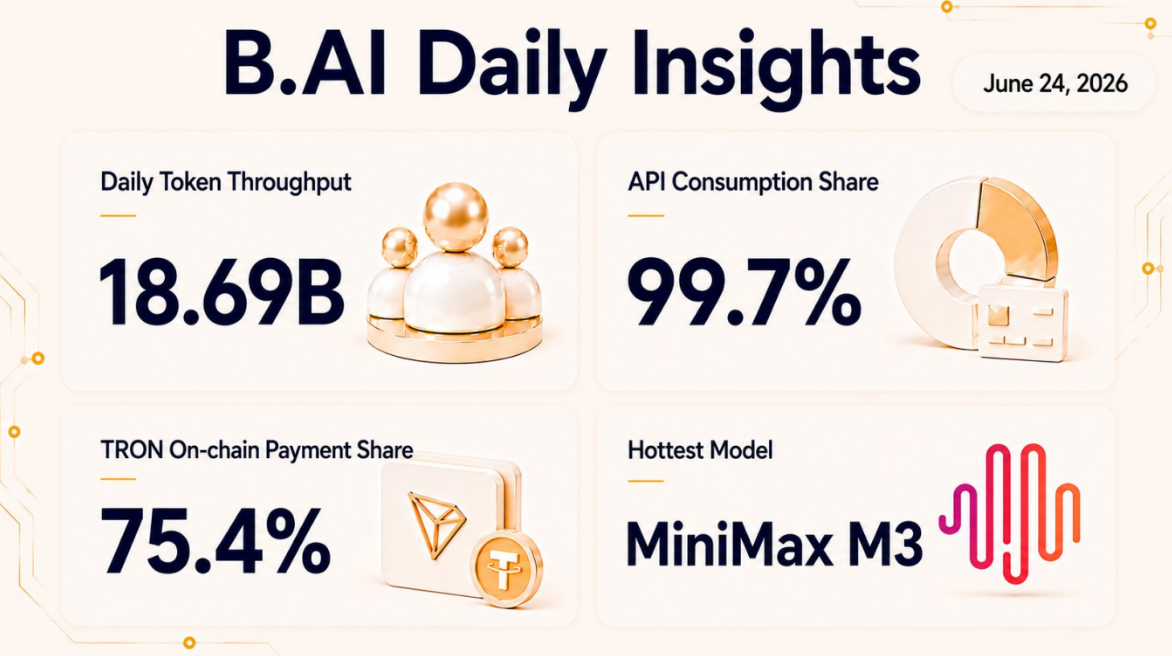
On one hand, the platform is attracting more traditional developers and production-grade users, extending use cases from front-end conversations to back-end calls and automated workflows. On the other hand, users are beginning to make practical choices between different models based on cost, performance, and task type: complex tasks can use more powerful models, high-frequency tasks can use more cost-effective models, and testing scenarios can opt for more flexible discount service providers. This further highlights the practical value of model aggregation, intelligent routing, and multi-service provider integration.
As AI agents move from demonstrations to real-world workflows, model calls will no longer be one-off conversations but will become continuous, high-frequency, billable service consumption. For an agent to truly enter a business system, it needs not only model capabilities but also stable interfaces, clear billing, flexible payments, and a sustainable operating environment. BaiB.AI's current efforts, focused on building unified APIs, multi-model access, service layering, and diverse payment experiences, are precisely aimed at adapting to this new way of using AI.
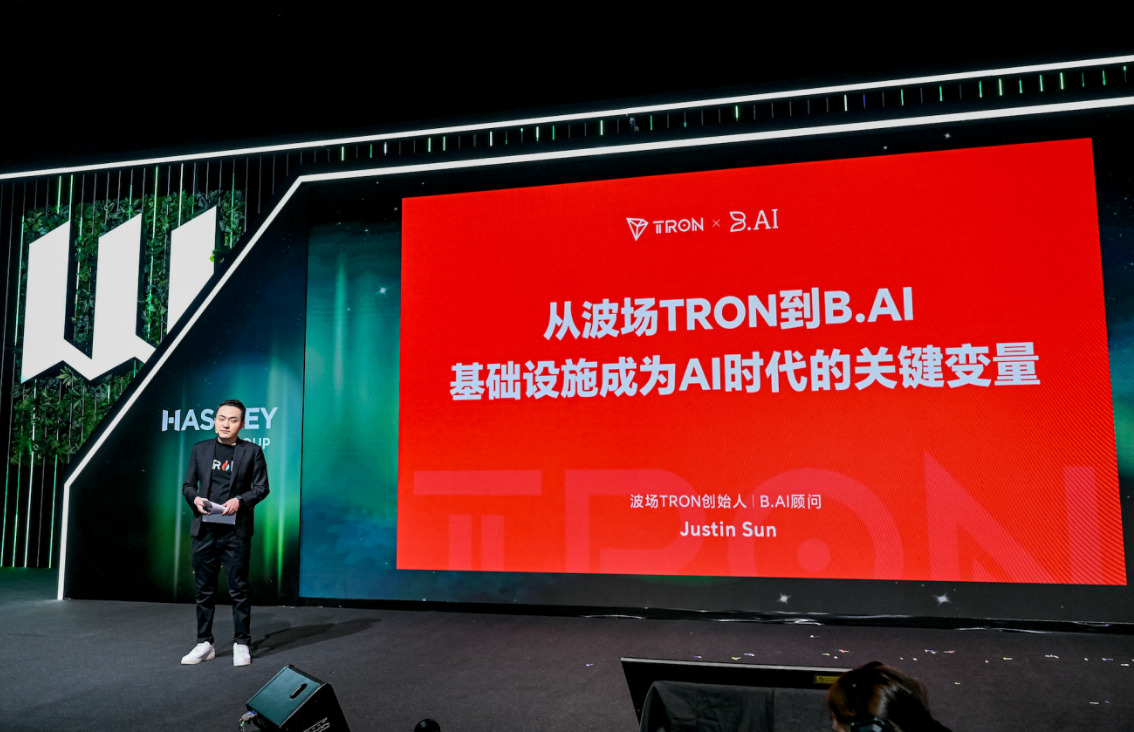
The involvement of TRON founder Justin Sun as an advisor to Bai B.AI also makes it easier for the outside world to understand its long-term strategy from the perspective of AI service infrastructure. Sun has repeatedly emphasized that the era of AI agents requires new underlying capabilities for support. As AI transitions from an assistive tool to autonomous execution, model calls, resource purchases, and automated settlements will become higher-frequency demands. Bai B.AI's value lies in its attempt to provide lighter, more flexible, and more scalable underlying support for these new types of AI service consumption and agent operation scenarios.
From exceeding 2 million users to a single-day token throughput of 18.69 billion and an API call share peaking at 99.7%, Bai B.AI is forging a clearer development path. In the short term, it is an aggregated entry point for users and developers to access multiple model capabilities. In the medium term, it is a service platform for AI applications and agents to reduce call costs and improve integration efficiency. In the long term, as AI agents become more widely involved in task execution and machine-to-machine collaboration, Bai B.AI aims to become an AI infrastructure platform connecting model capabilities, service consumption, payment methods, and the developer ecosystem.


