






Chip stocks fell for two consecutive sessions, with AI "horror stories" emerging one after another: Meta and Anthropic相继传出新动作,prompting the market to reassess the AI trade?


- Key Thesis: News of Meta exploring the commercialization of AI computing power and Anthropic developing its own chips has triggered a market repricing of the AI industry, shifting the focus from "competing on capital expenditure" to "competing on capital efficiency." This led to a significant correction in chip stocks, but it does not signify the peak of AI demand; rather, it indicates the industry is entering a new phase emphasizing return on investment.
- Key Elements:
- Meta plans to commercialize or lease its surplus AI computing power externally, aiming to improve the return on its tens of billions of dollars in AI infrastructure investments.
- Anthropic is in discussions with Samsung to develop its own AI chips, potentially using a 2-nanometer process, to lower long-term computing costs and reduce dependence on a single supplier.
- These two news items have collectively driven a market reassessment of the AI capital expenditure super-cycle, with the Philadelphia Semiconductor Index falling over 10% over two days, led by declines in semiconductor equipment and memory stocks.
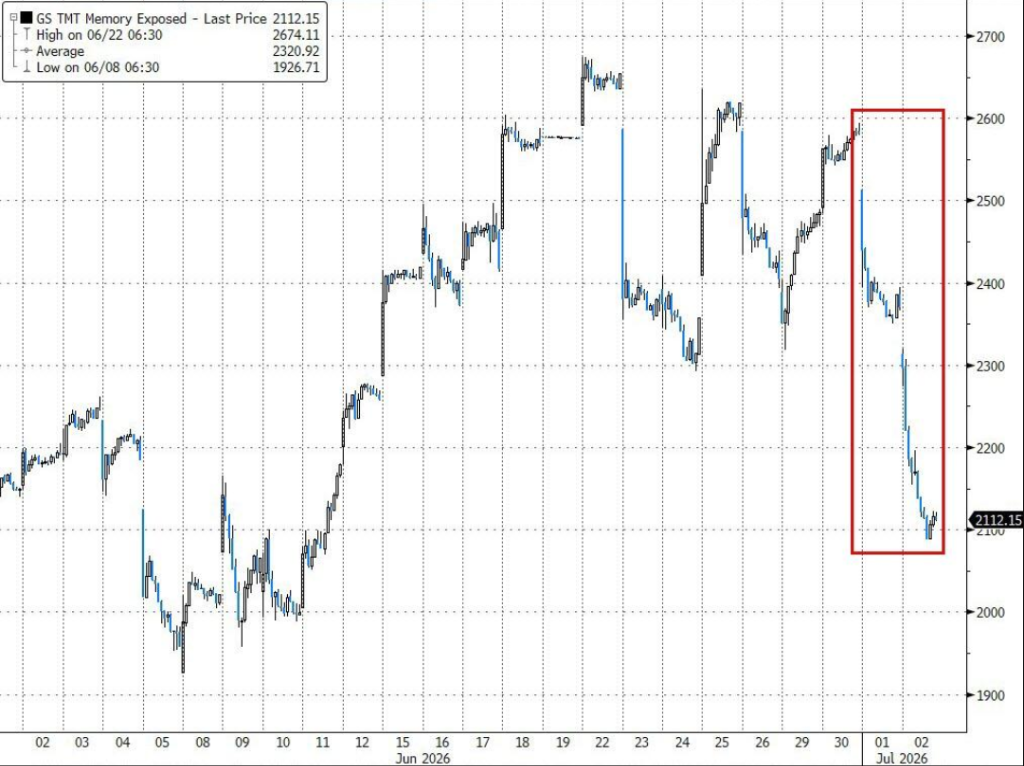
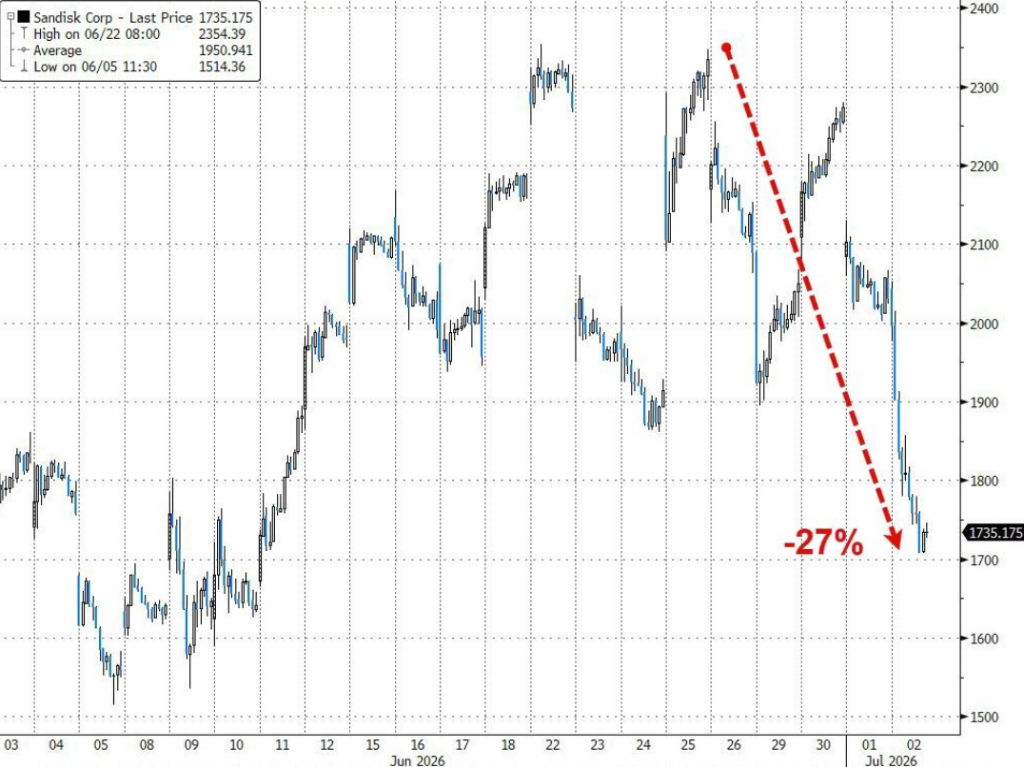
- Goldman Sachs' basket of memory stocks fell over 18% over the past two days, the most severe two-day drop in 12 years, with SanDisk entering bear market territory.
- Institutions believe the market is not rejecting AI demand but rather reassessing the trading logic. AI application penetration rates remain low, and the long-term demand for infrastructure exists.
- Competition in the AI industry is shifting from "who invests more" to "who can generate a higher return on every dollar of capital expenditure," with business models increasingly emphasizing a closed loop.
Original Authors: Li Dan, Ye Zhen
Original Source: Wall Street Insights
The AI hardware sector has been adjusting for two consecutive days, but what truly caught the market's attention was not the chip companies themselves, but the latest moves from two major AI model companies.
On Wednesday, news emerged that Meta is exploring the commercialization of its surplus AI computing power. Just a day later, reports surfaced that Anthropic is discussing a collaboration with Samsung Electronics to develop its own proprietary AI chips, and is considering using Samsung's 2-nanometer process for manufacturing.
These two pieces of news seem unrelated, yet they both touch upon the most sensitive topic in the AI industry chain today – is the AI capital expenditure that has been rapidly expanding for two years entering a new phase?
The market was the first to choose repricing. U.S. chip stocks have broadly continued their sharp decline over the past two days. The Philadelphia Semiconductor Index (SOX) fell over 10% cumulatively on Wednesday and Thursday, marking its worst two-day drop in nearly a month. The semiconductor equipment sector, most sensitive to the capital expenditure cycle, led the decline. Teradyne (TER), Entegris (ENTG), KLA Corporation (KLAC), Applied Materials (AMAT), and Lam Research (LRCX) all fell over 10% intraday on Thursday. ASML's U.S.-listed shares (ASML) once fell over 5% on Thursday.
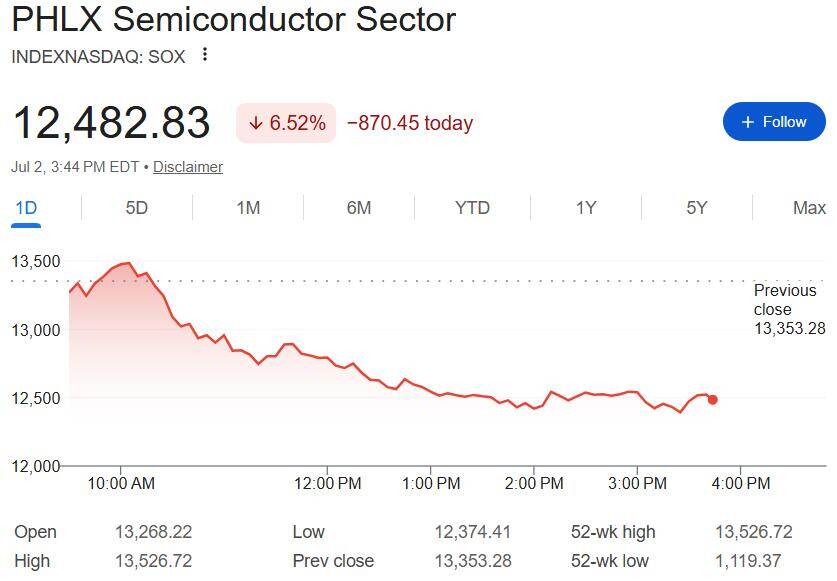
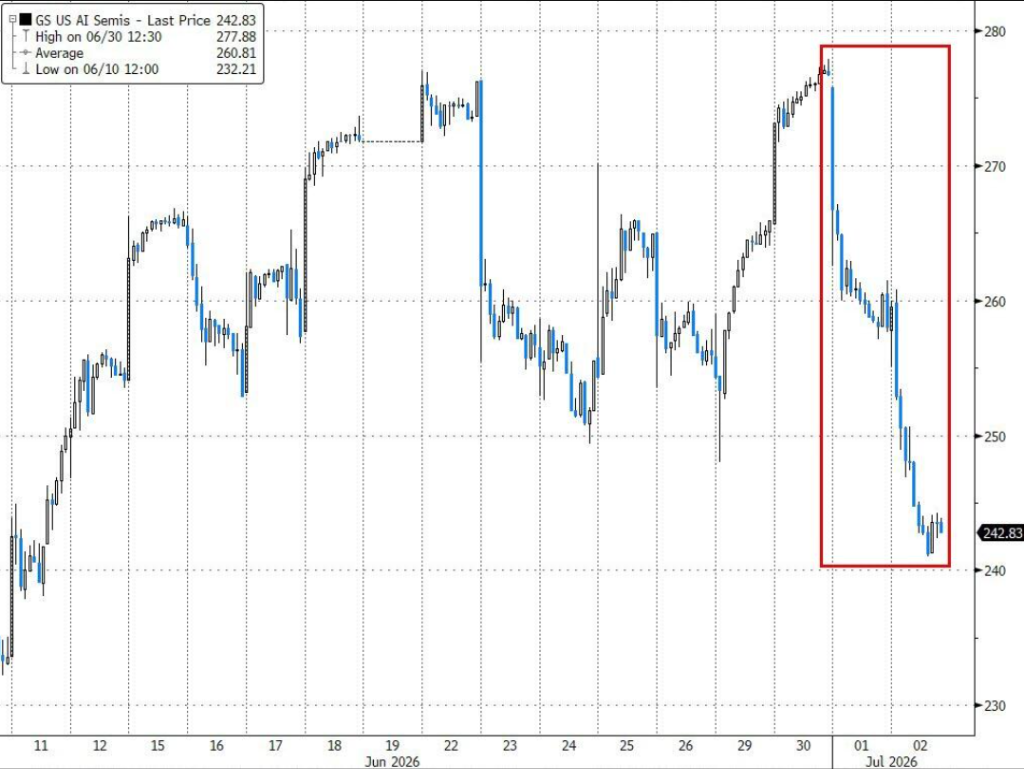
Goldman Sachs' basket of AI semiconductor stocks was hit hard, experiencing its worst two-day performance since tariff day.
Memory stocks suffered heavy losses. Goldman Sachs' basket of memory stocks fell over 18% in the past two days, the most severe two-day drop in 12 years.
Sandisk even fell into bear market territory.
In contrast to the dismal performance of capital recipients like chip companies, the stock prices of hyperscale cloud service providers, which are the capital spenders, have somewhat stabilized.
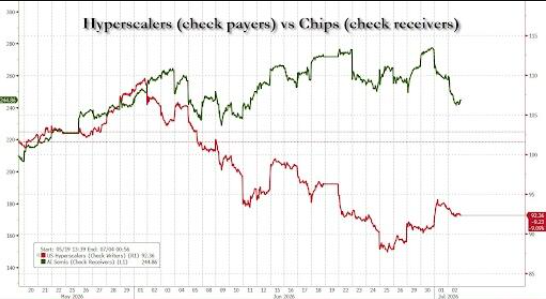
However, many institutions believe that these two news items are more like catalysts for the market to re-evaluate the AI investment logic, rather than a fundamental reversal of the AI industry's prosperity. What the market is truly trading on is not "whether AI demand has peaked," but the AI industry moving from a phase of "competing on capital expenditure" to a new phase of "competing on capital efficiency."
The Market's True Concern is Not Anthropic Making Chips, but the Changing Logic of AI Capital Expenditure
Over the past two years, the AI hardware sector has soared, driven by a core logic that has remained largely unchanged: rapid iteration of AI models has led to explosive growth in computing power demand, GPUs have been in persistent short supply, and tech giants have continuously raised capital expenditure, creating an unprecedented "super cycle of AI capital expenditure" that has driven demand for GPUs, High Bandwidth Memory (HBM), high-speed networking, advanced packaging, and semiconductor equipment.
This logic not only propelled Nvidia to become the world's most valuable company but also made equipment makers like Applied Materials, Lam Research, ASML, and KLA, as well as memory manufacturers like Micron and Sandisk, the biggest winners in the capital market.
However, the two news items over the past two days have led the market to seriously consider: If the AI industry begins to focus more on capital efficiency, rather than purely expanding investment, will this super cycle of capital expenditure enter a new phase?
On Wednesday, reports indicated that Meta is planning to build an AI cloud computing business, potentially opening up AI models deployed on its infrastructure to external clients in the future, or directly leasing surplus AI computing power, aiming to commercialize its tens of billions of dollars in AI infrastructure investment.
On Thursday, news followed that Anthropic is discussing developing its own proprietary AI chips.
Viewed separately, the two companies are taking different paths. But together, they point towards a common shift – AI companies are starting to think about how to improve the return on investment of existing infrastructure, rather than merely continuing to expand capital expenditure.
It is this shift in expectations that has triggered the market's re-evaluation of the AI trading logic.
Anthropic's Proprietary Chip Development: Is the AI Industry Entering a "Cost Optimization Era"?
More noteworthy than the market's initial concern about whether "proprietary chips will reduce GPU procurement" is the business logic behind Anthropic's move.
Reports state that Anthropic is in early-stage discussions with Samsung Electronics to develop custom chips designed for AI training and inference.
If this progresses, Anthropic will join Google, Amazon, Microsoft, and Meta as yet another foundational model company investing in proprietary AI chips.
This does not mean abandoning Nvidia GPUs; rather, it is a natural evolution of the AI industry.
Over the past two years, the competition among large model companies has focused on who can secure more GPUs and build more data centers. However, as model scales continue to grow, training and inference costs rapidly escalate. Reducing per-token costs, improving computing utilization, and decreasing dependence on a single supplier are becoming the new focal points of competition.
ASICs designed for specific models can achieve a better balance among performance, energy consumption, and cost. This is a key reason why Google's TPU, Amazon's Trainium, and Meta's MTIA have been steadily advancing in recent years.
In this sense, Anthropic's exploration of proprietary chips is more of a significant indicator of the AI industry shifting from "competing on investment" to "competing on efficiency," rather than a sign of cutting AI investment.
Meta and Anthropic: Different Paths, Same Goal
Meta and Anthropic have adopted different strategies, but their goals are highly aligned.
Meta aims to generate revenue from temporarily idle AI computing power, improving the return rate on its tens of billions of dollars in capital expenditure. Anthropic seeks to reduce long-term computing costs through custom chips, enhancing its self-reliance in infrastructure.
Whether it's selling surplus computing power or developing ASICs, neither action is fundamentally about reducing AI investment. Instead, both are about finding a more sustainable AI business model.
However, for the capital market, these two pieces of news could easily trigger a different line of thinking: if AI companies start paying more attention to capital efficiency, will future GPU procurement, cloud computing leasing, and new data center investment maintain the high growth rates of the past two years?
Consequently, the market has begun to reassess whether expectations for AI capital expenditure can continue its previous trajectory of "only increasing, never decreasing."
This is precisely why, during the two-day market adjustment, the biggest decliners were not the model companies themselves, but the semiconductor equipment companies most closely tied to new capital expenditure. Compared to GPU and memory manufacturers, equipment suppliers' orders more directly reflect future investment plans of fabs and chip companies, making them the most sensitive to changes in capital expenditure expectations.
Institutions: The Market is More About Re-evaluating AI Trades Than Denying the AI Super Cycle
Despite consecutive days of adjustment in semiconductor stocks, most institutions have not interpreted these two news items as a sign of cooling AI demand.
Regarding Meta, many analysts believe that selling surplus computing power is more about finding a commercial outlet for its massive AI capital expenditure, thereby increasing the sustainability of future investments in GPUs, networking equipment, data centers, and energy infrastructure, rather than reducing capital expenditure.
Regarding Anthropic, institutions generally believe that developing proprietary chips aligns with the long-term development trend of major AI model companies. Even as more companies adopt ASICs, they will still rely on advanced manufacturing processes, HBM, high-speed interconnects, advanced packaging, and data center construction. The demand for AI infrastructure will not disappear but may be redistributed across different segments.
More importantly, the current penetration rate of AI applications is still relatively low. Industry insiders point out that with the continued growth in inference demand, the token consumption and computing power requirements of large models are still far higher than previously anticipated. The AI infrastructure construction cycle is still a considerable distance from true maturity.
Therefore, this week's market action seems more like a periodic repricing of the AI trade following historic gains.
If the AI competition over the past two years was about "who invests more," then the signals from Meta and Anthropic suggest that the AI industry is entering a new phase – where the competition shifts towards who can generate a higher return on every dollar of capital expenditure.
For the market, such a shift in expectations is sufficient to act as a catalyst for a correction in the AI hardware sector. However, for the industry itself, this does not necessarily mean the end of the super cycle. Instead, it may indicate that AI infrastructure investment is beginning to move towards a more mature stage, one that emphasizes a closed commercial loop.


