






从SpaceX、美光到Galaxy Digital,一文看懂罗素新增的37家AI公司与7家加密黑马


- 核心观点:罗素美国指数完成年度重组,共224家新公司被纳入罗素3000指数,其中AI/半导体相关公司约37家,加密相关公司约7家,这些新纳入成分股将因被动基金配置而获得市场流动性支撑。
- 关键要素:
- 2026年6月26日罗素3000指数重组当天,纳斯达克收盘集合竞价系统处理了3340.27亿美元交易量,创下历史单日最高纪录。
- 本次重组中,罗素1000与罗素2000的市值门槛提升24%至57亿美元,罗素2000最小成分股市值门槛升至1.464亿美元。
- 共224家公司新进入罗素3000指数:19家进入罗素1000,205家进入罗素2000;同时118家公司被剔除。
- 新增公司中约37家从事AI产业上下游业务,占比17%,其中SpaceX因IPO后市值超2万亿美元通过快速纳入机制直接空降罗素1000指数。
- 新增公司中约7家与加密行业相关,占比3%,包括Galaxy Digital、Hyperliquid Strategies、Tron等,其中5家从事DAT业务。
- 英伟达已取代苹果成为罗素1000指数中权重最大的成分股,半导体股票在罗素1000成长指数中权重增幅最大。
- 进入罗素3000指数后,中小型AI及加密企业将获得华尔街机构覆盖和被动基金配置,提升二级市场流动性。
Original | Odaily Planet Daily (@OdailyChina)
Author | Golem (@web 3_golem)
After the U.S. stock market closed on June 26, the Russell US Index completed its latest annual reconstitution, with all index constituents and their weightings finalized. The market began trading based on the new index when the U.S. stock market opened on June 29 (today).
The Russell US Index is one of the most important benchmarks for the U.S. stock market globally, tracking the stock performance of the top 3,000 publicly traded companies in the U.S. by market cap (Odaily note: The actual number may fluctuate slightly due to IPOs and delistings; e.g., the 2025-2026 data was around 2,900+ companies). It represents approximately 98% of the investable U.S. stock market, making it the most comprehensive combined large-cap and small-cap index in the U.S.
If the Russell US Index is compared to a pyramid, the Russell 1000 forms the top, containing the largest 1,000 U.S. companies by market cap. The Russell 2000 forms the middle-lower section, containing small-cap companies ranked 1,001 to 3,000. Together, they constitute the complete Russell US Index, also known as the Russell 3000 Index.
According to official sources, over $12 trillion in assets globally are benchmarked to the Russell US Index (including passive ETFs, mutual funds, pension funds, etc.). Therefore, every year during the reconstitution, numerous ETFs, index funds, and institutional accounts must adjust their holdings simultaneously. According to data released by Nasdaq, on the reconstitution day of June 26, its Closing Cross system processed $334.027 billion in trading volume, the highest single-day volume ever recorded for a Russell 3000 reconstitution in Nasdaq's Closing Cross history, significantly surpassing the 2025 data.
There are approximately 5,650 stocks listed on Nasdaq and the NYSE. While the Russell 3000 Index covers 97% of the U.S. investable market by float-adjusted market cap, it only represents about 53% in terms of the number of constituent stocks. Therefore, the composition of the Russell 3000 after reconstitution is highly anticipated by the market, especially for stocks newly added to the index. Being included means these stocks will attract billions of dollars in passive fund inflows for the first time, potentially leading to better future performance and making them worth positioning for.
224 Companies Added to the Russell 3000 Index
According to official disclosures, following this reconstitution, the market cap threshold dividing the Russell 1000 and Russell 2000 surged by 24% to $5.7 billion. This means many companies with market caps around $5 billion were moved down from the Russell 1000 to the Russell 2000. Meanwhile, the minimum market cap threshold for the smallest constituent in the Russell 2000 rose to $146.4 million (an increase of nearly 23% compared to 2025).
A total of 61 companies were newly added to the Russell 1000 Index, of which 42 were promoted from the Russell 2000. These new constituents are concentrated in the technology (18 companies) and industrial (17 companies) sectors, with only 19 genuinely new companies joining the Russell 1000.
A total of 244 companies were newly added to the Russell 2000 Index, of which 39 were downgraded from the Russell 1000, 83 came from the Russell Microcap Index, 17 joined the Russell 2000 via IPOs, and the remaining additions came from outside the Russell US Index's constituent universe. Among these 244 new additions, 88 belong to the healthcare sector, 36 to the technology sector, 31 to the consumer discretionary sector, and 28 to the industrial sector.
Therefore, in this reconstitution, a total of 224 new companies were added to the Russell 3000 Index. 19 entered the Russell 1000, and 205 entered the Russell 2000. Simultaneously, 118 companies were completely removed from the Russell 3000 Index.
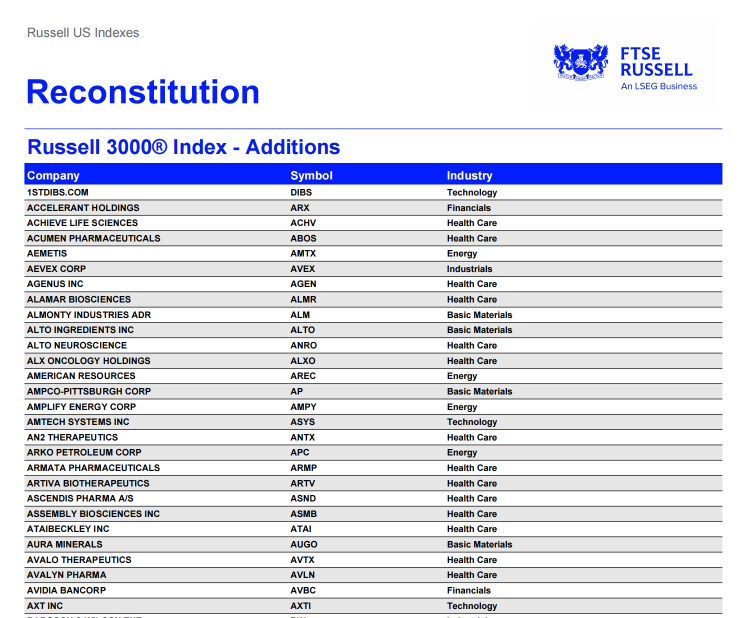
List of companies added to the Russell 3000 Index (click here for the full list)
Approximately 37 AI and Semiconductor Companies Added to the Russell 3000
Compared to the Russell 2000, the technology sector’s weight within the Russell 1000 is significantly higher than other sectors. Nvidia, driven by its rapid market cap expansion, has officially surpassed Apple to become the largest weighted constituent in the Russell 1000. With the boom in the AI and semiconductor industry this year, semiconductor stocks saw the largest increase in weight within the Russell 1000 Growth Index (Odaily note: The Russell 1000 Index can be further broken down into Growth, Value, Top 200, and Mega Cap indices).
By weight, the companies contributing the most new weight to the Russell 1000 Growth Index are Micron Technology and SanDisk. Both companies transitioned from being 100% value stocks to 100% growth stocks.
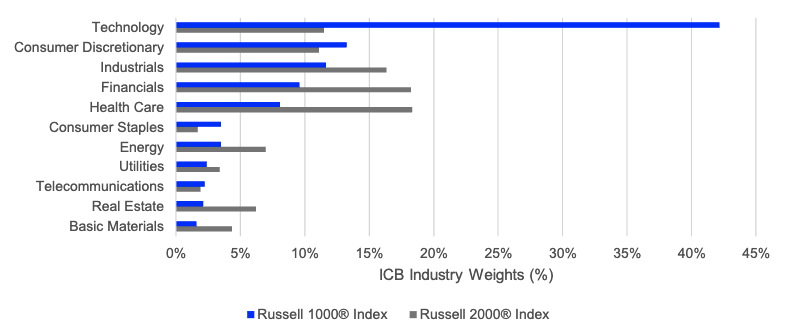
Industry breakdown of companies in the Russell 1000 vs. Russell 2000 Index
Meanwhile, according to Odaily's tally, among the 224 companies newly added to the Russell 3000 Index, approximately 37 are involved in the AI industry's upstream or downstream supply chain, accounting for about 17% of the new additions.
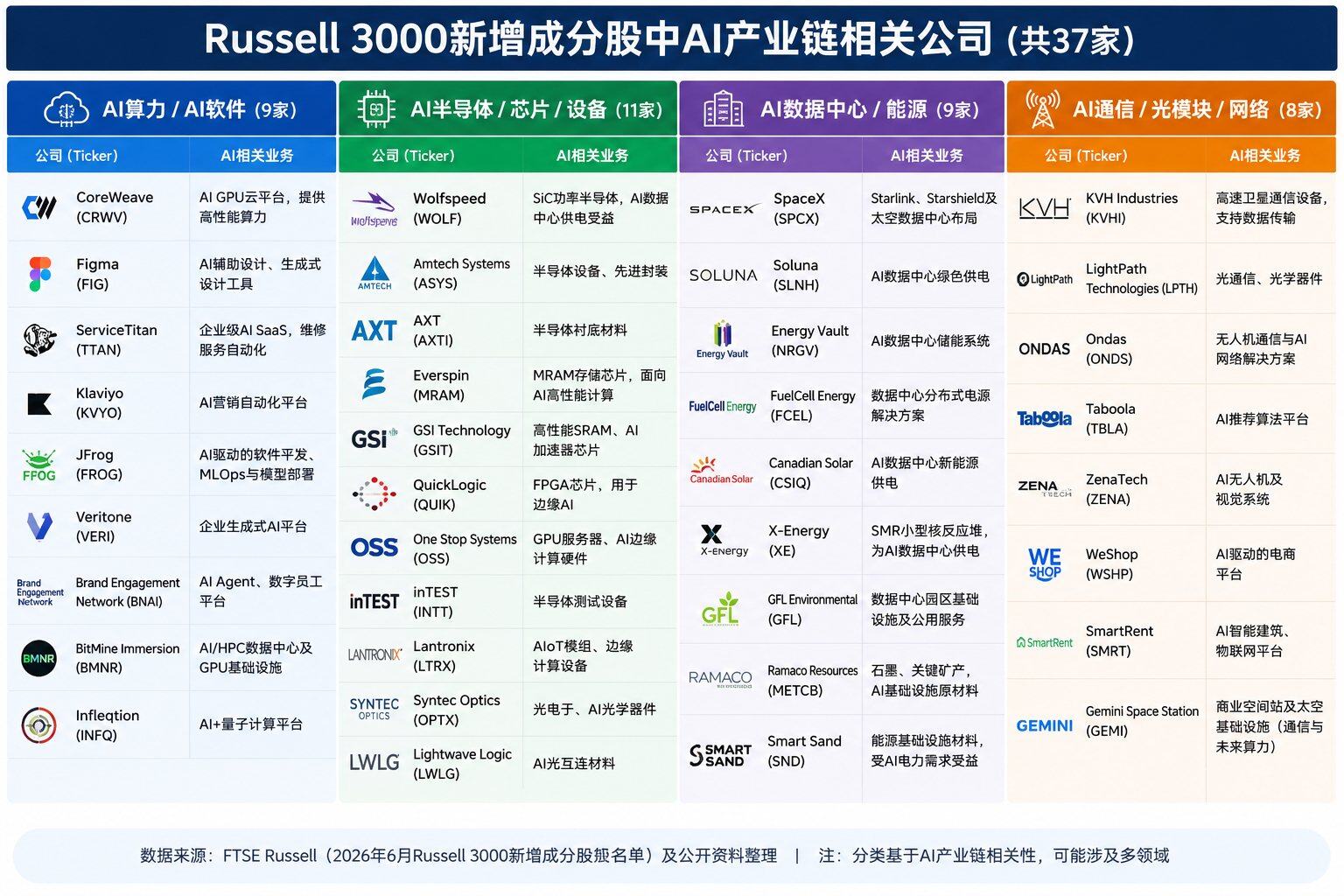
AI-related companies among the new additions to the Russell 3000 Index (created by AI)
Among these 37 companies, the most notable is SpaceX. After its IPO on June 12, 2026, SpaceX's market cap soared to over $2 trillion, triggering Russell's "Fast-track" addition mechanism. Consequently, it directly landed in the Russell 1000 Index and simultaneously entered the Russell Top 200 Index. SpaceX's stock will be classified as approximately 90.4% growth stock and 9.6% value stock, making it a significant component for growth-oriented investments linked to the Russell 1000.
Beyond the Russell 1000, SpaceX is also set to be included in the Nasdaq 100 Index on July 6 and begin trading.
For other newly added AI concept stocks in the Russell 3000, this is not just an honorary title. It represents a tangible positive catalyst that can directly translate into secondary market liquidity and stock price support.
Previously, these small-to-mid-cap AI and semiconductor companies (especially those in the list with market caps below $5.7 billion, placed in the Russell 2000), due to size constraints, were often excluded from the stock pools of major Wall Street mutual funds or hedge funds. After being included in the index, Wall Street analysts may be compelled to start covering these companies, increasing their "visibility" to institutional investors. Benefiting from being in the hot AI sector, they might attract active funds or pooled capital, driving their stock prices higher.
Approximately 7 Crypto-Related Companies Added to the Russell 3000 Index
Following this Russell 3000 Index reconstitution, several cryptocurrency firms have been included for the first time. According to Odaily's tally, among the 224 companies newly added to the Russell 3000 Index, approximately 7 are related to the crypto industry, accounting for about 3% of the new additions. They are: Galaxy Digital, SharpLink, Bitmine, Forward Industries, Hyperliquid Strategies, Tron, and IREN.
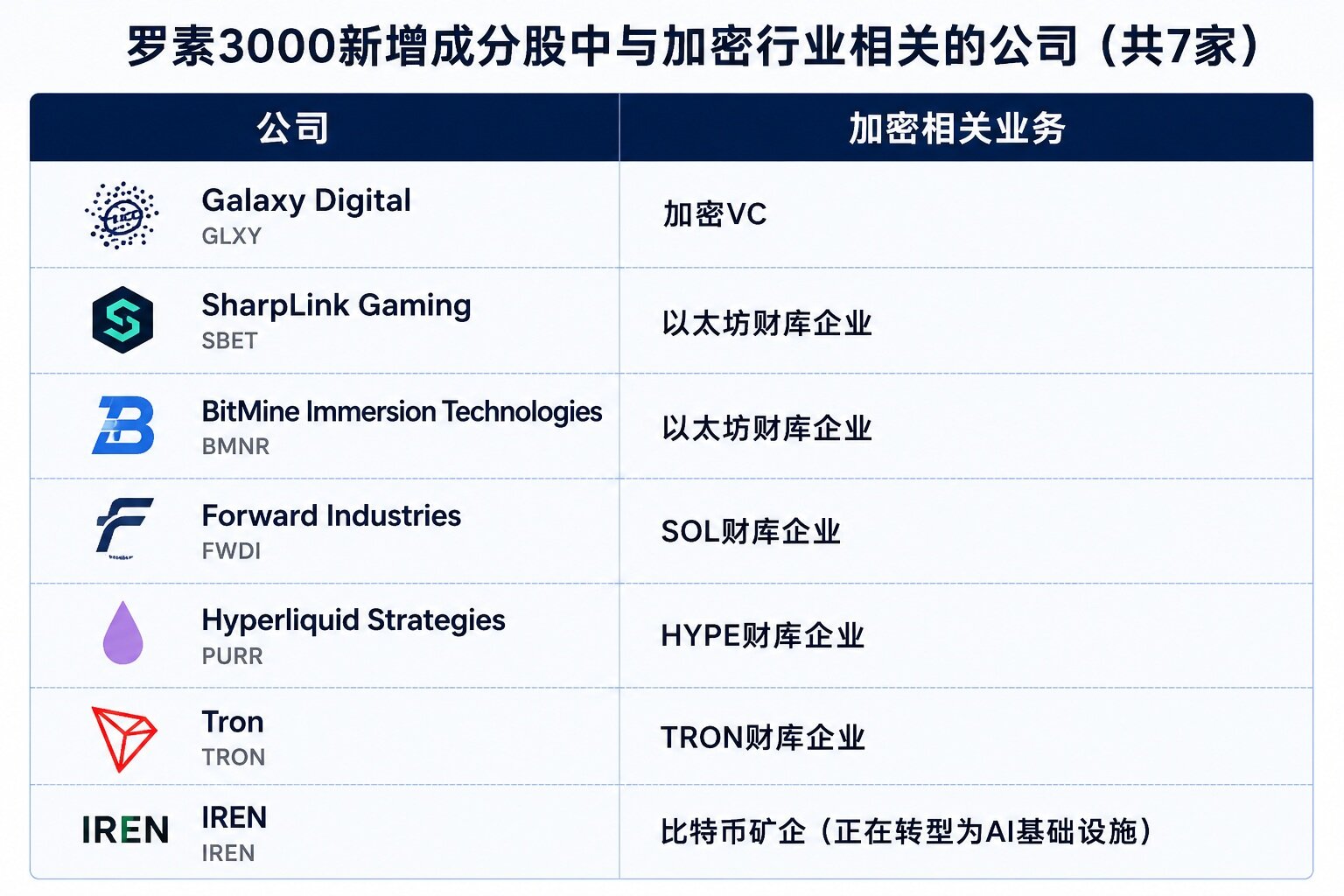
Crypto-related companies among the new additions to the Russell 3000 Index (created by AI)
These 7 companies successfully joining the Russell 3000 Index means their stocks will likely become passive allocations for large funds in the future, presenting potential for upside. Furthermore, 5 out of these 7 companies selected for the Russell 3000 are engaged in DAT (Digital Asset Treasury) businesses, corresponding to different ecosystems like ETH, SOL, HYPE, and TRON. It is worth noting that the Russell 3000 Index is essentially a cold, hard machine that values market cap above subjective preferences. The inclusion of these 5 companies proves that while the DAT hype may have subsided, their business model has withstood the test of market and time.


