






世界杯小组赛收官窗口:赔率收敛与冠军格局定价


- Key takeaways: During the final stages of the World Cup group stage, the market is experiencing odds convergence and a repair of risk appetite, but liquidity has not entered an expansion cycle. Overall, the market is in a phase of oscillatory price discovery with no confirmed direction, so the focus should be on risk management and structural understanding.
- Key elements:
- The guest emphasized prioritizing the reduction of leverage and positions when volatility rises, adopting a strategy of "defense first, retain flexible positions" to avoid being repeatedly hit by the market while using high leverage.
- BTC and ETH are in a phase of oscillatory price discovery rather than a trend launch. This is because external risks have decreased, but liquidity has not clearly expanded, which limits trend formation and means a direction is still brewing.
- Odds changes in prediction markets are the result of a superposition of information convergence and consensus formation. The profit potential for popular outcomes is compressed, while unpopular outcomes carry high risk but offer larger profit margins due to better odds.
- High-attention events (like the World Cup) primarily amplify short-term volatility and trading activity through sentiment, but do not change the market's long-term direction.
- At this stage, price is the market's direct form of expression. The difficulty in trading lies in understanding the rhythm and structure, rather than judging the direction.
World Cup Group Stage Finale: Odds Convergence and Championship Structure Pricing
The backdrop for this Space discussion is quite clear: as the World Cup enters the closing stages of the group phase, odds are beginning to converge rapidly, with much of the previously dispersed information gradually being priced in collectively. At the same time, the global macro environment is moving from an initial shock phase into a rebalancing process, with the market reassessing liquidity and the positioning of risk assets. Adding to this, the marginal easing of geopolitical tensions has led to some recovery in overall risk appetite, yet the structure remains unstable.
Putting it all together, the current state of the market resembles this: events are decreasing, but prices are accelerating in their adjustments. The direction hasn't fully materialized yet, but volatility has already priced in some expectations ahead of time.
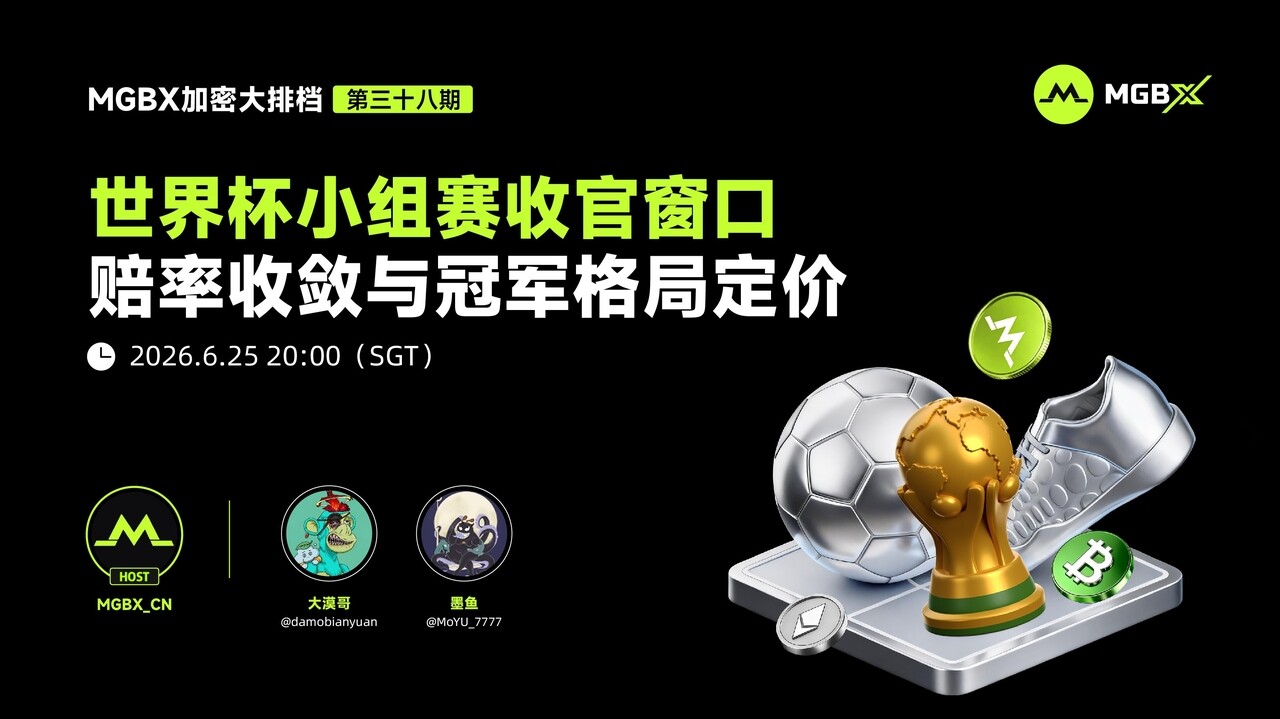
Against this backdrop, the first part of the discussion focused on trading rhythm and position management.
Teacher Damo ( @damobianyuan ) has a relatively direct approach. He believes that in this phase of rising volatility, the most important thing is not to increase aggressiveness, but first to reduce risk. Because once volatility increases, market noise will significantly amplify. If one maintains a high-leverage state, they can easily be repeatedly impacted in a short period.
Therefore, his strategy is first to reduce the overall position, bring down the leverage, make the core position lighter, and return the account structure to a relatively safe position. However, he also emphasizes that this does not mean exiting completely, because this environment is often accompanied by rapid, event-driven fluctuations, such as changes in sentiment or short-term data shocks, which still present trading opportunities. So the overall approach is more like "defense first, but maintain a flexible position."
The second question turned to the current stage of BTC and ETH.
Teacher MoYu ( @MoYU_7777 ) judges that the current situation is more like a phase of consolidation and price discovery, rather than the early stage of a trend launch. Although external risks are declining and market sentiment is recovering, the key issue is that liquidity has not yet entered a clear expansion cycle, which limits the formation of a trend.
Under this structure, BTC is primarily undergoing consensus adjustment within its range. Some capital is trading on future recovery expectations, while another part remains on the defensive against macro risks. ETH is more sensitive to sentiment, but similarly, it hasn't shown sufficient volume structure to support a trend.
So the overall state is more like: a direction is brewing, but hasn't been confirmed yet.
The third topic discussed the nature of prediction markets and changes in odds.
Teacher Zhenai ( @nice11018 ) believes that the changes in odds at this stage cannot be simply understood as "information pricing" or "emotional bias," but rather the result of a combination of both.
As the matches enter the closing stages, information is indeed converging, leading to increasingly concentrated odds. But at the same time, market consensus is also forming, which will make prices increasingly reflect "consensus probability," not necessarily the true probability itself.
Therefore, the market will exhibit a typical structural divergence: popular outcomes become increasingly stable, but the profit margin continues to compress; underdog outcomes offer large potential rewards, but the risks are also significantly higher.
Under this structure, trading essentially becomes a choice. It's no longer about judging right or wrong, but about choosing between leaning more towards certainty or towards the potential payoff offered by the odds.
The fourth question discussed from a more macro perspective whether the activity in sports betting and prediction markets affects global asset volatility.
Teacher Damo ( @damobianyuan ) believes that such phenomena do have an impact, but mainly on the emotional level, rather than the trend level. High-attention events like the World Cup can temporarily increase market participation, raise risk appetite, and consequently amplify volatility and trading activity.
However, it will not change the long-term direction of the market; it only alters the rhythm. In other words, it functions more like an "emotional thermometer," reflecting market heat but not determining its direction.
The overall discussion finally returned to a common question: In this phase where the World Cup sentiment cycle, macro re-pricing, and risk appetite repair are all overlapping, is the market being driven by fundamentals, or is it being reshaped by events and sentiment?
Judging from the views of these guests—whether it's the convergence of odds, the choppiness of BTC/ETH, or the structural changes in prediction markets—they all point to the same state: the market is continuously being re-priced by information, but this pricing process is dynamic, not unidirectional.
In this phase of high volatility and high event density, price itself is the market's most direct form of expression. The difficulty of trading lies not in direction judgment, but in understanding the rhythm and structure.
It is precisely for this reason that such windows often don't represent the "easiest" market conditions but can be among the best phases for clearly discerning the market's structure.
👉 To download MGBX, please visit the official website: https://mgbx.com/
Company: MGBX
Email: pr@mgbx.com
Official Business Contact: @MGBXVIP
Risk Warning: Digital assets and leveraged trading carry high risk. Market volatility may lead to the loss of your principal. Please make rational judgments and prudent decisions.


