






Coin Market Observer × Hong Kong Wang Fugui: From TVB Voice Actor to Web3 KOL, Where Do Opportunities Lie for Ordinary People in His Eyes


- Core Insight: Over the past three years, Hong Kong's Web3 ecosystem has evolved from "struggling to survive on cryptocurrency" to widespread merchant adoption of stablecoin payments. However, the real opportunity for ordinary people lies not in licenses and grand narratives, but in specific areas like building a personal brand, prediction markets, and leveraging information asymmetry.
- Key Elements:
- Ecosystem Adoption: Compared to the "Seven-Day Challenge" three years ago where all 200 merchants approached rejected crypto payments, many Hong Kong restaurants now accept stablecoins, and some are collaborating with RWA projects while awaiting regulatory clarity.
- RWA Substance: Stablecoins represent the most successful RWA case to date. Their core value lies in enhancing the efficiency of global capital flow, not merely in on-chain asset representation. However, risks related to asset authenticity and regulation remain.
- Information Asymmetry: The maturation of the industry hasn't eliminated information asymmetry; it has transformed it into a cognitive gap. Bridging this gap requires continuous learning and practice, not chasing shortcuts through hype.
- Investment Advice: For ordinary people with limited research capabilities, the strategy should be simplified to long-term holding of mainstream assets and avoiding blind trend-chasing. Understanding one's own limitations is more important than chasing hot topics.
- Emerging Opportunities: Prediction markets are seen as a high-potential sector, offering numerous opportunities in community building, research, and content creation. Meanwhile, a personal brand is a crucial long-term asset for the future, built through consistent content creation and trust-building.
In many people's impression, Wang Fugui from Hong Kong is a Web3 KOL with hundreds of thousands of followers, and also the person who once took on the challenge of "surviving seven days using only digital currency" in Hong Kong alongside Brother Dog. But defining him merely as a "blogger" is far from sufficient.
He has worked as a Cantonese dubbing actor for TVB and recorded a large amount of voice-over content for brands like DJI; before coming to Hong Kong, he was also a food blogger with over 400 restaurant review videos. Now, he has become a content creator active in the Web3 community, the RWA赛道 (RWA track), and the personal IP field.
These seemingly unrelated identities, in his view, actually share one commonality: continuously exploring new possibilities.
This episode mainly discusses: the changes in Hong Kong's Web3 ecosystem over the past three years, whether stablecoins and RWA will truly change the future of finance, and what worthwhile opportunities ordinary people can seize in this cycle.
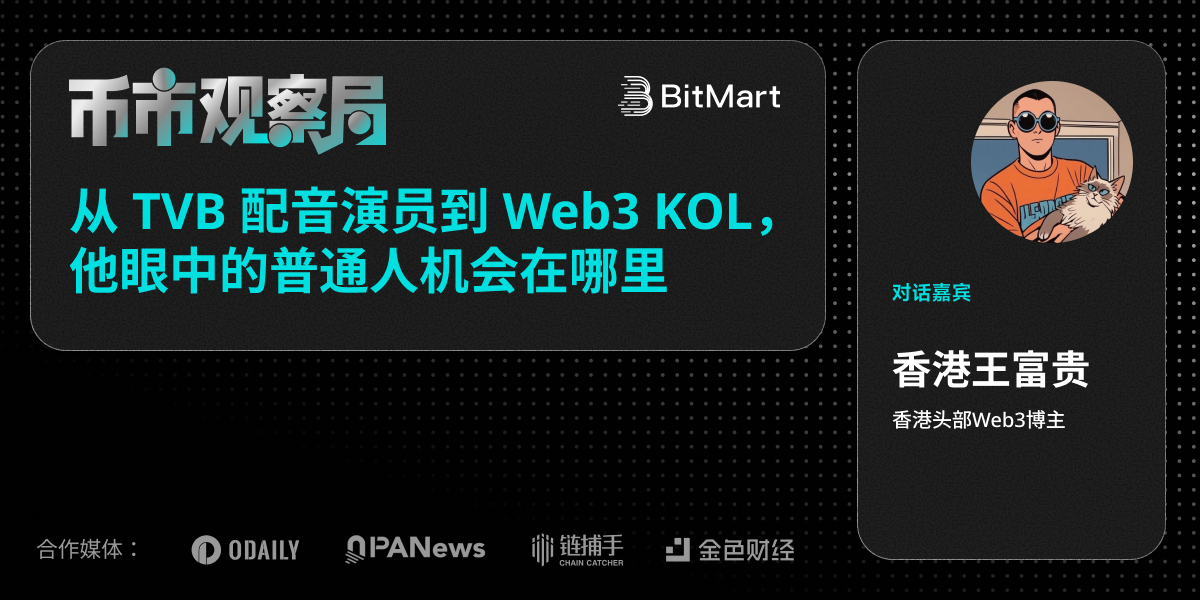
Guest: Wang Fugui (Hong Kong), Top Hong Kong Web3 KOL
Host: yuanyuan, BitMart Marketing VP
(Link to this episode: https://www.xiaoyuzhoufm.com/episode/6a2a15a4dbccffcfa9c71204 )
From Voice Actor to Web3 KOL, There's No Standard Answer in Life
Wang Fugui doesn't like others putting labels on him. He believes that people are inherently complex. Today, he can be a voice actor; tomorrow, a content creator; and in the future, he doesn't even rule out starting his own business.
Over the past few years, he has maintained a kind of "slash-style survival": doing voice-over work during the day, and running his Twitter account, researching projects, and participating in the community in his spare time. Compared to joining a company for a fixed salary, he enjoys the freshness that comes from constantly trying different identities.
In his view, one of the greatest charms of Web3 is that it allows everyone to find their own place.
A "Digital Currency Survival Challenge" Showed Him the Real Changes in the Industry
If there is one experience that truly made more people know Wang Fugui from Hong Kong, it is undoubtedly the "Hong Kong Seven-Day Digital Currency Survival Challenge" he initiated with Brother Dog.
Three years ago, they took a budget of $2,000 and attempted to spend only cryptocurrency in Hong Kong for seven days. On the first night, they couldn't find accommodation that accepted crypto payments and had to sit overnight in McDonald's; to have a meal, they had to ask merchants one by one if they accepted Bitcoin; for transportation, they had to rely on drivers willing to accept digital currency. They asked over 200 offline merchants in total, and most gave negative answers.
But in just three years, the situation has significantly changed. More and more Hong Kong restaurants are starting to accept stablecoin payments, and some merchants are even collaborating with related RWA projects, preparing for the application scenarios after the future implementation of Hong Kong's stablecoin regulatory framework.
In his view, true Web3 adoption isn't about price fluctuations; it's about reaching a day when people can naturally use stablecoins for payments as easily as swiping a bank card.
What Stablecoins Truly Solve Isn't Payments, But Global Financial Efficiency
Regarding the currently hottest RWA (Real World Assets) track, Wang Fugui stated that stablecoins themselves are the biggest successful case of RWA so far. He believes that so-called asset tokenization is not just about putting houses, stocks, or bonds on the chain, but about rebuilding asset transfer efficiency through blockchain.
Stock tokenization, bond tokenization, and real estate digitization essentially allow global capital to flow faster and at a lower cost.
However, at the same time, he also reminds everyone that RWA is currently still in a stage where regulations are gradually improving. Many projects still face issues regarding asset authenticity, custody transparency, and legal frameworks. Before regulations are fully mature, ordinary investors should focus more on the assets themselves, rather than being purely attracted by the term "tokenization."
The Information Gap Hasn't Disappeared; It Has Just Become a Cognitive Gap
Many people believe that as institutions enter, the information gap in the crypto industry is disappearing. Wang Fugui doesn't entirely agree. He feels that the real information gap is slowly evolving into a cognitive gap. The same news can lead to completely different conclusions for people with different backgrounds and life experiences. Even in a highly open information environment like Hong Kong, there are huge differences in how everyone accesses and processes information. And there is no shortcut to narrowing this gap. It only comes through continuous learning, continuous trial and error, and continuous practice.
He admits that when he first entered the crypto space, he also experienced countless "hitting a wall." Blowing up on 100x leverage, blindly following others into private sales, chasing hot NFT trends, missing stop-profit opportunities... These experiences eventually made him realize that finding an investment method that suits oneself is more important than how much money is made.
If you don't have the ability to research on-chain projects, don't participate blindly; if you are more suited for long-term holding, focus on mainstream assets. Knowing yourself is more important than chasing hotspots.
The Real Opportunity for Ordinary People Might Not Be a Stablecoin License
When discussing future opportunities, he specifically mentioned that many people focus on grand narratives like stablecoin licenses and RWA infrastructure, but for ordinary people, those may not be their real opportunities.
In contrast, he pays more attention to prediction markets, personal IP, and various new professions emerging around the Web3 ecosystem. For example, he is very optimistic about the development of prediction markets.
As major global prediction platforms continue to grow, he believes this could become an important new track in the future. And the communities, content, and research formed around prediction markets also present a wealth of opportunities. As for investing itself, his advice is surprisingly simple: if you don't have enough research capabilities, just buy a bit of mainstream coins.
In the IP Era, Everyone Should Become Their Own Media
Besides growth and entrepreneurship, Wang Fugui has persistently done one other thing over the years: operating his own content brand. From a food blogger to a voice actor to a Web3 KOL, he has always believed that personal IP will become an increasingly important asset in the future. Because many opportunities arise not because people know you and then trust you, but because they have seen your content over the long term and are then willing to get to know you.
He has also observed that more and more talented people are entering Web3 but don't know how to express themselves. They lack not ability, but consistent output. For newcomers wanting to enter the industry, his advice is very direct: you must use Twitter, you must build a personal IP. If you don't know how, just look at how others do it, and start doing it first.
In an era where information is increasingly fragmented and attention is increasingly scarce, consistent self-expression is itself a form of long-term compounding. And for ordinary people, perhaps the truly timeless opportunity in the next cycle is not a specific coin, nor a specific hotspot, but building a version of oneself worthy of long-term attention and trust from others.
—-----
The complete content of this episode can be found by searching for and following "Crypto Market Watch Bureau" on Xiaoyuzhou, Apple Podcast, and Spotify.
You are also welcome to follow BitMart Crypto Market's TwitterX for more industry insights, market trends, and platform updates.
Risk Disclaimer
The statements or views expressed in this program solely represent the personal stance of the guests and do not represent the views of BitMart or its affiliates, nor should they be considered professional financial investment advice.
Cryptocurrency investment is highly speculative and carries significant risk of loss. Past performance, hypothetical scenarios, or simulation results do not guarantee future returns. The value of digital currencies can fluctuate, and buying, selling, holding, or trading digital currencies may involve substantial risks. Before engaging in trading or holding digital currencies, please carefully assess their suitability based on your own investment objectives, financial situation, and risk tolerance. BitMart does not provide any investment, legal, or tax advice.


