






As Messi and Ronaldo once again step onto the World Cup stage, the sense of participation in the tournament is also evolving.


- Core Insight: BitMart is launching a points-based prediction event spanning the entire 2026 World Cup. Designed with dynamic odds, free point acquisition, and multi-phase gameplay, it aims to transform fans' viewing and forecasting behaviors into sustained engagement, moving beyond single-match outcome predictions to build a long-term tournament participation experience.
- Key Elements:
- The event adopts a points system. Users earn prediction points through low-barrier activities such as a goalkeeper mini-game, trading tasks, inviting friends, and daily check-ins.
- The prediction process covers the group stage through the final, divided into multiple phases. Users can dynamically participate in subsequent matches, emphasizing continuous engagement throughout the tournament's progression.
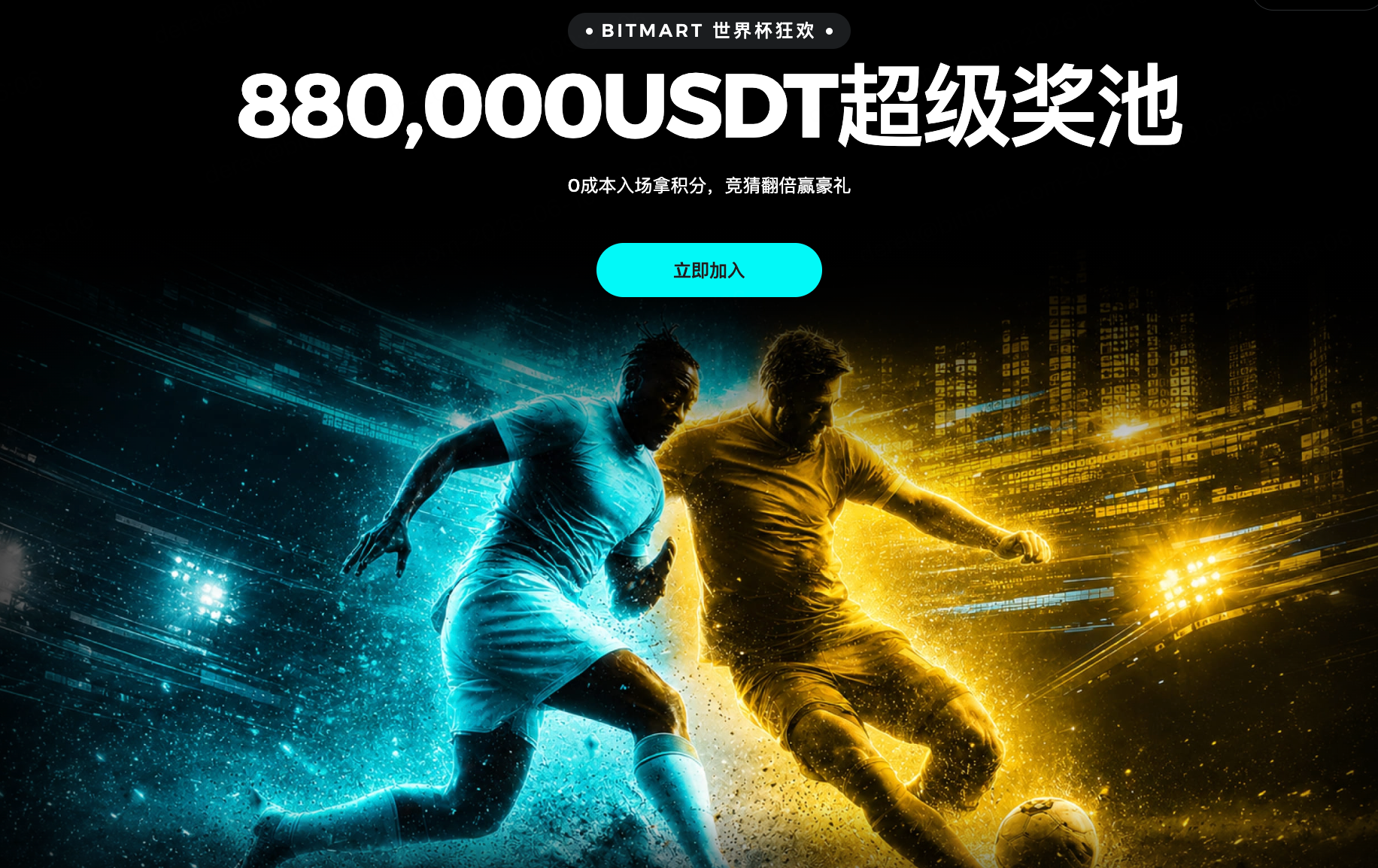
- The total prize pool reaches 880,000 USDT, including leaderboard rewards, individual rewards, and token rewards. Additional prize pools are designated for matches involving popular teams like Brazil and France.
- Prediction outcomes are calculated using dynamic odds, with different matches offering varying point returns, adding strategic depth and entertainment value.
- Beyond the points leaderboard, users can also earn individual rewards based on their prediction win rate, focusing on the participation process rather than just the final ranking.
With the 2026 World Cup approaching, national teams have successively announced their final 26-man squads. As rosters are released, discussions around the tournament are heating up rapidly. From title favorites and dark horse teams to coaching decisions and key player form, conversations about this World Cup are updated almost daily.
Interestingly, the 2022 World Cup, which countless fans had dubbed a "twilight of the gods" four years ago, did not truly mark the end of an era.
Many believed at the time that it would be the last World Cup appearance for a generation of stars like Messi, Ronaldo, and Modrić. Especially after Messi led Argentina to lift the trophy, the narrative of "legends saying goodbye" became one of the most complete storylines of that tournament.
But four years later, the story is far from over.
Messi still appears on Argentina's roster, Ronaldo once again leads Portugal into the World Cup, and Modrić continues to be selected for the Croatian national team. Those names once thought to be exiting the World Cup stage are now back in the spotlight of fan discussions.
For many fans, this sense of familiarity is itself an integral part of the World Cup.
The Greatest Charm of the World Cup Has Never Been Just the Matches Themselves
One key reason the World Cup is one of the most-watched sporting events globally is its ability to generate endless topics for discussion.
Before the tournament begins, people make predictions about the champion, the Golden Boot winner, and potential dark horses. During the group stage, fans analyze qualification scenarios. As the knockout rounds commence, every high-stakes match becomes a subject of deep analysis.
Each World Cup produces unexpected storylines. Some remember South Korea's run to the semi-finals; others recall Morocco achieving the best result for an African nation. The charm of the World Cup lies precisely in its duality: while strong teams often prevail, it also leaves room for upsets and miracles.
This is why predicting World Cup outcomes has become a part of fan culture.
Whether in offices, at gatherings with friends, or on social media, debates about match results often last longer than the games themselves. Sometimes, arguments over who will win begin days before a match even kicks off. In a sense, many people watch the World Cup not just for the games, but for the thrill of making predictions.
From Pre-Match Discussions to Live Guessing: How Fan Participation is Evolving
Looking back a few years, the most common ways for fans to engage with the World Cup were chatting with friends, sharing opinions on social media, or participating in various prediction games.
But as online entertainment becomes more diverse, simply discussing matches no longer satisfies all users. More and more platforms are integrating event content with interactive features, allowing users not only to watch the games but also to engage in related topics and predictions.
This is why, during major events like the World Cup or European Championship, various prediction activities see significant growth. Compared to traditional prediction contests, many modern guessing games emphasize sustained participation. Users no longer focus solely on the outcome of a single match; instead, they continuously make new judgments and choices as the tournament progresses.
For fans, this shift is easy to understand. After all, the World Cup lasts over a month, and what truly captivates audiences isn't just the moment the final champion is crowned, but the ever-changing storylines throughout the entire journey.
BitMart Turns the World Cup into a Full-Tournament Guessing Game
Among the many World Cup-themed activities, BitMart's recently launched World Cup Prediction Event has attracted significant user attention.
Unlike many prediction contests centered around single matches, BitMart has chosen to incorporate the entire World Cup schedule into its event scope. From the group stage to the final, the activity progresses in sync with the tournament, divided into multiple phases.
In terms of gameplay, the event uses a points-based prediction system. Users can earn prediction points through activities like a goalkeeper mini-game, trading tasks, inviting friends, and daily check-ins. These points are then used to make predictions on World Cup matches. Successful predictions yield more points, allowing users to continue participating in subsequent game forecasts. This design shifts the focus away from any single match.
If traditional prediction contests are like one-off guesses, BitMart wants users to follow the World Cup all the way to the final. From accumulating points in the first round of group matches to competing for rankings in the knockout stage, and finally predicting the champion, the entire process offers continuous participation.
For many fans, this rhythm closely mirrors the viewing experience of the World Cup itself.
Beyond the Prize Pool: What Truly Makes the Event Appealing
Of course, when it comes to World Cup prediction events, the prize pool is often the first thing users notice.
According to event details, the total prize pool is 880,000 USDT, covering leaderboard rewards, individual rewards, token rewards, and other incentives.
However, focusing solely on the size of the prize pool might overlook more interesting aspects of this event.
For example, the activity includes ways to earn points for free, allowing users to participate without additional costs. Prediction outcomes are calculated using dynamic odds, meaning different matches may offer varying point returns. Besides the points leaderboard, users can also receive individual rewards based on their prediction win rate.
Additionally, for matches involving popular teams like Brazil, France, and Argentina, the platform sets up extra reward pools. For matches that already attract high attention, this undoubtedly draws more users into making predictions.
These design elements collectively point to one characteristic: the event cares not only about the final ranking but also about the entire process of participation.
Some users enjoy analyzing odds changes, others prefer studying match results, and some simply want to see how far their favorite team can go. Different types of users can find something engaging in this activity.
Beyond the World Cup: The Search for a Sense of Participation
Every World Cup produces a new champion and leaves behind new classic matches.
But for many fans, the truly captivating aspect of the World Cup is not just the final score. From pre-tournament predictions to post-match analysis, from supporting favorite teams to discussing game momentum, the World Cup is essentially a weeks-long global topic of conversation. The matches are the core, but the discussions, predictions, and interactions surrounding them form an equally important part of World Cup culture.
Activities like BitMart's World Cup prediction event essentially take what fans already do – predict matches, discuss results, and track team performance – and transform it into a form of sustained interactive participation.
As the World Cup officially kicks off, various prediction and interactive activities surrounding the event will enter their most intense phase. For fans, having another way to participate besides watching the games might just be another joy the World Cup brings.


