






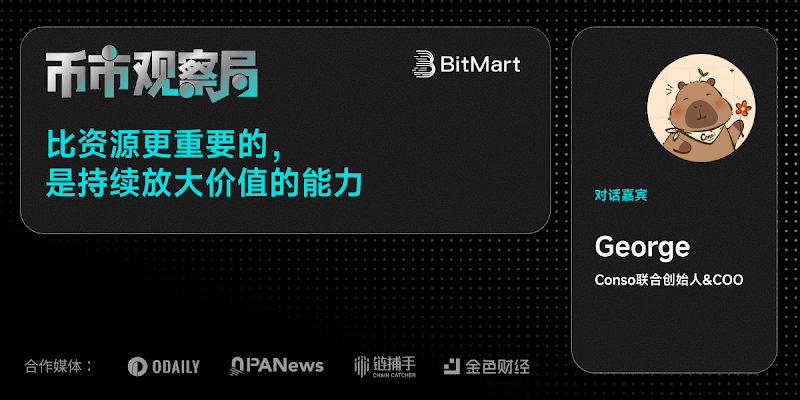
币市观察局 × Conso George:比资源更重要的,是持续放大价值的能力


- 核心观点:在随Crypto周期变化的新阶段,增长核心在于通过个人IP、AI杠杆和Web2用户获取,持续创造并放大价值,而非依赖单一赛道或资源。
- 关键要素:
- 创业最大危机是失去方向而非缺钱;George经历投资人撤资后,将长期能力定位在用户增长上,而非追逐热点。
- 增长本质是寻找杠杆,而非单纯投流;其项目Conso曾用约2万美元预算获取超100万用户,依赖算法、裂变、本地化等多杠杆叠加。
- TON的真正机会在于Telegram的用户网络与Mini App生态,而非仅作为公链,其重点是为数亿用户提供链下服务。
- 个人IP是长期信任资产,通过持续输出内容建立信用;未来信用将更多来自公开内容,而非传统履历。
- AI放大个人能力,但难以替代产品与创意能力;未来竞争不在于工具多少,而在于利用工具创造价值的能力。
In this Crypto cycle, a very interesting phenomenon is unfolding.
More and more people are starting to discuss personal brands, solopreneurs, AI, growth methodologies, and how to acquire incremental users from Web2. Compared to previous years when the industry was obsessed with public chains, DeFi, NFTs, or Memes, people now seem more concerned with a practical question: as traffic becomes more expensive and competition intensifies, what should an ordinary person or a startup rely on for sustained growth?
From starting a business at 21 and achieving tens of millions in annual revenue, to facing investor withdrawal and team disbandment; from quantitative trading to wallet products, and now deep-diving into the TON ecosystem and user growth. Over the past eight years, George has experienced several crucial cycles in the Crypto industry.
More than the track, fundraising, or valuation, George cares more about: how to continuously create value and consistently amplify it.
Guest: George, Co-founder & COO of Conso
Host: yuanyuan, BitMart Marketing VP
The biggest crisis for a startup isn't a lack of money, but losing direction
Many might find George's entrepreneurial journey quite legendary. At 21, the project he founded was already generating tens of millions in revenue; later, entering the Crypto space, he dabbled in quantitative trading, wallets, gaming, and more. From the outside, it seems like a very smooth entrepreneurial path.
But what truly left the deepest impression on him wasn't those highlight moments, but the sudden crisis in 2022. When investors were forced to withdraw funds due to external events, the company's cash flow broke instantly. Faced with the choice of holding on or disbanding the team, he ultimately chose the latter. The team was let go, severance was paid, operations paused, and everything reset to zero.
Looking back, he believes the toughest part wasn't the financial pressure, but the ensuing confusion. Simply copying and pasting a Web2 product into Web3 wasn't sustainable, yet a new direction remained elusive. Throughout 2023, he repeatedly pondered one question: if the market environment changes, what is the ability I can truly rely on long-term? Ultimately, he came back to growth.
Compared to investing, trading, or chasing hot trends, he placed more faith in his accumulated experience in user growth and market operations. It was during this phase that he re-established his future development direction—helping more Web2 users enter Web3.
Anxiety isn't a weakness, but a competitive advantage
Another word George repeatedly mentioned in the show is anxiety. Many people wish to get rid of anxiety, but in George's view, it's almost impossible for people not to feel anxious. There will always be someone better, new opportunities will always appear, and new changes will always happen. The problem is never how to eliminate anxiety, but how to coexist with it.
He says he has long been accustomed to a state of "walking on eggshells." Because this state constantly reminds him to cherish opportunities, treat every partner seriously, and not stop moving. To some extent, this persistent sense of crisis becomes a driving force.
Many entrepreneurs, at a certain stage, start relying on resources, connections, or past advantages. But George prefers to rely on himself. This is also why he insists on long-term planning. Inspired by a teacher at 18, he set himself a life goal of multiplying by ten every five years: achieving 1 million in annual revenue at 20; 10 million at 25; 100 million at 30... It sounds somewhat idealistic, but the goal isn't to show off numbers; it's to help continually expand his own capability boundaries. After achieving the first 1 million, he found 10 million was no longer an abstract concept; after achieving 10 million, 100 million gradually became tangible.
For entrepreneurs, the greatest growth often isn't how much money they make, but continuously improving their ability to solve problems.
The essence of growth isn't traffic acquisition, but finding leverage
Over the past few years, the industry has seen countless growth myths. Some relied on airdrops, some on subsidies, some on traffic dividends.
George believes growth is essentially about finding leverage. He shared the example of his current project Conso, which acquired over 1 million users with a budget of about $20,000. Many people's first reaction would be channel dividends or traffic luck, but in his view, what really worked was the stacking of a series of leverages. From TikTok's algorithm recommendations to viral spread via micro-KOLs; from performance-based payment models to multi-platform syndication; from localized operations to user referral mechanisms, each part acted as a fulcrum.
He always believes in the saying: "Give me a lever long enough and a fulcrum on which to place it, and I shall move the world." And growth is the continuous search for new fulcrums.
The opportunity for TON might go beyond just being a public chain
Over the past year, TON has undoubtedly been one of the most watched ecosystems in the industry. However, in George's view, many people still think of TON purely as a public chain. What's truly important is the user network behind Telegram.
Compared to most Crypto products, Telegram naturally has hundreds of millions of users and has formed a mature Mini App ecosystem. For many users in developing countries, Telegram has even become an integral part of daily life. This means the challenge TON faces is different from traditional public chains. Most public chains primarily consider on-chain users, whereas TON focuses more on how to better serve users off-chain.
George mentioned that one of the reasons he is bullish on the long-term development direction of Web3 financial infrastructure lies here.
The industry narrative has constantly changed over the past few years, from DeFi to NFT, from GameFi to AI. But the truly persistent main thread has never changed: making Web3 the new financial infrastructure. Especially in many developing countries, where local currencies face long-term devaluation pressures and cross-border payments are inefficient, these real needs won't disappear with the end of a market cycle. Platforms capable of connecting hundreds of millions of ordinary users naturally have a greater opportunity.
The IP era: Everyone should become their own media outlet
Beyond growth and entrepreneurship, George has done another thing in the past year—helping creators grow.
In this process, he found that many talented people aren't lacking in ability; they lack expression skills. Many developers, entrepreneurs, and even project leaders have impressive backgrounds and genuine achievements, yet have almost no presence on social media. It's not because they aren't good enough, but because they don't know how to convey their value to a wider audience.
Therefore, George increasingly believes that everyone should cultivate their personal brand. This isn't about becoming an influencer, but about building trust. Touching on this point, he mentioned the young KOL "Enheng" who rapidly rose during this cycle. In his view, many people see the results but overlook the underlying accumulation. As early as 2024, Enheng was already active in various communities, continuously learning and observing. What truly creates distance between people isn't luck, but the ability for continuous learning and consistent output.
As industry information becomes increasingly fragmented, a person who consistently produces content tends to get more opportunities, collaborations, and resources. Many times, people don't trust you because they know you personally, but because they've seen your content for a long time, they become willing to get to know you.
In the past, a person's credit mostly came from education, resume, and company background. Today, more and more credit is coming from public content itself. What you've written, thought about, and shared is becoming a crucial basis for others to judge you.
For entrepreneurs, a personal brand isn't just a communication tool; it's a long-term accumulated trust asset. And the biggest characteristic of this asset is that it generates compound interest over time.
AI won't replace you, but someone who uses AI will
In the AI era, work that used to require three people can now be done by one person. A large amount of repetitive work, such as design, editing, data analysis, and operations management, is being redefined. George believes the greatest value of AI isn't replacing jobs, but amplifying individual capabilities. The abilities that are truly hard to replace will become even more important, such as product sense and creativity. Because AI can generate answers, but it cannot replace the person who creates the answers.
Future competition might no longer be about who masters more tools. It will be about who can use tools to create more value. He also stated that AI is unlikely to replace him, so he wouldn't entrust his social media accounts to AI for maintenance either.
Real opportunities come from continuously amplifying value
Resources can disappear, connections can change. But when a person can continuously create value, opportunities often come to them. And this might be the most important lesson from George's eight years of entrepreneurship.
"Entrepreneurs must break free from dependence on resources and connections, and prioritize self-improvement," he says. Because investors can leave, markets can change, trends can shift. What works today might not work tomorrow. The only thing that can accompany you long-term is your ability itself.
Whether it's the TON ecosystem, growth hacking, building a personal brand, or using AI, his real concern always comes down to one thing: how to create value and how to amplify it. Because an individual's ability to create and amplify value will accompany them through cycles. This holds true for entrepreneurs, for companies, and perhaps for the entire Crypto industry as well.
—-----
The full content of this episode can be found by searching for "Crypto Market Watch" on Xiaoyuzhou, Apple Podcasts, and Spotify. < /p >
Also, welcome to follow BitMart's Twitter for more industry insights, market trends, and platform updates.
Risk Disclaimer
The remarks or opinions expressed in this column represent the personal views of the guests and do not represent the views of BitMart or its affiliates, nor should they be considered professional financial investment advice.
Cryptocurrency investment is highly speculative and carries significant risk of loss. Past performance, hypothetical scenarios, or simulated results do not guarantee future returns. The value of digital currencies can fluctuate, and buying, selling, holding, or trading digital currencies may involve substantial risk. Before engaging in transactions or holding digital currencies, please carefully evaluate their suitability based on your investment objectives, financial situation, and risk tolerance. BitMart does not provide any investment, legal, or tax advice.


