






原生隐私功能,以太坊的救命稻草?


- Core Thesis: Ethereum's market downturn is attributed to the complete transparency of on-chain data, prompting developers to accelerate the implementation of native privacy features. Industry insiders warn that a privacy upgrade must be completed within 12 months, or the network risks losing users and capital to privacy-focused coins and competing platforms.
- Key Factors:
- Market Divergence: ETH has fallen ~30% year-to-date to $2000, while privacy coins like ZEC have seen double-digit percentage gains, reflecting capital rotation into the privacy sector.
- User Exodus: Holdings by mid-sized investors (100-1000 ETH) dropped from 16.2 million in 2023 to 8.75 million, with large holders also consistently reducing their positions.
- Competitive Pressure: GSR data shows blockchain revenue flowing to Solana, Tron, etc., with the ETH/BTC ratio hitting a low for mid-2025.
- Privacy Roadmap: Vitalik is pushing a short-term roadmap focused on account abstraction, the FOCIL mechanism, ephemeral keys, and the Kohaku toolset, aiming to enable native private transactions.
- Institutional Demand: Lawyer Gabriel notes that privacy upgrades are crucial for the asset tokenization market, as enterprises require confidentiality for financial data like supply chains and transaction paths.
- Time Sensitivity: Varys Capital Director Dunleavy warns that if privacy features are not implemented within 12 months, ETH will lose its competitive edge.
Original author: Oluwapelumi Adejumo
Original translation: Chopper, Foresight News
TL;DR
- Amidst the current sluggish ETH market, privacy coins are bucking the trend and strengthening. Ethereum developers are urgently advancing native privacy features.
- The complete transparency of asset balances and transaction history on the Ethereum blockchain not only deters institutional investors but also weakens its core competitiveness as the industry's default settlement layer.
- Industry insiders state that Ethereum's privacy features must be implemented within 12 months, otherwise, the project risks remaining at the theoretical research stage, with traffic and attention continuously being captured by competitors.
As market capital flows shift towards assets in the privacy sector, compounded by negative舆论发酵 (negative sentiment brewing) and doubts about its development direction, Ethereum is currently struggling to retain investor interest. Consequently, developers are全力 (going all out) to build native privacy capabilities for the world's largest smart contract public chain.
Year-to-date, the price of ETH has fallen approximately 30%, recently trading around the $2,000 mark. In contrast, over the same period, Zcash (ZEC) has achieved double-digit gains, creating a stark divergence in their price trajectories.
This contrast in market performance has transformed privacy protection from a long-standing aspiration of the cypherpunk community into a hard product goal with a firm deadline for Ethereum.
Currently, Ethereum still holds a monopoly in stablecoin settlements, asset tokenization, decentralized finance (DeFi), and the Layer 2 ecosystem. However, the完全公开 (complete public transparency) of on-chain data is a major pain point for both retail users and institutions, as asset balances, transaction counterparties, and historical records are all exposed for real-time public tracking and溯源 (tracing).
Tom Dunleavy, Head of Ventures at Varys Capital, is optimistic about Ethereum's privacy upgrade but emphasizes the need to accelerate the timeline. "I am hugely bullish on Ethereum implementing privacy features, but the entire package must be delivered within 12 months, otherwise, it all becomes meaningless. Ethereum is currently in a fierce product race. Competitors are well-funded, execute quickly, and possess industry resources that Ethereum lacks. Only by delivering on time can it avoid being left behind."
This warning comes as Ethereum's market position is already under pressure. According to data from GSR Research, revenue in the blockchain sector is increasingly flowing to competitors like Solana, Tron, and Hyperliquid. Furthermore, the ETH/BTC ratio has fallen to its lowest level since mid-2025.
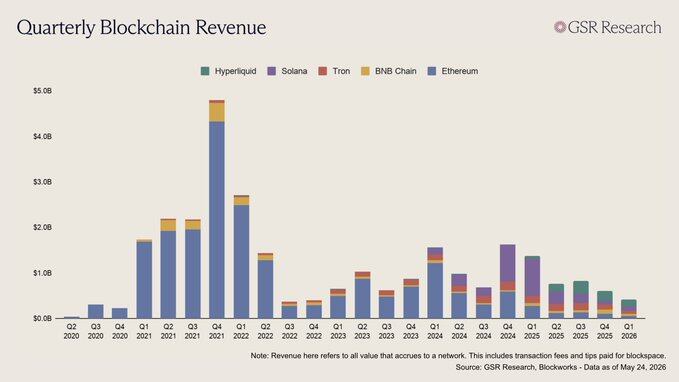
Quarterly Blockchain Revenue, Source: GSR Research
Data from CryptoQuant also reflects the crisis, showing a large-scale exodus of small and medium-sized Ethereum holders. Over the past three years, the total asset balance held by wallets with 100 to 1,000 ETH has nearly halved, dropping from a peak of 16.2 million ETH in 2023 to approximately 8.75 million ETH today.
Large holders have also started to reduce their positions. Addresses holding 1,000 to 10,000 ETH, which significantly drove ETH's price increase in 2024, have been gradually decreasing their holdings since the end of last year.
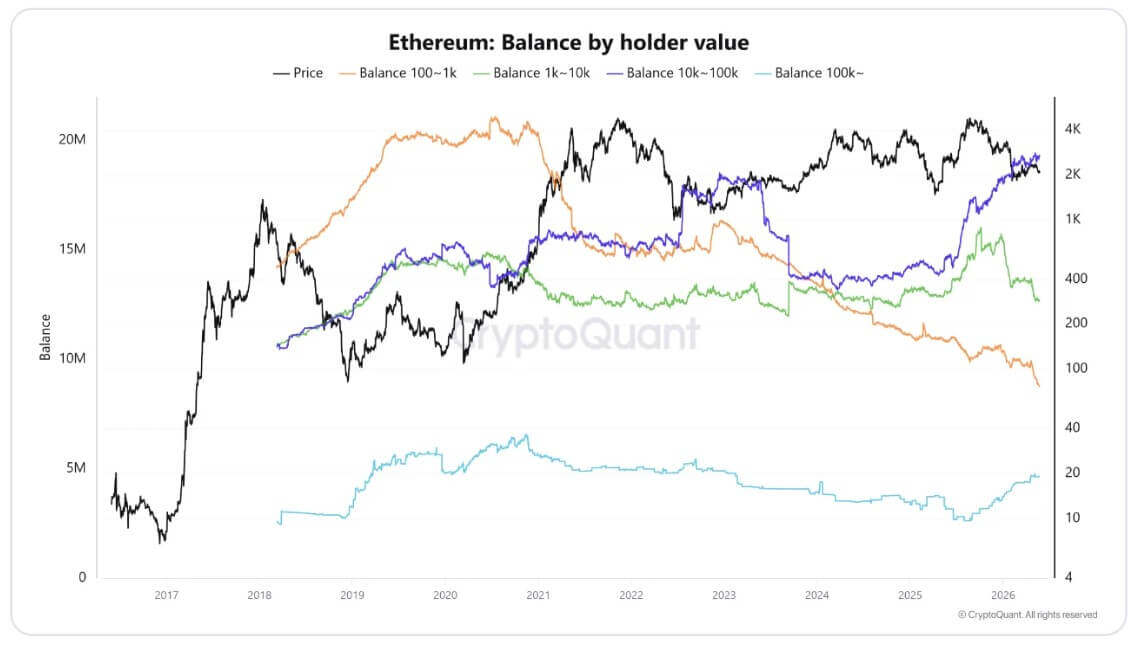
Ethereum Holder Balances
The capital outflow cannot be solely attributed to the rising demand for privacy, but with the surge in popularity of privacy assets and investors actively seeking catalysts for an ETH price rebound, the loss of holdings further exacerbates the development pressure on Ethereum.
Privacy Has Become the New Core Theme in the Crypto Market
While Ethereum is ramping up its privacy features, a consensus is forming across the industry: financial privacy will dominate the next major cycle in the crypto market.
A recent analysis by Grayscale Research indicated that the digital asset industry is about to witness a third wave of widespread public interest in financial privacy.
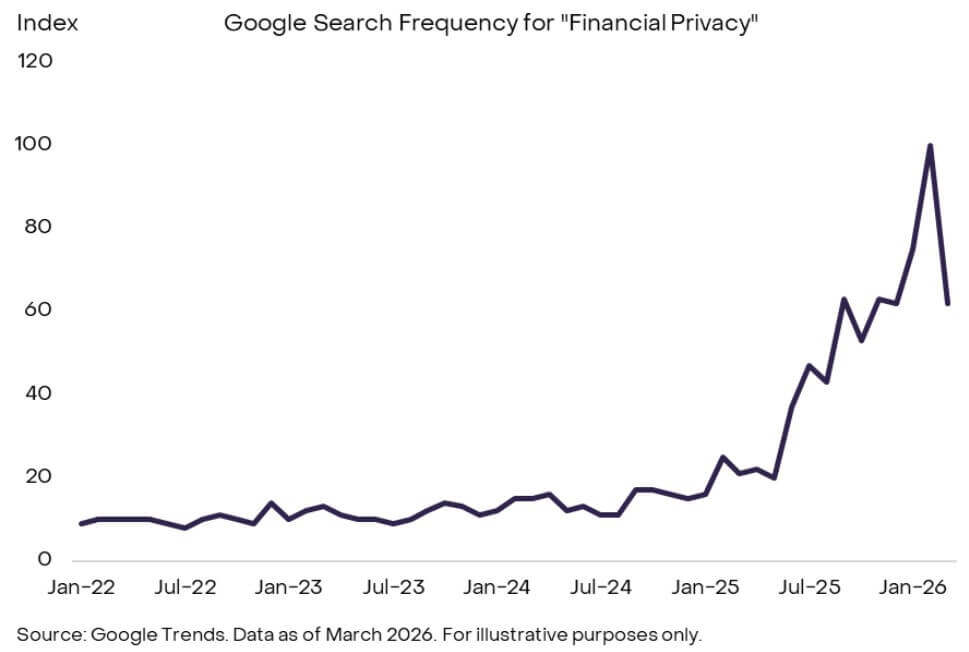
Google Search Volume for Financial Privacy, Source: Grayscale
This trend is driven by the普及 (proliferation) of stablecoins, the real-world application of on-chain protocols, and the rapid development of artificial intelligence technology. Grayscale warns that AI tools have created more sophisticated financial tracking methods, while on traditional public blockchains, asset balances, transaction counterparties, and history are permanently公开 (exposed).
The market demand for privacy stems not only from groups seeking complete anonymity but also from the legitimate need of the general public and businesses to keep financial information confidential.
Regular users do not want their spending habits publicly recorded; businesses need to keep supplier payments, payroll, and company fund flows confidential; and institutions find it unacceptable for their wallet address structures to be openly tracked and analyzed in real-time.
However, implementing privacy features also requires balancing business pros and cons. Historical experience shows that strong privacy attributes often reduce asset liquidity and create resistance in areas such as exchange listings, regulatory compliance, and wallet integration.
Despite these challenges, Barry Silbert, Chairman of Grayscale Investments, has declared that the privacy era for the digital asset industry has officially arrived.
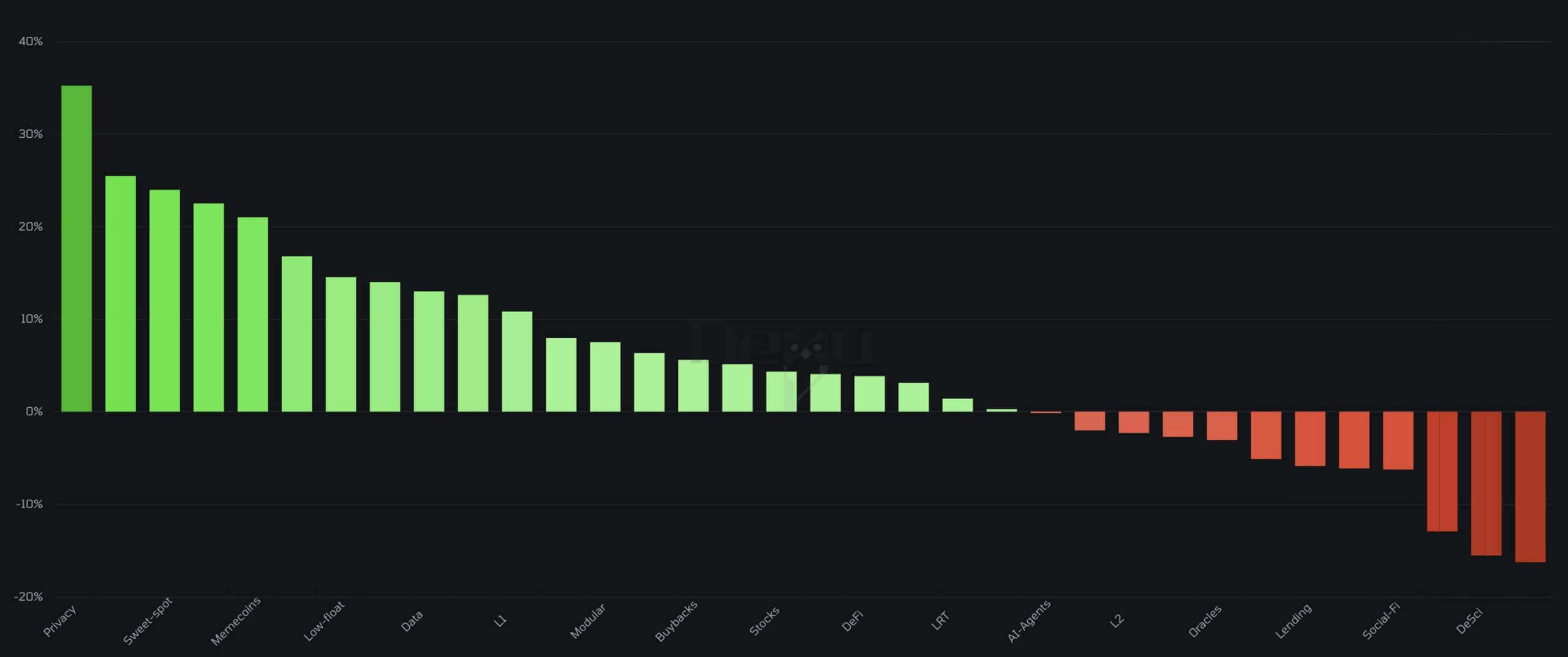
Privacy Coins Begin to Dominate the Crypto Industry
The shift in market direction is perfectly reflected in price action: over the past year, ZEC's market cap surged by over 900%, approaching $10 billion. Even Monero (XMR), which has long faced regulatory scrutiny, saw its price double.
Ethereum Co-founder Pushes for Privacy Upgrade
Recently, Ethereum co-founder Vitalik Buterin has prioritized privacy building back to the top of the technical agenda. After years of research and discussion, he is urging developers to accelerate the realization of the cypherpunk vision of privacy.
Ethereum's short-term privacy roadmap primarily focuses on three key areas: Account Abstraction and FOCIL, Key Randomization, and Access Layer privacy modifications. This package aims to enhance the censorship resistance of on-chain transactions, break address linkability, and reduce reliance on trusted third-party infrastructure.
FOCIL, which stands for Fork-Choice enforced Inclusion Lists, is designed to address transaction censorship.
Currently, transactions enter a public mempool before being included in a block. Block builders and intermediary parties can view pending transactions, allowing them to censor, front-run, and monitor data. The FOCIL mechanism allows a committee of validators to propose a list of transactions that the block builder must include. Blocks that violate this rule are rejected by the network, fundamentally reducing the risk of private transactions being censored.
Account Abstraction addresses another flaw in Ethereum's current design, where most users still rely on Externally Owned Accounts (EOAs) controlled by a single private key. Account Abstraction makes accounts behave more like programmable smart contracts, enabling features like social recovery, multi-signature authorization, and gas fee sponsorship.
From a privacy perspective, this feature can optimize wallet behavior patterns, preventing all activities from being exposed through the same account, and also facilitates third-party fee sponsorship.
Key Randomization aims to solve a narrower but critical metadata leakage issue. Ethereum relies on a nonce to prevent transaction replay attacks. This nonce is sequentially incrementing, allowing outsiders to link seemingly unrelated transactions and trace back to the same account. The new方案 (proposal) splits the account counter into multiple independent domains, where different types of transactions use different nonces, significantly increasing the difficulty of address tracing.
Additionally, the Ethereum Foundation has released an open-source toolset called Kohaku, which is arguably the most ambitious part of this privacy upgrade. This project isn't just about achieving private transfers; it focuses on solving data leakage at the access layer before transactions are submitted on-chain.
Even if transactions themselves are privacy-preserving, when users query on-chain balances, call contracts, or initiate transactions, their wallets still leak information like IP addresses and wallet identity to Remote Procedure Call (RPC) nodes. Kohaku provides privacy and security components for wallet developers that can be integrated directly into existing products. Its features include private transfers, secure key management, private on-chain queries, and comes with a reference wallet. The tool can also interface with Ethereum's existing privacy protocol, Railgun, and the still-in-development Privacy Pools. The goal is to allow users to experience private transfers and private DeFi services without changing their preferred wallets or using niche tools.
Ethereum researcher soispoke.eth stated that if these proposals are implemented concurrently, Ethereum could achieve native, trustless, and censorship-resistant private transactions as early as next year.
Why Privacy Features Are Crucial for Ethereum
Gabriel Shapiro, a lawyer specializing in crypto, believes that the privacy upgrade will help Ethereum compete for the institutional asset tokenization market. Enterprises have strong confidentiality needs in scenarios like securities tokenization, treasury management, and DeFi interactions.
This also touches on the core investment thesis for Ethereum. For a long time, Ethereum's advantage has been its comprehensive ecosystem, covering stablecoins, lending, decentralized exchanges, asset tokenization, Layer 2 networks, and various development infrastructures. However, if all financial interactions remain completely public by default, ecosystem breadth alone will be unsustainable.
For institutions, a public settlement layer without privacy is inherently risky: companies don't want competitors to map out their supply chain relationships; asset managers don't want their trading strategies tracked; and banks cannot afford to have their clients' tokenized securities activities exposed on a public blockchain.
Ethereum has the underlying infrastructure to serve institutional clients, but the market demands a deliverable product, not just theoretical research.
This reinforces Dunleavy's 12-month countdown warning. Zcash has already established a clear privacy narrative. Monero remains a dominant privacy coin despite regulatory pressure. Meanwhile, competitors like Solana, Tron, and Hyperliquid continuously capture market attention, and Bitcoin still firmly holds institutional capital preference.
Currently, the value of tokenized assets on the Ethereum blockchain exceeds $350 billion, and its application ecosystem remains the deepest in the industry. However, this leading advantage is not permanent.
If Ethereum can launch a mature, usable privacy product within a year, it will further consolidate its position as a settlement infrastructure for both individuals and institutions. Conversely, if the privacy upgrade remains stuck at the technical planning stage, market capital will continue to flow towards projects that have prioritized privacy as a core feature from the start.


