






Loss of $75,000, Is Bitcoin Headed for Its Final Drop?


- Core View: The crypto market has recently experienced a significant correction, with Bitcoin falling below $75,000. Market fear is spreading. This is primarily driven by escalating geopolitical risks in the Middle East and substantial profit-taking by institutional investors through Bitcoin spot ETFs. The market may continue to face consolidation and volatility in the short term.
- Key Elements:
- The market fear index has dropped to 34. Over the past 24 hours, total liquidations across the network reached $470 million, with long position liquidations hitting $420 million, reflecting extremely bearish market sentiment.
- US-Iran tensions have escalated, with Trump threatening to control Iranian assets and the US military striking Iranian military bases. This geopolitical risk has fueled risk-off sentiment, leading to capital outflows from risk assets like crypto.
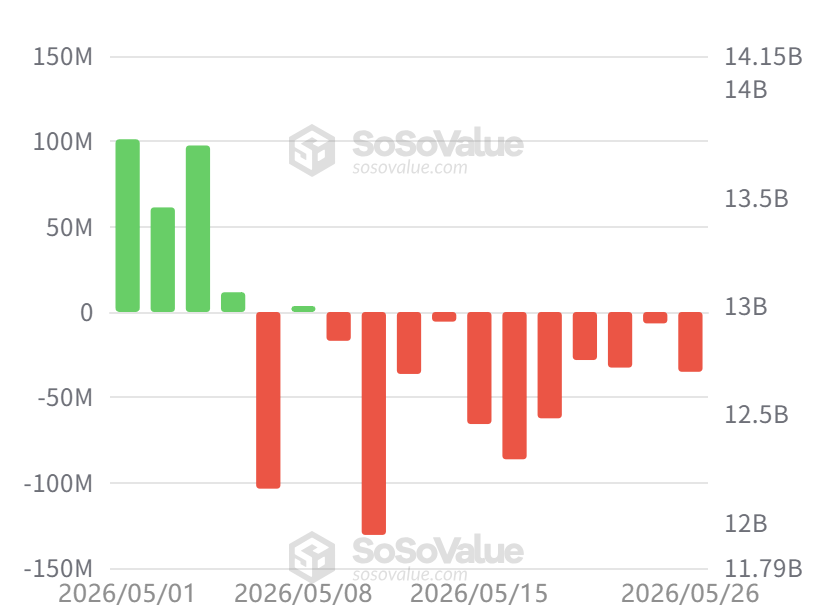
- From May 5 to May 26, US Bitcoin spot ETFs recorded consecutive net outflows, with a single-day peak of $600 million. Ethereum ETFs also experienced substantial net outflows, reflecting institutional profit-taking.
- Analysts point out that the activity weight of short-term capital on the chain has fallen to historically low levels, similar to past bear market bottoms, indicating a significant cooling of short-term turnover and that the market may be at a bottom or accumulating.
- Institution Wintermute believes that after the AI (e.g., Nvidia) momentum fades, macro factors (inflation, consumer confidence) will gain greater weight, and the crypto market cannot remain unaffected.
- Analysts consider the $75,000 to $76,000 range as a key support level for Bitcoin. If this level holds, it could regain its upward momentum; a breakdown could lead to a rapid slide towards $70,000 to $72,000.
Original Author: Ma He, Foresight News
On May 28th, after repeatedly battling the $75,000 level, the price of Bitcoin ultimately failed to hold and has now slid to around $74,000. ETH is fluctuating repeatedly around the $2,000 mark. Previously strong performers like NEAR, WLD, and ONDO have all experienced pullbacks.
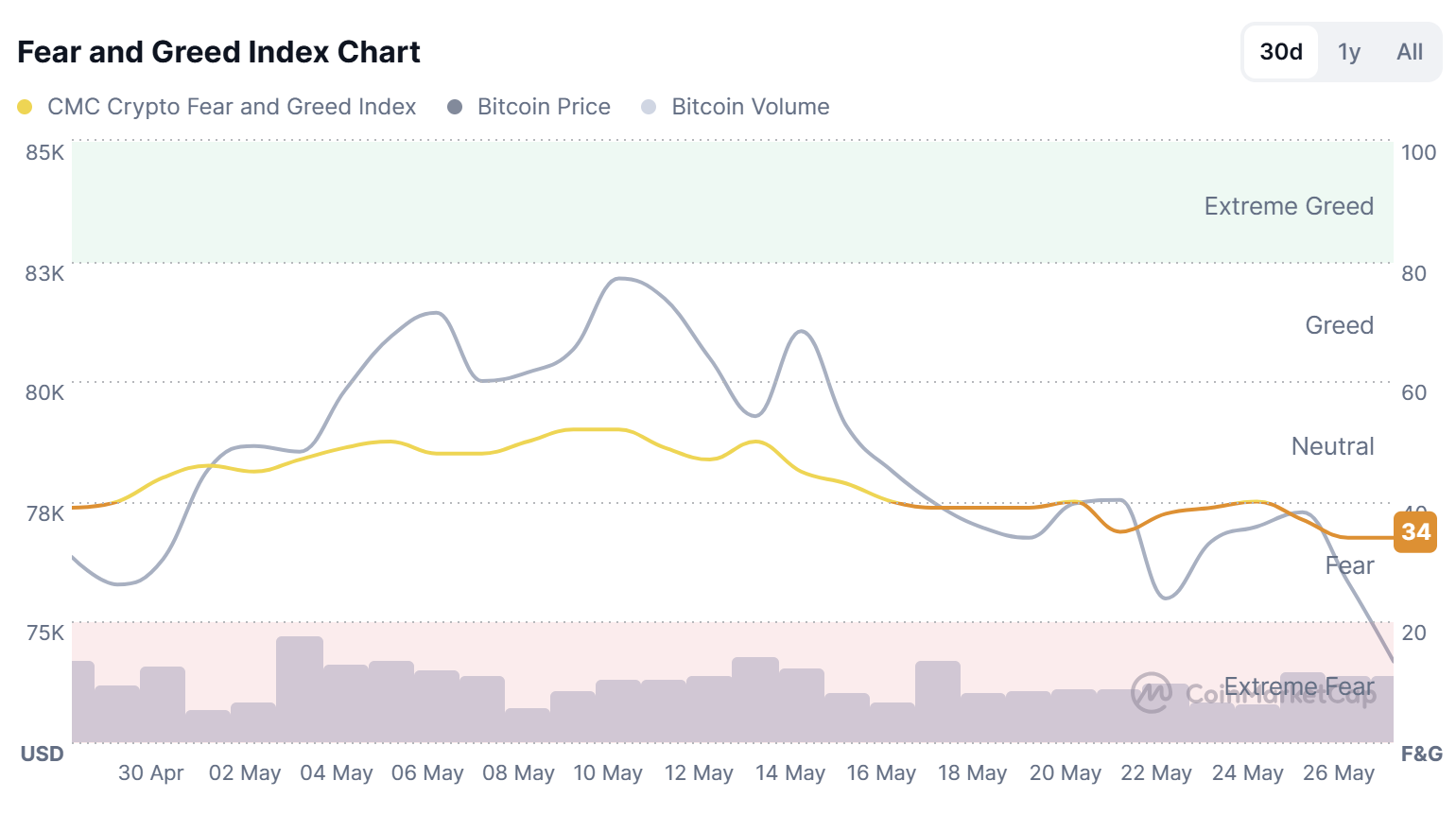
Currently, the market fear and greed index has fallen back to 34, indicating a state of fear.
Coinglass data shows that total liquidations across all contracts on the network reached $470 million in the past 24 hours, with long positions accounting for $420 million of that amount.
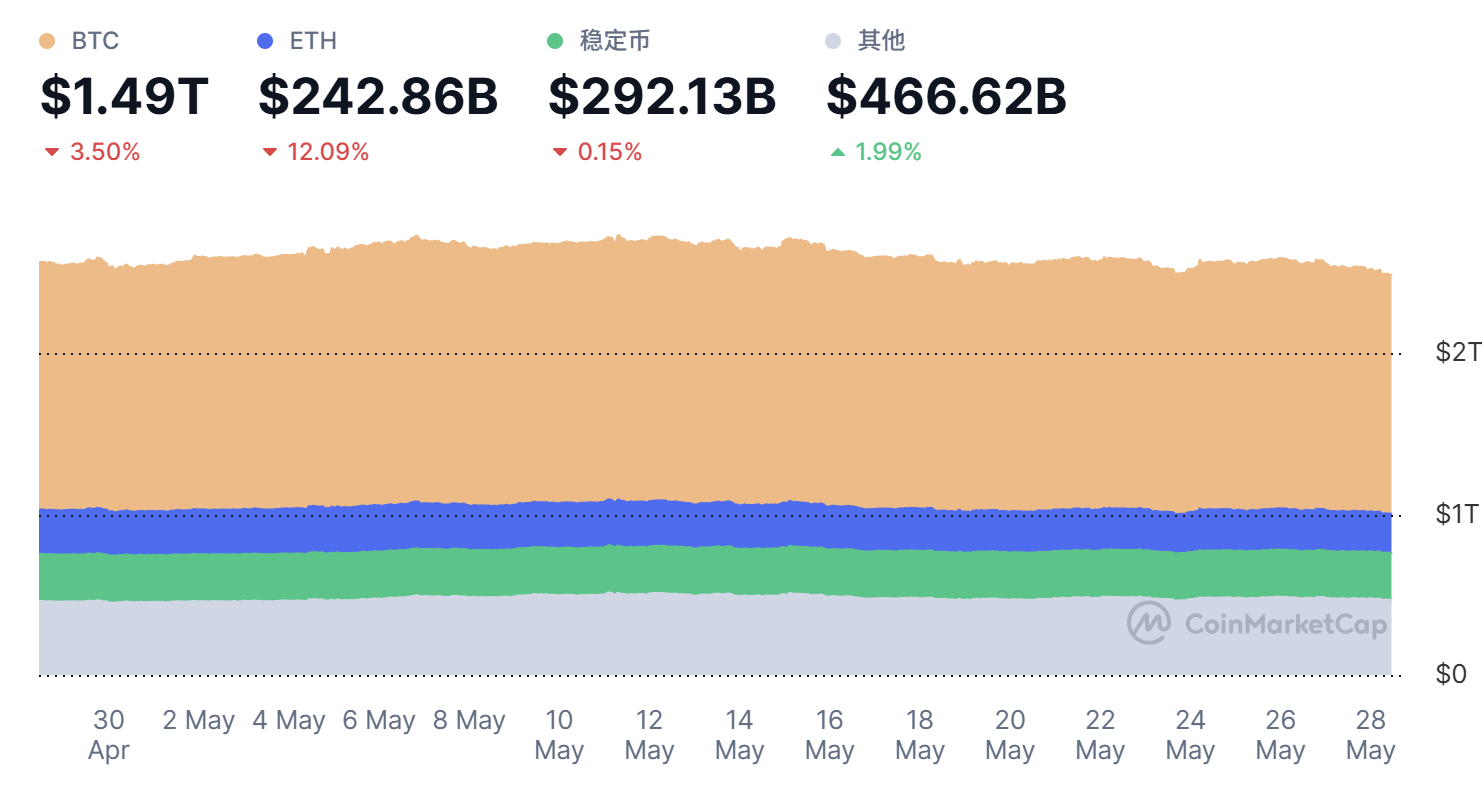
Over the past few weeks, Bitcoin has oscillated repeatedly between $75,000 and $80,000, briefly attempting to break above $78,000 but failing to hold that level. Over the last 30 days in the crypto market, BTC has dropped 3.5%, ETH has fallen approximately 12%, and stablecoins have also declined by 0.15%.
On the macroeconomic data front, Brent crude oil edged up to $97/barrel, silver dipped slightly to $73, the Dow Jones Industrial Average rose 182.60 points (+0.36%) to a new record high. The S&P 500 index increased by 1.24 points (+0.02%). The Nasdaq Composite Index stood at 26,674.73 points, up 18.55 points (+0.07%). Spot gold fell below the $4,400/ounce mark for the first time since March 27th, dropping over $50 intraday, a decline of 1.25%.
US-Iran Conflict Reignites
Geopolitical risks in the Middle East have become another significant external variable. Since 2026, tensions between the US, Iran, and related parties over issues like Iran's nuclear facilities and the safety of shipping through the Strait of Hormuz have repeatedly escalated and de-escalated. In recent months, the US has employed a strategy combining military action with diplomatic pressure, interspersed with airstrikes, rumors of port blockades, and repeated ceasefire negotiations.
Even during windows of ceasefire or diplomatic progress, the market's pricing for the risk of "reignition" has not fully dissipated.
Early on May 28th, US President Donald Trump stated that the United States would continue to control Iranian assets. Iran has started providing us with what we want. If things don't go well, US Secretary of Defense Pete Hegseth will get the job done. We could end the war with Iran quickly, and may have to. However, I don't think we need to.
Around 5:00 AM Beijing time, according to Iranian media Fars News, local residents reported hearing an explosion at the port of Bandar Abbas in southern Iran.
A US official told Reuters that US military forces carried out new strikes against an Iranian military base that posed a threat to US forces and commercial navigation in the Strait of Hormuz. US forces also intercepted and shot down several Iranian drones that threatened US forces and commercial maritime traffic.
Tensions surrounding the Strait of Hormuz have once again become a focal point, leading to increased oil price volatility and putting pressure on global risk assets. In this environment, Bitcoin has demonstrated more characteristics of a risk asset than its traditional "digital gold" safe-haven function—geopolitical uncertainty boosts demand for the US dollar and US Treasuries while simultaneously dampening risk appetite, leading to capital outflows from the crypto market.
ETF Net Outflows Reveal Institutional Profit-Taking
Since their launch in early 2024, US Bitcoin spot ETFs have seen cumulative net inflows exceeding $57 billion, becoming a primary channel for institutional allocation to Bitcoin. However, a clear reversal in flows began in May 2026.
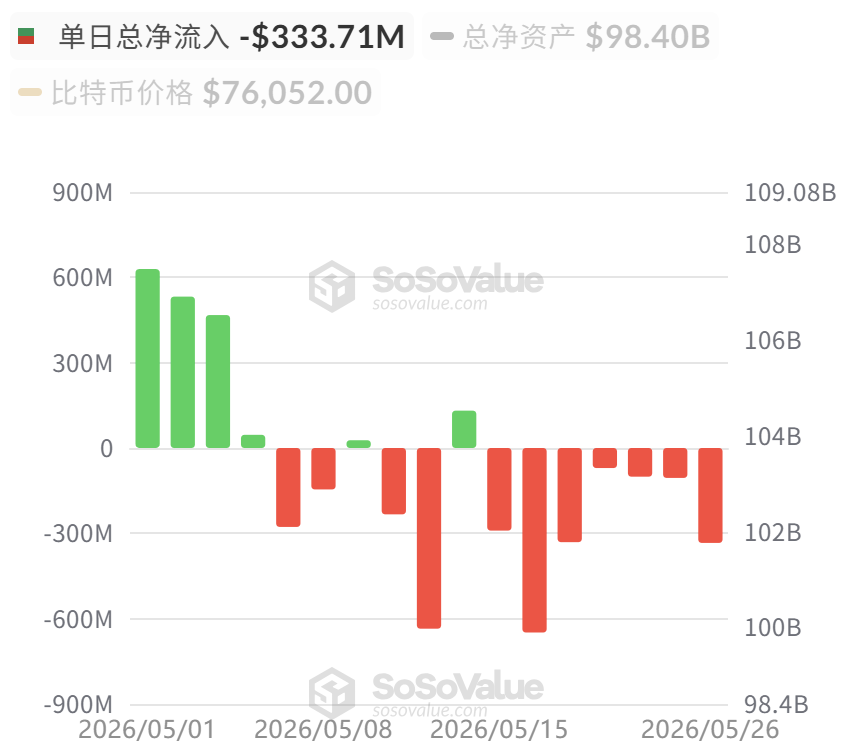
According to tracking data from SoSoValue, between May 5th and 26th, US Bitcoin ETFs recorded consecutive net outflows. The daily outflow scale expanded from tens of millions of dollars to as high as $600 million on two separate occasions.
The situation for Ethereum spot ETFs is similarly bleak, mirroring Bitcoin with significant net outflows since the beginning of May.
This may not simply be a "fear-driven sell-off," but rather systematic profit-taking by holders who bought at lower prices. ETF holders include traditional asset managers, family offices, and hedge funds. After Bitcoin recovered from its lows to the $75,000-$80,000 range, they chose to lock in profits via the redemption mechanism. Some of this capital may have rotated into stronger-performing AI-related tech stocks—the S&P 500 and Nasdaq indices hit new highs during this period, while the crypto market broadly underperformed, highlighting intra-risk-asset capital reallocation.
Future Trajectory
Wintermute posted that BTC experiencing over $1 billion in ETF outflows for two consecutive weeks (following six weeks of inflows) indicates institutions are capitalizing on recent positive gains. More noteworthy is AI. Nvidia delivered textbook-beating earnings, yet saw almost no movement after hours. Incremental beats are no longer moving the needle. If the AI momentum fades, the macro picture (record-low consumer confidence, sticky inflation, a hawkish Fed under new leadership) will gain more weight, and crypto will not be spared.
BTC's long-term structure remains intact (reserves at multi-year lows, long-term holders accumulating, CLARITY progressing, HYPE doing what major early-stage tokens should do). However, short-term fund flows drive price, and currently, they are negative. The $75,000 to $76,000 range is a critical line for BTC. Holding this level could allow BTC to re-test $80,000; breaking below it could lead to a rapid slide towards $70,000 to $72,000.
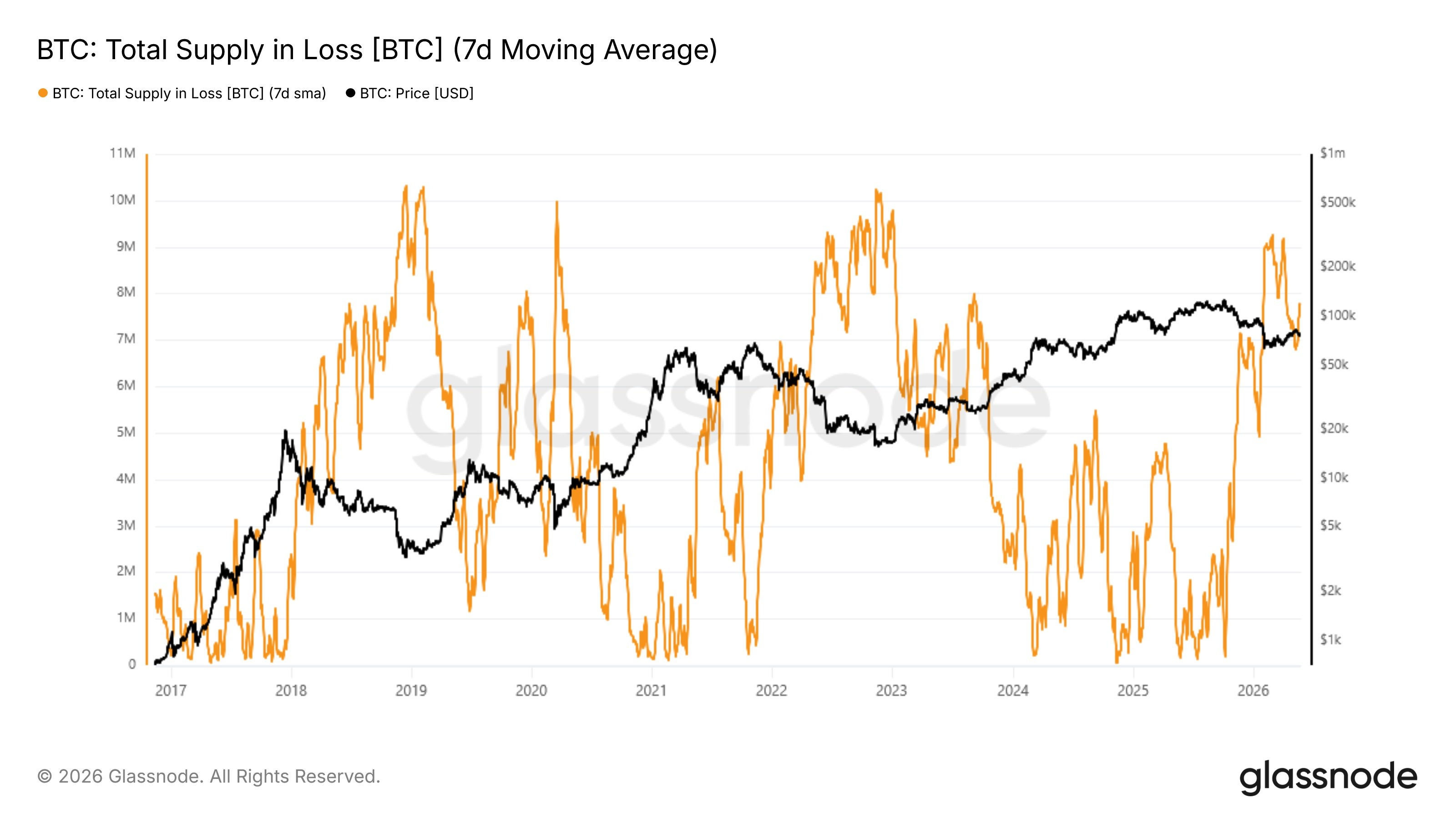
Glassnode tweeted that at a price of $76,000, approximately 7.75 million BTC are in a loss-making state. This supply overhang is a structural characteristic of a bear market and is typically only resolved when weak hands capitulate.
BIT tweeted that regarding Bitcoin, the sustained upward trend over the past period largely depended on the interplay between institutional demand and marketable supply. Over the past year, Bitcoin spot ETFs and Strategy have been significant sources of this demand. When ETF inflows accelerated and Strategy continued increasing its BTC holdings, Bitcoin's price typically trended higher.
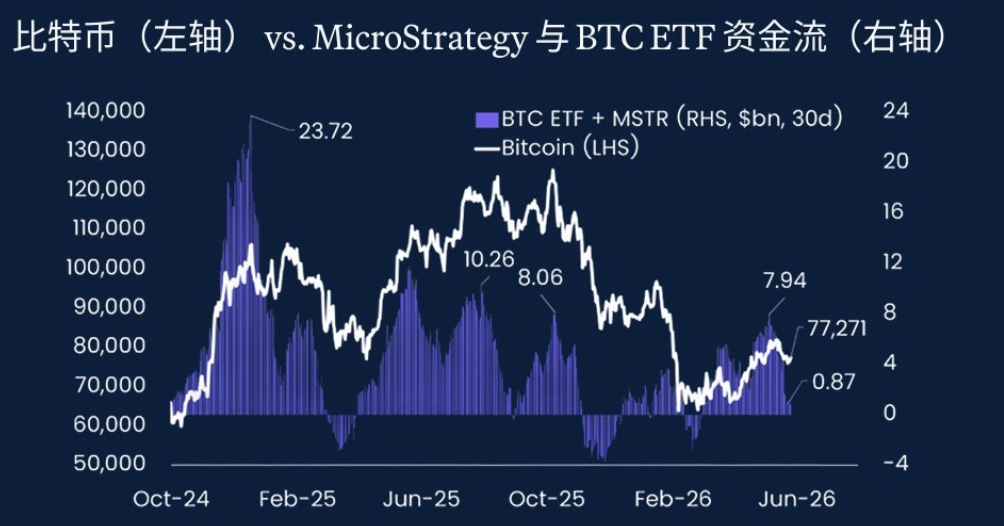
BIT stated that the combined net purchases of ETFs and Strategy have now dropped to just $870 million, primarily due to significant capital outflows from ETFs, shifting them from net buyers to net sellers. Until ETF inflows stabilize and recover, Bitcoin is likely to remain in a phase of volatile consolidation in the short term.
Analyst Murphy stated, using the on-chain metric "Short-Term Holder Spent Output Value Dominance" (weighting the USD value carried by short-term coin turnover), to observe the current state of the BTC market. This metric reflects recent short-term trading activities such as speculation, arbitrage, profit-taking, or panic selling. Currently, this weight has dropped to historically extreme low levels, seen only in the deepest bear market bottoms over the past 15 years. This signifies a significant cooling of short-term turnover, with economic value shifting towards long-term holdings, and the market exhibiting characteristics of low volatility, accumulation, or clear bottoming phases.
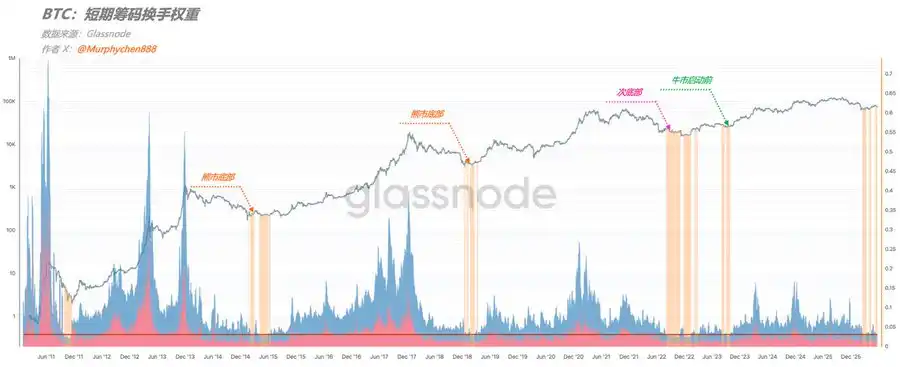
Murphy judges that based on this, the current market might be in one of three phases: a bear market bottom; a secondary bottom, possibly with one final decline; or accumulation before a bull run. However, under rational judgment, pre-bull accumulation can be temporarily ruled out. He does not recommend betting fully on any single scenario and suggests adopting a diversified position strategy to handle different outcomes. The relative position in the long-term direction already indicates that Bitcoin is near a bottom.


