






「美股大作手」特朗普,托举起量子计算整个赛道


- Core Insight: The Trump administration, through funds from the CHIPS and Science Act, has adopted an aggressive investor strategy of "investment for equity," pouring $2 billion into the quantum computing sector in exchange for minority, non-controlling stakes. This aims to boost the independent development of the U.S.'s high-tech industries.
- Key Elements:
- The Trump administration provided a total of $2 billion in funding to nine quantum computing companies in exchange for minority, non-controlling stakes, with the funds sourced from R&D allocations under the CHIPS and Science Act.
- Fund allocation: IBM received $1 billion (via its subsidiary), GlobalFoundries received $375 million (equity stake of approximately 1%), and the remaining seven companies each received about $100 million.
- Following the announcement, the U.S. stock quantum computing sector surged in early trading, with D-Wave rising 16%, Rigetti up 14%, and Infleqtion gaining 25%.
- Previous typical operation: The government purchased nearly 10% of Intel shares at $20.47 per share, which appreciated by over $45 billion within seven months, reflecting the "America First" strategy and the effect of government endorsement.
- In contrast to the Biden administration's pure subsidy model, the Trump administration has adopted a "proactive investor" model, which has so far attracted over $645 billion in private investment and created 525,000 jobs.
Original by Odaily Planet Daily (@OdailyChina)
Author by Wenser (@wenser 2010 )
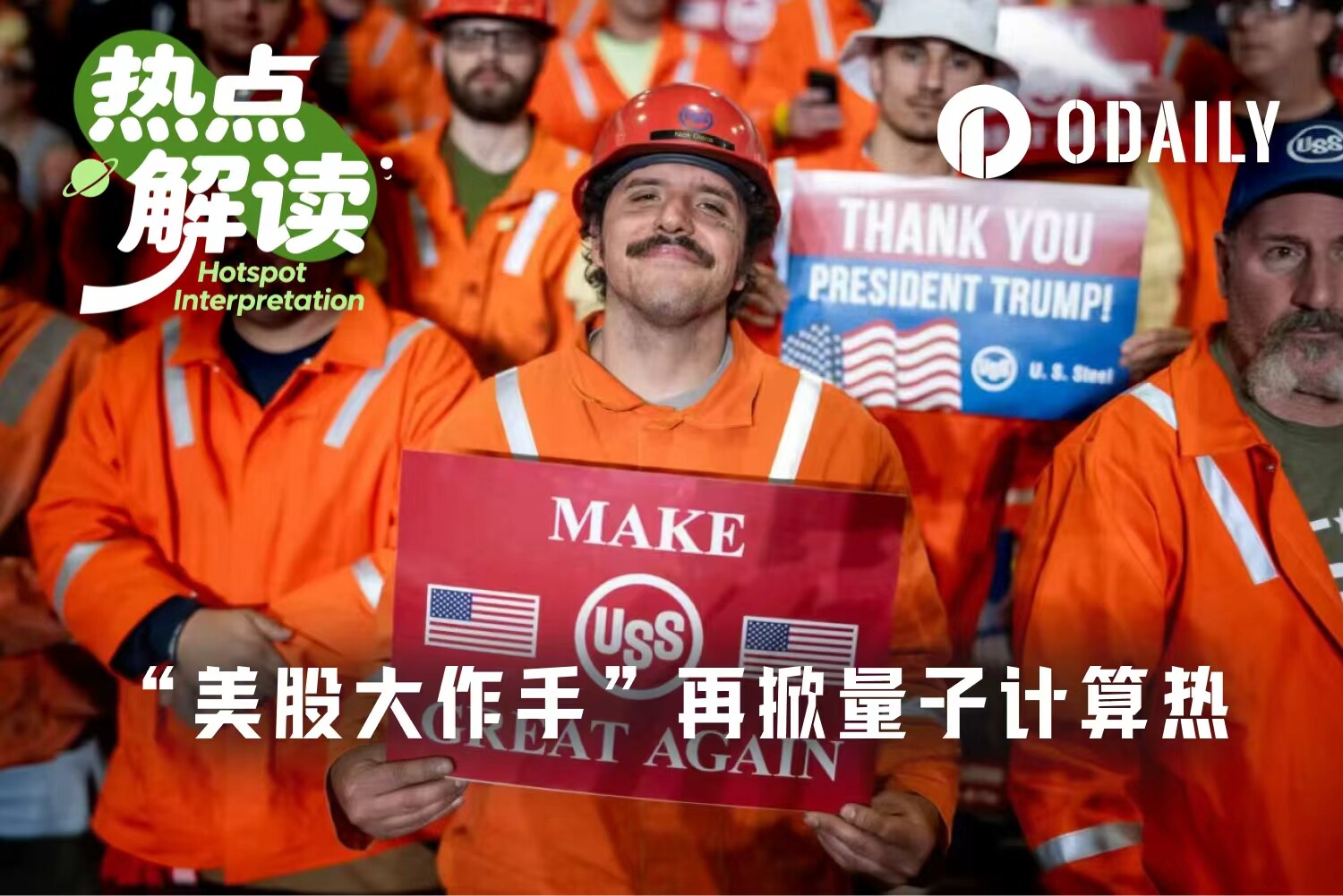
In August last year, driven by Trump, the U.S. government utilized the CHIPS Act to convert funds, directly purchasing nearly 10% of Intel's newly issued original shares (approximately 433.3 million shares) at $20.47 per share. At that time, the value was less than $9 billion; less than a year later, in early May, as Intel's stock price hit an all-time high, the total value of these shares had reached $54.1 billion, appreciating by over $45 billion in just seven months.
Referencing this matter, Trump couldn't hide his pride and posted, saying, "I made the U.S. $45 billion in the last 8 months."
As a capital maestro known for "posting and manipulating the U.S. stock market" at the slightest whim, Trump has an outsized influence on the movements of U.S. stocks. Recently, he has begun his performance again—providing a total of $2 billion in funding to 9 quantum computing companies through the U.S. Department of Commerce in exchange for equity. Odaily Planet Daily will provide a brief analysis of this in the following article.
U.S. Government Strikes Again, Pouring $2 Billion into the Quantum Computing Arena
On May 21st, the Trump administration announced it would provide a total of $2 billion in funding to 9 quantum computing companies through the U.S. Department of Commerce in exchange for partial equity. The specific fund allocation plan is as follows:
- $1 billion will be awarded to IBM (IBM) for the operational development of its independent subsidiary, Anderon;
- $375 million allocated to chip manufacturer GlobalFoundries (GFS);
- Publicly listed companies such as D-Wave (QBTS), Infleqtion (INFQ), and Rigetti (RGTI) will each receive $100 million;
- Private companies like Atom Computing, PsiQuantum, and Quantinuum (Honeywell-HON, independent subsidiary) will each receive $100 million;
- Startup company Diraq is expected to receive $38 million.
According to official documentation, this is part of the Trump administration's "activist investor" industrial policy, with funds sourced from the R&D appropriations of the 2022 CHIPS and Science Act. The Commerce Department emphasized this is a "portfolio" strategy, covering two quantum foundries and seven quantum computing companies. It targets various quantum modalities like neutral atoms, silicon spin, superconducting, photonic, and trapped ion, aiming to solve key engineering bottlenecks such as device reproducibility, error rates, optical complexity, and cryogenic system integration.
On the day of the announcement, the U.S. quantum computing sector surged in early trading. D-Wave Quantum rose 16%, Rigetti Computing rose 14%, Infleqtion stock rose 25%, quantum computing rose 9%, and IonQ rose 3.1%.
It is worth noting that among these recipient companies, only GlobalFoundries Inc. (GFS) disclosed an equity exchange ratio of approximately 1%. For the others, whether public or private, the exchanges involve minority, non-controlling stakes, with specific ratios not yet public. The final ratios await disclosure in SEC filings after formal agreements are signed.
Capital Operations Under the "America First" Strategy
A closer look at this "investment for equity" operation reveals it is still a maneuver by the Trump administration under the "America First" strategy.
Previous investments by the U.S. government in Intel (INTC), the only full supply chain rare earth producer in the U.S., MP Materials (MP), Trilogy Metals (TMQ), Lithium Americas (LAC), U.S. Steel, etc., were also strategic moves to maintain the competitive advantage of the domestic semiconductor industry chain.
Especially regarding the nearly $9 billion investment in Intel, the Trump administration explicitly stated the goal was to support advanced semiconductor manufacturing in the U.S. and reduce dependence on TSMC. Therefore, the U.S. government's relevant shareholding is passive, without board seats, and does not involve participation in the company's daily operations or management. Most matters follow the board's voting decisions.
However, the U.S. government's "equity investment" is not just financial support; it also includes endorsement and multiple policy supports (such as export licenses and tariff protection). Previously, after receiving government funding, Intel received strong assistance from U.S. Commerce Secretary Howard Lutnick, who met multiple times over the past year with Apple CEO Tim Cook, Tesla CEO Elon Musk, and Nvidia CEO Jensen Huang, persuading them to cooperate with Intel. With Apple on board, Intel has now established relevant collaborations with all three companies.
Shift in Operational Approach under the CHIPS and Science Act: From Subsidies to Equity Exchanges
Behind the $2 billion investment in quantum computing companies is the CHIPS and Science Act, a landmark bipartisan piece of legislation enacted by the U.S. government in 2022. Officially the "CHIPS and Science Act of 2022," the Act authorizes a total of approximately $280 billion over 10 years to support the development of the semiconductor industry and fundamental science and technology R&D. Its primary goal is to revitalize the U.S. semiconductor manufacturing sector through massive investment, strengthen scientific research and innovation capabilities, and address competition from other countries in high-tech fields.
However, unlike the grant or pure subsidy model of the Biden administration, the Trump administration's approach is the aforementioned "activist investor" model—shifting towards funding in exchange for minority, non-controlling stakes. As of May this year, the Act has attracted over $645 billion in private investment in semiconductor manufacturing, involving more than 140 projects and creating 525,000 new jobs.
Indeed, while personally pumping stocks like Dell (DELL), Micron (MU), and Palantir (PLTR) in his name, Trump is also driving the U.S. stock market boom through entities like the U.S. government, which explains his frequent boasts that "the new highs in U.S. stocks are mostly because of me."

Additionally, it is noteworthy that a previous investment announcement from the U.S. Commerce Department stated, "The CHIPS Research and Development Office continues to invite proposals from eligible applicants for research, prototyping, and commercial solutions for microelectronics technologies in the United States. Eligible applicants should submit applications via announcement 2025-NIST-CHIPS-CRDO-01 on the website www.grants.gov." In other words, the U.S. government's "investment door" remains open. For more information and funding announcements, see official sources.
Of course, the scope of companies invested in by the U.S. government is broad, covering areas like electrical equipment, critical minerals (rare earths), new energy (lithium batteries), medical supplies, and communication infrastructure. Examples include Westinghouse Electric, Lithium Americas, Trilogy Metals, USA Rare Earth, Vulcan Elements, XLight, and L3 Harris Technologies.
Furthermore, Commerce Secretary Howard Lutnick has hinted to the media that the current U.S. government might take equity stakes in major defense contractors like Lockheed Martin (LMT).
In summary, the listed companies and targets in critical mineral/rare earth/battery material supply chains, nuclear energy/small modular reactors (SMR) and advanced nuclear fuel, alongside quantum computing, mentioned above, could become the focus of the Trump administration's continued bets in the latter half of the year.


