






币市观察局 × LTP Bing:当华尔街开始靠近Crypto,真正的机会可能藏在交易背后


- ประเด็นหลัก: Bing เทรดเดอร์ผู้มากประสบการณ์ที่มีพื้นฐานมาจากการเงินแบบดั้งเดิม เชื่อว่าการพัฒนาในระยะยาวของอุตสาหกรรมคริปโตเคอร์เรนซีขึ้นอยู่กับความสมบูรณ์ของโครงสร้างพื้นฐาน ไม่ใช่ความผันผวนของราคา เขากำลังมุ่งมั่นสร้างบริการนายหน้าซื้อขายหลักทรัพย์ (Prime Brokerage) ที่หาได้ยากในแวดวงคริปโต โดยเชื่อมต่อการแลกเปลี่ยนที่หลากหลายและให้การจัดการความเสี่ยงแบบรวมศูนย์ เพื่อผลักดันให้เงินทุนจากสถาบันไหลเข้าสู่ตลาดอย่างแท้จริง
- ปัจจัยสำคัญ:
- สาเหตุหลักที่เงินทุนจากสถาบันยังไม่หลั่งไหลเข้าสู่ตลาดเป็นจำนวนมากนั้น ไม่ใช่เพราะขาดอุปสงค์ แต่เป็นเพราะตลาดคริปโตยังขาดโครงสร้างพื้นฐานที่สมบูรณ์แบบเช่นเดียวกับการเงินแบบดั้งเดิม เช่น การดูแลทรัพย์สินแบบรวมศูนย์ การจัดการความเสี่ยง และการชำระบัญชี
- นายหน้าซื้อขายหลักทรัพย์ (Prime Broker) คือโครงสร้างพื้นฐานที่ถูกมองข้ามในโลกคริปโต อุปสรรคสำคัญอยู่ที่การจัดการความเสี่ยง ซึ่งรวมถึงการเรียกหลักประกันเพิ่ม การบังคับขายทำกำไร หรือขาดทุนในสภาวะตลาดที่รุนแรง และการจัดการความเสี่ยงในกรณีที่เลวร้ายที่สุด (Tail Risk)
- สภาพคล่องไม่ได้ถูกกำหนดโดย Market Maker (ผู้ดูแลสภาพคล่อง) เพียงอย่างเดียว ผู้ดูแลสภาพคล่องมีผลกระทบต่อความลึกของกระดานคำสั่งซื้อขายในระยะสั้นเท่านั้น ทิศทางราคาในระยะยาวยังคงถูกกำหนดโดยเงินทุน อารมณ์ของตลาด และปัจจัยทางเศรษฐกิจมหภาค
- AI จะไม่สามารถแทนที่เทรดเดอร์ได้ในระยะสั้น เนื่องจาก AI ไม่ได้รับผิดชอบผลของการตัดสินใจ (เช่น ความรับผิดชอบต่อผลขาดทุน) มนุษย์ยังคงเป็นผู้ตัดสินใจขั้นสุดท้าย ในระยะยาว หาก AI สามารถจัดสรรทรัพยากรได้อย่างเหมาะสมที่สุด อาจเปลี่ยนแปลงแก่นแท้ของการเทรดได้
- การเปลี่ยนแปลงที่ใหญ่ที่สุดในอุตสาหกรรมในอีกไม่กี่ปีข้างหน้าอาจเป็นการหลอมรวมระหว่างการเงินแบบดั้งเดิมและคริปโต: วงการคริปโตจะเรียนรู้การจัดการความเสี่ยง ในขณะที่การเงินแบบดั้งเดิมจะเรียนรู้การชำระบัญชีบนเชน (On-chain Settlement) เส้นแบ่งระหว่างทั้งสองจะค่อยๆ เลือนหายไป
In the crypto industry, most people's attention is perpetually fixed on prices.
How much has Bitcoin risen, will ETH hit a new high, and will the next narrative revolve around AI, RWA, or prediction markets. The market creates new hotspots every day, and people constantly enter and leave the industry due to price volatility. But if you talk long enough with those who have truly stayed in the market for a long time, you'll find they talk less and less about price itself.
They start talking about structure, mechanisms, risks, and also about the underlying changes that ordinary users hardly notice. Because price is merely the result; what truly determines how far a market can go is often the infrastructure hidden behind the trading.
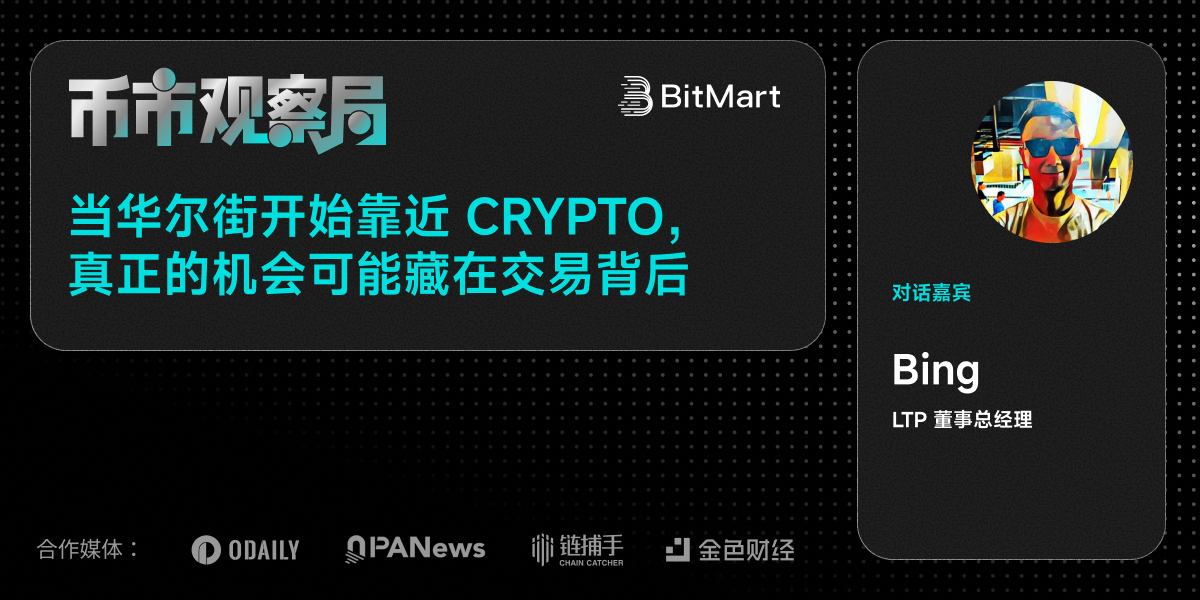
In this edition of "Crypto Market Watch," we invited Bing, Managing Director of LTP. From handling FX options trading at Lehman Brothers' Tokyo office to working at top global hedge funds and proprietary trading teams, and later founding his own fund in Hong Kong, Bing's career spans nearly two decades of traditional finance development cycles. After experiencing different stages of traditional finance, he ultimately chose to enter Crypto and started working on something very mature in traditional finance but still extremely scarce in the crypto industry—Prime Brokerage.
Guest: Bing, Managing Director of LTP
Host: yuanyuan, Marketing VP at BitMart
(Episode listen link: https://www.xiaoyuzhoufm.com/episode/6a1507f2e59ebca936498313)
From Wall Street to Crypto: What Attracted Him Wasn't Making Money, But Change Itself
Many people assume that when someone from traditional finance enters Crypto, it's probably for higher returns. But what truly attracted Bing wasn't the "wealth effect," but the change within the industry itself.
Bing's first job was at Lehman Brothers' Tokyo office, primarily handling FX derivatives trading. He later moved through top hedge funds and bank prop trading desks in the US and Europe, focusing on macro and volatility arbitrage trading for a long time. Subsequently, he founded his own fund in Hong Kong, also experiencing the changes brought by entrepreneurship and market cycles.
Compared to identities like manager or entrepreneur, he prefers to see himself as a trader. Because in his view, trading itself is a very interesting endeavor—constantly understanding the market, finding patterns, and then continually overturning existing knowledge.
In fact, he got into Crypto quite early. He started mining as early as 2016 and mentioned that much of his earliest Crypto accumulation was "mined." But his professional entry into Crypto came many years later.
For a long time in the past, Bing believed Crypto and traditional finance were two different systems. But later, he gradually discovered that the once clear boundaries between the two were becoming increasingly blurred.
Traditional finance began focusing on on-chain assets and digital settlement, while Crypto started building an increasingly mature financial system. Two sets of logic that were originally non-overlapping are now moving closer in the same direction.
Why Institutions Have Always Wanted to Enter Crypto But Haven't Truly Done So
Over the past few years, a common phrase in the industry has been "institutional entry." But in Bing's view, this statement isn't quite accurate. Institutional demand has always existed; the market just wasn't ready. In the traditional financial system, before a large fund enters a market, a very mature set of infrastructure is in place: trading, financing, custody, risk control, clearing, and settlement—each link corresponding to professional service institutions. But Crypto isn't like that.
For a long time, whether individuals or institutions, almost everyone directly opened accounts on exchanges. Exchanges took on too many roles simultaneously, acting as trading venues while also handling financing, custody, and risk management. This model wasn't a big problem in the early days of the industry, but as the market scale continued to grow, it became increasingly unsuitable for large institutions. Because large capital won't want to spread assets across multiple exchanges, nor will it accept completely different risk systems on each platform. What they need is a more unified, mature underlying architecture. And this is precisely the problem LTP is trying to solve.
Prime Broker: One of the Most Underestimated Infrastructures in the Crypto World
In traditional finance, Prime Brokers are very common. Almost all large funds use this service system. Simply put, it is responsible not just for trading access but also for financing, risk management, clearing, settlement, and asset custody. If exchanges are the market, then a Prime Broker is more like an operating system connecting the market. But the truly difficult part isn't simply connecting multiple exchanges. Bing mentioned that building a Prime Broker is like the bucket theory. What determines its height is never the longest plank, but the shortest one. And the hardest part is actually risk control.
Because when a platform starts offering financing and leverage, it ceases to be just a platform collecting fees. When clients make money, there's no problem. But once a client suffers extreme losses, the platform itself starts bearing risk. When should margin be increased? When should positions be forcefully liquidated? How to handle extreme market conditions? How to control systemic risk, technical risk, and legal risk? These things are hardly felt in normal times, but when they do happen, they often determine life or death. In Bing's view, a Prime Broker essentially bears a kind of tail risk. And in the Crypto world, this capability is still very scarce.
Liquidity Isn't Just "People Buying and People Selling," and Market Makers Aren't Price Setters
When discussing trading, we also touched upon a frequently mentioned but often misunderstood concept: liquidity. Many ordinary users think liquidity simply means there are buyers and sellers in the market. But in reality, this is a very superficial understanding.
In traditional financial markets, a large amount of liquidity comes from natural trading demand. Because there are enough participants, orders themselves can form depth. But Crypto is different. Especially for many new exchanges, without market makers, the order book can be very sparse. Therefore, many exchanges specifically set up market-making incentive programs, hoping market makers will maintain market depth, control spreads, and provide two-way quotes.
However, this leads to another common misconception: since liquidity is provided by market makers, are prices also decided by them? On this, Bing gave a very clear answer: no. Because a market maker is essentially a passive counterparty. They determine the thickness and depth of the short-term order book, but what truly determines market direction is still capital, sentiment, narrative, and the macroeconomic environment.
In the short term, market makers determine what the order book looks like; in the long term, the market determines where prices go.
Will AI Replace Traders? The Question Might Be Bigger Than Imagined
In the past year, AI has become an unavoidable topic in the industry. More and more trading platforms are launching AI Trading features, and more people are discussing whether traders will be replaced in the future.
But Bing says not in the short term, and his reasoning isn't because AI isn't smart enough, but because AI doesn't bear the consequences.
In his view, trading isn't simply making judgments; it's about making decisions. Decision-making implies responsibility.
When people make mistakes, they lose money, get fired, and it affects their lives. But AI doesn't. If a program has issues, it can be deleted and started over. So, at least at the current stage, humans will still make the final decision, with AI playing a supporting role.
However, later in the conversation, he put forward an even more interesting thought.
Financial markets, in essence, are about resource allocation—moving funds from one place to another, transferring risk from one entity to another. If AI can truly achieve optimal resource allocation in the future, then many "trading behaviors" themselves might no longer need to exist. Because AI would have directly accomplished what the market was originally supposed to do. This sounds a bit distant, but perhaps many changes are already underway.
The Biggest Future Changes Might Not Happen at the Exchange Level
Towards the end of the conversation, we discussed where the biggest changes in the industry might occur in the coming years. Many people focus on new hotspots, new assets, or new trading venues, but Bing pays more attention to the infrastructure itself.
In his view, the biggest change in the next few years might be the further integration of traditional finance and Crypto. Crypto is learning about risk management and institutional construction from traditional finance; traditional finance is beginning to learn about Crypto's on-chain clearing, settlement, and asset digitization capabilities. Two completely different systems are continuously moving closer to the middle. So, the biggest future change might not be a specific new hotspot, but rather the gradual disappearance of existing boundaries.
After listening to the entire conversation, you'll notice that Bing rarely predicts prices or judges the rise or fall of a specific sector. Because for someone who has been trading for a long time, understanding the market is more important than predicting it.
After all, many times, the truly big opportunities are never in the most crowded places. They are in places most people haven't seen yet.
—-----
Recording time for this episode: May 9, 2026
Full content can be found by searching for and following "Crypto Market Watch" on Xiaoyuzhou FM, Apple Podcasts, and Spotify.
Also, welcome to follow BitMart's TwitterX for more industry insights, market trends, and platform updates.
Risk Disclaimer
The statements or opinions expressed in this column are solely those of the guest and do not represent the views of BitMart or its affiliates, nor should they be considered professional financial investment advice.
Cryptocurrency investment is highly speculative and involves significant risk of loss. Past performance, hypothetical scenarios, or simulated results do not guarantee future returns. The value of digital currencies may fluctuate, and buying, selling, holding, or trading digital currencies may involve substantial risk. Before engaging in trading or holding digital currencies, please carefully assess their suitability based on your investment objectives, financial situation, and risk tolerance. BitMart does not provide any investment, legal, or tax advice.


