






美股喊单王Serenity:领先机构低位建仓,年回报3840%


- 核心观点:本文介绍了匿名交易者Serenity通过其独创的“供应链瓶颈(Chokepoint)投资法”,在美股AI半导体领域取得超常收益(年内回报率3840%),并引发市场对其真实性及动机的广泛讨论。
- 关键要素:
- Serenity自称前WSB交易者与AI专家,2024年5月粉丝达35.8万,其公开收益率(年内3840%、两年2256%)远超市场平均水平。
- 其核心策略“瓶颈点投资法”聚焦于AI产业链中具有不可替代性、未被充分定价的上游“隐形冠军”企业,如光模块、硅光、存储等赛道的21只持仓股均盈利超100%。
- Serenity公开拒绝付费社区和实盘展示,仅以收益率验证其论点,引发市场对其“拉高出货”操纵小市值股票的质疑,但其解释称旨在对抗机构、提前分享信息。
Original by Odaily Planet Daily (@OdailyChina)
Author: Golem (@web3_golem)
As an investor focused on U.S. stocks in AI and semiconductors, if you haven't heard of Serenity yet, chances are your research is still at the entry level.
Why is that? Because he is currently the most popular stock picker on the entire internet. From retail investors to Wall Street, almost everyone reads his reports and follows his trades. Some have even packaged his free public insights into paid courses and sold them within communities.
On May 24, Serenity revealed his investment performance for this year on X: a year-to-date return of 3840.39%. Just a day earlier, he also showcased his two-year return, an astonishing 2256.99%.
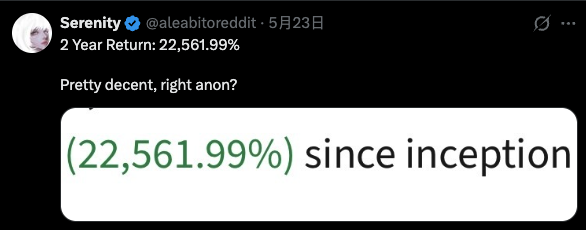
Serenity: "Far Ahead of the Curve"
Serenity joined X in July 2025, and by May of this year, his follower count had surged to 358,000, with over 32,000 subscribers—just shy of Elon Musk's subscriber count by less than 15,000. Yet, no one knows Serenity's true identity. What people know about his background comes solely from his bio:
- A former prominent Reddit WSB trader now on X (Odaily note: Wall Street Bets is the largest retail trading community in the U.S. Serenity was banned in 2022 for recommending a stock ticker AXTI, which has risen over 700% year-to-date);
- AI and semiconductor supply chain analyst, former RISC-V Foundation member, former AI research scientist;
- Currently primarily trades "the overlooked bottlenecks";
From his bio, Serenity positions himself as an expert in the AI field. He has even claimed to have turned down an offer from NVIDIA's AI team in 2018. In one post, Serenity stated that his investment approach is based on a thorough understanding and research of the AI and semiconductor industries. His typical research process is: first, conduct initial paper research, then translate these ideas into actual strategies and trades, followed by due diligence on the alpha, and finally, celebrate when the stock price rises.
As shown below, community user @kaikaibtc compiled Serenity's current main stock holdings, primarily focused on sectors within the AI supply chain such as optical modules, silicon photonics, storage, CPO, and substrates. Not one of these 21 stocks has yielded a profit of less than 100%. Serenity's most frequently mentioned stock, AXTI, which he has been touting for over two years, has generated a profit exceeding 10,000%. He has also publicly stated that AXTI is his most legendary trade.
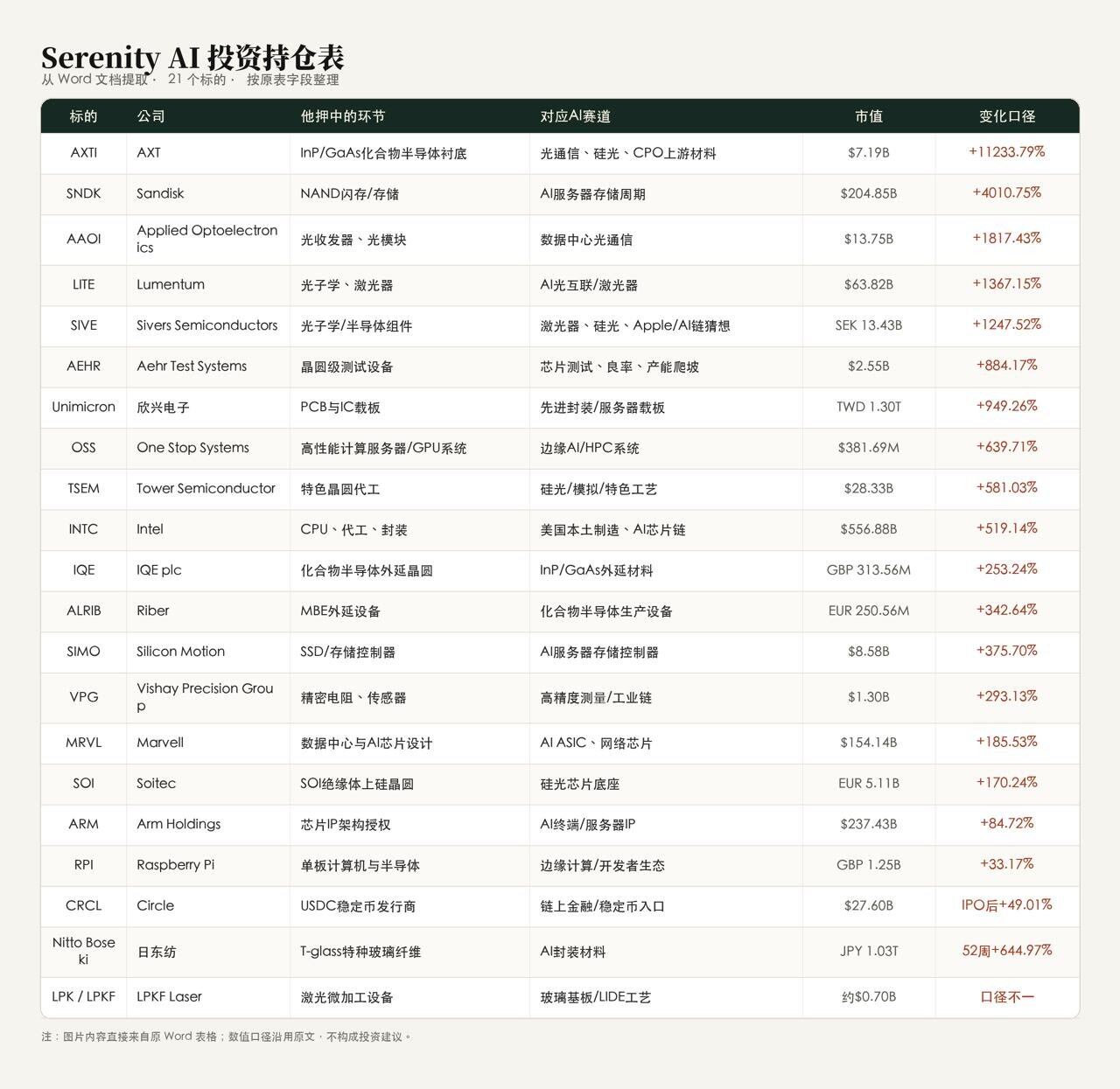
However, what is perhaps even more remarkable than these staggering profits is that before Serenity unearthed these targets, not only had retail investors overlooked them, but institutions had not even entered the market yet.
When Serenity posted about a particular stock, he was often met with skepticism. Yet, months or even a year later, when investors saw the stock's phenomenal performance, they would belatedly realize he was right. RPI, AXTI, SIVE, and others are vivid examples. After such cases occurred repeatedly, Serenity's account naturally became a must-read for retail investors, Wall Street, and even Silicon Valley investors.
Why can Serenity always stay ahead of the market and uncover these undervalued stocks? His secret lies in a supply chain bottleneck (Chokepoint) investment theory he developed himself.
The Chokepoint Investment Method
"Chokepoint" is the most frequent word in Serenity's posts and the core of his investment logic.
AI is undoubtedly the dominant narrative in the world today, but the AI industry exhibits a clear supply-demand imbalance. On one hand, internet giants are pouring money into AI infrastructure in an "arms race." On the other hand, the supply side is clearly insufficient, with Nvidia's orders even entering a "rationing system." Consequently, capital has realized that the current stage of AI development is not about the downstream, but the upstream supply chain. Whoever holds a critical position in the AI supply chain, whoever becomes irreplaceable, should be most deserving of re-pricing.
Thus, over the past few months, the market's hype around the AI industry has been deconstructing from the initial GPU computing power along the chain step by step: the second layer is storage, data centers, and optical modules; further down are electricity, materials, and network equipment. This method of deconstructing the AI supply chain and identifying the key "bottleneck" enterprises at each stage is essentially Serenity's Chokepoint investment method, except that he acts far earlier than the vast majority of retail investors and institutions.
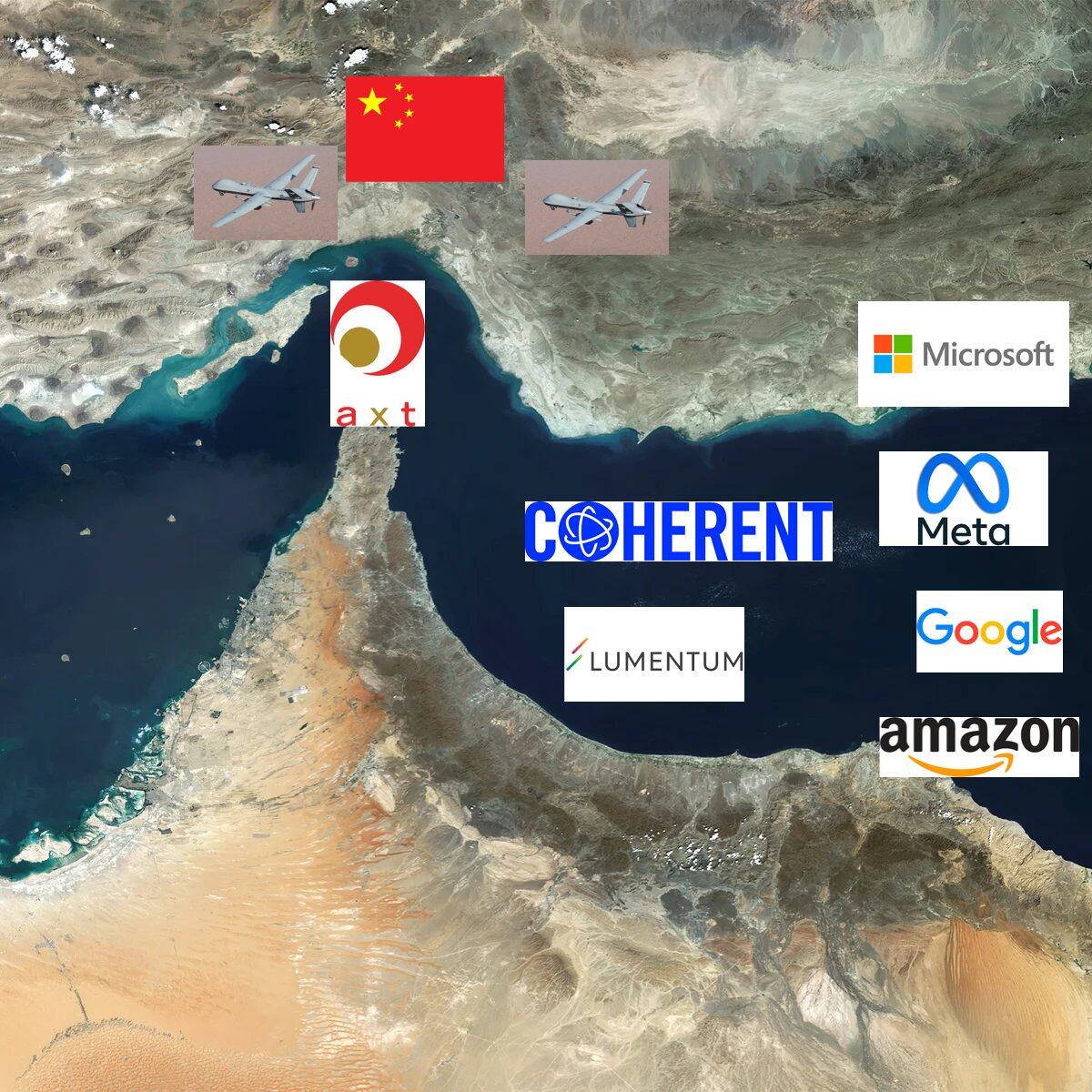
On March 31, Serenity used an analogy when touting AXTI, vividly explaining what a chokepoint is. He compared it to the Strait of Hormuz, through which over 20% of the world's crude oil supply passes. It is a critical chokepoint in global energy trade. Similarly, AXTI's relationship to AI optical module companies is like the Strait of Hormuz's relationship to global energy trade.
The essence of Serenity's ability to generate excess returns still lies in market information asymmetry. He uses sharp thinking and foresight to find those "invisible champions" on the AI supply chain that are not yet fully priced in. These companies are not as dazzling as giants like Nvidia, Micron, or SK Hynix, but they are small monopolies whose shortage or shutdown could cause an earthquake in the trillion-dollar downstream AI industry.
For example, when Serenity touted IQE around February-March this year, he repeatedly stated that IQE and Landmark are both major photonic chip epitaxial wafer foundries, but IQE's overall capacity is significantly larger than Landmark's. At that time, Landmark had a market cap of about $3.8 billion, while IQE's market cap was only $135 million.
It is worth noting that Serenity is not a superhuman who knows every link of the AI supply chain inside out. He often mentions using AI to assist in his AI supply chain research, including deconstructing the industry chain, mining for suppliers, and debating viewpoints with AI.
A True Legend or a "Photoshop Master"?
In the investment world, excessively deifying any individual is extremely dangerous. Serenity's win rate is not 100% either. Stocks he recommended early this year, like CPSH and INFQ, also experienced significant pullbacks in February and March. Rather than blindly copying his holdings, retail investors and traders should learn from his research framework and mindset, forming their own system to ultimately find their own alpha.
Serenity is also a highly idealistic and mysterious figure. None of his publicly available personal information has been verified by a third party. No one even knows his/her gender. The only personal information he has disclosed is that he leads an international digital nomad lifestyle, currently studying Japanese in Japan. He also lived briefly in mainland China, so he understands some Chinese. He frequently travels to countries like South Korea, the UK, Singapore, and Canada, claiming to have visited at least 28 countries.
Because Serenity only shows his rate of return (RoR) without actual trade confirmations or portfolio screenshots, some question whether his returns are fabricated. To this, Serenity's response is "The reason I don't disclose the specific amount is that the amount doesn't matter." He says he just wants to prove that users can find pure, valuable information from free posts, and that percentage-based market returns are the best way to validate a thesis. He also claims to hate traditional KOLs who flaunt their money, luxury watches, cars, and private jets.
Opposing paywalls or paid communities is also a defining characteristic of Serenity. Most of Serenity's core market research is published on X, free for anyone to read with no barriers or paid communities. His subscription costs only $1 per month, and the content is just a spreadsheet. Not subscribing doesn't affect understanding his core views at all.
In a world where "everyone flocks for profit," Serenity's behavior—seemingly indifferent to fame and fortune, generously sharing his views—seems unnaturally selfless. Therefore, some speculate that Serenity is merely using his influence to manipulate the prices of these low-market-cap stocks, buying low, pumping, and dumping, leaving only a token position to mislead followers, especially since he only ever shows his rate of return, never his actual profit.
This sounds a bit like "a petty person measures the heart of a gentleman," but of course, Serenity has his own gentlemanly explanation.
He believes the stock market is a positive-sum game. His goal is to share critical information *before* institutions "buy-in," allowing retail investors to also find the right path and capture gains. He feels especially proud when he sees they can find the "wealth code" without spending over $2000 to join a paid community. He claims he is changing the old paradigm. For instance, he said if he hadn't told the story of IQE, institutions like AVGO would have simply bought IQE out quietly, and retail investors would have gotten nothing.
Which version is the truth? Is Serenity truly someone who sees through the AI supply chain, or is he a top-tier player using the "bottleneck narrative" to harvest traders? For now, we don't know. Whether Serenity will eventually become a legend or a bubble, we can only leave it to time to tell.


