






SEC delays "stock-token" innovation exemption: who is fiercely opposing it?


- Core Viewpoint: The U.S. SEC originally planned to introduce an "innovation exemption" for "stock tokenization." However, due to strong opposition from traditional Wall Street forces and within the SEC itself—citing concerns over liquidity fragmentation, compliance risks, and legal loopholes—the plan has been postponed, leading to a sharp short-term decline in the cryptocurrency market.
- Key Elements:
- The SEC has delayed the "innovation exemption" plan, which was intended to allow stock trading services on the blockchain under more lenient conditions, and was seen as an important signal supporting tokenized securities.
- Affected by this negative news, BTC fell below 76,000 USDT, and ETH dropped below 2,100 USDT; the related concept token ONDO gave back its gains, falling 6.4% in 24 hours to 0.382 USDT.
- The opposition camp is mainly comprised of traditional Wall Street forces like Citadel Securities and SIFMA, who worry about market liquidity fragmentation, lack of AML/KYC compliance, and legal and technical loopholes in the enforcement of token rights.
- SEC Commissioner Hester Peirce, known as the "Crypto Mom," also tends to restrict the scope of the exemption, supporting tokenization led by issuers themselves rather than third-party issuance of synthetic assets.
- Despite the regulatory delay, crypto-native forces (such as Ondo, Hyperliquid) and Wall Street institutions (such as DTCC, Nasdaq, ICE) are each accelerating their own deployment of tokenized assets and blockchain frameworks.
Original: Odaily Planet Daily (@OdailyChina)
Author: Azuma (@azuma_eth)
In the early hours of May 23rd, Beijing time, Bloomberg reported, citing sources, that the U.S. Securities and Exchange Commission (SEC) has delayed its planned “innovation exemption” program. Originally designed to greenlight products related to tokenized U.S. stocks, the SEC decided to postpone the initiative following numerous concerns raised by market participants.
Affected by this negative news, the cryptocurrency market experienced a sharp decline. BTC fell below 76,000 USDT, and ETH dropped below 2,100 USDT. Concepts related to “tokenized U.S. stocks” were hit even harder. ONDO directly retraced its short-term gains from yesterday, which were indirectly stimulated by the “SEC’s penalties on brokers like Tiger, Futu, and Longbridge.” As of press time, ONDO was trading at 0.382 USDT, down 6.4% in 24 hours.
Innovation Exemption Slammed on the Brakes at the Last Minute
Since Chairman Paul Atkins took office, the SEC has moved away from its previously tough “enforcement-first” approach, leaning towards providing a compliant testing ground for the crypto industry.
Earlier this week, market rumors emerged that the SEC would unveil an exemption proposal as early as this week, allowing trading platforms to offer on-chain token trading services for listed securities (such as NVDA, AAPL, TSLA, etc.) under more lenient regulatory conditions. Pushed by SEC Chairman Paul Atkins and Commissioner Hester Peirce, this exemption aimed to create a legal testing space for tokenized securities. The market interpreted this as a significant signal of U.S. regulators further shifting towards supporting tokenized securities.
However, this innovation exemption, initially expected to be revealed to the public as early as this week, was abruptly put on hold just before its launch. Sources revealed that the SEC has returned the draft and has begun intensively consulting with stock exchanges and other market participants again.
From “full green light” to “emergency brake,” what resistance did the SEC face? Who is fiercely opposing this epic battle over “putting US stocks on the chain”?
The Opposition: Wall Street Again
Similar to the CLARITY bill, which is also facing resistance (see CLARITY Review Abruptly Delayed: Why Is the Industry So Divided?), the traditional Wall Street forces represented by Citadel Securities and the Securities Industry and Financial Markets Association (SIFMA) are at the forefront of fiercely opposing this exemption proposal.
Months ago, when this policy was still in its early stages, these traditional financial giants had already submitted strongly worded letters of opposition to the SEC. Overall, Wall Street's core arguments against the exemption focus on three main areas:
First, concerns over potential market liquidity fragmentation. Institutions like Citadel Securities warned that allowing various third parties to issue “synthetic US stocks” without going through the issuer would fragment US stock assets, scattering them across countless DeFi platforms lacking interconnectivity, depth, and price transparency. This would not bring efficiency but rather make it difficult for investors to determine the actual value of the tokenized stocks they hold at any given time.
Second, concerns that tokenized US stocks could threaten traditional compliance defenses. On anonymous or pseudo-anonymous public blockchain networks, how can it be ensured that trading of these third-party tokens does not become a hotbed for money laundering? Wall Street giants argue that the current technical capabilities of decentralized platforms are insufficient to rigorously implement core investor protection mechanisms like AML and KYC.
Third, existing technical and legal gaps remain. Citing legal experts, the institutions pointed out that allowing an unauthorized third-party crypto platform to enable “token holders to enjoy voting rights and dividend distributions” for companies like Apple or Microsoft on the blockchain presents uncertainties within the current legal framework and technical pathways.
Reservations Also Exist Within the SEC
Notably, this wave of opposition comes not only from Wall Street's “vested interests” but also includes cautious reservations within the SEC itself.
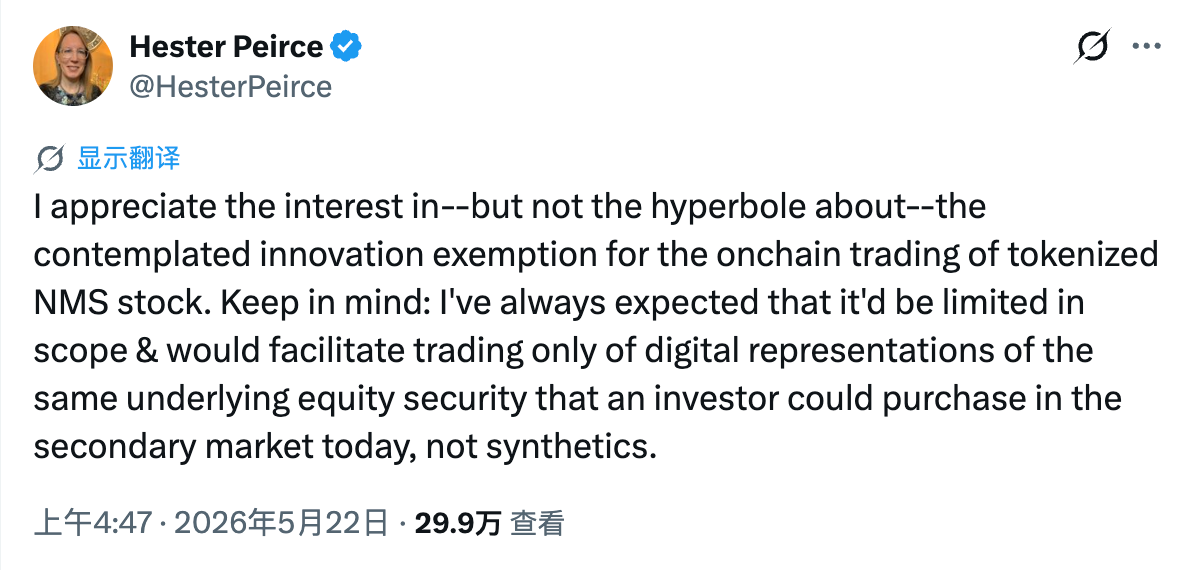
Hester Peirce, an SEC commissioner and a long-time ally of the crypto community affectionately known as “Crypto Mom,” publicly expressed a shift in stance on X yesterday, stating that the scope of this exemption should be strictly limited.
Peirce stated that the SEC should only allow attempts at digitalizing or tokenizing their own stocks on-chain, led by “the issuers themselves or their affiliates”; it should not permit the market to be flooded with synthetic assets issued by third parties beyond regulatory control. In other words, the “tokenized US stocks” Peirce envisions should be led, authorized, or endorsed by the specific listed company (the issuer) itself, and must guarantee investors the same rights as ordinary shareholders (such as dividends, voting rights, etc.), rather than the more prevalent derivative synthetic tokens issued by third parties that merely track the price movement of the underlying stock.
Even Peirce, a known and aggressive supporter of crypto innovation, chose to side with “limiting the exemption scope,” highlighting the significant legal and compliance hurdles the proposal faces.
What Does the Future Hold for Crypto-Stocks?
This week's “postponement” is undoubtedly a heavy blow for the RWA (Real World Assets) sector, which was on the verge of a breakout. The sharp short-term decline in tokens like ONDO reflects the market's overly optimistic previous expectations for “full on-chain compliance of US stocks.” However, it's undeniable that regardless of the regulator's wavering stance, the trend of integrating US stock assets with blockchain technology has become an unstoppable torrent. Beneath the shadow of this regulatory game, both the crypto-native forces and Wall Street institutions are racing at full speed on their respective tracks.
- On one hand, crypto-native forces are breaking in from the bottom up. Projects like Ondo, xStocks, and MSX are actively bringing US stock assets onto the chain, while platforms like Hyperliquid, Trade.xyz, and major CEXs are indirectly providing global crypto users with windows to invest in US stocks through perpetual contracts. This bottom-up innovation demand is constantly pressuring regulators to provide clear answers.
- On the other hand, Wall Street itself is also accelerating its layout for related businesses. The Depository Trust & Clearing Corporation (DTCC) plans to officially launch limited production trading of tokenized assets in July this year and expand its promotion in October. Nasdaq is also diligently developing a blockchain-based stock issuance framework. The Intercontinental Exchange (ICE) has chosen to cooperate with OKX, a leading crypto exchange, to jointly advance the development of tokenized stocks and crypto-related products.
In essence, this delay in the exemption is a fierce collision between the innovative attempts of new forces and the defensive mechanisms of traditional forces. Based on current developments, the SEC has not made a final decision on revising the draft, meaning the “innovation exemption” is not completely dead yet. However, it is foreseeable that amidst the fierce backlash from Wall Street giants and internal opinion adjustments within the SEC, even if this exemption is eventually reintroduced, its aggressiveness and scope of application may be subject to certain “discounts.”
The dream of fully liberalizing “crypto-stock” trading may still have a long way to go amidst the regulatory tug-of-war, but the door to asset tokenization has been pushed open and is destined never to close again.


