






ZEC Surge Behind the Scenes: A "Coordinated Long Play" Unfolds


- Core Thesis: The privacy token ZEC has recently surged over 20%, breaking through $689. This move is not merely sentiment-driven but is supported by multiple substantive bullish catalysts: the SEC ending its investigation, Grayscale advancing an ETF application, Robinhood listing, Foundry launching a mining pool, and public companies accumulating holdings. This marks ZEC's transition from a fringe privacy asset back into acceptance by mainstream financial markets.
- Key Elements:
- The SEC concluded its investigation into the Zcash Foundation, explicitly stating no enforcement action would be taken, significantly removing ZEC's heightened regulatory risk label and initiating its compliance journey.
- Grayscale submitted the first spot Zcash ETF application to the SEC, publicly praising its "selective disclosure" mechanism, advancing ZEC towards becoming an institutionally allocable asset.
- Nasdaq-listed Cypherpunk Holdings holds nearly 1.78% of ZEC's circulating supply, with an average cost of approximately $335.89. The company recorded $50.4 million in unrealized gains from ZEC's fair value in fiscal year 2025.
- Mining giant Foundry launched a dedicated ZEC mining pool, offering compliant, institutional-grade mining services, reintroducing institutional miners to support the network.
- Robinhood listed ZEC for trading, bridging the gap for mainstream retail capital inflow, driving up trading volume and price, and significantly improving liquidity.
- The Zcash team fixed a critical security vulnerability involving over 25,000 ZEC. AI-assisted discovery earned a $50,000 bounty, maintaining network security.
- BitMEX co-founder Arthur Hayes and a Hyperliquid whale took highly leveraged long positions on ZEC, amplifying market sentiment, and fueling price volatility and attention.
Original|Odaily Planet Daily (@OdailyChina)
Author|Wenser (@wenser2010)

After months of silence, the long-dormant privacy token sector is finally seeing a resurgence, with ZEC once again becoming the "star of the show." This morning, the price of ZEC surged, briefly breaking through $689, representing a gain of over 20% in 24 hours.
Amidst a fluctuating and weakening market trend, the narrative of "privacy BTC" has once again been frequently raised by the market. However, compared to the rally driven more by sentiment and capital games last November, this recent surge in ZEC is clearly supported by more tangible factors, including regulation, liquidity, institutional channels, and ecosystem development.
Behind this rally is a privacy coin that once hovered in the shadows of being "delisted by exchanges" and "marginalized by regulators," now being re-accepted by mainstream financial markets and effectively "jointly manipulated" by institutions.
The 4 Pillars Supporting the ZEC Surge: Regulation, Liquidity, Mining Pools, and Trading Channels
In the past few years, ZEC has been delisted or restricted from trading on exchanges in multiple countries and placed on Binance's monitoring list. While it hasn't completely detached from the mainstream like Monero, it has long existed on the periphery of the regulatory and compliance framework.
But this year, things have changed: the SEC ended its investigation, Grayscale is pushing for an ETF, Robinhood listed it for trading, Foundry launched a dedicated mining pool, a publicly traded company is openly accumulating ZEC, and a Hyperliquid whale is taking high-leverage long positions... ZEC is transitioning from a "marginalized anonymous asset" back to an "institutionally tradable asset."
SEC Ends Investigation: ZEC Begins to Shed Its "High-Risk Privacy Coin" Label
In mid-January this year, the U.S. Securities and Exchange Commission (SEC) officially concluded its investigation into the Zcash Foundation, clearly stating no enforcement action would be taken.
For the privacy coin sector, long under regulatory pressure, this was a landmark event. In recent years, the market has consistently questioned whether privacy coins can legally exist within the financial system. Especially after privacy coins like XMR continued to face delistings, ZEC was also widely regarded as a "high-risk asset." The change in the SEC's stance represents a significant turning point.
Subsequently, in March, the SEC and CFTC jointly issued an explanatory document classifying crypto assets into five categories, with most assets not considered securities. The regulatory pressure on ZEC significantly eased, paving the way for the introduction of liquidity from compliant channels.
ZEC Enters the "Privacy Asset ETF Era": Grayscale Becomes the Biggest Driver
The SEC's actions were about risk mitigation; Grayscale's endorsement truly began to bestow upon ZEC the attribute of an "institutionally allocated asset."
In February this year, at the Consensus conference in Hong Kong, Grayscale's Chief Legal Officer, Craig Salm, publicly praised ZEC's "selective disclosure" mechanism. He stated: "What I find most interesting about privacy-preserving tokens like Zcash is 'selective disclosure.' You can selectively disclose information to a counterparty – for example, proving to the IRS that you've paid your taxes correctly, while maintaining privacy in everyday business or personal transactions. So, we see it as a very interesting currency."
This statement carried significant weight, as Grayscale conveyed a new logic to the market: privacy and compliance are not necessarily inherently opposed. He also emphasized that "Grayscale holds a substantial amount of ZEC in its trust and is actively working towards converting it into an ETF."
On May 8th, Grayscale formally submitted the first application for a Zcash spot ETF to the SEC. Consequently, ZEC's market cap entered the top 15 of the crypto market, briefly surpassing Cardano.
Multicoin Capital co-founder Tushar Jain commented on this, stating that the move likely corresponds to the market's expectation of increased demand for privacy assets following the proposed U.S. wealth tax legislation.
For ZEC, this could mean Wall Street is beginning to consider that "privacy coins" can be a viable option for long-term asset allocation.
ZEC "Siphons" BTC: Real Market Demand Behind the Need for Privacy
The anonymity of BTC has long been considered one of the key functional attributes of cryptocurrencies.
However, cases like Zhang Jian's and the Silk Road-related seizures have cast significant doubt within the crypto market and globally on the perception of "BTC as an anonymous asset." With the increasing capabilities of on-chain analysis tools, AI monitoring, and regulatory investigation systems, the market belief that "BTC is sufficiently anonymous" has clearly weakened.
Against this backdrop, privacy tokens like ZEC are regaining attention, with some capital even beginning to view them as "alternative privacy assets" to BTC. In early May, U.S. Bitcoin spot ETFs saw a net outflow of $268 million, with some of that capital flowing towards privacy and AI infrastructure tokens.
In a March report, Grayscale analyst Michael Zhao noted: The development of AI surveillance and on-chain transparency could propel privacy from a niche need back into a core financial function, a shift the market is currently underpricing. At the time, ZEC was priced at around $224.
From a narrative perspective, in an era where all on-chain activity can be permanently recorded, "selective privacy" itself may become a scarce financial commodity.
Public Companies Hoarding ZEC: The "Treasury Logic" for Privacy Coins
Beyond shifts in market sentiment, what truly provides sustained liquidity support for ZEC is the tangible capital investment from "ZEC treasury companies."
In March this year, Nasdaq-listed ZEC treasury company Cypherpunk Holdings published its fiscal year 2025 report. It disclosed that, as of March 12, 2026, the company held 294,743.1 ZEC, approximately 1.78% of the circulating supply, with an average purchase price of $335.89.
The financial report showed that the company's net profit for fiscal year 2025 reached $4.8 million. The primary reason for this profit growth was an unrealized gain of approximately $50.4 million from the fair value of the ZEC tokens in its treasury.
Meanwhile, the Zcash Open Development Lab, founded by former Electric Coin Company CEO Josh Swihart, completed a funding round of over $25 million in early March.
Participating investors included Paradigm, Andreessen Horowitz, Coinbase Ventures, Winklevoss Capital, Cypherpunk Holdings, Maelstrom, Chapter One, Balaji Srinivasan, David Friedberg, Haseeb Qureshi, and James Nicholas, among others.
Its core goal is to develop an open, self-custodial private financial platform, aiming to expand ecosystem interoperability through collaboration and bring protected ZEC transactions to the global mainstream market.
ZEC is no longer just an "old-school privacy coin"; capital is repackaging it as "privacy financial infrastructure."
Foundry Launches Mining Pool: Institutional Miners Begin Re-betting on ZEC
In April, Foundry, the mining giant under Digital Currency Group (DCG) which controls approximately 31% of Bitcoin's hashrate, officially launched a dedicated mining pool for Zcash (ZEC).
Unlike traditional anonymous mining pools, Foundry offers compliant, auditable, institutional-grade mining services. This has allowed institutional miners to re-engage with the ZEC network openly.
The market sees this move as a significant signal that privacy coins are regaining institutional endorsement.
Robinhood Lists ZEC: Completing the Last Piece of the Mainstream Retail Liquidity Puzzle
In late April, Robinhood Markets officially listed ZEC.
Beyond just "adding a new trading pair," this means ZEC has regained a direct purchasing channel for mainstream U.S. retail capital.
The biggest challenge for privacy coins in recent years has been the gradual loss of access to mainstream trading platforms and compliant capital entry points. Robinhood's listing plugged the last critical gap in retail liquidity for ZEC. Subsequently, ZEC's trading volume surged rapidly, and its price steadily recovered.
Behind the Price Surge: The ZEC Team's Efforts – Fixing Bugs, Centralizing Management, Rebuilding Ecosystem
In addition to external positive catalysts, the ZEC team has also completed several key internal actions over the past few months.
Critical Security Vulnerability Affecting Over 25,000 ZEC Fixed; Security Researcher Receives Over $50,000 Bounty
In April, the ZEC project disclosed and fixed a critical security vulnerability that could have been exploited by malicious miners to transfer over 25,000 ZEC (approximately $6.5 million) from the deprecated Sprout privacy pool. Security researcher Alex "Scalar" Sol disclosed on March 23rd that the vulnerability stemmed from the zcashd node skipping proof verification when processing transactions involving the Sprout pool. The team stated that the vulnerability had existed since July 2020 but was not actually exploited, and user funds remained safe. The development team released version v6.12.0 to patch the issue, with major mining pools completing upgrades within days. Additionally, the unaffected Zebra full node implementation has the ability to trigger a chain fork, providing an extra layer of protection in case of exploitation.
According to the disclosure, while the Sprout pool closed to new deposits in November 2020, it still holds approximately 25,424 ZEC that were not migrated. Even if the bug were exploited, Zcash's "turnstile" mechanism would prevent inflationary minting, ensuring the total supply remained unbreached.
Notably, this vulnerability was discovered with the assistance of AI, and the researcher will receive a total bounty of 200 ZEC (approximately $51,000).
Zcash Foundation Formally Takes Over Management of Core Community Assets
In early May, the Zcash Foundation announced it had officially taken over the management rights for several core Zcash community assets, including the Zcash GitHub Organization, the website and its domain, and the official X account @Zcash.
As Zcash development increasingly centers around Zebra and the foundation-maintained infrastructure, consolidating these community assets under the Foundation's management aims to improve long-term coordination efficiency and accountability. The Zcash GitHub organization contains core code repositories like librustzcash, zips, lightwalletd, and zcashd. The Zcash Foundation will manage access permissions and repository governance, but existing open-source licenses, community contribution permissions, and collaborative development models will remain unchanged.
While the departure of the former core Zcash development team, the Electric Coin Company, was lamentable, the Foundation's actions ensure the stable operation and healthy development of the ZEC project to a certain extent. Moreover, the former team members remain committed to developing the ZEC ecosystem; they simply changed companies, preserving the productive development force of the ZEC ecosystem.
Arthur Hayes and the Hyperliquid Whale: ZEC's "Market Sentiment Amplifier"
In early May, following several previous instances of publicly announcing his holdings, BitMEX co-founder Arthur Hayes once again posted, stating that his target price for ZEC is 10% of BTC's price, indicating significant remaining upside potential.
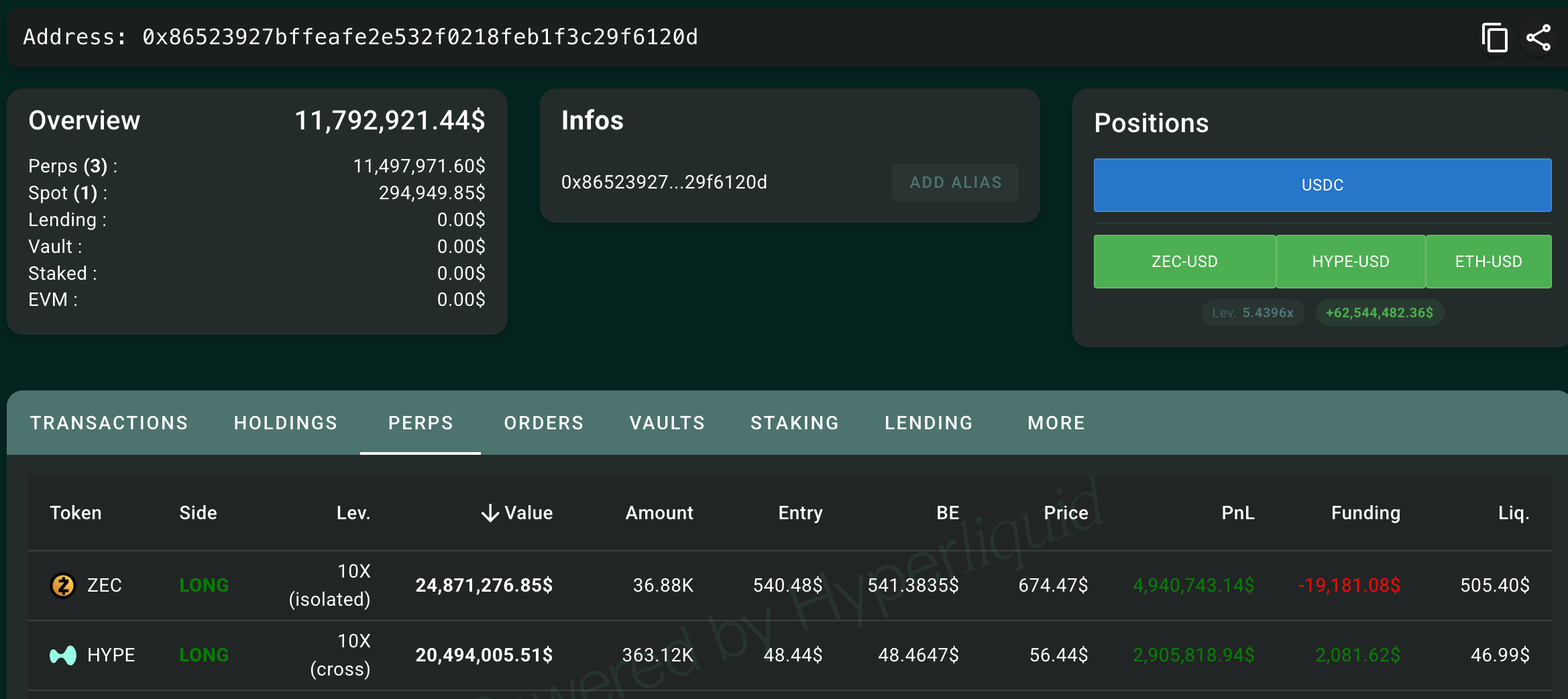
Furthermore, a recent crypto whale, Evaded (@ICanPlug), opened a 10x leveraged long position of 36,875 ZEC (worth $21.59 million) on the Hyperliquid platform. Combined with their long position on HYPE, this resulted in an unrealized profit of $2.1 million within just two days. Currently, the whale's long position remains open, with unrealized profits having grown to approximately $4.94 million.
These high-leverage, publicly visible, large-scale bets are continuously reinforcing market attention and FOMO sentiment towards ZEC.
For the past several years, ZEC, as an established mainstream coin, has been in an awkward position, caught between regulation, exchanges, and market sentiment.
Now, it is clearly transitioning back from a marginalized asset to the mainstream table.
Wall Street, institutional miners, trading platforms, and market whales are joining forces during a weak crypto narrative bull market to push ZEC back into the spotlight.
Recommended reading:
Buying ZEC to Dump BTC? The 4 Major Industry Truths Behind the Privacy Coin Surge
The Hidden Narrative Behind the ZEC Surge: The Haven Shift of "Chen Zhis and Qian Zhimins"


