






RWA热潮为何难以惠及DeFi?


- 核心观点:链上代币化现实世界资产(RWA)规模近300亿美元,但仅24.7亿美元(约9%)真正流入DeFi生态,二者存在严重割裂。许可型架构的合规限制是最大壁垒,而高适配产品已证明可组合性是释放潜力的关键。
- 关键要素:
- RWA各品类DeFi渗透率极低:债券货币基金(9.2亿/166亿)、黄金商品(1.8亿/57亿)、股票(0.78亿/27亿),唯有私人信贷赛道依靠原生DeFi设计渗透率达39%。
- 贝莱德BUIDL等许可型基金通过白名单、线下确权等机制限制二次交互,直接阻断了与Aave、Uniswap等无需许可协议的组合,成为DeFi可组合性最大障碍。
- 实现高渗透的典范包括:Ondo USDY锁仓超10亿并覆盖9条公链、Morpho和Aave Horizon成功落地RWA抵押借贷,证明从设计端兼顾合规与自由流通的可行性。
- 行业分化为两大方向:一是优先合规的严格许可管控路线;二是兼顾合规与生态可组合性的开放流通路线,后者被视为衔接现实资产与加密市场的关键。
- 央行与监管机构警示,缺乏统一标准导致“资产孤岛”,流动性集中在封闭圈层;多数资产受制于最低投资额、身份核验等传统规则,与DeFi实时定价逻辑冲突。
Original Author: Gino Matos
Original Translation: Chopper, Foresight News
According to DeFiLlama data, the total value of tokenized Real World Assets (RWA) on-chain is approaching $30 billion. However, only $2.47 billion of this is reflected as Total Value Locked (TVL) actively deployed in DeFi, representing the actual capital deposited into third-party DeFi protocol pools and participating in ecosystem operations.
The vast majority of the remaining RWA assets remain isolated from composable crypto-native scenarios like lending markets and collateralized treasuries. Bonds and money market funds are the largest RWA category, with a total on-chain market cap exceeding $16.6 billion. Yet, only $920 million flows into the DeFi ecosystem as active TVL. Gold and commodity-based assets have an on-chain market cap of $5.7 billion, with only $183.6 million actively circulating in DeFi. Equity-based assets on-chain total $2.7 billion, with a mere $78.27 million penetrating the DeFi market.
The private credit sector stands out: boasting an on-chain market cap of $3.226 billion, its effective DeFi TVL reaches $1.257 billion, achieving a 39% ecosystem penetration rate. This is because projects like Maple Finance and Centrifuge were designed from inception as lending financial instruments, making them naturally compatible with DeFi applications.
Conversely, tokenized products like Treasury funds, gold assets, and equities were designed by their issuers primarily to cater to institutional custody needs, with overall architectures conforming to traditional compliant fund operational models.
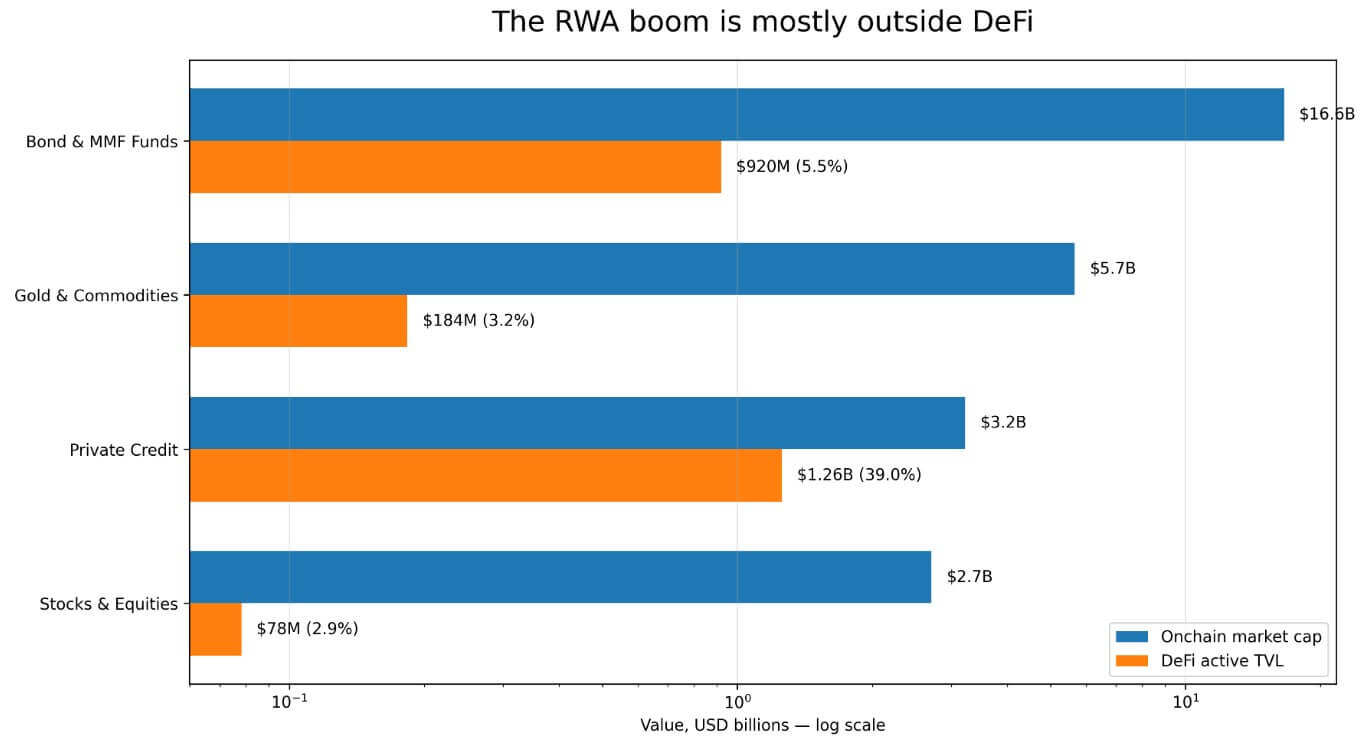
Distribution of on-chain market cap vs. active DeFi TVL across four RWA categories
Permissioned Architecture: The Biggest Barrier to DeFi Composability
DeFiLlama classifies BlackRock's money market fund product, BUIDL, as a permissioned fund. Its effective TVL within the DeFi ecosystem is a mere $18.9 million.
The International Organization of Securities Commissions (IOSCO), in its November 2025 final report on financial asset tokenization, noted that BUIDL creates a permissioned system on a public blockchain for issuance, custody, secondary trading among qualified investors, dividend distribution, and redemptions.
Potential investors must pass a whitelist screening via the Securitize platform. Moreover, on-chain asset transfers only gain full legal effect after information is confirmed and reconciled with an off-line transfer agent.
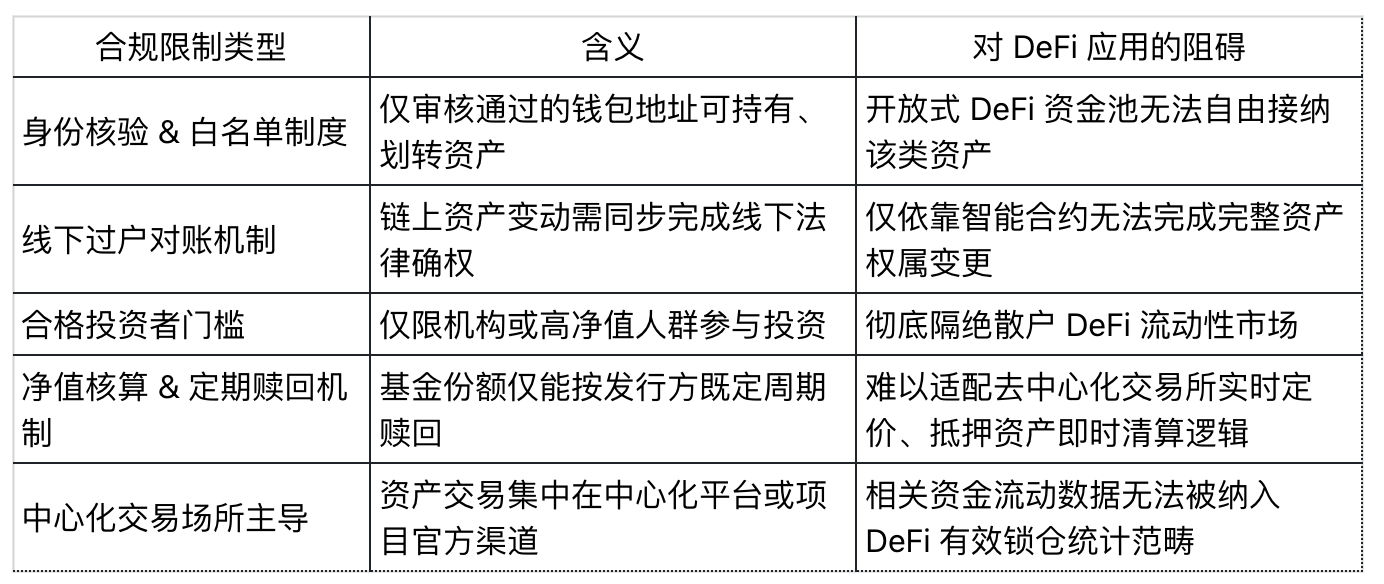
This implies BUIDL is essentially a compliant custody infrastructure built on a blockchain backbone, primarily serving institutional asset custody and off-line book reconciliation needs. Its smart contracts only allow interactions with whitelisted addresses. Without a compliant wrapper layer, these tokens cannot be directly deposited into permissionless DeFi protocols like Aave or Uniswap.
In February 2026, BlackRock integrated BUIDL with Uniswap, enabling some assets to enter liquidity pools. However, asset access permissions remain controlled by Securitize, limited to qualified institutional investors with net assets of at least $5 million, excluding ordinary market participants.
IOSCO found that the vast majority of tokenized money market funds currently on the market operate under a similar model. These assets have yet to deliver the high secondary market liquidity value previously anticipated by the industry.
In a March 2026 report on the tokenization industry, RedStone stated that the most challenging aspect of asset tokenization is coordinating a complex set of rules across different jurisdictions and public chain ecosystems, including compliance checks, identity verification, transaction permission restrictions, sanctions screening, and corporate rights distribution. Currently, Morpho and Aave Horizon are among the few successful cases of RWA assets being practically deployed in DeFi.
In short, every compliance barrier set by project teams raises the threshold for assets to access the DeFi ecosystem. Products like Treasury bill tokens and money market funds are inherently designed with various permission constraints to meet the regulatory requirements of licensed institutional investors.
Gold and commodity-based assets face another practical issue. CoinGecko data shows tokenized gold spot trading volume reached $90.7 billion in Q1 2026, surpassing the total for all of 2025. However, the vast majority of this trading occurs on centralized exchanges. The previously cited $183.6 million in effective DeFi TVL represents only a tiny fraction of on-chain circulation; the massive trading volumes on centralized markets fall entirely outside DeFiLlama's data scope.
Positive Outlook: High-Compatibility Products Set a Precedent
In early 2026, Ondo's USDY surpassed $1 billion in TVL, achieving full coverage across nine major public chains. Launched in September 2025, Ondo's Global Markets segment focuses on tokenized US stocks and ETFs for international investors. Designed from the outset to allow free asset transfers and direct use as DeFi collateral, this segment now has a TVL of $650 million and cumulative trading volume exceeding $12 billion.
According to RedStone, RWA asset deposits on the Morpho platform exceed $620 million, while the total size of related assets on Aave Horizon reaches $423.5 million. Both lending protocols have successfully implemented mature models for RWA-backed lending.
These real-world examples fully demonstrate: as long as assets are designed with a permissionless and freely transferable philosophy from the issuance stage, RWA assets can achieve composability within the DeFi ecosystem.
During an industry roundtable held by DWF Labs in April 2026, project teams including Centrifuge, Falcon Finance, and xStocks jointly proposed that the RWA sector has now diverged into two major development paths: one prioritizing asset ownership compliance via strict permission controls, and the other balancing compliant issuance standards with secondary market liquidity, focusing on ecosystem composability as a core design principle.
Graham Nelson, project lead at Centrifuge, stated that strict whitelist mechanisms mean each pool participant requires individual qualification review, directly blocking assets from entering open DeFi protocols.
Centrifuge's DeRWA solution addresses this by compliantly wrapping primary issuance assets while relaxing transfer restrictions in the secondary market. Artem Tolkachev of Falcon Finance also noted that ecosystem composability and flexible exit mechanisms are the crucial bridges connecting real-world assets with crypto market liquidity.
Optimists in the industry believe that as total on-chain RWA assets approach $50 billion, if more projects in the sector shift towards DeFi-compatible designs, the penetration rate of RWA assets in the DeFi ecosystem could break through its current low of 9%.
Negative Reality: Industry Growth May Be Confined to Traditional Finance
Standard Chartered Bank predicts the global tokenized asset market will reach $2 trillion by 2028, but warns this boom will likely be confined within the traditional banking and financial system, with limited growth spillover into the open crypto market.
IOSCO's November 2025 findings confirm this. Due to barriers to entry inherent in Distributed Ledger Technology and liquidity shortcomings, the distribution, circulation, and secondary market trading of tokenized assets still heavily rely on traditional financial infrastructure.
In an April 2026 industry research report on tokenization, the European Central Bank further noted the lack of a unified global standard for asset tokenization, which easily leads to isolated asset silos. Different asset systems have their own compliance rules, settlement layers, and access mechanisms, ultimately concentrating liquidity within closed circles and hindering interoperability.
The DeFi penetration rates for bonds and money funds (5.5%), gold and commodities (3.2%), and equities (2.9%) visually confirm this structural fragmentation.
The vast majority of Treasury token and money fund products on the market commonly feature minimum investment thresholds, mandatory identity verification, off-line asset reconciliation cycles, and fixed redemption windows tied to net asset value. These underlying rules inherently conflict with the operational logic of decentralized exchanges requiring real-time pricing and permissionless collateral vaults. These constraints are regulatory requirements and a necessary choice for asset issuers to adapt to the compliance environment.
Two Markets, One Industry Label
The $30 billion total on-chain RWA market cap and the $2.47 billion effective DeFi circulation volume, while seemingly part of the same RWA track, actually represent two completely separate markets:
- The compliant on-chain financial market: Primarily money market funds, Treasury funds, and institutionally custodied assets. Asset transfers rely on off-line transfer agents for reconciliation and confirmation, fully adhering to traditional financial regulatory rules.
- The composable DeFi ecosystem market: Assets can be freely deposited into lending protocols, used as permissionless collateral, and integrated into various automated yield strategies for unrestricted circulation.
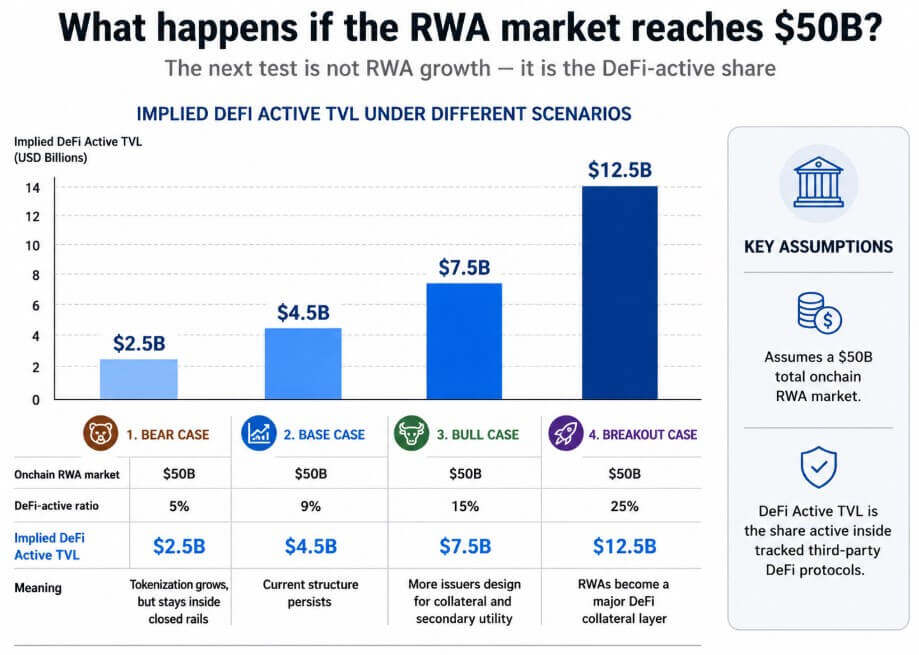
The chart above projects the implied active DeFi TVL in a $50 billion RWA market under four scenarios, ranging from 5% to 25% penetration.
Morpho's over $620 million in RWA deposits and USDY's circulation across 9 blockchains prove the real potential of the second market type.
To push RWA's DeFi penetration rate beyond 9%, asset issuers must abandon the "compliance-first" design approach represented by BlackRock's BUIDL, and instead adopt underlying architectures that natively support permissionless, free circulation.
Currently, $28.56 billion in on-chain RWA assets belong to the permission-controlled track. This signifies that today's tokenized real-world assets are, overall, more akin to compliant on-chain traditional financial products rather than universal collateral assets suitable for the open DeFi ecosystem.


