






a16z, the biggest financial backer behind the US midterm elections


- Core Viewpoint: a16z (Andreessen Horowitz) has become the largest donor in this round of US midterm elections, with total political donations exceeding $115 million, far surpassing other billionaires. This marks a historic moment where Silicon Valley venture capital firms are systematically participating in politics with unprecedented intensity to advance policies favorable to their business interests.
- Key Elements:
- a16z and its founders donated $115.5 million this cycle, primarily directed towards crypto industry super PACs ($47.5 million) and pro-AI super PACs ($50 million), while also funding committees affiliated with Trump and the Republican Party.
- a16z's strategy involves permanent political engagement rather than one-time speculation. The firm continued investing immediately after the elections and participates in government bodies like the White House Technology Council.
- The donor entity has shifted from individuals to institutions. a16z's massive political spending has sparked controversy, with critics arguing it will co-opt the electoral process to serve private business interests.
- a16z's political stance has shifted from supporting Democrats to the right, focusing on a "single-issue" agenda of supporting startup development. This shift stems from conflicts with media and government tech policies.
- These actions have triggered backlash both within and outside the industry. Internally, a partner resigned due to disagreements, while externally, opposing PACs (such as "z16a") have emerged to counterbalance a16z's influence.
Original Author: Theodore Schleifer, The New York Times
Compiled by Luffy, Forsight News
The biggest spender in the current U.S. midterm elections is neither Elon Musk, George Soros, nor any other billionaire with the deepest pockets in politics.
The true top donor is a venture capital firm: Andreessen Horowitz (a16z).
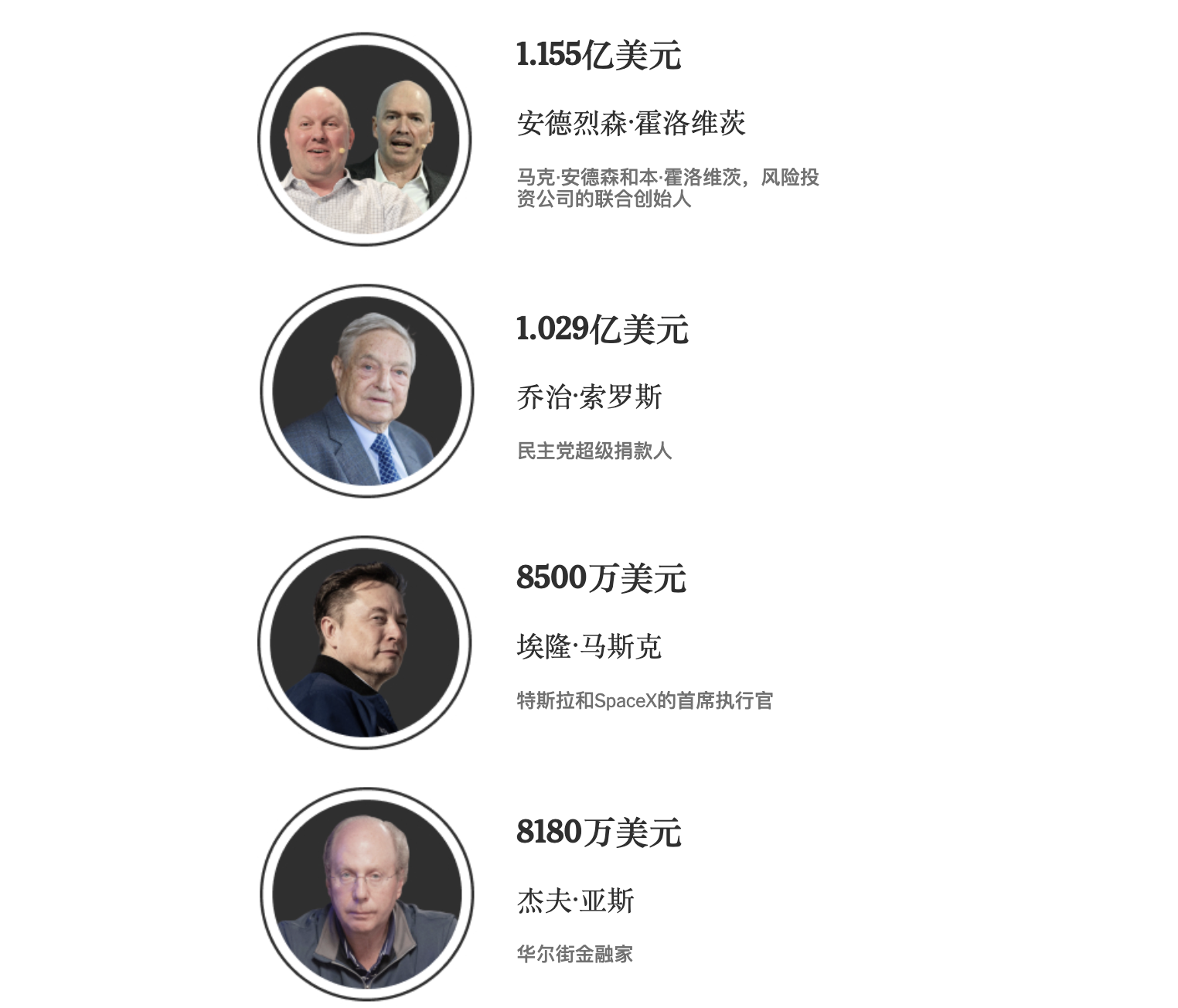
Ranking of top donors for the current midterm elections. Source: Federal Election Commission, The New York Times
An analysis by The New York Times shows that the Silicon Valley venture capital firm, along with its co-founders Marc Andreessen and Ben Horowitz, has donated over $115 million in political contributions related to the midterm elections, making them the largest known donors in this election cycle.
A16z's involvement in politics is not new; both founders are veteran political donors worth billions. However, the scale of donations this cycle has far exceeded the approximately $63 million donated during the 2024 election cycle. The top-tier investment firm is ramping up its political spending at an unprecedented rate, attempting to influence policy direction to align with its own business interests.
After the last general election, a16z established a long-term posture of political engagement. Conventionally, the day after a general election (two years before the next major election) is not the time for massive donations. But on November 6, 2024, a16z injected over $23 million into two core crypto industry Super PACs, sending a clear signal: its political strategy is long-term, not a fleeting trend.
In response to media interview requests, a16z declined to comment and did not arrange for the two founders to be interviewed.
A few days later, during a post-election podcast, Andreessen stated directly, "My conclusion is that we have to treat political engagement as a permanent mission." "Sometimes the political winds are at your back, other times you have to fight hard. But regardless, we need to be deeply involved throughout the entire process."
The massive political contributions by venture capital firms also reflect a significant shift in the U.S. political landscape. In this midterm election cycle, the top donors have shifted from individual billionaires to corporate entities like a16z. Critics argue that the entry of huge institutional funds may co-opt the electoral process, solely to advance their own commercial interests.
Since the 2024 general election, a16z has poured $47.5 million into Fairshake, a network of crypto industry Super PACs. Its political布局 has also expanded beyond the crypto sector: mirroring the Fairshake model, it spearheaded Leading the Future, a Super PAC focused on supporting pro-AI lawmakers, and injected $50 million into it. Both Fairshake and Leading the Future adopt a bipartisan strategy, simultaneously funding Republican and Democratic candidates.
Furthermore, a16z and its two founders have donated a total of $12 million to Trump's Super PAC, MAGA Inc., including a single $6 million donation in March. In the same month, a trust associated with Andreessen donated nearly $900,000 to the Republican National Committee.
This series of political investments has also helped Marc Andreessen build a close network with the Trump administration.
The chart showing the surge in public political contributions from Andreessen and Horowitz this cycle indicates: Political donations from a16z and its founders skyrocketed from $2 million in 2022 to $115.5 million in 2026; funds primarily flowed to AI initiatives, Republican Party causes, and the crypto industry.
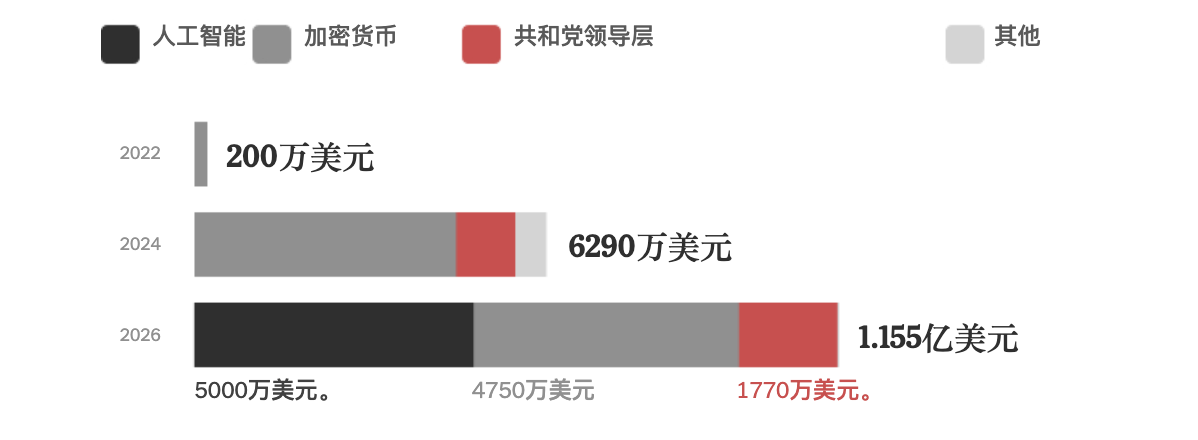
Source: Federal Election Commission, The New York Times
Before Trump began his second term last year, Andreessen revealed that he spent half his time at Mar-a-Lago, assisting the Trump team with presidential transition. The venture capitalist also served as an informal advisor to the Department of Government Efficiency, spearheaded by Musk. Two former a16z partners have joined the government as senior officials, with one responsible for AI regulatory affairs.
In March this year, the 54-year-old Andreessen was appointed to the White House's top tech advisory council; he was also recently invited to the U.S. state dinner for Britain's King Charles III and a private club dinner hosted by Trump at the White House Rose Garden.
According to regulatory filings, the large donations from Andreessen and Horowitz mostly come from a16z, which they wholly own. The $115.5 million for this election cycle does not include the tens of millions of dollars the firm recently contributed to the emerging AI non-profit advocacy group American Innovators Network, which is not required to disclose its donors.
Founded in 2009, a16z is one of Silicon Valley's most prestigious investment firms. It models its startup incubation approach after Hollywood talent agencies, is aggressive in hiring, excels at self-promotion, and earned its reputation through early bets on crypto exchange Coinbase and social media platform Instagram.
Both founders have interesting political backstories. In the 1990s, Andreessen became wealthy at a young age due to the early browser Mosaic. He was a core member of former Vice President Al Gore's tech advisory team and a major Democratic fundraiser.
Years later, his political stance gradually shifted rightward. He revealed that after Trump's 2016 victory, he deliberately stepped back from political fundraising, embarking on a political "journey of self-reflection," re-evaluating various extreme ideological currents.
According to people familiar with his private social circles, Andreessen is now active in various private communities, often discussing current affairs with conservative activists.
Horowitz, 59, is the son of David Horowitz, a well-known conservative provocateur. However, sources say Horowitz himself is less vocal on political matters and has relatively limited involvement in the firm's Super PAC activities. A16z publicly endorsed Trump in the summer of 2024, but in October of the same year, Horowitz provided financial support to Democratic presidential candidate Kamala Harris based on personal friendship.
Andreessen and Horowitz describe themselves as "single-issue voters": they only vote and donate based on what benefits tech startup growth. Sources say their repeated clashes with the media and the Biden administration over tech policy ultimately solidified their resolve for deep political engagement.
Andreessen once recounted an incident to friends. About a decade ago, at the Condé Nast headquarters (parent company of The New Yorker), he argued with editor-in-chief David Remnick. Remnick's team accused tech elites of being out of touch with the public, but Andreessen, after touring their luxurious offices and bathrooms, felt it was the media elites who were truly disconnected from reality.
Before the 2024 election, Chris Lehane, a veteran Silicon Valley political strategist and Coinbase board member, spearheaded the formation of Fairshake. Andreessen and Horowitz believed the Biden administration was too tough on the crypto industry, where a16z was heavily invested. Coupled with the conviction of crypto-political figurehead SBF for fraud, the industry needed a new political path.
Thus, a16z, alongside crypto giants like Coinbase and Ripple, became a core funder of Fairshake, donating $47 million to the organization in the 2024 election cycle. Although most pro-crypto policies in Washington now originate from Trump (Fairshake did not endorse Trump), this political布局 is still viewed within the industry as a successful experiment.
In the spring of 2025, Lehane, now at OpenAI, once again took the lead, uniting a16z, tech donors, and political strategists to replicate the crypto industry's political fundraising model in the AI field, this time investing early and heavily.
A16z, with countless investments in the AI track, fully committed. In August 2025, it donated $25 million to the AI-focused PAC Leading the Future, followed by another $25 million in February 2026. Sources indicate the firm hasn't decided whether to contribute further.
Compared to the $100 billion in assets managed by a16z, the $115.5 million in political spending is not enormous. However, other top-tier Silicon Valley VCs, like Sequoia Capital and Founders Fund, have not adopted a similarly large-scale political strategy.
According to The New York Times tally, since the 2024 general election, the next largest public federal donors after a16z are Soros-affiliated entities (approximately $103 million) and Musk ($85 million).
A16z's heavy political involvement has also led to controversy and backlash from multiple sides.
Internally, early firm partner John O'Farrell resigned from his part-time advisory role in May last year due to political disagreements. He publicly criticized the two PACs, Fairshake and Leading the Future, and what he called "tech figures actively cozying up to the current administration, including many former VC peers and partners." He declined further comment.
Externally, a16z faces strong criticism from the progressive camp. Last year, several Democratic lawmakers publicly criticized Arizona Democratic Senator Ruben Gallego for co-hosting a fundraising event with Andreessen.
A16z's support for the AI PAC Leading the Future has also triggered industry countermeasures. Public First, a rival Super PAC dedicated to AI safety, was established specifically to counter the political influence of a16z and its allies. Insiders even jokingly named the organization "z16a," a deliberate inversion of a16z's nickname.
New York State Democratic Assemblymember Alex Bores, running for Congress and endorsed by Public First, said he is unafraid of attacks from Leading the Future: "A venture capitalist's logic is to pursue rapid scaling, but that logic shouldn't be applied to buying democratic politics."
Some Republicans are also unimpressed with a16z's political bets. They privately dislike the bipartisan neutrality strategy of Fairshake and Leading the Future, believing that AI and crypto industry policies are inherently more favorable to the Republican Party, and therefore these PACs should fully align with the GOP.
Andreessen and Horowitz have told allies that their decision-making power within these two PACs is limited, and they rarely interact directly with PAC management.
A16z's political strategy and Washington lobbying efforts are coordinated by Collin McCune, a former congressional staffer and Republican. He tracks the activities of both PACs in real-time and briefs Andreessen on the latest policy and political developments.
This doesn't mean Andreessen is naive about political rules. In the year 2000, at just 29 years old, he famously stated: "If you think political contributions are large today, you haven't seen real scale yet."


