






CZ New Interview: Still Devotes 80% of His Energy to Blockchain, Financial Freedom at $10 Million


- Core Viewpoint: CZ, the former founder of Binance, after his release from prison and pardon, still dedicates 80%-90% of his energy to blockchain. He believes the industry will become an irreplaceable settlement rail in the era of AI agents and that the scale of the future financial transaction network will far surpass the current one. Meanwhile, he holds a pragmatic attitude towards wealth, family, and legacy, emphasizing contribution over personal enjoyment.
- Key Elements:
- Prison Experience: CZ was imprisoned in the US for 76 days, during which he used a basic terminal to write a new book, three to four times a day, 15 minutes each session. He emphasized that prison made him clearer about what matters most (family) and made him stronger.
- Reason for Pardon: CZ stated that no deal was made for the pardon, and his case had unique characteristics (the first person imprisoned for a single violation of the Bank Secrecy Act). He mentioned facing behind-the-scenes lobbying resistance from other US exchanges.
- Business Reflection: His biggest mistake was not separating the platform into US and global versions and blocking US users from day one, which led to subsequent legal risks. US users historically accounted for up to ~30%, and losing them would not affect profitability.
- Industry Judgment: CZ believes blockchain is "the technology of money." When AI agents transact with each other, cryptocurrency is the only settlement option. The current $2 trillion market cap of crypto assets is severely undervalued.
- Investment Philosophy: YCi Labs' investment criteria focus on the team's ability and mission-driven motivation (rather than profit motive). He half-jokingly thinks Musk is an "alien," aiming to return to his home planet via Mars as a transfer point.
- View on Wealth: CZ believes personal financial freedom requires about $10 million, and the marginal happiness from money becomes zero beyond $50 million. He does not intend to leave billions of dollars to his children but will support their basic living and moderate growth through a trust.
Compiled & Translated by: Odaily TechFlow
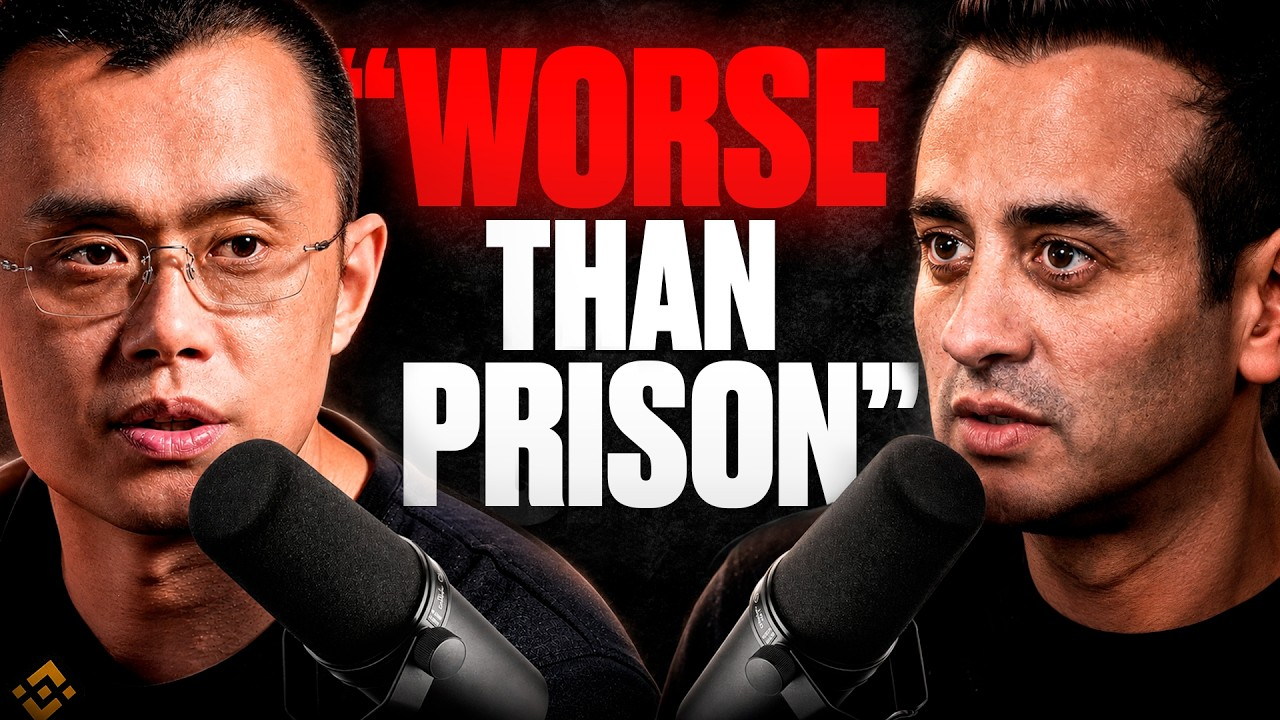
Guest: CZ, Founder of Binance
Host: Ran Neuner, CNBC Crypto Trader
Podcast Source: Crypto Banter & Crypto Insider
Original Title: CZ Life Before and After Prison, Crypto’s Future & The Freedom Of Money
Air Date: May 9, 2026
Key Takeaways
In this exclusive interview, Ran Neuner engaged in an in-depth conversation with Binance founder CZ, discussing his new book "Freedom of Money" (original English title), his prison experience, the pardon process, family relationships, and the future of the crypto industry. CZ recalled the process of writing a book in a US prison, coping with uncertainty, and rebuilding his life priorities. He also explained why he still dedicates 80% to 90% of his time and energy to blockchain. In his view, the era of AI Agents will spawn a financial transaction network far larger than today's, and blockchain is likely to become an irreplaceable settlement rail. At the end of the interview, CZ also shared his understanding of wealth, children, investment, health, and legacy: money is not the end; the real importance lies in using one's ability and resources to improve the world.

Highlights & Quotes
On the 76-Day Prison Experience and Mental Rebuilding
- “I started writing it in prison. I had a lot of time, but not much access to the outside world. No internet, just a very basic terminal for 15 minutes at a time, after which I'd get kicked off. The terminal wouldn't let me copy-paste, so I had to type everything out.”
- “The newspapers called me the richest person to enter a US prison and the only one imprisoned for a single violation of the Bank Secrecy Act. Before I went in, my lawyer told me, 'You are a prime target for extortion.'”
- “No one in US history has gone to prison for a single Bank Secrecy Act violation, even today. I'm the only one, the first, and the only. So I'm special, and they treated me specially. I didn't know what other 'special treatment' there would be.”
- “After I got out, I wrote in the book that I don't care about my reputation, or even my legacy that much. I don't care how others see me. What I care about is how I see myself when I'm old.”
- “Very clearly, it's people. I miss my family, my children, my loved ones, and my friends. When everything is taken away, you figure out what you miss the most.”
On the Pardon, Citizenship, and US Crypto Regulation as Business Competition
- “There were absolutely no deals made for the pardon. My lawyer was very clear: 'You don't want to get into more trouble trying to get a pardon.'”
- “We did face very strong lobbying, counter-lobbying, and reverse-lobbying. Some of our competitors in the US didn't want me to get pardoned. Other American crypto exchanges didn't want me pardoned because they fear Binance returning to the US. This is business competition.”
- “Unrelated to the negotiations, I was invited to become a citizen of the UAE. ... However, I didn't use the UAE citizenship. I didn't want to use it as a tool to just hide there. Getting it actually pushed me more to go to the US to resolve the issue, rather than relying on it.”
- “When you were convicted, part of the terms was you couldn't operate Binance. With the pardon, for me personally, that disappears, so I have no restrictions. But for the company, there may or may not be some restrictions.”
Business Reflection: CZ on His Biggest Business Mistakes in Retrospect
- “If I could go back, I would have created two platforms from the start: a Binance US and a Binance Global, and blocked US users from day one. That would have saved a lot of trouble.”
- “US users never made up more than 30% of our user base at any point, ranging from 10%, 20%, to 30% in different phases. ... We became profitable within 3 months and had very high margins. So even with 30% less, we probably would have survived.”
- “But I later learned that the US looks back many years. They look back at what you did before.”
- “I'm much more cautious in business, but I won't have my lawyers review every tweet. ... For business matters, I now involve more lawyers. That's what I learned. Law is my weakness; I don't have a legal background.”
Crypto x AI: Why the Crypto Rail is Severely Underestimated
- “Blockchain is about money, the technology of money. We will always need money, and increasingly more efficient and freer money.”
- “I still devote 80% to 90% of my time, money, and energy to blockchain. AI and biotech are great, but they aren't my expertise.”
- “Based on what I see today, Bitcoin still holds a dominant position and has the endurance to continue leading. Currently, nothing can replace Bitcoin.”
- “It's not just AI trading with AI. It's one AI representing a person trading with another AI representing another person on the other side of the world. I see no alternative; this money must be crypto.”
- “It will definitely far exceed $2 trillion, and also far exceed our monetary system today. The future monetary system will be much larger than today's.”
Wealth, Trust Arrangements, and the Hard Numbers for 'Financial Freedom'
- “I won't give my children a lot of money. For the adult ones, I told them, if you want to live comfortably for the rest of your life, I can support that. But if you want luxury, sports cars, private jets, yachts, a big house, you have to earn it yourself.”
- “I won't leave them billions of dollars. I might leave them assets in the tens of millions, hopefully arranged through a trust where they receive a fixed amount each year when young, less for the younger ones, and more as they get older.”
- “I want to use most of my money while I'm alive. I don't really believe in the approach of donating everything to charity at the end of your life. I think that's a terrible way to use funds because you can't truly control it then.”
- “For almost everyone on earth, $90 million is enough. ... But I think for a normal life, $10 million is enough for financial freedom. When I say $100 million, I mean beyond that number, it really doesn't make a difference. If you have $100 million and say you're unhappy, thinking $200 million will make you happier, that's madness. It won't work.”
- “Beyond $50 million, the difference is zero. If you're obsessed with money making you happy, you will be unhappy.”
- “When I'm old and sick in bed, I want to look back and say: I did my best to contribute to the world I came into. I want to leave this world a little better than I found it.”
YZi Labs Investment Thesis and Elon Musk's 'Alien Theory'
- “I don't look at shiny things, or fancy 'great brands' or 'genius new ideas'. I look at very fundamental things.”
- “I look for people who truly believe in their mission, who would do it even without money. If you just want to make money, I think you'll stop at a point of relative success, but you won't build a great company in history. So it's these two things: capability and mission.”
- “I think Elon doesn't care about money. My theory is he's an alien, and he wants to go back to his home planet. Mars is just a transit station. That's my theory, half-jokingly, half-seriously.”
'The Freedom of Money': CZ's New Book Launch
Host Ran Neuner: When did you write your new book 'The Freedom of Money'?
CZ:
I started writing it in prison. I had a lot of time, but not much access to the outside world. No internet, just a very basic terminal for 15 minutes at a time, after which I'd get kicked off. The terminal didn't allow copy-paste, so I had to type everything manually. I couldn't easily delete either; if I deleted something, I had to retype it. So basically, I just poured out what was in my head and emailed it to my assistant and a friend.
After I got out, it took about another year and a half to complete. It took roughly 6 months to write the first draft, but then there were many rounds of editing. Each round was a 400-page document, taking 2 to 3 weeks.
Host Ran Neuner: What goes through a person's mind before writing a book? Why write one? You were in prison, likely scared, stressed, anxious – why was your first instinct to write a book? What were you thinking?
CZ:
Several reasons. First, in prison, I wanted to keep myself busy, and writing a book is a great project. It doesn't require anything else but staying in your head and putting the content down. So I was always trying to queue for the computers.
More importantly, some say writing a book is really writing to yourself, you're having a dialogue with yourself, looking back at your life, thinking about what's important, meaningful, unimportant, and interesting, and then writing it down.
After getting out, I also felt it was a natural turning point in my life, a chapter break. I initially wanted to publish it immediately after release, but it took longer. In the following months, I was also applying for a pardon, not knowing when it would come. When it eventually did, I was quite surprised and felt it would be a great ending for the book.
Host Ran Neuner: Tell me about the experience of writing a book in prison. You mentioned sometimes using a computer. People outside don't really know what it's like inside, we only see it in movies. Did you write with pen and paper? Was there only one computer? Could it access the internet? How did it work exactly?
CZ:
Our unit had 200 inmates and 4 terminals. You had to queue to use a computer. Once on, you only had 15 minutes. The computers had no internet. You could only use a messaging app to contact pre-approved contacts, up to 30 people. I only had two contacts: my assistant and a friend.
So each session was 15 minutes. After you timed out, you had to wait hours to use it again and then re-queue. I could use it about 3 or 4 times a day. I also had pen and paper, primarily to jot down key points I wanted to write next time. When I got on the computer, I would write as fast as possible. This writing process lasted several months.
Host Ran Neuner: You were there for 4 months. Was the task of writing a book simply to keep busy? Were you counting down the days, day 1, day 2, day 3, and just keeping your mind occupied?
CZ:
Sort of, but strictly speaking, I was in prison for 76 days. Then I went to a halfway house, where I could go to an office but still couldn't go anywhere I wanted. I was there for about 3 to 4 weeks, and was re-incarcerated for the final 14 days of my sentence. It's in the book. I couldn't write those last 14 days because I had no access to anything.
Host Ran Neuner: What was the scariest part of prison? Was it the moment you walked in, or a specific moment inside?
CZ:
Before I went in, you don't know what to expect. The newspapers called me the richest person to enter a US prison and the only one imprisoned for a single violation of the Bank Secrecy Act. So before I went in, my lawyer told me, 'You are a prime target for extortion.' The question was, how to protect myself from being extorted? I didn't know what form the extortion would take. What if someone put a knife or a metal bar to my neck? How to avoid it? So there was a lot of preparation, which also brought significant mental anxiety. The book doesn't cover this part much.
But once you're actually inside, the intake process itself is a bit scary. You walk into a unit, and 200 strong men are all looking at you. But in the end, most inmates are quite reasonable. Some are criminals, some shouldn't be there, and some have been there too long.
Then the worry was, would they keep me there forever? Would they find other charges? Would they find other reasons? Especially when I got to the halfway house, I was supposed to be transferred to home confinement for the last 9 days. But on the 13th day from the end, the police came, handcuffed me, and sent me back to a detention center. The detention center was worse than prison because it was temporary and had nothing. That's when I thought, 'Are they bringing new charges?' The mental stress was immense.
Even on the day I was supposed to leave, I was nervous. Even on the plane, I didn't relax. I waited until the plane left US airspace.
Host Ran Neuner: It sounds like you have a lot of PTSD or distrust of the system. I think this distrust might come from the fact that you didn't initially think you would be imprisoned. The whole process sounds like the rules could change at any time; there were no fixed rules to the game.
CZ:
Exactly. Any lawyer can tell you, no one in US history has gone to prison for a single Bank Secrecy Act violation, even today. I'm the only one, the first, and the only. So I'm special, and they treated me specially. I didn't know what other 'special treatment' there would be.
Five days before my sentencing, Senator Elizabeth Warren declared war on crypto. That was during the Biden administration, and there was indeed a war on crypto at the time, so there was a lot of uncertainty. I was a special case; I didn't know what to expect. Even my sentencing judge said he couldn't follow precedent because I was a special case.
Host Ran Neuner: You're a special case. When you walk down the street here, people come up, you're very respected. What was it like in prison? When


