






The "VVV" concept that surged 9x: What story is it actually telling?


- Core Thesis: The "VVV" themed tokens in the Base ecosystem (represented by $VVV) are transitioning from purely speculative assets to "tech stock"-style value assets through token deflation, subscription revenue buybacks, and a novel $DIEM staking utility mechanism, driving the rise of related tokens like $POD and $SR.
- Key Elements:
- The $VVV token supply, initially 100 million, has been reduced by approximately 42% (33.73 million tokens) through burns. The annual issuance rate has been cut from 8 million to 5 million tokens, with plans to further reduce it to 3 million in July, aiming for net deflation.
- Venice platform generates $835,000 in monthly revenue, with a 15% month-over-month growth rate. Subscription revenue is directly linked to token buybacks. The Pro, Pro+, and Max plans correspond to $2, $5, and $10 buybacks, respectively, used to burn $VVV.
- The $DIEM token is minted by staking $sVVV. Each staked $DIEM provides $1 worth of Venice API credit daily (valued at approximately $1,500 per token), binding the token to actual product utility.
- The price of $VVV has rebounded from a market cap low of approximately $45 million, rising over 9x since entering 2026. This is primarily driven by platform user growth (over 2 million total users) and tokenomics optimization.
- Related concept tokens have been boosted by the ripple effect: $POD (Dolphin distributed inference network) has surged over 12x due to jointly developing a model with Venice; $SR has risen approximately 4x due to collaborating with Venice on developing a robot VLM reasoning layer.
Without a doubt, the current main storyline of the Base ecosystem remains AI. But to be more specific, it's about "VVV."
Before introducing the tokens related to the "VVV" concept, let's first understand what "VVV" actually is.
What is the "VVV" Concept?
$VVV is the token of Venice, a privacy-focused and uncensored generative AI platform built on the Base ecosystem, led by Erik Voorhees.
Erik is a veteran OG who has been involved in cryptocurrency since 2011 and played a key role in the early adoption of Bitcoin. After the Mt. Gox collapse, he founded ShapeShift, one of the earliest trading platforms emphasizing non-custodial and privacy-first principles. His expertise in decentralized finance and user sovereignty makes him a strong advocate for permissionless AI.
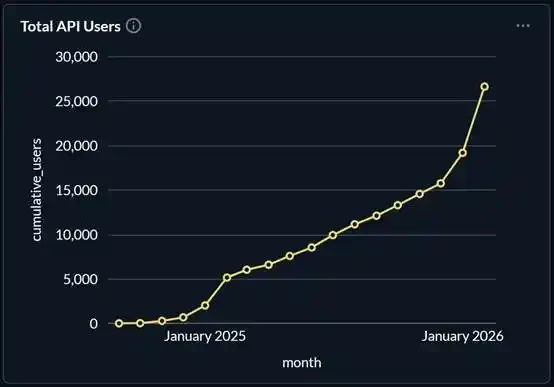
According to a chart of Venice API user numbers released by Erik Voorhees in March this year, the number of Venice API users grew from near zero to 15,000 throughout 2025.
However, correspondingly, the price performance of $VVV has been lukewarm. Occasional rebounds have at most reached a market cap of around $200 million, and it once fell below $45 million, far from its all-time high of $1 billion shortly after its launch.
At the same time, entering 2026, the number of Venice API users has seen rapid growth. This is largely attributed to the explosive popularity of OpenClaw. Due to its privacy-focused positioning, Venice was once highlighted and recommended in the model provider section of OpenClaw's official documentation.
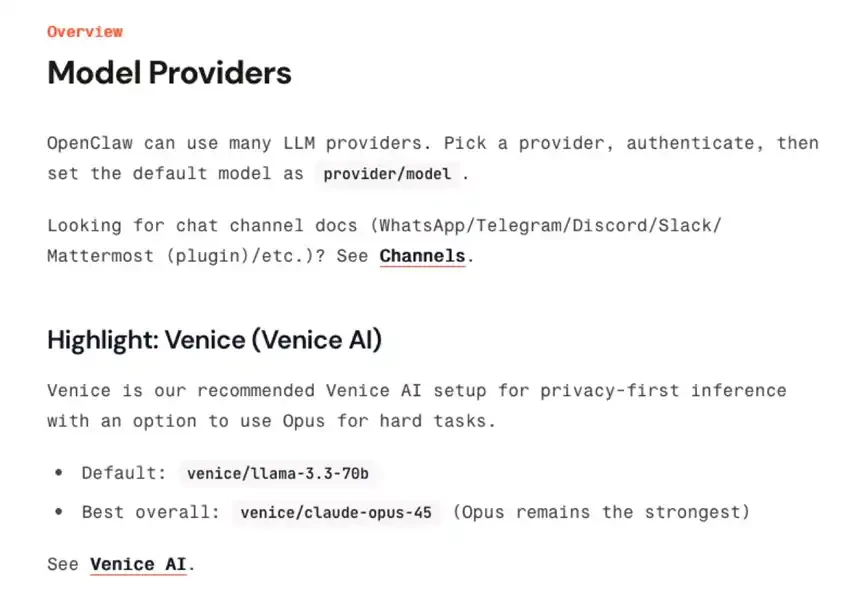
Although this highlight recommendation was later removed, 2026 has become a year of rapid growth for Venice. According to data disclosed by Erik Voorhees, by March this year, Venice's total user base exceeded 2 million, with paid subscribers reaching 55,000. Monthly revenue reached $835,000, with a monthly growth rate of 15%.
Correspondingly, $VVV has seen a sustained increase. Since the beginning of 2026, $VVV has risen over 9 times.
$VVV/$DIEM
Earlier, we introduced Venice's growth in terms of exposure and user numbers this year, which represents a macro-narrative reason for the price increase. However, as a crypto AI project with a token, its price appreciation is also closely tied to the token's own mechanisms.
Since the start of this year, the annual emission rate of $VVV has been adjusted and reduced multiple times, from 8 million tokens per year down to 5 million. By July 1st, the annual emission will be further reduced to 3 million. The official goal is to achieve net deflation for $VVV, where the burn amount exceeds the emission amount, ensuring native yield for $VVV.
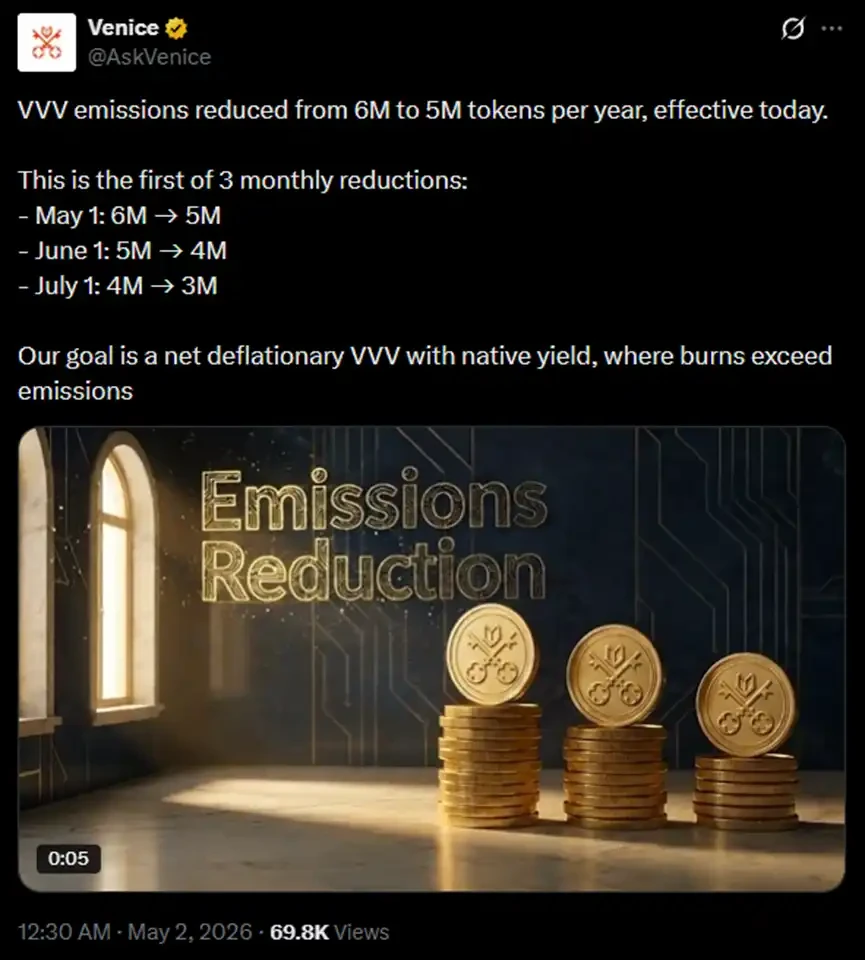
The initial total supply of $VVV was 100 million tokens. The current total token supply is approximately 79.9 million, and 42.22% (about 33.73 million) of the current supply has already been burned.
The burning of $VVV is linked to Venice's subscription revenue. At the end of April, Venice started allocating more subscription revenue to token buybacks. For each new Pro plan subscription ($18), $2 will be used to buy back and burn $VVV. The Pro+ plan ($68) and Max plan ($200) correspond to buybacks and burns of $5 and $10, respectively.
The current circulating supply is approximately 46 million tokens. Additionally, about 8.85 million tokens remain locked, while approximately 32.47 million are staked.
What's quite interesting is the utility of the $VVV token. Compared to the awkward situation many past crypto projects faced, where "token rights were useless compared to equity," $VVV offers a very intriguing solution.
On top of continuously controlling the token supply, staking $VVV not only earns more $VVV and more rewards from emission reductions but also grants the right to mint $DIEM using the staked token $sVVV.
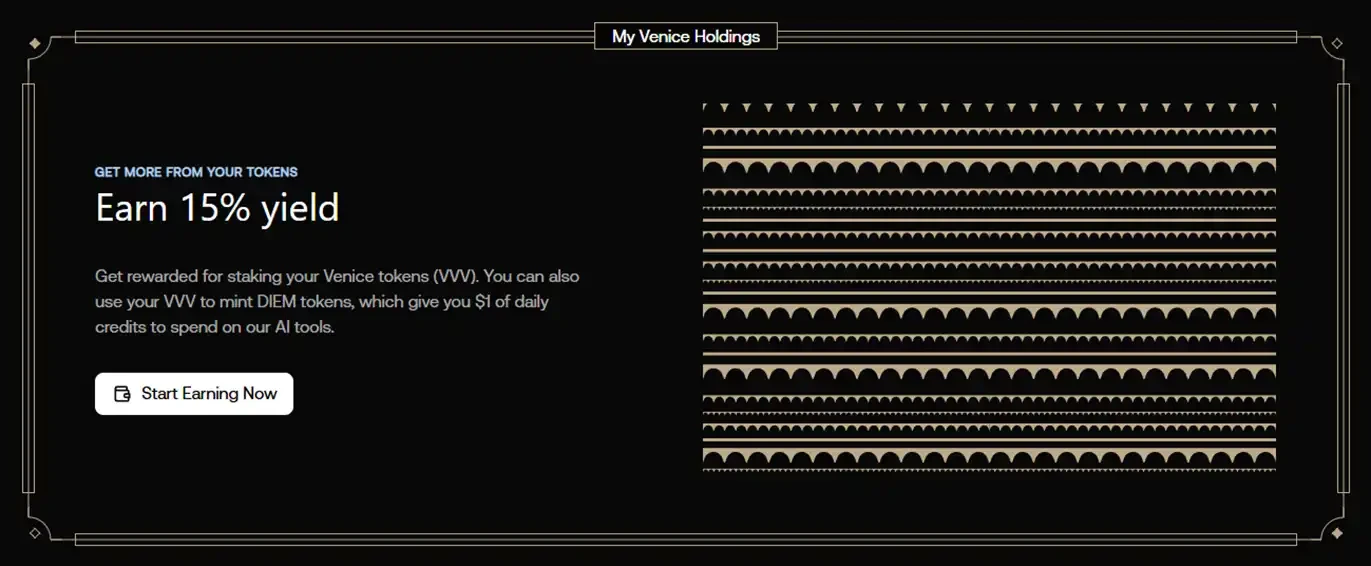
$DIEM can either be traded or staked. Staking 1 $DIEM corresponds to $1 worth of Venice API credit every day.
This credit line resets daily. If you use it up today, it's available again tomorrow, and it's valid forever. $1 of Venice API credit can do quite a lot. Here's Venice's own answer:
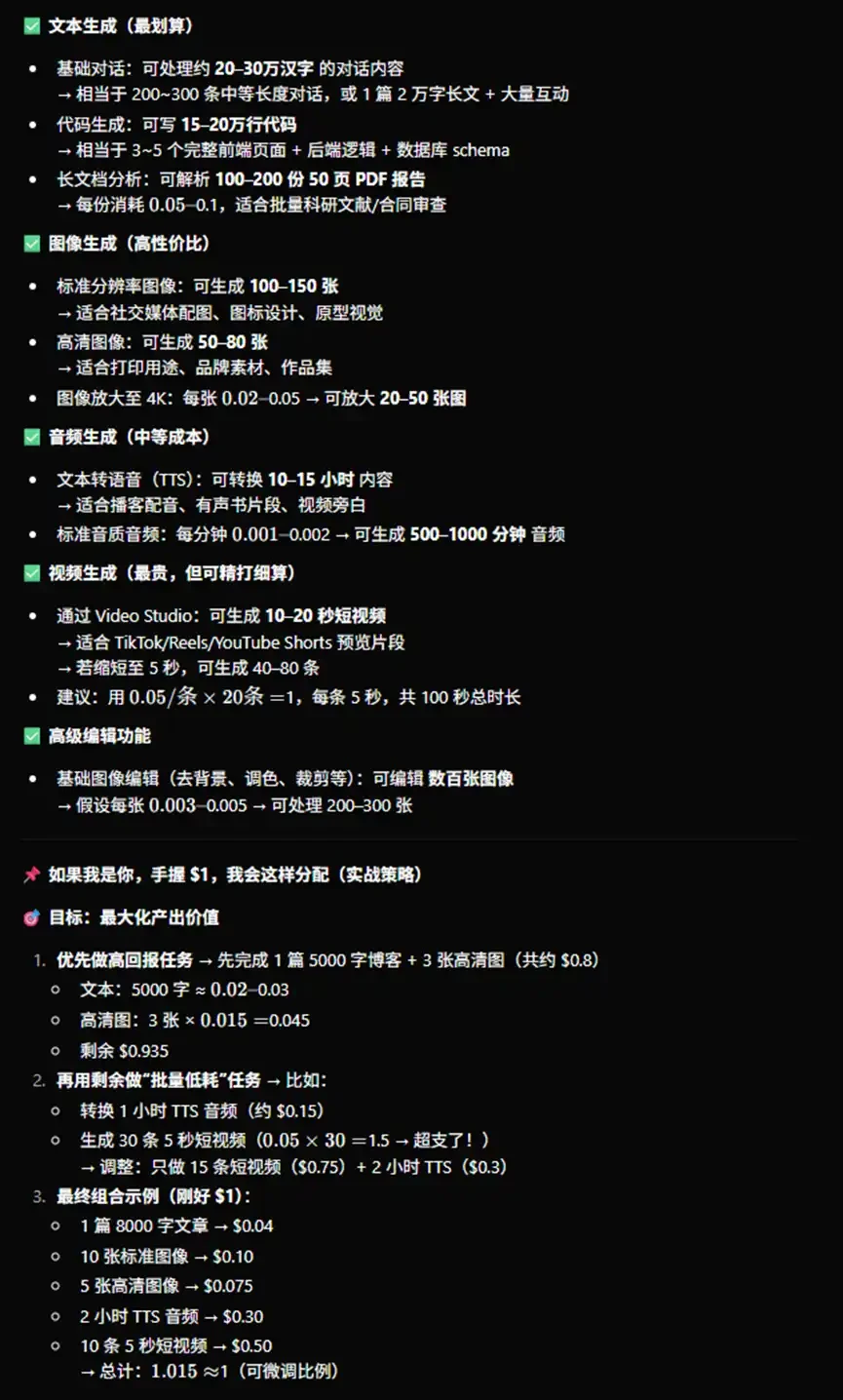
Staking 1 $DIEM allows you to use Venice for free daily to process the above tasks.
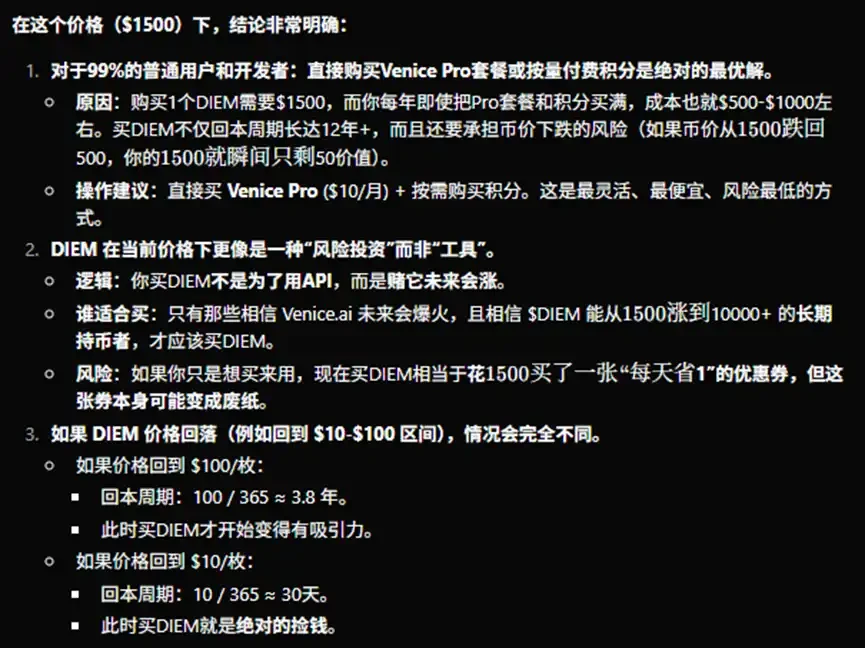
However, it's important to note that the price of one $DIEM has now skyrocketed to $1,500. Minting one $DIEM requires approximately 756 $sVVV, costing as much as around $12,800. Whether it's worth it or not, here's Venice's own calculation:
Overall, the $VVV/$DIEM economic structure, combined with Venice's regulatory mechanism, gives $VVV a distinct flavor of a "tech stock," while retaining the unique characteristics of the crypto space:
- Reducing emissions on the supply side prevents excessive dilution of token value (and also prevents dilution of $VVV dividends for stakers).
- Subscription revenue is used for token buybacks.
- Staked $VVV can be used to mint $DIME, allowing the token to play a practical role in the product through $DIME.
- However, there is a trade-off for this utility: $VVV used to mint $DIME only receives 80% of the dividends ($VVV staking rewards).
- Users can perform DeFi operations on-chain, such as staking $VVV to get $DIEM, then selling $DIEM to buy more $VVV. There are even community projects like @cheaptokensAI that allow users to resell the daily credit granted by $DIEM for profit without selling the $DIEM itself.
$POD
Since the beginning of May, $POD has surged over 12 times at its peak, with its market cap rising from approximately $7.8 million to briefly exceeding $100 million.
$POD is the token for Dolphin's distributed AI inference and training network. This is easy to summarize: users "mine" by providing idle GPU power to those who need AI computing services, earning $POD rewards in return.
However, the reason for $POD's surge is not the network itself but Dolphin's other business – AI models. Venice's current default model, Venice Uncensored 1.2, was co-developed by Dolphin and Venice, and evolved from the Dolphin Mistral 24B Venice Edition.
Therefore, although $POD serves only as the token for Dolphin's distributed AI inference and training network, at this stage, it is being heavily speculated on as the sole investment vehicle for betting on Dolphin.
$cyb3rwr3n
This project claims to build a marketplace for auctioning Venice usage credits based on USDC. However, a larger reason it's considered part of the "VVV" concept is that some players, after analyzing on-chain behavior and its correlation with tweets, believe this project is highly related to Venice founder Erik Voorhees.
The official Venice Twitter account has already clarified this speculation, stating that cyb3rwr3n is not an official Venice project.

This news, released last month, caused a price drop of about 50%, but it hit a new all-time high just a few days ago. The official clarification did not completely dispel market associations. Based on discussions among some players, Erik Voorhees was the first follower of the cyb3rwr3n official Twitter account, and other Venice team members like co-founder @TeanaTaylor, CTO @jesseproudman, and product lead @willyogo also follow the account. They believe that even if Venice is not officially associated with the project, the support conveyed through these interactions is a significant positive signal.
Indeed, this is currently one of the cheaper "VVV"-related tokens, with a market cap of only $4 million. However, it's cheap for a reason; its product isn't out yet, and for now, it can only be considered a meme coin.
$SR
STRIKEROBOT.AI is a full-stack embodied intelligence platform building a humanoid robot framework for Physical AI Business Process Outsourcing (BPO), focusing on safety in hazardous environments such as nuclear power plants, high-pressure facility zones, and radiation areas.
They have a robot training and simulation platform called SR Platform, and $SR is the token for this platform. The project's connection to Venice was announced on May 7th, stating it will co-develop a VLM inference layer designed for robots with Venice and has received sponsorship funding from Venice.
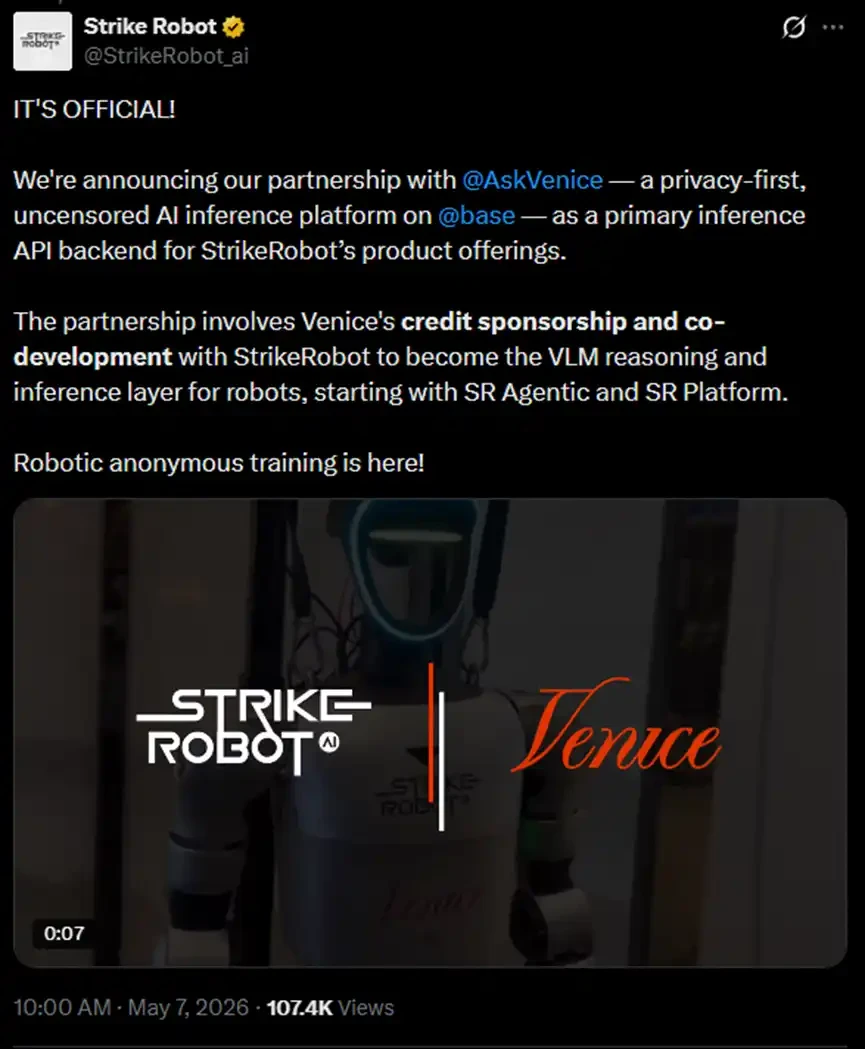
Since the beginning of May, $SR has risen about 4 times, and its current market cap is approximately $9 million.


