






6天60倍,Slonks靠「画错」复活了NFT?


- 核心观点:Slonks项目通过将AI图像生成模型植入以太坊智能合约,基于AI临摹CryptoPunks时产生的“失真”像素(slop)构建稀缺性,并通过Merge、Void与Revival机制实现图币互换,形成自洽的经济循环,是NFT领域一次结合技术与投机的微创新实验。
- 关键要素:
- Slonks NFT不存储图片,而是将214KB的AI模型嵌入合约,实时生成临摹CryptoPunks的24×24像素图像,平均每张图有4%的像素点(约24个)与原版不同,称为slop。
- 上线6天内,铸币价约0.004 ETH(约70元),地板价涨至0.123 ETH(约60倍),七天成交量达586 ETH,超两万三千笔交易,供应量一万张中已烧毁1348张。
- Merge操作可合并两张同等级Slonks,烧毁一张并混合特征生成新图,slop值只升不降,同时减少总供应量,人为制造稀缺性。
- $SLOP代币通过Void操作按slop值1:1铸造(需ZK证明验证),Revival操作可用代币随机复活虚空中的Slonks,价格采用荷兰拍机制(576-100代币),并有1%概率产生slop超过400的极端版本。
- 交易池2%手续费的一半自动购买地板价Slonks并送入虚空,形成交易活跃度与库存增长的正循环飞轮;代币硬顶576万个,因Merge烧毁永久锁定部分供应。
Original Author: Curry, TechFlow
The crypto market seems to be warming up recently, with some established sectors also introducing innovative gameplay, such as the long-dormant NFT market.
On May 1st, an NFT collection called Slonks launched on Ethereum, with a mint price of less than 0.004 ETH, equivalent to under seventy RMB.
Six days later, the floor price stands at 0.123 ETH, an increase of about 60 times. The 7-day trading volume on OpenSea is 586 ETH, with over 23,000 transactions. Out of a total supply of 10,000 pieces, 1,348 have been permanently burned, leaving 8,642 in circulation.
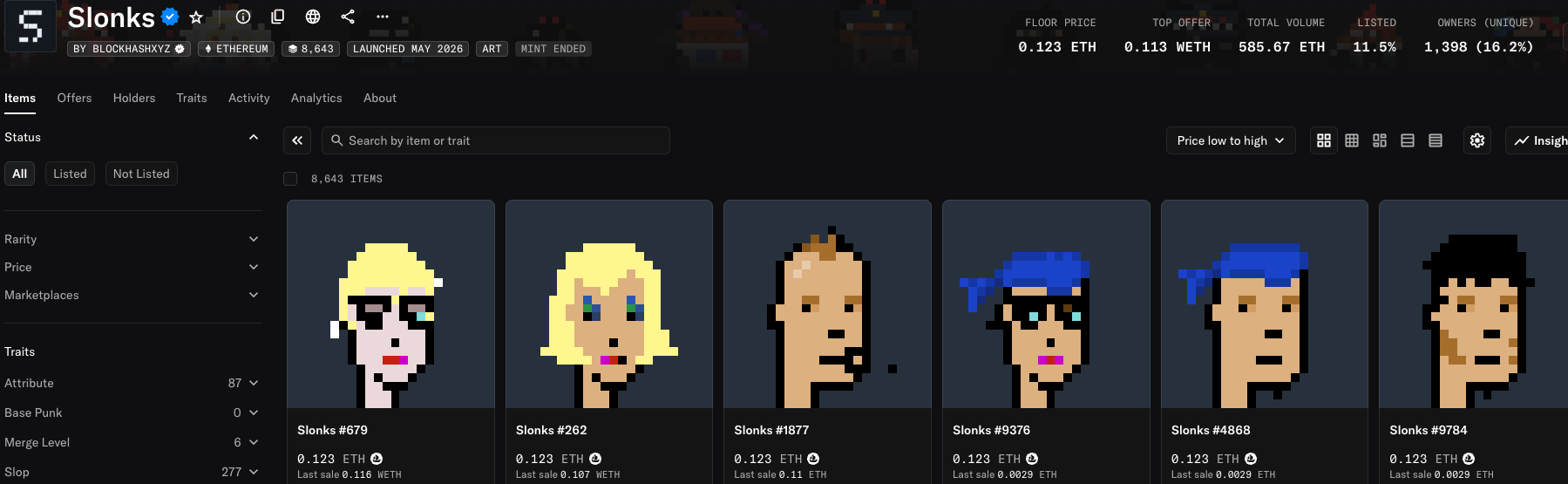
What level do these numbers represent in the 2026 NFT market? In the same week, the eight-year-old blue-chip project CryptoPunks completed a total of 20 transactions. Slonks recorded 23,000 transactions.
And tonight at 9 PM, this project is launching a token called $SLOP.
If you search for Slonks on Twitter, you'll find an interesting phenomenon. Almost everyone says the project has "ingenious mechanics" and "a self-consistent design," but when you ask them to explain exactly how it works, most people get stuck after saying, "Pictures can be swapped for tokens, and tokens can be swapped for pictures..."
Some call it GameFi, an on-chain AI art experiment, or an evolved version of CryptoPunks; others say it's essentially a "Fantasy Westward Journey pet fusion" game.
After a quick research, I think these descriptions all have some truth, but they don't quite hit the mark.
What's truly interesting about Slonks might be how it turns a highly counter-intuitive idea into a business. That idea is:
AI's mistakes are worth more than its successes.
Why are AI's pixel mistakes valuable?
What sets this project apart from some previous NFTs is that its NFTs are not image files.
Traditional NFTs usually store a completed image on an off-chain server, with only a link placed in the contract. Slonks is different. It embeds an AI image generation model directly into an Ethereum smart contract, totaling only 214KB—roughly the size of a low-resolution phone wallpaper.
Every time someone views a Slonk, the contract runs the model inference on the spot, generating the image in real-time.
It doesn't store pictures; it stores the ability to draw. This is actually a micro-innovation in NFT gameplay.
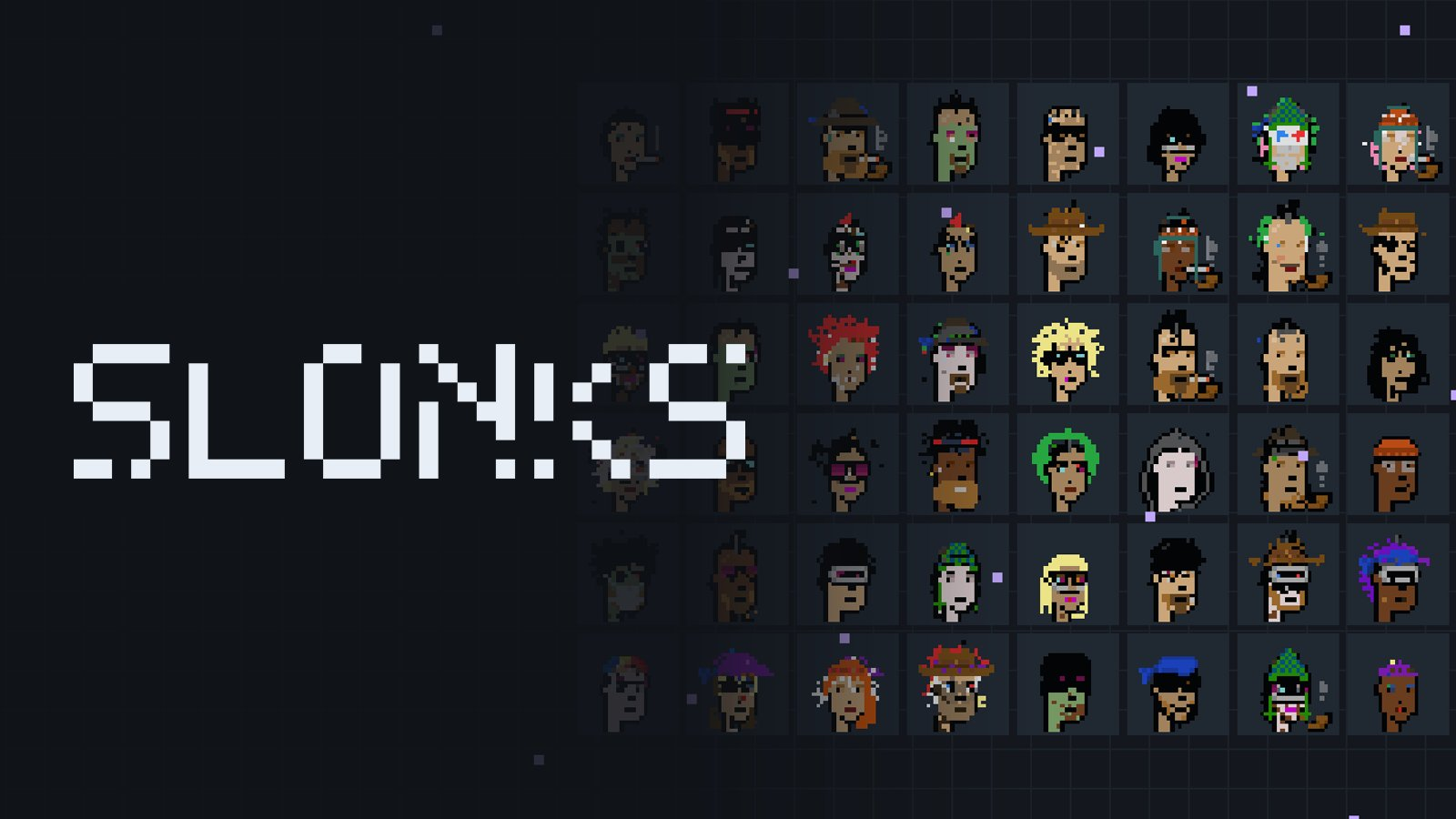
So, what exactly is this model drawing?
Actually, it's copying... The model's task is to create a replica for each of the 10,000 original CryptoPunks images. Each CryptoPunk corresponds to one Slonk. The model looks at the original and tries to redraw it using the same color palette.
But a 214KB model trying to remember 10,000 faces is really stretching it.
Each image has a total of 576 pixels. On average, the model gets about 24 pixels wrong, meaning roughly 4% of each image differs from the original. Out of 10,000 images, only 32 are perfectly replicated; the rest come with varying degrees of "distortion."
The project calls these incorrectly drawn, distorted pixels "slop."
If 0 pixels are wrong, slop is 0; if all are wrong, slop is 576. Hirsch, the project's developer, summarized the project's attitude in one tweet:
The slop is not a bug. It is the medium.
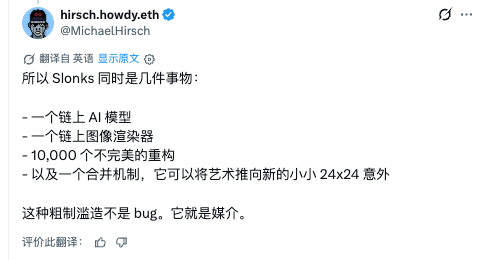
This essentially means using an AI model to re-copy the old NFT OG project. However, because it makes mistakes, and the mistakes take different forms, it creates varying degrees of scarcity and speculative value.
Consequently, the entire project's economic model is built on this logic: the more mistakes, the more valuable it is.
Slonk holders can perform an operation called Merge. Take two Slonks of the same level in your possession, choose one to keep, and burn the other. The contract mixes the features of the two images and has the model redraw a new one.
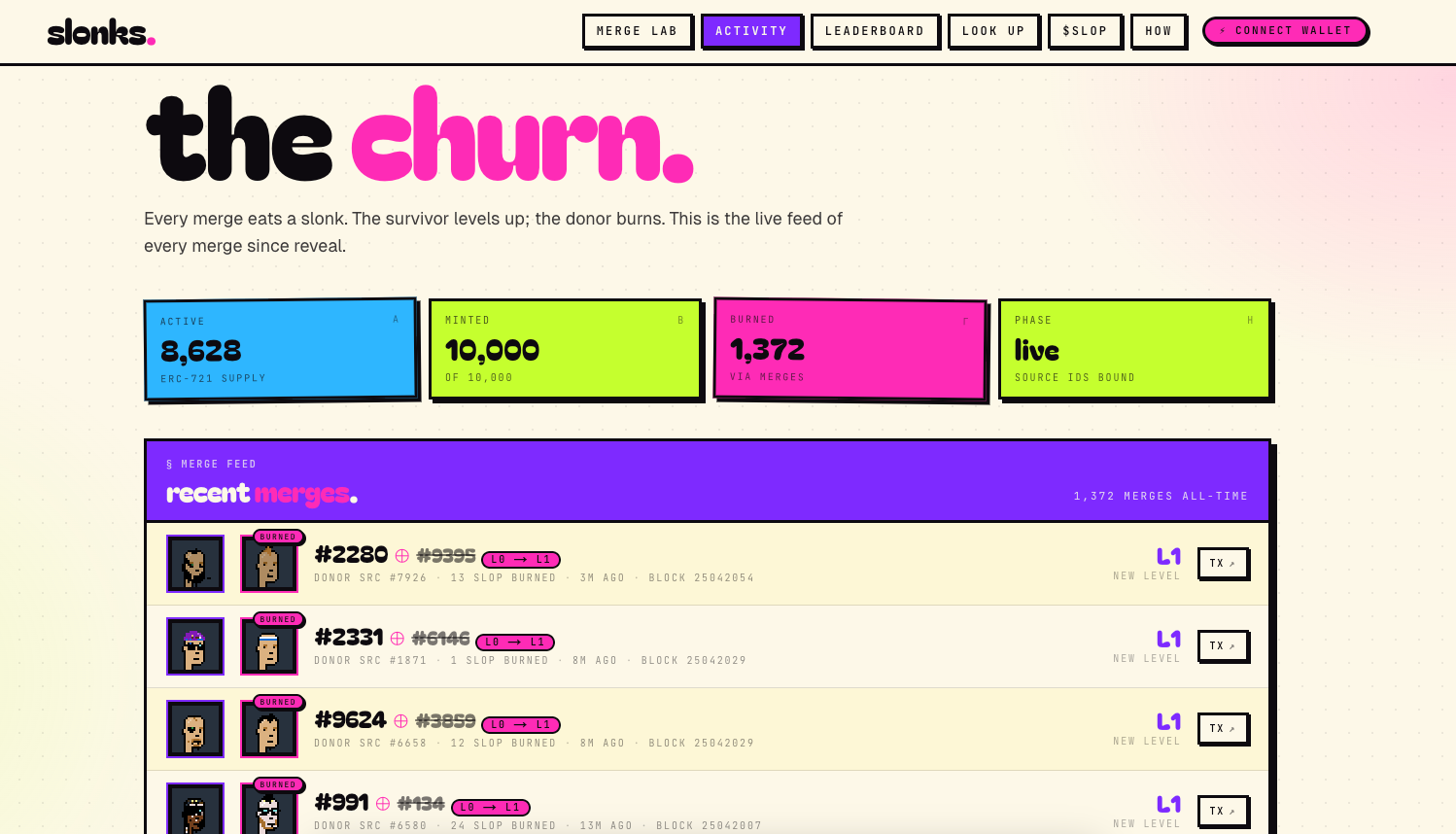
Because two different images are stirred together, the newly drawn result will inevitably deviate further from the original CryptoPunk, not less.
With each Merge, slop only goes up, never down. And the burned image is gone forever, reducing the total supply by one.
This explains why, in six days since launch, over 1,300 of the 10,000 pieces have been burned. Players keep merging to create versions with higher slop, simultaneously shrinking the circulating supply.
At this point, Slonks is already a quite interesting on-chain art experiment, using AI algorithms to create a form of artificial scarcity.
$SLOP: Putting a Price Tag on Every Wrong Pixel
What turns this project into a real business might be the official project token $SLOP, launching tonight.
Its purpose is to turn the "number of incorrectly drawn pixels" on each image into a tradable asset.
How? Through an operation called Void.
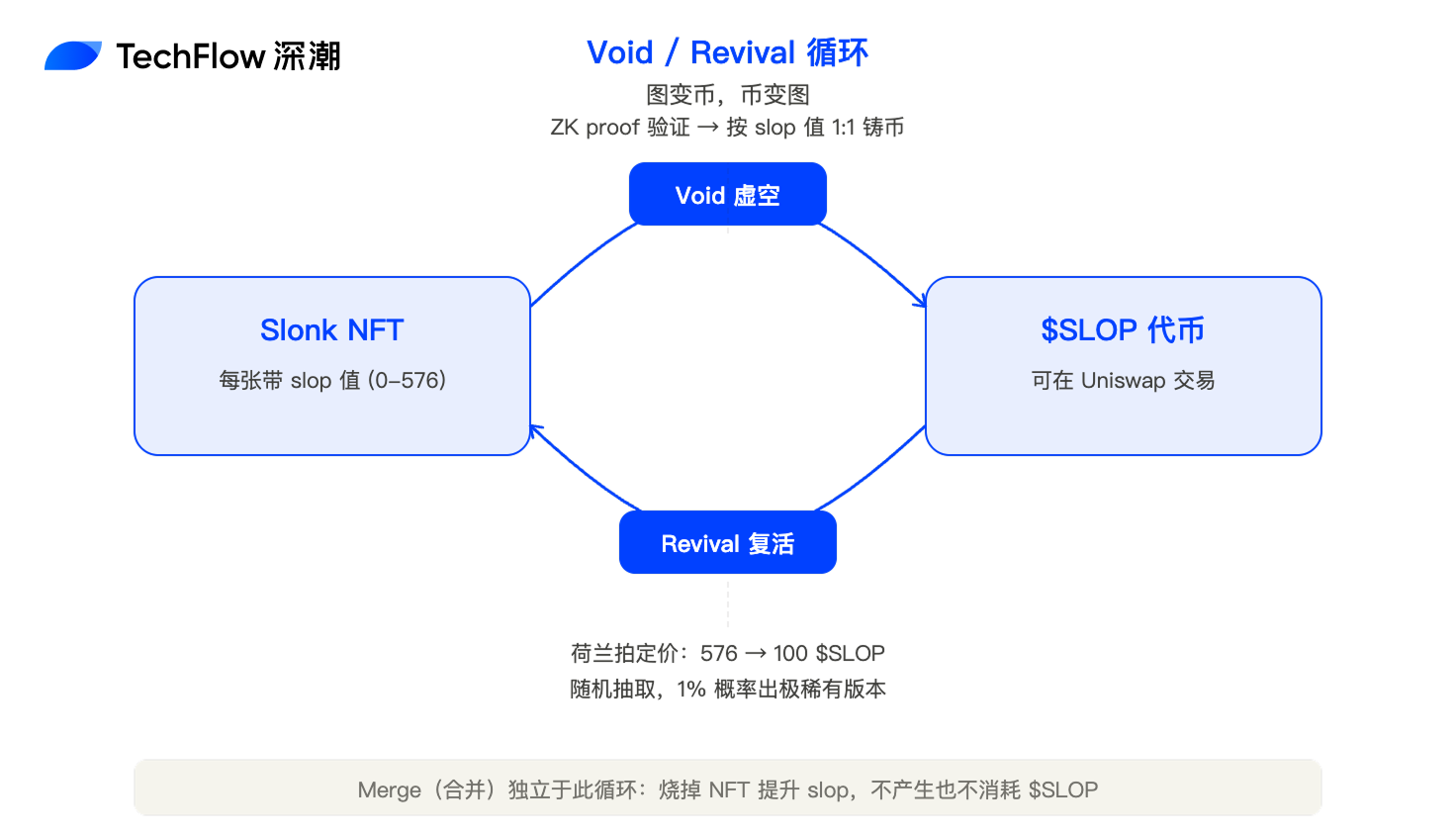
Holders can "send their Slonk into the Void." The NFT leaves circulation, and the contract mints and sends you $SLOP tokens equivalent to the image's slop value on a 1:1 basis.
For example, if your image has a slop of 287, you get 287 $SLOP. Slop of 450 means you get 450.
This process isn't just calling out a number. The contract requires you to first generate a ZK proof, verifying that the on-chain model's rendering result for that image is indeed what you claim. Only after verification does it mint the tokens.
In simple terms, you have to "inspect the goods" first, proving your image actually has that many wrong pixels before the contract acknowledges it.
Slonks sent into the Void are not destroyed; they remain in the contract. This leads to the second operation: Revival.
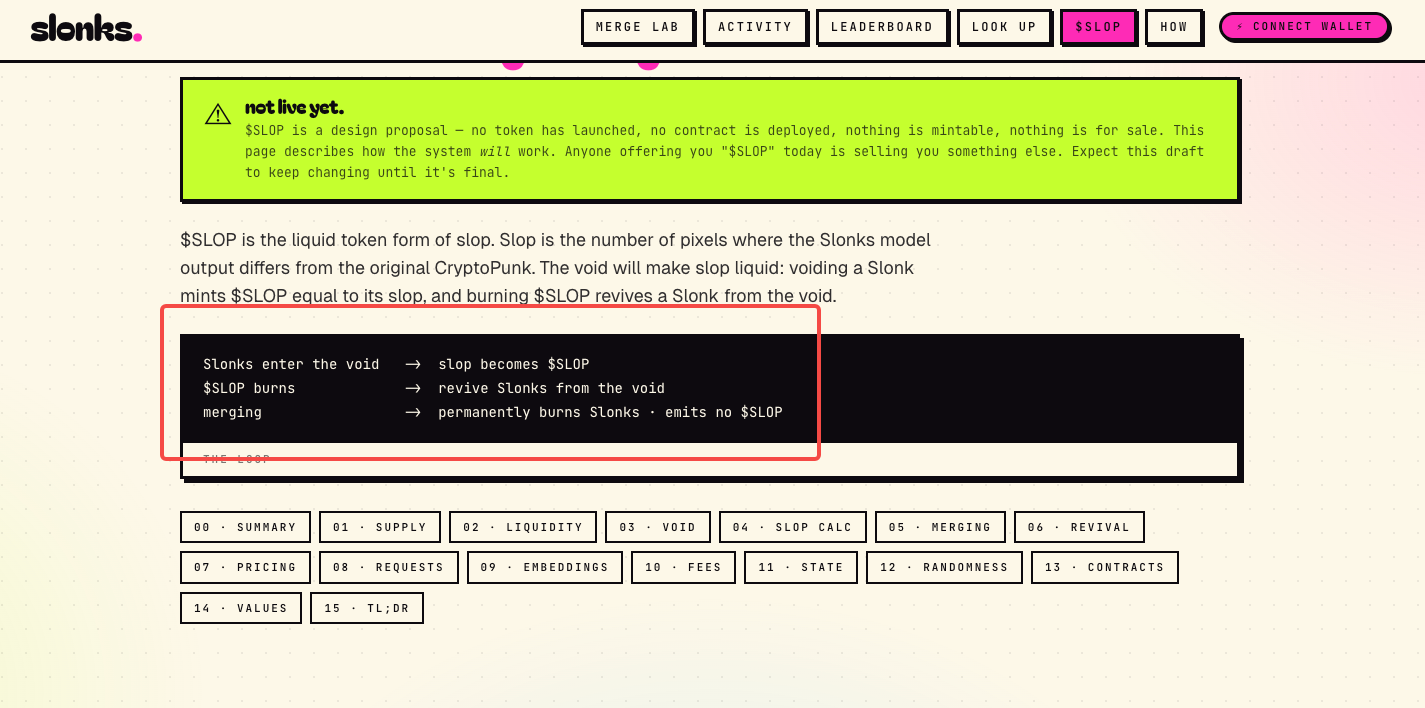
By spending a certain amount of $SLOP, you can randomly pull one Slonk back from the Void. You can't choose which one you get, and upon return, the model redraws the image, likely resulting in a different appearance than before.
Revival uses a Dutch auction pricing: starting at 576 $SLOP, decreasing by 1 with each block, down to a minimum of 100. However, as soon as someone buys, the price instantly resets to 576 and starts decreasing again. Waiting gets you a cheaper price, but you risk someone else snatching it first.
Most revived images will be relatively close to the original CryptoPunk, with low slop. But there's a 1% chance the model "goes completely wild," producing an extreme version with slop exceeding 400. That 1% is the lottery ticket.
By now, you might have spotted that Void and Revival form an "NFT-token swap" economic cycle:
- Buy a Slonk with high slop at a low price, send it into the Void to exchange for tokens.
- Wait for the token price to rise, spend tokens to revive a new image.
- If you're lucky and pull a high-slop image, send it back into the Void for more tokens.
- Images become tokens, tokens become images, back and forth.
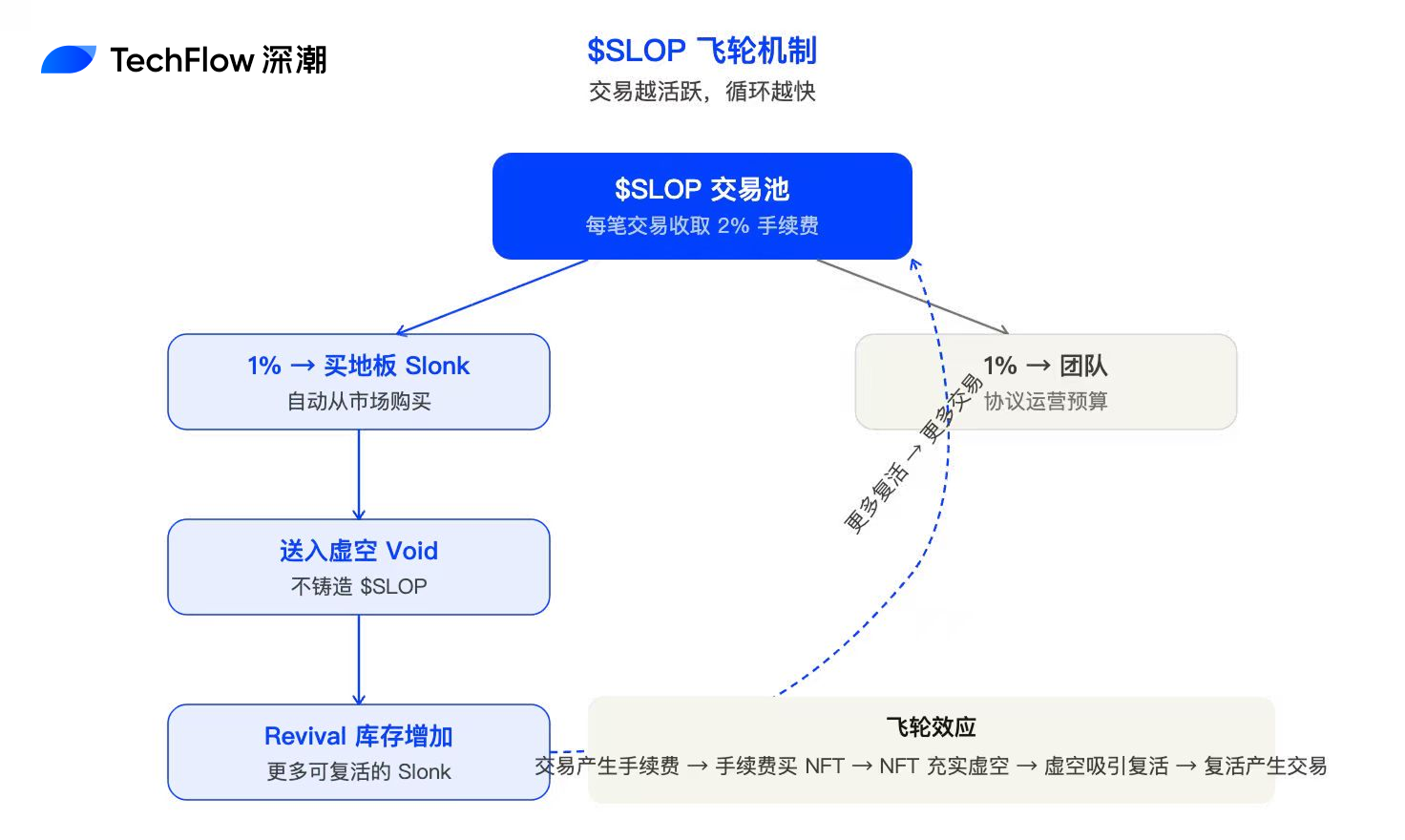
The project also designed an automatic flywheel: the $SLOP trading pool charges a 2% fee. Half of this fee is automatically used to buy floor-priced Slonks from OpenSea, which are then sent into the Void as inventory for future Revivals.
The more active the trading, the larger the Void inventory, and the more items available for Revival draws.
Regarding tonight's token launch, Hirsch revealed the specific process a few hours ago. 576,000 SLOP will be placed into a single-sided liquidity pool, with an initial market cap of around $50,000.
Buyers bring their own ETH to buy. For the first 6 hours post-launch, only token trading is possible; Void is disabled. This 6-hour period is purely for price discovery, allowing the market to set a price for $SLOP first, after which Void opens, truly connecting the conversion channel between NFTs and tokens.
The hard cap for $SLOP is 5,760,000, exactly equal to 10,000 images multiplied by 576 pixels each. However, this number will never be fully minted because images burned through Merge generate no tokens; the slop from those already burned (over 1,000) is locked forever.
In my view, the smartest part of this design is binding "speculation" and "creation" into the same action.
When you Merge two images, you are speculating, because higher slop means potentially more tokens. But at the same time, you are creating, because the model draws a brand new, never-before-seen 24×24 pixel image. Making money and engaging in on-chain art use the same button, and they positively reinforce each other.
Therefore, this gameplay can be seen as a micro-innovative Ponzi economic structure in NFTs regarding creating scarcity, NFT-token swapping, and designing deflation.
Inscription Veteran, Old Tricks in New Wrappers
Not many in the community know about Slonks' creator, Michael Hirsch, but he's not a novice.
Remember ETHS on Ethereum during the inscription craze? The project peaked at a market cap of about $420 million, and Hirsch was its founder.
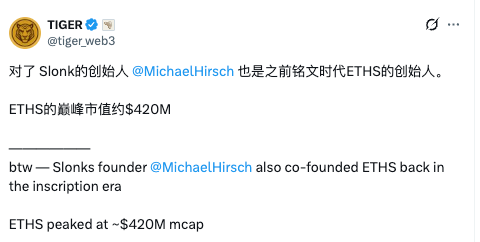
After the inscription sector cooled down, he moved on to build Blockhash, a small studio focused on on-chain products. They've built DEXs, NFT trading platforms, token-gated chat tools, and various things he describes as "weird crypto experiments."
Slonks is this studio's latest work.
Someone who experienced the highs and lows of the inscription cycle choosing to launch a project with a high understanding threshold right now is a noteworthy signal in itself. Is it because on-chain liquidity and market conditions are recovering, leading to micro-innovations and speculative hype?
I think it's worth observing.
As mentioned, $SLOP launches tonight at 9 PM. For the first six hours post-launch, only token trading is allowed; you cannot use Void to swap NFTs for tokens. These six hours are a pure price discovery period with no new supply, where buyers determine the price among themselves.
After six hours, the Void channel opens, initiating the two-way conversion between NFTs and tokens.
An initial market cap of $50,000 means extremely thin liquidity, and early price volatility will be very high. The whitepaper still bears the "v1 · draft" label.
This project has technical ingenuity, a proven founder, and a logically self-consistent economic cycle. However, at its core, it's still a micro-innovation in economic models and manufactured scarcity.
Veterans who have been through several cycles will certainly smirk at this gameplay. But regardless, having something new in the current market climate is, in itself, a good trend.
DYOR.


