






Review of the "American Stock Version of the Chosen One": A Full Breakdown of Leopold Aschenbrenner's Portfolio Logic


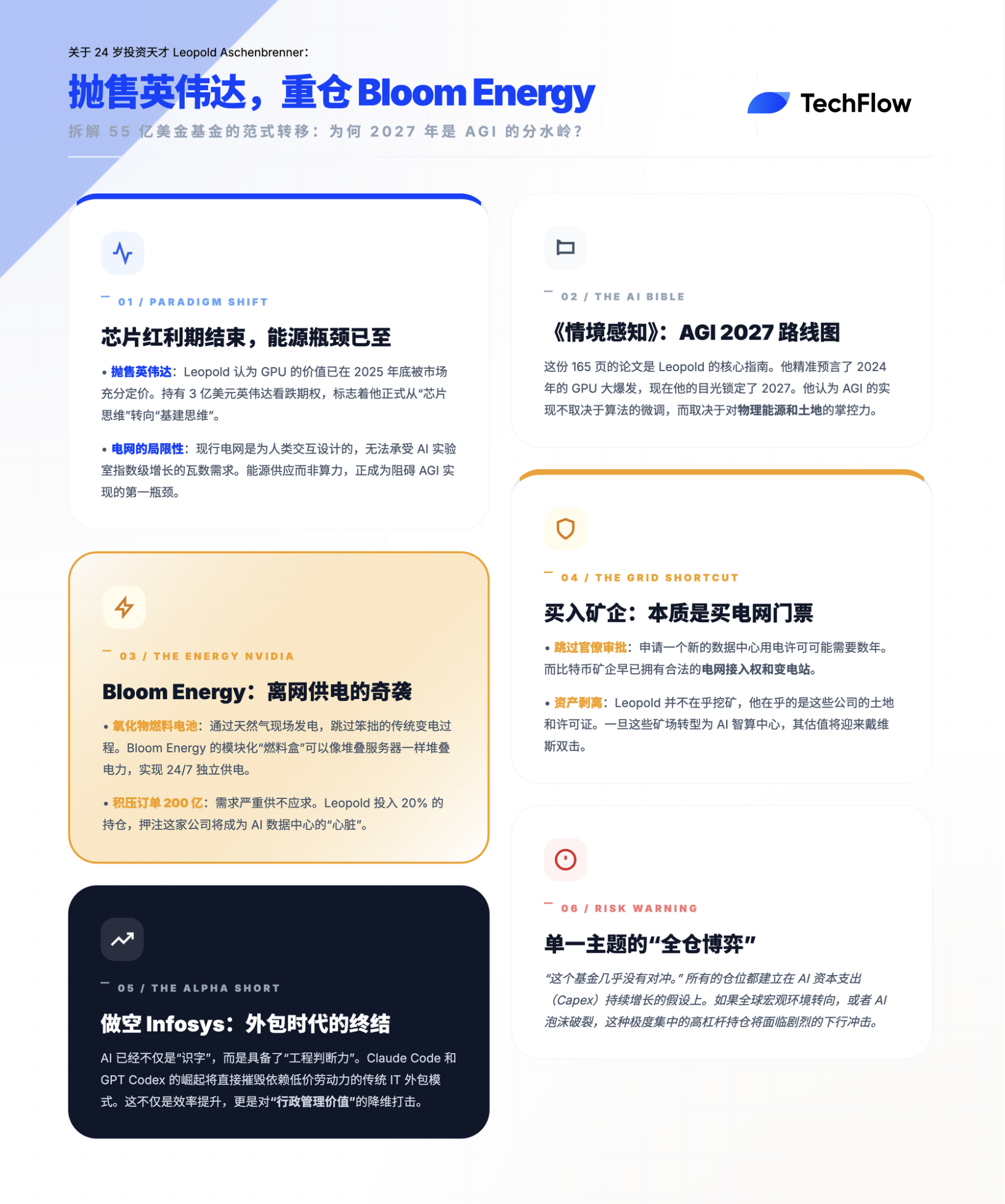
- Core Thesis: The AI hedge fund managed by 24-year-old portfolio manager Leopold Aschenbrenner grew from $1 billion to $5.5 billion in one year. Its core strategy involves anticipating AI development bottlenecks, shifting investments from GPUs to energy and infrastructure, with a primary focus on Bloom Energy and the pivot of Bitcoin mining companies.
- Key Elements:
- Leopold liquidated positions in GPU-related stocks like Nvidia and Broadcom, believing the market has fully priced in their value, and pivoted to investments in the energy and power grid bottlenecks facing AI.
- His largest holding, Bloom Energy, constitutes 20% of the portfolio (approximately $855 million). The company uses solid oxide fuel cells to convert natural gas into electricity, allowing for modular, rapid deployment independent of the existing power grid.
- He made significant investments in Bitcoin mining companies, aiming to acquire their existing land and power grid access permits as a "shortcut" for building AI data centers, avoiding lengthy approval processes.
- Leopold is shorting the IT outsourcing company Infosys, arguing that AI models like Claude Code are now powerful enough to automate the cheap labor services they provide.
- His investment philosophy has shifted from software to the physical world (manufacturing, energy, infrastructure), viewing these areas, which cannot be automated by AI, as the core bottlenecks of the future.
Compiled & Translated by: Odaily

Hosts: Josh Kale; Ejaaz Ahamadeen
Podcast Source: Limitless Podcast
Original Title: Forget NVIDIA | This 24-Year-Old's $4.5B Bet on AI's Real Problem (Leopold Aschenbrenner)
Air Date: March 4, 2026
Key Takeaways
Recently, everyone is talking about Leopold Aschenbrenner – 24 years old, managing a $5.5 billion AI-focused hedge fund, the poster child of the US stock market. However, most discussions stay at the surface level of "he's impressive" and "he's made a lot of money," without truly deconstructing the logic behind his portfolio holdings.
Two months ago, the Limitless Podcast did an episode analyzing his 13F filing line by line: why he exited Nvidia, why he put 20% of his portfolio into a fuel cell company, why he scooped up a bunch of Bitcoin mining stocks, and why he shorted Infosys. At the time, the episode generated almost no discussion. Looking back now, many of his judgments have played out significantly, making it well worth a re-examination.
Highlights of Key Insights
Regarding Leopold Aschenbrenner's Investment Performance
- "Last year he was managing $1 billion... Today, just one year later, that $1 billion has grown to $5.5 billion."
- "His fund was launched at the end of 2024 with an initial size of $255 million. Within just 6 months, his fund outperformed the S&P 500 by 8 times."
- "In his 165-page article titled 'Situational Awareness,' he essentially predicted we would achieve Artificial General Intelligence (AGI) by 2027."
Shift in Investment Paradigm: From Chips to Infrastructure
- "He sold off Nvidia, Broadcom, TSMC, and Micron. These are major AI infrastructure companies."
- "By the end of 2025 or early 2026, he believes the market has largely priced in the value of GPUs."
- "He turned his focus to the major bottleneck investors haven't paid enough attention to yet – energy and infrastructure."
- "The existing power grid was designed for humans, not for the massive AI demand we face today. That's the core focus of his current investments."
Core Holding: Bloom Energy
- "Bloom Energy is currently his largest position, making up 20% of the entire portfolio... He built a massive position in this company worth $855 million."
- "Bloom Energy has developed a device known as a solid oxide fuel cell... It can directly convert natural gas into electricity usable by data centers. It's modular and can be deployed quickly."
- "Their backlog of demand orders is as high as $20 billion. Revenue grew by about 34% in 2025, and they project another 40% revenue increase in 2026."
- "If you use a product like Bloom Energy's natural gas turbine, you don't need to rely on the grid at all. You just install it right next to the AI data center."
Infrastructure and the Bitcoin Mining 'Shortcut'
- "Leopold invested heavily in CoreWeave. He made his biggest leveraged bets in the core GPU infrastructure and energy supply sectors."
- "He invested in many Bitcoin mining companies... The reason is that these companies possess the two key elements needed for building AI infrastructure: land and power."
- "He acquired these companies to get their permits and grid interconnection rights. Normally, obtaining these permits takes months or even years."
- "It's a bit like taking over a bar that already has a liquor license, rather than applying for a new one and waiting for years. It's a very clever 'shortcut'."
Short Thesis and the End of IT Outsourcing
- "He holds a short position in a specific company, which is Infosys... Their business model relies entirely on providing cheaper labor than Western countries."
- "He realized these models are now powerful enough not only to automate simple tasks but also to handle some very significant IT processes. So, he took a massive short position against this company."
Investment Philosophy: A Return to the Physical World
- "Software-only companies will find things very difficult in the future. This shift of his isn't just about building around architecture; it's investing in the physical world – things like manufacturing, factories, energy, and infrastructure."
- "These are areas that can't be built with AI; they are hardware and infrastructure that require manpower, permits, and legislation to realize."
- "Energy is the one resource everyone can't get enough of... It all revolves around one core idea: powering the future."
The Young Investment Prodigy: Leopold Aschenbrenner
Josh Kale:
There's a guy named Leopold Aschenbrenner, who is 24 years old. We covered him last year on a show when he was 23, managing $1 billion focused on emerging frontier AI concepts and technology. Today, just one year later, that $1 billion has grown to $5.5 billion.
This guy, much younger than both of us, just had a generational performance, making more money in AI than any other fund in the world. What's more, AI is the hottest market right now, meaning competition is fierce. So clearly, this guy Leopold is doing something different.
Just last week, his new 13F filing for the latest quarter was released, finally giving us a peek into his recent trades. So, we'll delve into these documents to see exactly what this guy did to take his funds from $1 billion to $5.5 billion.
Insights from the 13F Filing
Ejaaz Ahamadeen:
He accomplished all this in 12 months. His fund was launched at the end of 2024 with an initial size of $255 million. Within just 6 months, his fund outperformed the S&P 500 by 8 times, growing to $2 billion. Since we last discussed his Q3 fund report on the show, his fund has grown by another $1.5 billion. So, he's definitely in a generational breakout phase right now.
He's very young, and he's made a pretty significant shift, but it all aligns with his so-called "bible" – a 165-page article titled 'Situational Awareness.' In this article, he basically predicts that we will achieve AGI by 2027. In this grand article, he details his view on how the AI revolution will unfold. His predictions have been almost exactly correct. He successfully foresaw the GPU infrastructure boom, and now he's pointing to another crucial shift, which we'll dive into next.
The Shift from Chips to Infrastructure
Josh Kale:
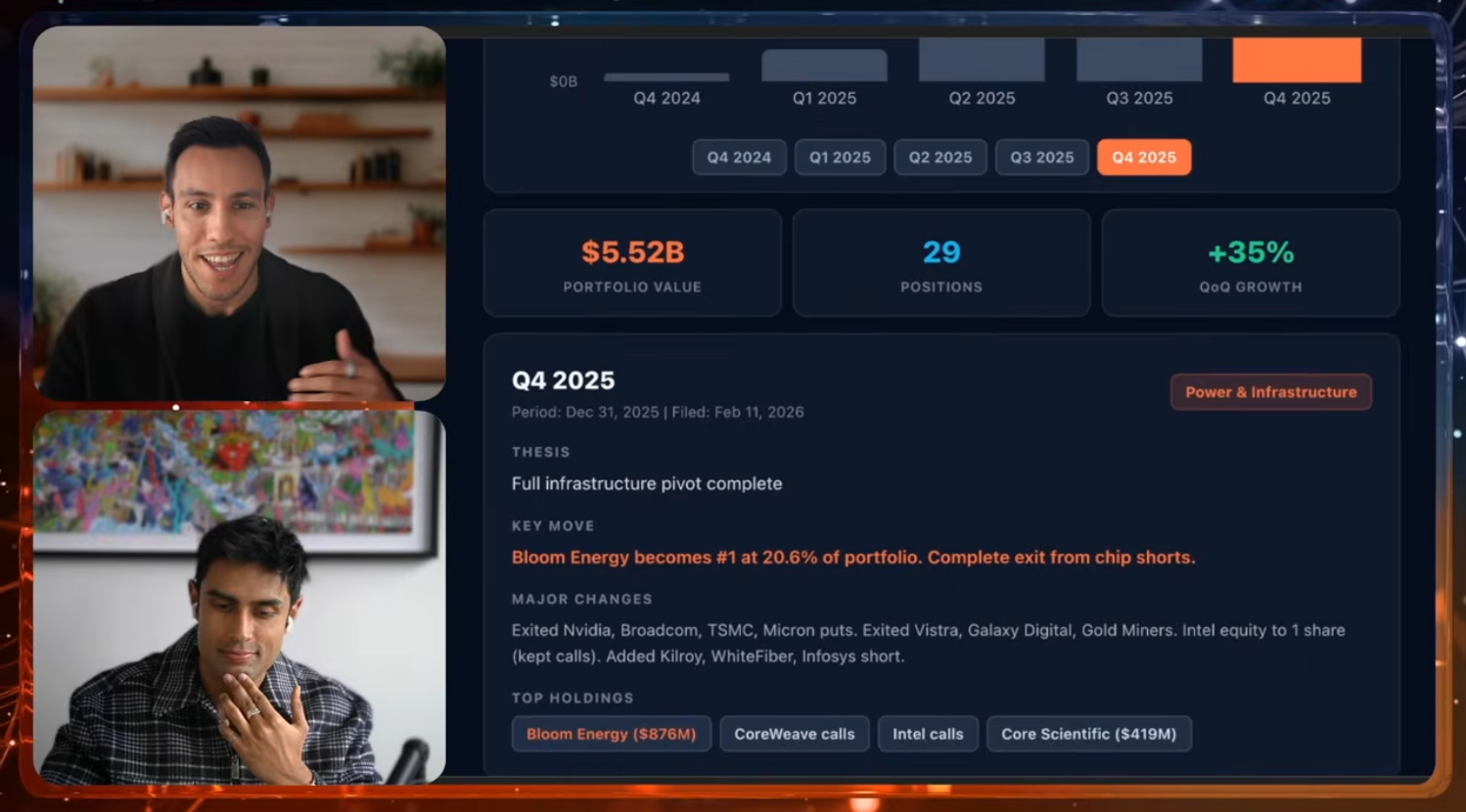
I think the entire investment thesis is shifting from chips to infrastructure. What we're seeing on screen now is really interesting. He used Claude to create a document that guides us through the entire change log from last year to this year. Maybe we can start with the assets he sold, because the positions he exited were quite large. This includes Nvidia, where he sold put options worth $300 million in a single quarter.
Ejaaz Ahamadeen:
You'll see many of the stocks he sold are very popular companies that many people are investing in right now. So the question is, why did he sell $1 billion worth of stock in these companies? He sold Nvidia, Broadcom, TSMC, and Micron. These are major AI infrastructure companies.
He actually made money selling Nvidia stock; he held $300 million in put options, meaning he likely profited from Nvidia's price decline over the past few months. So the question is, why did he do this?
In his 165-page thesis, he mentioned that by the end of 2025 or early 2026, he believes the market has largely priced in the value of GPUs. This value primarily comes from companies like Nvidia and Broadcom that manufacture these chips and stack them together for AI labs like OpenAI and Anthropic to train models.
And now, he's shifting his focus to the major bottleneck investors haven't fully focused on yet: energy and infrastructure. Currently, a major issue for many AI labs is: First, they have too many GPUs; second, the existing power grid was designed for humans, not for the massive AI demand we face today. That's the core focus of his current investments.
Selling Nvidia Put Options
Josh Kale:
Seeing him sell Nvidia puts and completely exit Nvidia is fascinating to me. Because when I chat with friends or regular folks on Wall Street, Nvidia is the company everyone talks about; it's the biggest investment target. Seeing him walk away from Nvidia, I think, proves again that he's always one step ahead, always foreseeing future trends rather than sticking with past hotspots. In his view, the future is about infrastructure, shifting from chips to the informational game.
This is likely where we can delve into his new investments, as these are stocks you should pay attention to. These are assets he currently holds and believes will grow. If his judgment is correct, we should see considerable returns from these. So what new investments did he add this quarter?
Ejaaz Ahamadeen:
Here's a very neat portfolio chart that categorizes all of Leopold Aschenbrenner's investments by AI tech stack layers. We can see the investments are divided into categories like Power Production, Real Estate & Facilities, Compute & Hosting, Connectivity, Storage & Memory, and Chips & Silicon.
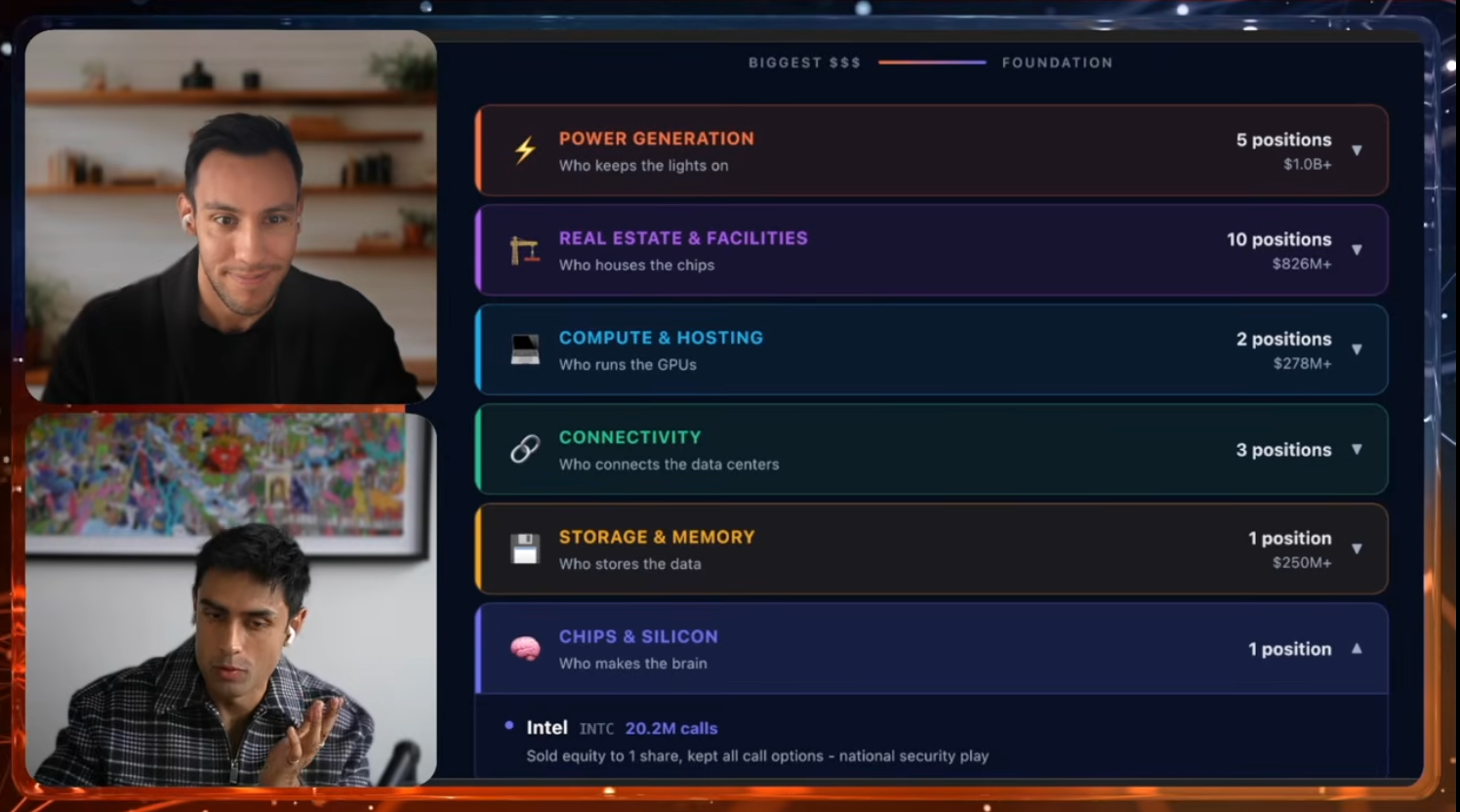
Actually, I want to add something to our previous point. I noticed he made a very clever trade with Intel. He sold off his existing shares, but still holds a huge long position. This freed up liquidity, allowing him to deploy capital into other companies. The main company he poured a massive amount of capital into is in the Power Production sector, a company called Bloom Energy. Almost no one knew about this company about three months ago, but they specialize in manufacturing power generation turbines used for AI data centers.
He built a massive position in this company worth $855 million. Although it shows $876 million here, the filing states $855 million.
Bloom Energy: The Power Innovator
Josh Kale:
Bloom Energy is currently his largest position, making up 20% of the entire portfolio. This is completely unrelated to the chip sector; it's a completely different direction. I looked into their business, and it's indeed interesting.
Bloom Energy has developed a device known as a solid oxide fuel cell, an advanced technology for generating electricity on-site from natural gas. Normally, when natural gas is delivered to a data center, it needs to go through turbines for heating and cooling, which is a clunky energy production process. Bloom Energy's "fuel boxes" can directly convert natural gas into electricity usable by data centers. It's modular, can be deployed quickly, and doesn't seem to face supply shortages. From what I understand, they plan to produce 2 gigawatts of power this year.
This is a very interesting energy play. I've been looking for the "Nvidia of energy" – the "chipmaker" in the energy sector. I haven't found a perfect equivalent yet, but perhaps Bloom Energy could become that company.
Ejaaz Ahamadeen:
I also looked into their latest earnings report, as they are a public company. Their backlog of demand orders is as high as $20 billion. Revenue grew by about 34% in 2025, and they project another 40% revenue increase in 2026. Clearly, their demand outstrips supply.
You mentioned solid oxide fuel cells. Their natural gas turbines are particularly attractive because they don't need to rely on the existing power grid. As I mentioned earlier, the grid is under immense pressure now because humans need energy, and AI data centers also need energy, leading to higher energy prices in areas where AI data centers are located. If you use a product like Bloom Energy's natural gas turbine, you completely don't need to rely on the grid. You just install it right next to the AI data center and get cost-effective power for training or inferencing your GPUs and data centers.
Companies like Broadcom and CoreWeave will all need this kind of energy, especially the hyperscale cloud service providers and AI labs. This reminds me of the game Civilization, have you played it? This situation is like moving your infrastructure and energy production facilities to your own small settlement to drive its development; what's happening here is very similar to that scenario.
Josh Kale:
What's obvious is that there's no shortage of energy demand; the problem is who can produce the most energy. They do have a very large order backlog, but can they produce enough to meet these orders? Manufacturing capacity becomes a key issue here. In many of these investments, we're entering an "atoms" world, where manufacturing truly becomes important. I'd love to delve deeper in the future to see if they actually have the capacity for mass production. But for now, this is undoubtedly a very important investment sector, comprising 20% of his portfolio. So, what other notable positions are in his new portfolio?
Ejaaz Ahamadeen:


