






鲍威尔谢幕不退场,特朗普降息算盘恐落空


- 核心观点:美联储4月30日议息会议以罕见的8比4分裂投票维持利率不变,内部分歧反映了对通胀压力的持续担忧,同时现任主席鲍威尔留任理事以捍卫美联储独立性,打破了新任主席沃什可能受政治压力降息的预期。
- 关键要素:
- 会议以8比4投票维持联邦基金利率在3.5%-3.75%不变,这是自1992年以来反对票最多的一次,显示美联储鹰派立场加深。
- 4张反对票中3张反对声明中的“宽松倾向”措辞,鹰派官员担忧美伊冲突导致油价长期高企,将通胀从“略高”视为“偏高”。
- 鲍威尔宣布任期届满后(5月15日)将继续留任美联储理事,打破传统,以制衡特朗普对美联储的政治施压。
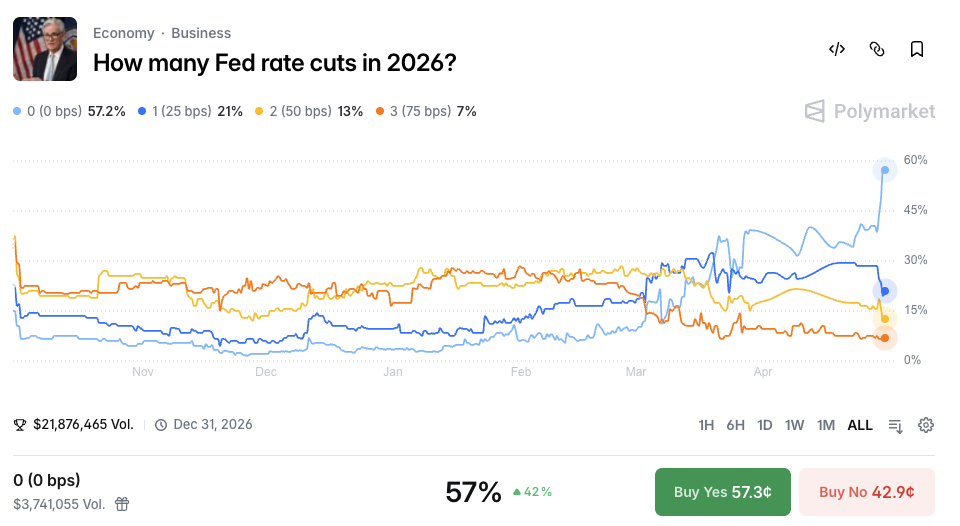
- 预测市场Polymarket显示,“2026年不降息”概率从38%升至57%,表明市场对降息预期进一步降温。
- 特朗普钦点的新主席沃什提名已推进,但鲍威尔留任限制了特朗普在理事会安插亲信,使沃什面临鹰派委员会的阻力。
Original by Odaily (@OdailyChina)
Author: Golem (@web3_golem)
At 2:00 AM Beijing time on April 30, the Federal Open Market Committee announced its latest interest rate decision, keeping the federal funds rate target range unchanged at 3.5%-3.75%. The Fed held rates steady as expected, but what unsettled the market was a rare split vote of 8 to 4 among the 12 voting members, marking the most dissenting votes on a Fed rate decision and policy statement since October 1992.
Meanwhile, in the post-rate decision press conference, current Fed Chair Jerome Powell stated this would be his last press conference as chair. However, he will remain as a Fed governor after his term expires (May 15) for an unspecified period. (Odaily note: Powell's term as a Fed governor runs until January 2028.)
The implications of this FOMC meeting are significant. On one hand, the rare four dissenting votes indicate a deepening hawkish stance within the Fed. On the other hand, Powell breaking the tradition of previous Fed chairs also resigning as governors upon term expiry is a direct challenge to Trump, thwarting his plan to politically pressure the Fed into cutting rates.
The Fed's Hawkish Stance Deepens
According to the FOMC statement, among the four dissenting votes at this meeting, Fed Governor Christopher Waller voted as usual against maintaining rates, favoring a 25-basis-point cut. However, the remaining three dissenting votes—from Cleveland Fed President Beth Hammack, Minneapolis Fed President Neel Kashkari, and Dallas Fed President Lorie Logan—objected to the inclusion of "dovish-leaning" language in the monetary policy statement. In short, they were more explicitly opposing any hint of future rate cuts.
This rare internal split stems from the US-Iran conflict, which has led to a contraction in global oil supply. The sustained surge in crude oil prices could exacerbate the already stubbornly high inflation in the US. Powell acknowledged in the press conference that there were "vigorous debates" within the committee, noting that "the number of officials supporting a shift to a neutral bias has increased, and perhaps the next meeting will consider changing the current dovish bias." He also emphasized that the market is overreacting to the dissenting votes, and that opposing the dovish language does not mean officials favor a rate hike. "People aren't saying we need to raise rates now; it's more of a discussion about whether the Fed should be neutral on the policy outlook," he said.
However, the market generally believes that this public display of internal division signals a deepening of the Fed's hawkish stance. In the past, the Fed tended to view price increases triggered by geopolitical events as "temporary shocks." For example, in 2025, when Trump's tariff policies impacted goods trade and led to price increases, the Fed judged it as a "one-time price level adjustment," which ultimately did not prevent rate cuts.
Now, the Fed's attitude towards oil price increases caused by the US-Iran conflict is shifting. The US-Iran conflict has been ongoing for about two months, but with no substantial progress in peace negotiations and the Strait of Hormuz remaining under restrictions, crude oil prices remain elevated. In this context, more officials within the Fed now believe that high oil prices have transitioned from a short-term impact to a persistent long-term pressure, prompting a more cautious policy stance.
In this FOMC statement, the Fed also upgraded its description of inflation from "somewhat elevated" to "elevated," indicating growing concern among officials about the potential pass-through effects of oil prices and the overall price level. While these statements and stances may not yet lead to a rate hike at the next FOMC meeting, they signal to the market that the difficulty of cutting rates has increased. According to monitoring by the Odaily Seer Channel, the probability on Polymarket that "the Fed will not cut rates in 2026" rose from 38% to 57%, an increase of 19%.
However, some argue that the 4-8 split vote at this FOMC meeting may have been intentional. The aim could be to send a warning to the incoming Fed Chair, Kevin Warsh, that the Fed's independence must be maintained. The message is: do not blindly follow Trump's orders to cut rates, or we will vote against it.
Trump's Political Pressure for Rate Cuts Falls Flat
Just hours before this deeply divided FOMC meeting, the Senate Banking Committee advanced Kevin Warsh's nomination for Fed Chair. Last Sunday, after the Justice Department concluded its investigation into Powell, Senator Thom Tillis also shifted his support to Warsh. The Senate Banking Committee ultimately voted 13-11 along party lines to send Warsh's nomination to the full Senate.
With the key obstacle of Republican Senator Thom Tillis now removed, Warsh is highly likely to be confirmed by the Senate before Powell's term expires. The official 2026 Senate calendar shows a recess from May 4 to May 8. Therefore, the earliest window for a full Senate vote is the week of May 11, after the recess. Under a Republican-controlled Senate, as long as a vote is scheduled, Warsh's confirmation could be completed between May 11 and May 15.
Although even after confirmation, Warsh would still need to be formally appointed by the president (Odaily note: Warsh is not currently a Fed governor; he would first need to take Waller's board seat) and be sworn in before officially taking charge of the Fed, he would still be in time to chair the June FOMC meeting, rather than Powell serving as interim chair. (Odaily note: In 2018, Powell was sworn in 13 days after confirmation, and his second term as chair took 11 days from Senate confirmation to being sworn in.)
Thus, Trump was pleased to reiterate today that it is a good time to lower interest rates, as his handpicked new Fed chair is about to take the helm just before the next FOMC meeting. Warsh has also made several dovish statements in the past. However, unbeknownst to Trump, even as an outgoing Fed chair, the deeply responsible Powell found ways to foil his plans.
In the FOMC press conference, Powell stated he would not become a "shadow chair" and will give Warsh ample room to govern. Powell's reason for remaining as a Fed governor is to defend the Fed's independence. He stated, "The events of the past three months (Trump's legal actions against Powell) leave me no choice but to stay on."
Powell had previously believed that Trump's investigation into the cost of the Fed building renovation was a political ploy to pressure him into cutting rates, but Powell did not let Trump succeed. Now, with Warsh, a Trump appointee and personal acquaintance, set to become the new chair, Powell fears Warsh might ignore objective economic data and follow Trump's orders to cut rates. Therefore, Powell's remaining on the board is aimed at preventing Trump from gaining full control of the Fed.
Powell's retention indeed limits Trump's ability to pack the Board of Governors with his loyalists from a personnel perspective. With Warsh's impending appointment, three of the seven Fed governors will be Trump nominees (the other two being Michelle Bowman and Christopher Waller). If Powell had resigned from the board upon stepping down as chair, Trump would have had another opportunity to appoint a governor, giving him four personally appointed members on the seven-person board.
Given that the Fed as a whole has already shown a hawkish stance (coincidentally, the three FOMC members who opposed the dovish language are all regional Fed presidents, not governors), even the dovish Warsh will face a policy committee highly resistant to rate cuts upon taking office.
Therefore, Trump's sustained political pressure on Powell and the Fed has so far been not only ineffective but has also strengthened the Fed's resolve to resist. Given the current situation, Trump's best course of action may be to quickly end the US-Iran conflict or reopen the Strait of Hormuz to lower crude oil prices, thereby providing a rationale for Warsh to convince other Fed officials to support rate cuts.


