






华尔街最难进的公司:年赚400亿的Jane Street,面试题有多变态?


- 核心观点:量化交易公司 Jane Street 凭借其极致的面试筛选机制和独特的交易文化,吸引并选拔具备“原始天赋”的交易员。2025年其营业收入高达396亿美元,超越华尔街传统巨头,证明了其人才策略和盈利能力的卓越性。
- 关键要素:
- 业绩突出:Jane Street 以3500名员工创下年度营收396亿美元,利润率达65-70%,人均利润约800-900万美元,为全球千人以上公司之首,超过摩根大通、高盛及英伟达等巨头。
- 面试难度S+级:面试以极高难度和高淘汰率著称,常被形容为“无法准备”,面试形式包括口述棋局、概率谜题及长达6小时的持续压力测试,与顶级AI实验室并列。
- 筛选标准:Jane Street 招聘看重“原始天赋”而非现有知识,倾向于有在不确定性下承担经济后果并做出决策经历的人,如扑克玩家或体育博彩赢家,而非单纯数学解题家。
- 交易文化:公司极度强调口头思考和即时决策,要求候选人“思考出声音”(think out loud),厌恶沉默思考。拒绝下注或慌乱接受不利报价等行为是面试大忌。
- 行业影响:多名加密圈知名人物(如 SBF、Caroline Ellison)曾在此受训或面试,其特有的市场思维框架深刻影响了后续加密交易策略的构建,间接塑造了行业格局。
This week on Wall Street, the most discussed topic is Jane Street.
With 3,500 employees, no banking license, no advisory fees, and no investment banking business. Solely through trading, it achieved full-year revenue of $39.6 billion in 2025. Surpassing JPMorgan. Surpassing Goldman Sachs. Surpassing any institution in Wall Street history.
With a profit margin of 65-70%, the company's profit per employee is approximately $8 million to $9 million. Among all companies with over 1,000 employees, it ranks first globally. For comparison, neighboring Citadel Securities has 1,800 employees and a per capita profit of $3.6 million; Hudson River Trading is at $6.6 million; even Nvidia, a company the world is clamoring to give money, has a per capita profit of only $2.9 million.
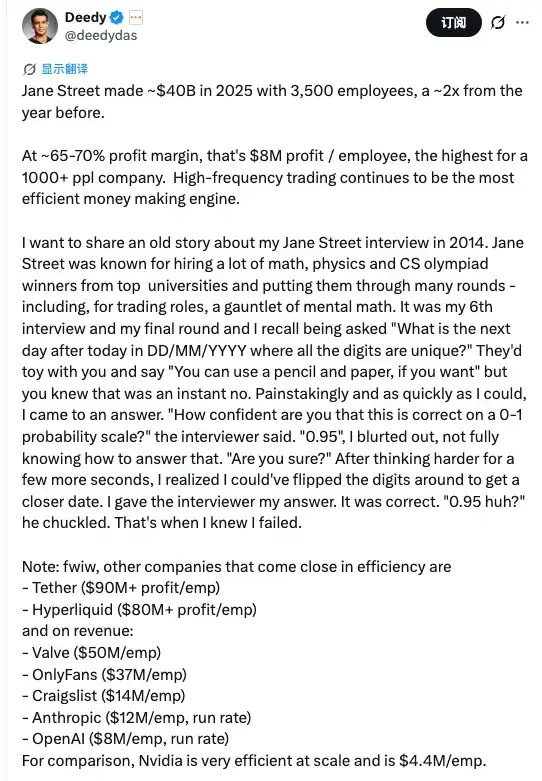
So this week, every finance professional on Twitter is discussing the same thing: How did Jane Street hire these people?
The Hardest Company to Get Into on Wall Street
The name Jane Street is no stranger to the crypto world.
FTX founder SBF's first job in the industry was as an intern at Jane Street. SBF's ex-girlfriend, Caroline Ellison, the CEO who later left a mess at Alameda, also started there. In Michael Lewis's book, SBF repeatedly mentioned that the market thinking framework he learned at Jane Street almost entirely determined his trading intuition when he later built FTX and Alameda.
Many crypto fund founders and project builders, before transitioning to crypto, have had some intersection with Jane Street on their resumes, but most people have "interviewed," not "received an offer."
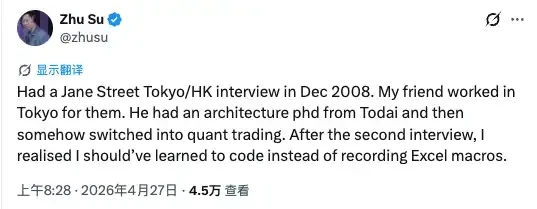
Three Arrows Capital founder Zhu Su also tweeted a memory: "Interviewed with Jane Street in Tokyo and Hong Kong in December 2008. My friend was at their Tokyo office at the time, a PhD in architecture from the University of Tokyo who switched to quantitative trading. After the second round, I realized one thing: I should learn to code, not mess around with Excel."
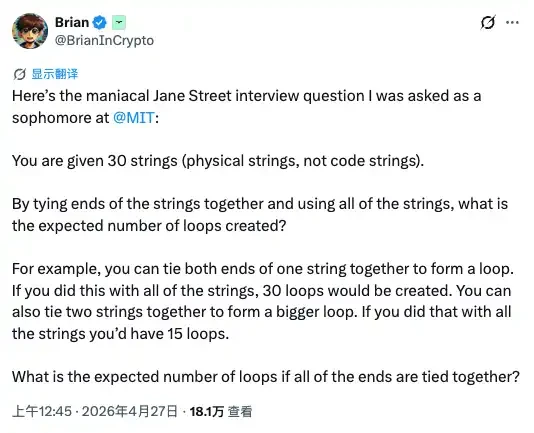
The Head of Growth at the Monad Foundation retweeted a question he was asked during his sophomore year at MIT, saying "I still remember how crazy that interview was." Brian, co-founder of Glider Finance, also joined the discussion about the same classic Jane Street cipher lock question.
Many seasoned players in the crypto circle have crossed paths with this company at some point.
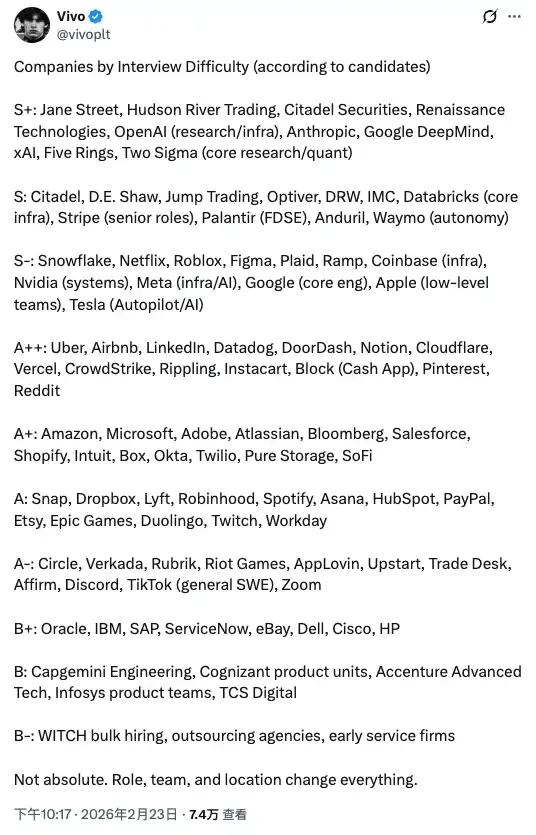
And Jane Street's interview difficulty is among the toughest on Wall Street. According to Twitter user @vivoplt's ranking of candidate interview difficulty, Jane Street is the top S+ difficulty tier, alongside top AI labs.
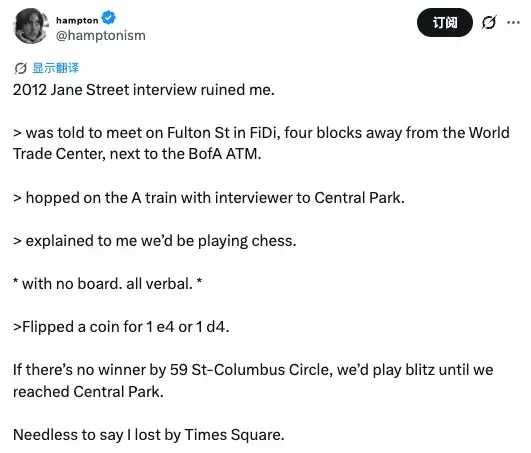
A Twitter user named Hampton shared a memory of his 2012 interview. It reads like a dark comedy: They met at Fulton Street in the Financial District, near an ATM of a Bank of America next to the World Trade Center. Then the interviewer took him onto the A train towards Central Park. They played chess on the subway, but without a board, purely verbally. A coin toss decided the opening: 1.e4 or 1.d4. If no winner was determined by Columbus Circle at 59th Street, they switched to blitz chess until Central Park. Hampton said he lost at Times Square.
Another investor named Alex Song recalled his 2010 Jane Street interview: "The worst interview of my life. For an hour, the guy explained the rules of some card game and gave me an hour to find the dominant winning strategy. It was definitely not Putnam math competition stuff, but worse than D.E. Shaw, QVT, and DRW."
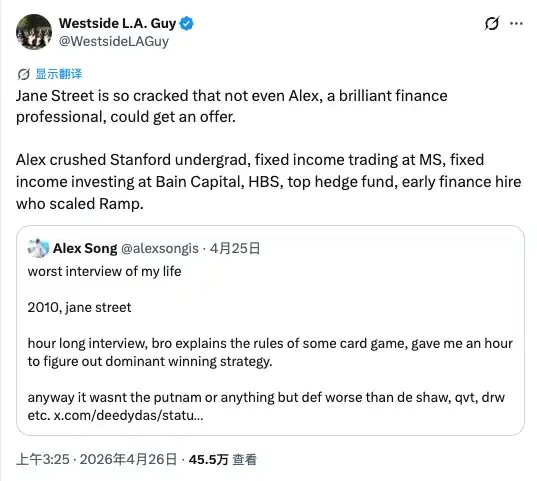
Another Twitter user retweeting this added: This Alex later had a resume including a Stanford undergraduate degree, fixed income trading at Morgan Stanley, fixed income investments at Bain Capital, an MBA from Harvard, work at a top hedge fund, and being Ramp's early Head of Finance. Jane Street didn't hire him.
One interviewee said, "This is still the toughest interview process in investment banking. Other companies you can prepare for; Jane Street you really cannot prepare for." Some netizens even joked, "If Oppenheimer were alive today, I bet he still wouldn't pass Jane Street's third round interview."
Tricky Interview Questions
Just hearing the stories isn't enough. Below are some questions repeatedly discussed on Twitter. The BlockBeats editor picked a few of varying difficulty. Readers can try them out and see how many they can solve.
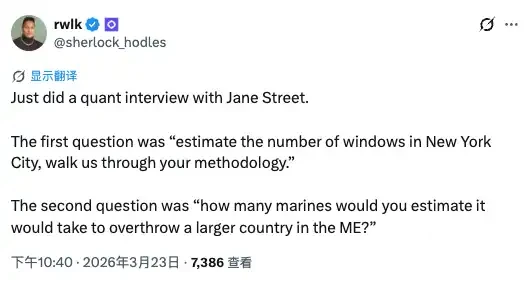
Question 1: "Estimate how many windows are in New York City? Explain your methodology."
Question 2: "How many Marines do you think it would take to overthrow a major country in the Middle East?"
Question 3: "A safe has a six-digit code. The lock will tell us if we have correctly entered four or more digits, but it only opens when all six are correct. What is the optimal strategy to find the code in the fewest number of attempts?"
Question 4: "You have 30 literal ropes. You randomly tie together all 60 ends in pairs. What is the expected number of loops formed? Example: tying the two ends of one rope = 1 loop; doing this for all 30 = 30 loops. Tying the ends of two ropes together = 1 large loop; doing this for all 30 in pairs = 15 loops."
Question 5: "What is the next date after today where all digits are unique? Format DD/MM/YYYY. How confident are you?"
Question 6: "What integer is closest to the square root of 1420?"
Question 7: "I have a relative who is a professional baseball player. What is the probability that this statement is true?"
Question 8: "What is the smallest positive integer composed only of the digits 1 and 0 that is divisible by 15?"
Question 9: "What is the angle between the hour hand and the minute hand of a clock at 3:15 PM?"
Question 10: "You have a chance to bid on a treasure chest. The true value of the chest is some number between $0 and $1000, and you are 100% confident it is within this range. If your bid equals or exceeds the chest's true value, you get the chest at your bid price; if lower, you get nothing. You also have a friend who will buy the chest from you for 1.5 times its true value. What should you bid?"
Question 11: "I will roll a 20-sided die (numbers 1 to 20) once. How much would you pay to play a game where you receive the number on the die in dollars? Now change the rule: each round you can either 'take the current number' or 'roll again.' A total of 100 rounds. What is your optimal strategy? What is this game worth?"
Question 12: "100 statements are written on a blackboard. The 1st says 'At most 0 of these 100 statements are true.' The 2nd says 'At most 1 of these 100 statements is true.' ... The nth statement says 'At most n−1 of these 100 statements are true.' The 100th statement says 'At most 99 of these 100 statements are true.' How many of these 100 statements are actually true?"
Question 13: "I flip 4 coins. What is the expected number of heads? Now you get one chance to re-flip all 4 coins (you must accept the new result). What is the expected value then?"
Question 14: "Two perfectly equal teams play a best-of-seven series. What is the probability that the series goes to Game 7?"
Question 15: "Suppose you and your roommate throw a party and invite 10 other pairs of roommates. During the party, you ask everyone except yourself: 'How many hands did you shake?' It is known that no one shook hands with their own roommate; everyone gives you a different answer. How many times did your roommate shake hands?"
Question 16: "100 prisoners are in 100 separate cells. There is a room with a single light bulb that can be turned on or off. Only one prisoner is allowed in the room at a time. Prisoners are called into the room randomly, with no control over the order or frequency. Any prisoner can announce at any time: 'All 100 of us have been in this room.' If correct, everyone is freed; if wrong, everyone is executed. Prisoners can devise a strategy before the game starts but cannot communicate afterward. What is the optimal strategy?"
Question 17: "Suppose I have 10 coins. One is a fair coin (50% heads, 50% tails), and the other 9 are biased, each to an unknown degree. With a limited number of flips, how do you identify the fair coin?"
Question 18: "1000 ninjas stand in a circle, each with a knife. No. 1 kills No. 2, No. 3 kills No. 4, No. 5 kills No. 6, and so on, continuing around the circle until only one person remains. What number is that person?"
If you survive all the previous phone interviews, the final stage is called Super Day. Upon entering, staff will hand you 100 poker chips. Then come 4 to 6 consecutive technical rounds, each one hour long, all pitting you against active traders. In each round, you use these chips to bet or make markets. When SBF entered Super Day, he was told: "No one who has ever lost all their chips has ever received an offer."
Who Does Jane Street Want?
Augustin Lebron, a former Jane Street trader who worked in the London office for many years and managed the intern program that included SBF, wrote a book titled "The Laws of Trading" after leaving Jane Street. In an interview, he said something very candid: "Globally, there might only be one to two thousand new people a year who can get into truly good quantitative trading companies."
"I've talked to many students. If you ask them why they want to do this, they'll say math is interesting, AI is interesting, statistics are interesting. But these skills can be used in many other places, so that reason alone doesn't really hold up." Augustin Lebron believes the real answers are usually two: first, it's a high-status thing; second, they actually want to get rich.
So what kind of people does Jane Street actually hire?
In the interview, Augustin Lebron explicitly stated that these organizations look for raw talent, not existing knowledge. That is, their past has pre-trained them for this job. People who have played poker, engaged in sports betting, and actually made money doing it. People who have had life experiences of "making decisions under uncertainty and bearing the economic consequences for those decisions."
Another very typical type is those who wash out quickly, even if they are extremely smart, very good at math, and very good at solving problems. They simply don't like trading. They care more about solving that math problem than making money. "In trading, you ultimately have to make money."
Some former Jane Streeters have also summarized a few common reasons candidates fail: overconfidence; thinking silently (Jane Street heavily emphasizes thinking out loud; silent thinking is a big no-no); refusing to bet (if you are given a market-making opportunity and refuse, it says "you are unwilling to take risks"); and when you are in a bad position, the interviewer will deliberately give you terrible prices, and if you accept in panic, you prove you shouldn't be hired. Ignoring hidden information in the question, etc.
And these might be significant reasons why Jane Street earns $40 billion a year.


