






China’s Top Scalper: A Trump Meet-and-Greet Ticket for $8,000


- Core Thesis: The Trump memecoin $TRUMP has commoditized "meeting with the president" through on-chain point rankings, spawning a complete industrial chain of quantitative funds, scalpers, and agents. Participants purchase entry tickets at $8,000, rather than investing in the token itself.
- Key Elements:
- TRUMP token point rankings are calculated based on holding duration and quantity, only counting on-chain and Robinhood holdings. This allows quant teams to lock in price risk for arbitrage; the Bigsong team secured 40 slots through lending and hedging.
- Entry tickets were priced at $8,000 and sold through super agents and a multi-tier distribution network. Buyers included international students and entrepreneurs, ultimately selling all 40 tickets.
- The event was essentially a crypto and business summit, with attendees including Cathie Wood, Mike Tyson, and others. Trump delivered a 45-minute speech but did not mention $TRUMP at all.
- For the 2026 event, the total holdings of 297 holders were approximately $29 million, an 84% decline from $148 million in 2025. The median holding dropped from $3.28 million to $539,000.
- According to Forbes estimates, as of April 2026, $TRUMP token trading fees generated nearly $400 million for Trump-affiliated entities, with the token price down 96% from its peak.
- After the event, $TRUMP fell 14% to $2.56, and some buyers have already started pre-ordering slots for the next event, indicating a repeat purchase trend in the industrial chain.
Original Author: Kaori
Original Editor: Sleepy.md
$8,000.
If you wanted to be at the Trump Mar-a-Lago gala last weekend, all it took was $8,000.
In January 2025, Trump launched a meme coin named after himself. Five months later, he announced that the top 220 holders could attend a dinner at his golf club. The coin transformed from a speculative on-chain asset into a ticket to meet the President of the United States.
In March 2026, the TRUMP coin dropped below $3, down 96% from its all-time high. But Trump's team announced a second gathering for holders. It was set for April 25th, with 297 spots available.
Bigsong, a crypto fund manager, saw the business opportunity behind this banquet.
The Apex of Scalping
Bigsong has three partners and runs a crypto fund, Saucerful Labs, which typically engages in cyclical trading, DeFi yield generation, and quantitative arbitrage. When the TRUMP coin dinner was announced, his first instinct was to short the coin. The price rallied 50% before retreating, and the short positions became profitable.
But while looking for a reason to close his short position, bigsong recalled an old story.
Last year, one of his partners, Luolan, tried to compete for a spot in the 2025 dinner. After qualifying, he sold the entry right to someone else for $30,000. He shared this experience with the team, highlighting it as a great arbitrage opportunity between different circles.
"People think it's incredibly hard to be in the top 297 for Trump Coin," bigsong said. "But actually, it's not."
Trump's gala team is operated by his long-time business partner, Bill Zanker. The top 297 on-chain addresses by holding score would earn entry to the Mar-a-Lago banquet. The ranking wasn't based on the number of coins held, but on a point system. Each coin generated one point per hour; the earlier and more coins you deposited, the higher your score.
Points were only calculated for coins held in on-chain addresses and Robinhood accounts; coins on other exchanges didn't count. This meant the number of addresses genuinely competing for the ranking was far less than the total TRUMP coin holders. Plus, since points were a function of time, the earlier you entered, the greater your advantage.
After their estimation, bigsong's team immediately held a project kickoff meeting. Their strategy was to borrow a portion of TRUMP coins from lending platforms and hedge the rest through derivatives to lock in price risk. This way, they didn't actually bear the risk of coin price fluctuations, only paying borrowing interest and hedging costs.
They used AI to write programs to monitor coin price volatility and loan health factors to prevent liquidation. They wrote scripts to monitor abnormal withdrawals from each wallet, analyzed all competitors' addresses, holdings, and estimated points on-chain, and built a real-time ranking dashboard. They even scanned social media every 24 hours to aggregate community discussions, media reports, and new information from official Twitter posts.
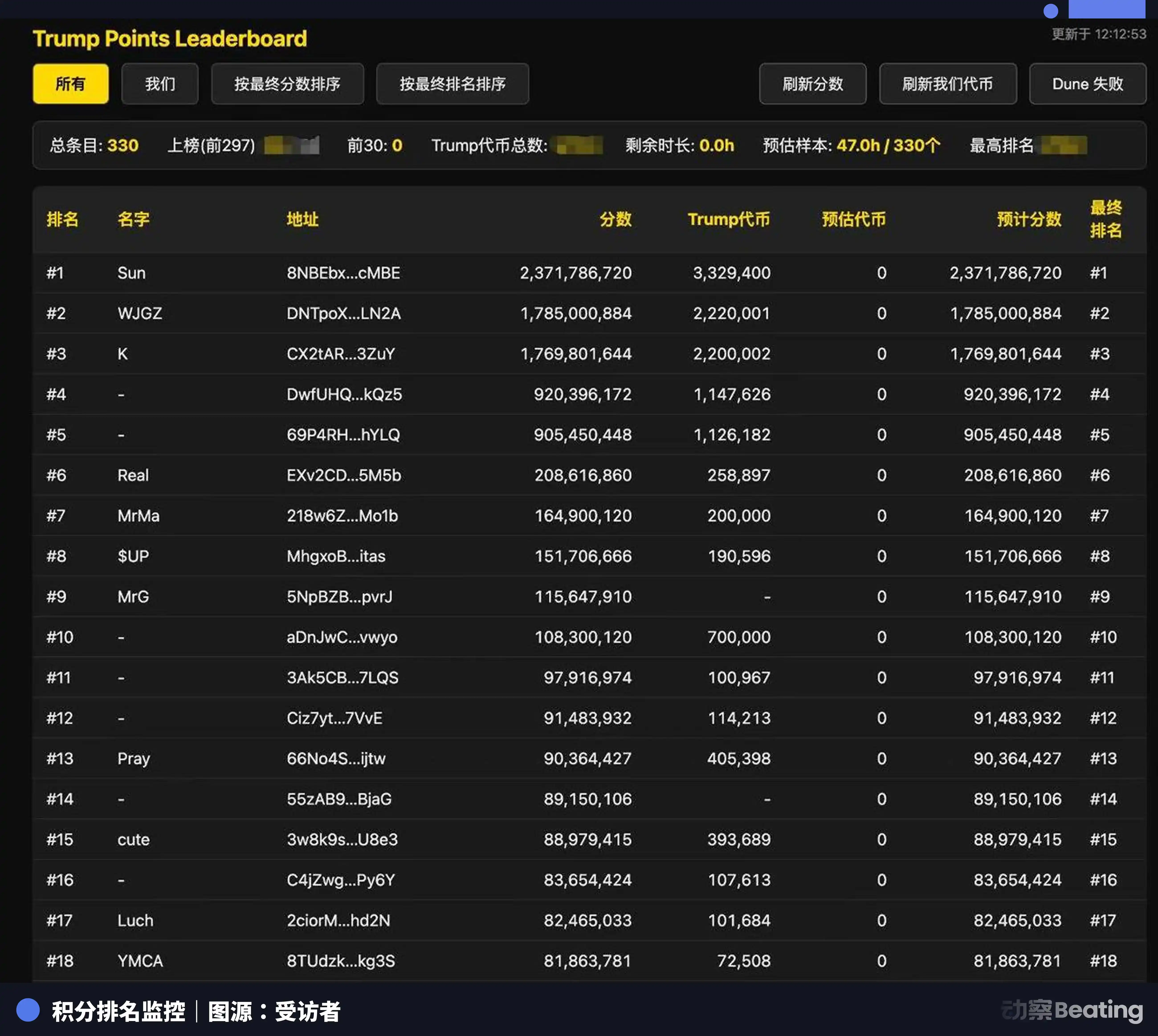
During this period, the $TRUMP team delayed the point settlement date by four days, meaning more capital would flow into the points system. Some of bigsong's clients even started competing for points themselves to secure an entry spot due to this rule change.
This wasn't an isolated case. Crypto investor Christensen bought tokens on an exchange while shorting $TRUMP to hedge his risk, spending only $500 on the entire operation.
It was a precision production line, the product being a meeting with the US President. Ultimately, of the 297 spots, bigsong's team secured 40.
They priced the entry tickets at $8,000.
If the production phase resembled an on-chain war among quant funds, the sales phase felt like a WeChat business convention.
Bigsong divided the sales process into two stages. In the first stage, he recruited super agents with social distribution capabilities, providing them with scripts, promotional images, and even dedicated web pages. In the second stage, about five days before the registration deadline, he started promoting within the crypto circle.
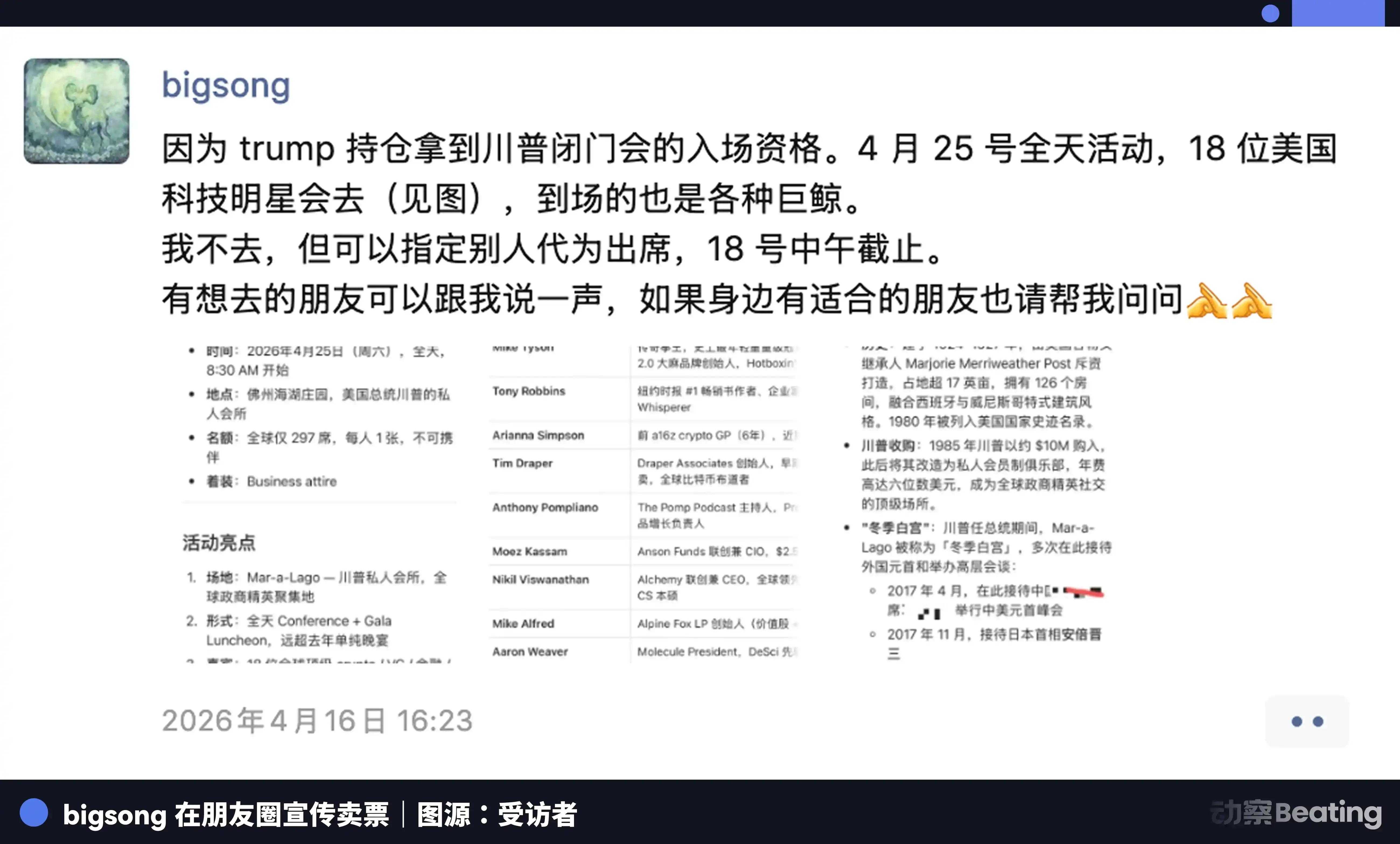
All 40 tickets were sold. Buyers included an international student studying in the US, socialites from Hong Kong and Taiwan, young entrepreneurs, and families who brought their elders along.
One person had been to Mar-a-Lago four months prior, taking photos outside and posting on social media with the caption, "Who can take me inside to see?" Four months later, he found bigsong through three layers of intermediaries.
"I really like my buyers," bigsong said. "They are mostly motivated people. I helped them fulfill their wishes using my own abilities. If I'm not the top scalper in China, I don't know who is. I'm selling the right to meet the President."
Selling the tickets didn't mean the business was over. Every buyer had to pass security checks conducted by the Secret Service and a third-party security company commissioned by Trump's team. This involved a tripartite collaboration: the TRUMP coin team verified holding qualifications, the third-party security firm conducted background checks, and Mar-a-Lago hosted the event.
Bigsong's team had to manage the review process for each client individually. This customer service phase consumed a significant amount of the team's energy, with paperwork comparable to applying for top-tier universities for 40 students simultaneously. Once the check passed, they quickly informed the client. If it didn't, they started gathering supplementary materials and communicated back and forth.
Some people paid and then suddenly decided not to go, initiating a refund process. But the intermediary fees had already been distributed to sub-agents and couldn't be recovered. Others bought tickets through secondary or tertiary dealers, making refund disputes incredibly complex within the multi-layered distribution network.
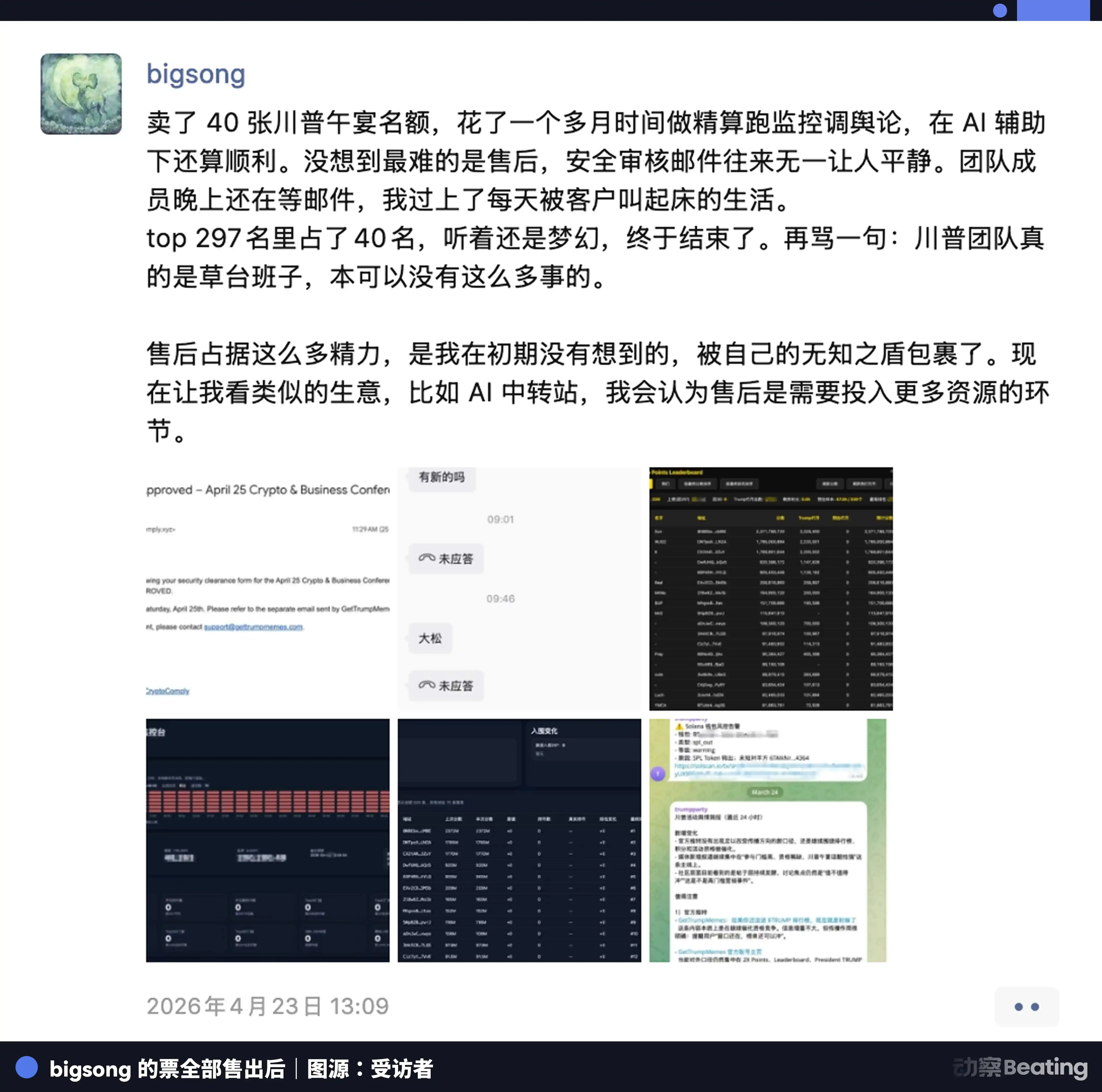
"We completely underestimated the difficulty of after-sales service," bigsong said. He is a quantitative trader, used to dealing with numbers. But this business dragged him into a traditional commercial world with upstream, midstream, and downstream, customer service, and dispute resolution.
However, from the official perspective, bigsong didn't exist. His 40 clients appeared on the review list as 40 unrelated individuals.
The Most Exclusive Business Conference
On Saturday, April 25, 2026, 297 top TRUMP coin holders – or at least those identified by the points ranking system – gathered at Trump's Mar-a-Lago estate in Palm Beach, Florida.
The event was packaged as a full-day crypto and business summit. The organizer, Fight Fight Fight LLC, printed a line on the promotional page: "The world's most exclusive crypto and business conference."
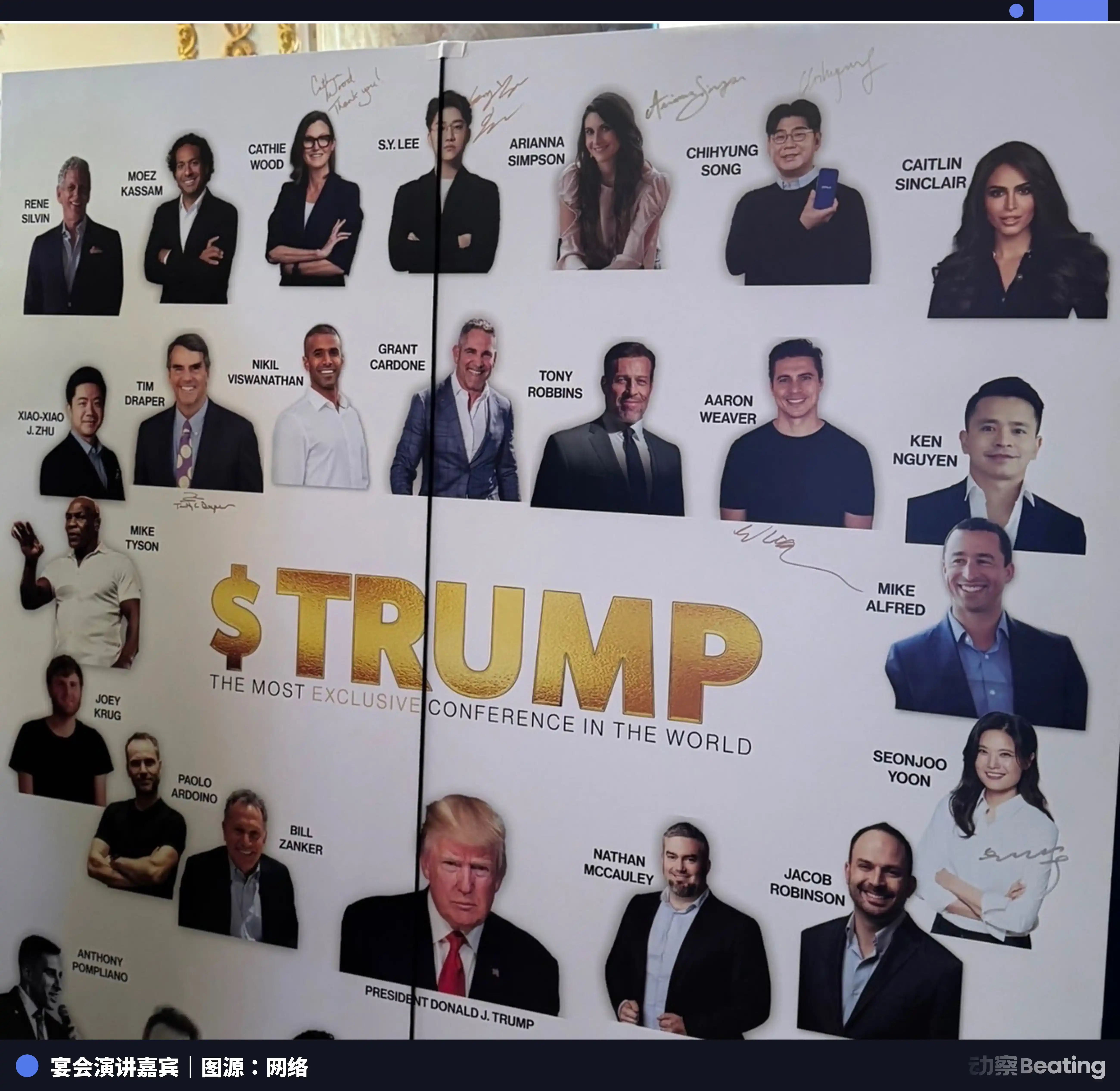
Cathie Wood was on-site interacting with attendees all afternoon. Boxer Mike Tyson delivered a keynote speech, followed closely by bestselling author Tony Robbins.
Paolo Ardoino, the CEO of stablecoin giant Tether, who has rarely made public appearances for years, was on the Mar-a-Lago lawn shaking hands and chatting with coin holders. Also present were venture capital godfather Tim Draper, Arianna Simpson from a16z, Song Chi-hyung, founder of Upbit, and Nathan McCauley, CEO of Anchorage Digital. The power structure of the crypto world was transported wholesale into this Palm Beach private estate.
Trump delivered a 45-minute keynote speech at the event. Just minutes before his speech, he had canceled the trip of the US negotiation team to Pakistan for Iran peace talks.
He talked about crypto going mainstream, that banks should not obstruct the legislative process for stablecoins, artificial intelligence, the Iran war, and even Trump brand sneakers.
Throughout the entire speech, he didn't mention his meme coin once.
One attendee, Turbo, a student studying in the US who does crypto investing for IOSG Ventures, said the person who impressed him most wasn't the President, but Tony Robbins.
Robbins walked off the stage, weaving between small round tables, eventually coming within half a meter of Turbo. He talked about AI, Crypto, and robots. When discussing Crypto, Turbo felt Robbins wasn't an expert, but his knowledge was deeper than the average person in every field, yet shallower than a professional. This position happens to be the most influential for communication.
"After many big company CEOs stop doing frontline research, they sit down and listen to Robbins. Robbins talks to the most senior people in each industry, brings that information to the CEOs, writes books, and brings that information to the masses. Bestselling author, resource integrator, top-tier speaking ability – three roles in one person. He's the best speaker I've ever heard live," Turbo said.
Totally Worth It
Sherry was one of bigsong's "super agents." Working in New York, she managed to sell 6 tickets from her end, including one to an older gentleman who had lived in the US for many years.
She had never thought she could see Trump in real life. "After Trump was shot, security has been much stricter than before."
But Sherry did the math. Mar-a-Lago is a members-only club. A few years ago, the annual fee was $500,000, and membership required a referral from an existing member. Even just having a member take you for a meal costs several thousand dollars. Getting to appear before the President for $8,000? "Totally worth it!"
After paying, the waiting game began.
The registration window was only three days. Rankings were locked on April 14th, with registration closing on the 17th. Required information included name, date of birth, current residential address, nationality, and social media accounts – LinkedIn, Instagram, even Xiaohongshu.
But out of her group of 6, two people's checks took a long time to pass. With less than two days to go before the event, no one had booked flights yet.
"They place great importance on social networks," Sherry said. Some people had strong financial standing and were very wealthy, but hadn't filled in their social accounts completely. "No matter how we communicated or wrote emails, it didn't pass."
On the night of the 23rd, the last person's security check finally passed. Sherry and her companions immediately booked flights and hotels, flying from New York to Florida. It was the first time for all of them to visit Mar-a-Lago and to see the US President.
At 6:30 AM on the 25th, Sherry arrived early with her group of six, but two of them hadn't received the entry QR code. The event started at 8:00 AM. Sherry negotiated with the organizers on-site for 30 minutes. She called out their names, they were all in the system, and the staff checked IDs one by one, ultimately granting them entry.
Bigsong's other clients faced the same issue. Before the event, Sherry created a WeChat group, gathering the Chinese faces on-site. She told bigsong to send anyone who hadn't received their QR code to her, so she could take them to communicate with the organizer together.
"If one person talks to the organizer, they might not care. But if a group of people talks to them, it gets their attention and speeds up the process."
This group later became the largest Chinese community at the entire event, with 90 members.
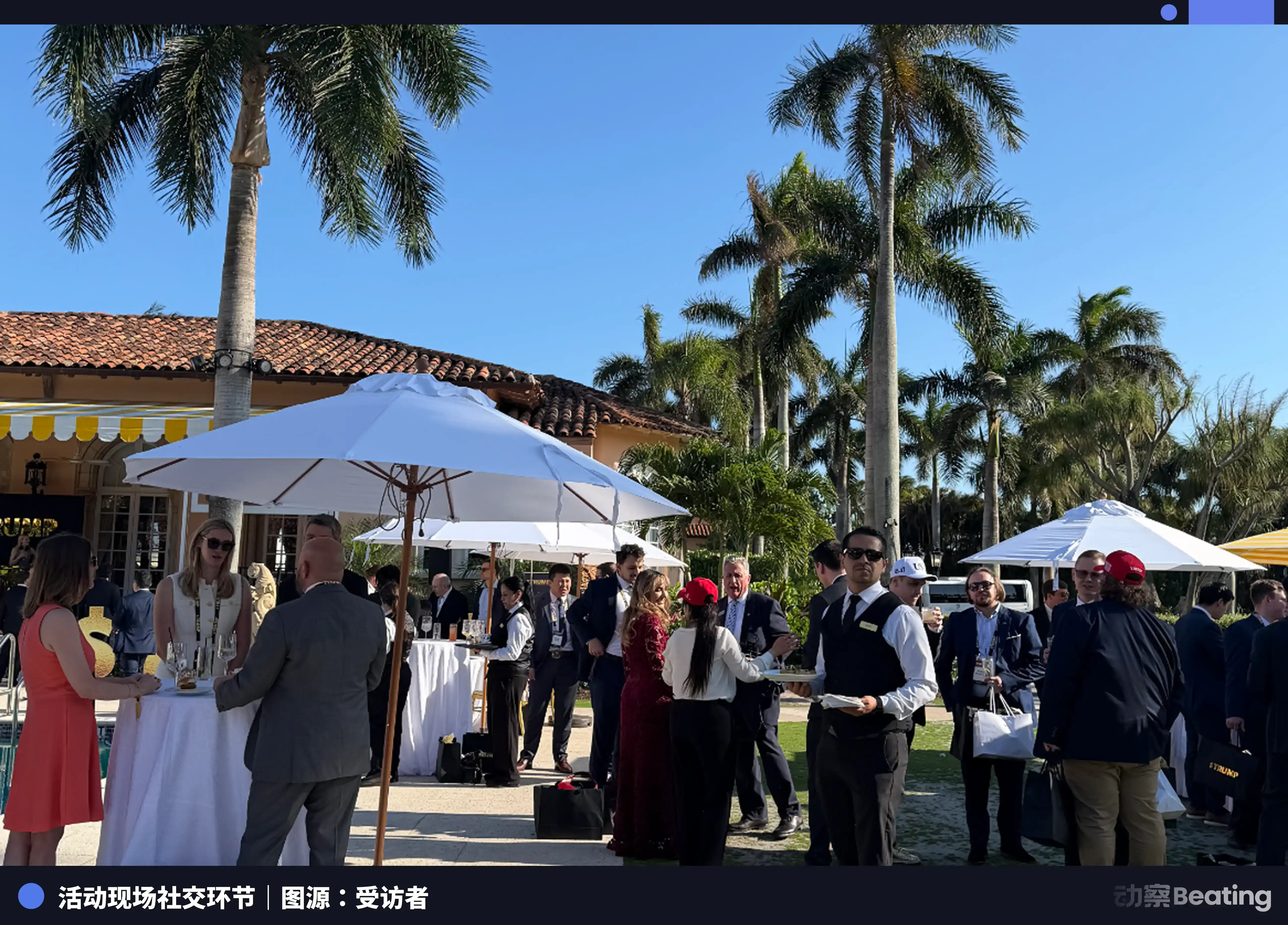
Bigsong handled production and sales; Sherry voluntarily took on the role of on-site organizer.
In this live group, people shared real-time information – where Tyson was hanging out, which area Cathie Wood was in, where to get the best photos. She helped fellow attendees she had just met grab photos and gave directions. Sherry ended up with the most photos and selfies with celebrities at the event.
Beyond the frenzy of taking photos with celebrities, attendees who bought tickets like Sherry all agreed that networking with these people was the most valuable part.
Turbo observed three types of people on-site: those who quietly sat and listened to the speeches, those who socialized occasionally, and those who eagerly sought out guests to chat with and explore collaboration opportunities. "Everyone comes for different reasons. Some just see it as entertainment, a way to prove their status."
He also experienced a culture shock. The atmosphere of the entire Palm Beach, Mar-a-Lago, and Trump's team exuded a "very, very traditional white culture" vibe, completely different from the more Democratic events he attended in New York.
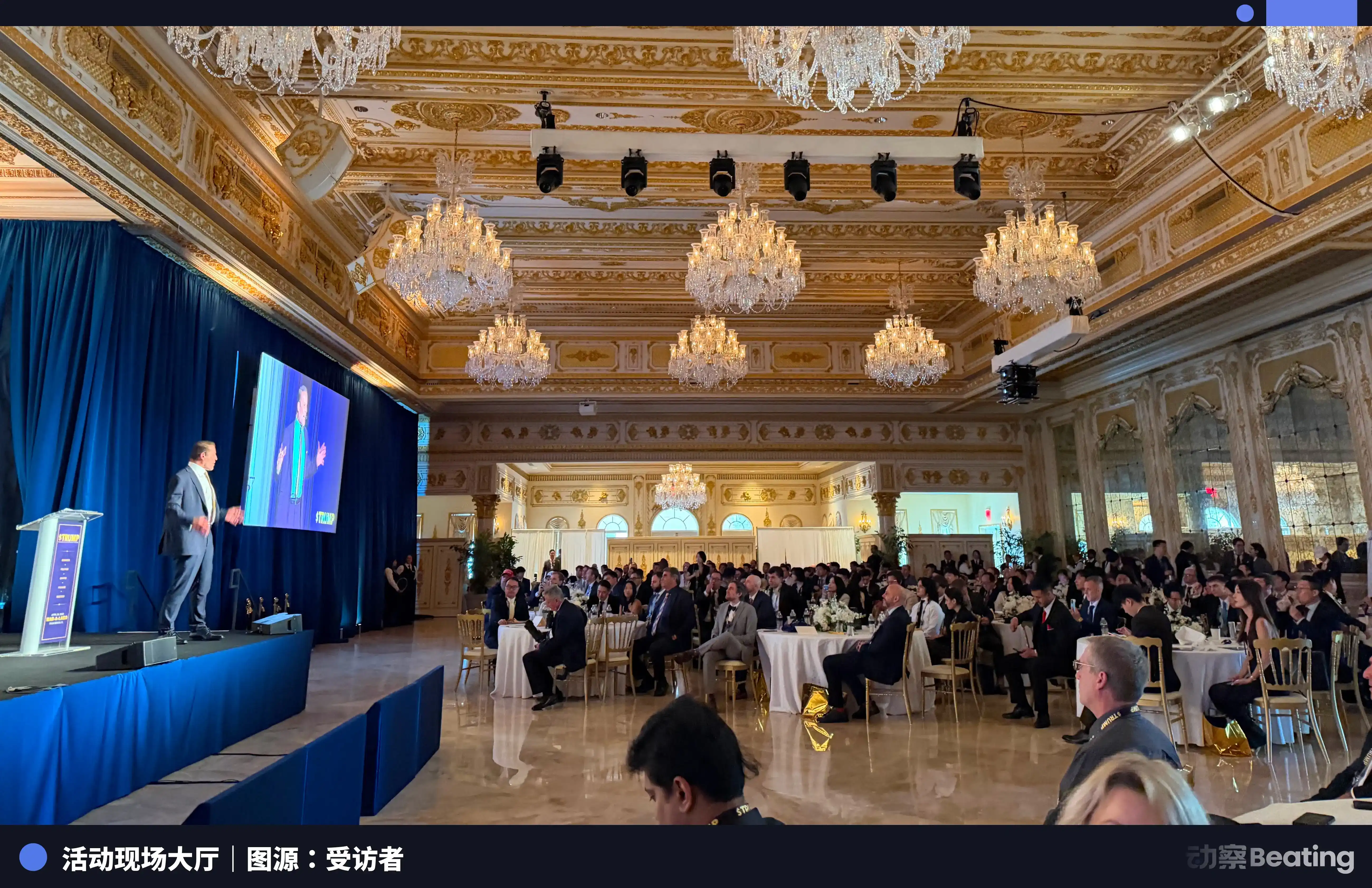
"Don't you think this is the ultimate social stage for the new generation?" Sherry felt the opposite. "We appear before the President, before these investment tycoons. We are young faces. When did previous generations of immigrants ever have this opportunity?"
Sherry shared her participation in this event on her social media. Everyone approved. She said the approval wasn't for the coin itself, but for the fact that these young Chinese people were present in this scenario, their understanding of politics, their interaction with the President, and their appearance on this social stage.
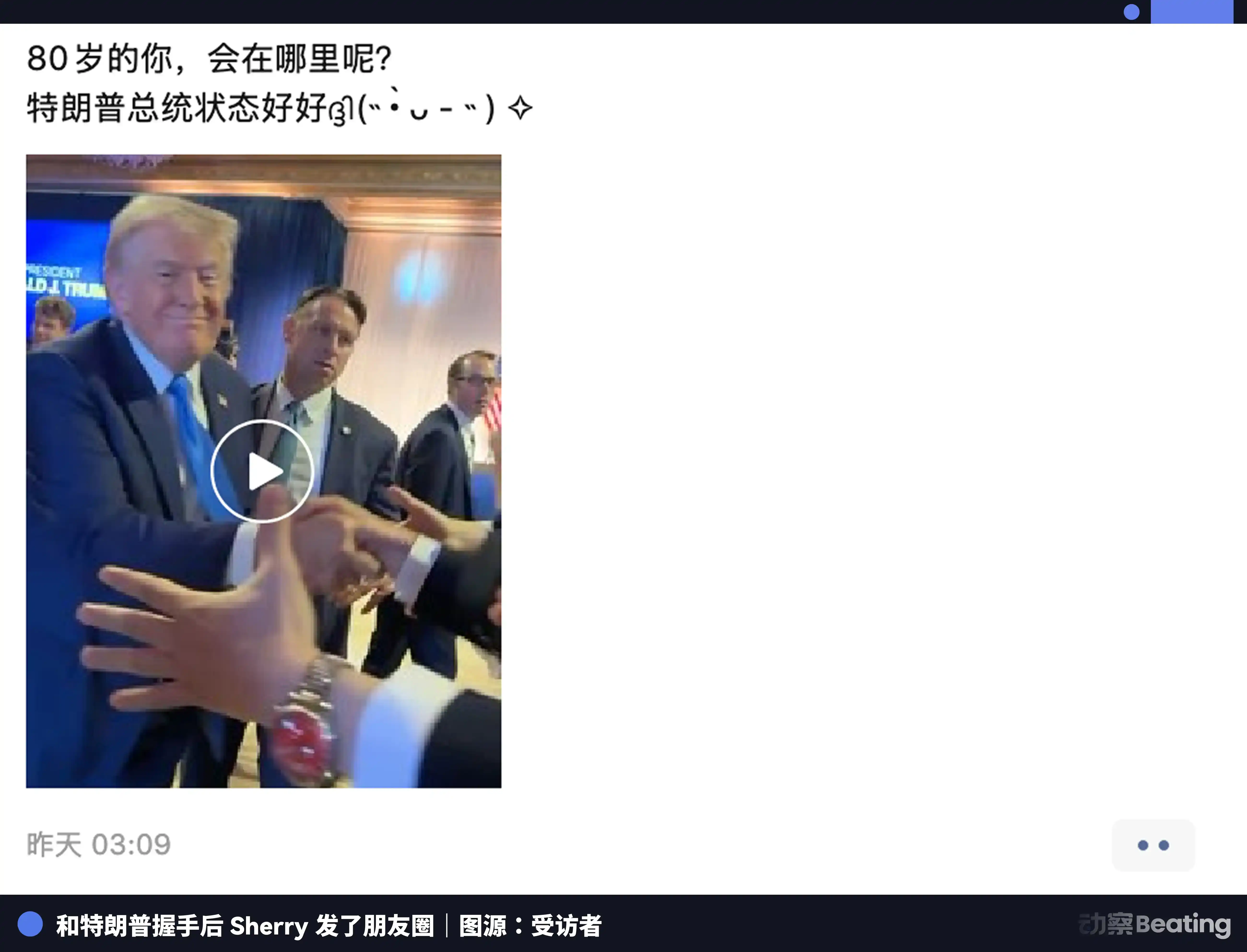
Throughout the entire speech, Trump didn't mention his meme coin once. Sherry didn't find this strange. "If you were a company boss, would you openly scream for people to buy your stock? The President certainly can't."
But her judgment of the coin itself differed from her judgment of the event. "This coin has no intrinsic value. No shitcoin has value."
So, what was she buying?
"The things behind it: social resources, network connections," Sherry said. "Everyone buys this coin, no explanation needed – it implies we're in the same circle. Plus, it offers exclusive things. The event is at Mar-a-Lago, providing access to business resources that ordinary people can't reach."
After the Curtain Falls
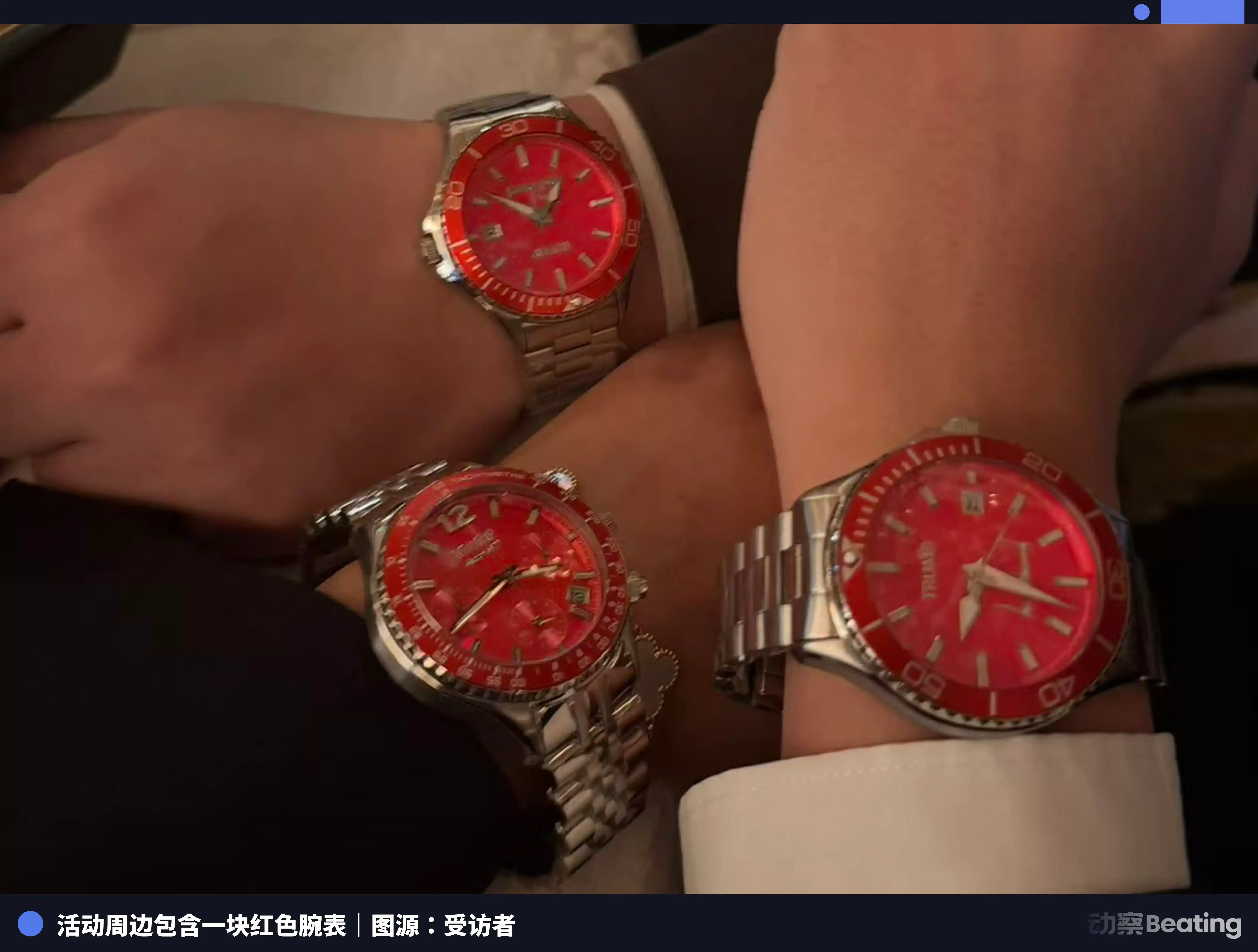
At the event, attendees received a bag of Trump-branded merchandise: a perfume, a red "Fight Fight Fight" wristwatch, a commemorative trading card, and a poster. The moment Sherry posted a photo of her watch, an elder relative pre-ordered it. "He said I absolutely had to keep it for him."
The organizers also launched a Trump Billionaire's Club mobile game and a membership program called $TRUMP Coin Club, promising holders access to luxury boxes at top global sporting events, private dinners, and the most elite, extraordinary experiences.
Later that same evening, Trump returned to Washington for the White House Correspondents' Dinner. Gunshots were reported on-site. Sherry jokingly remarked, "A lot of people got confused and thought it happened at the Mar-a-Lago event. But no one came to check on us; everyone only cared about how the President was doing."
Within hours of the event's conclusion, the TRUMP coin dropped 14% to $2.56.
According to Forbes estimates, as of April 2026, transaction fees from TRUMP coin trading had generated nearly $400 million in revenue for Trump-affiliated entities. While the coin price had fallen 96% from its peak, and his family entity controls 80% of the coin's supply, the money-making machine hasn't stopped for a single day.
Data from analytics firm Nansen indicates that the 297 attendees this year collectively held approximately $29 million worth of TRUMP coin, compared to $148 million held by the 220 attendees last year. The median holding for VIPs last year was $3.28 million; this year it was $539,000, an 84% decrease. Many sold their holdings immediately after the points window closed.
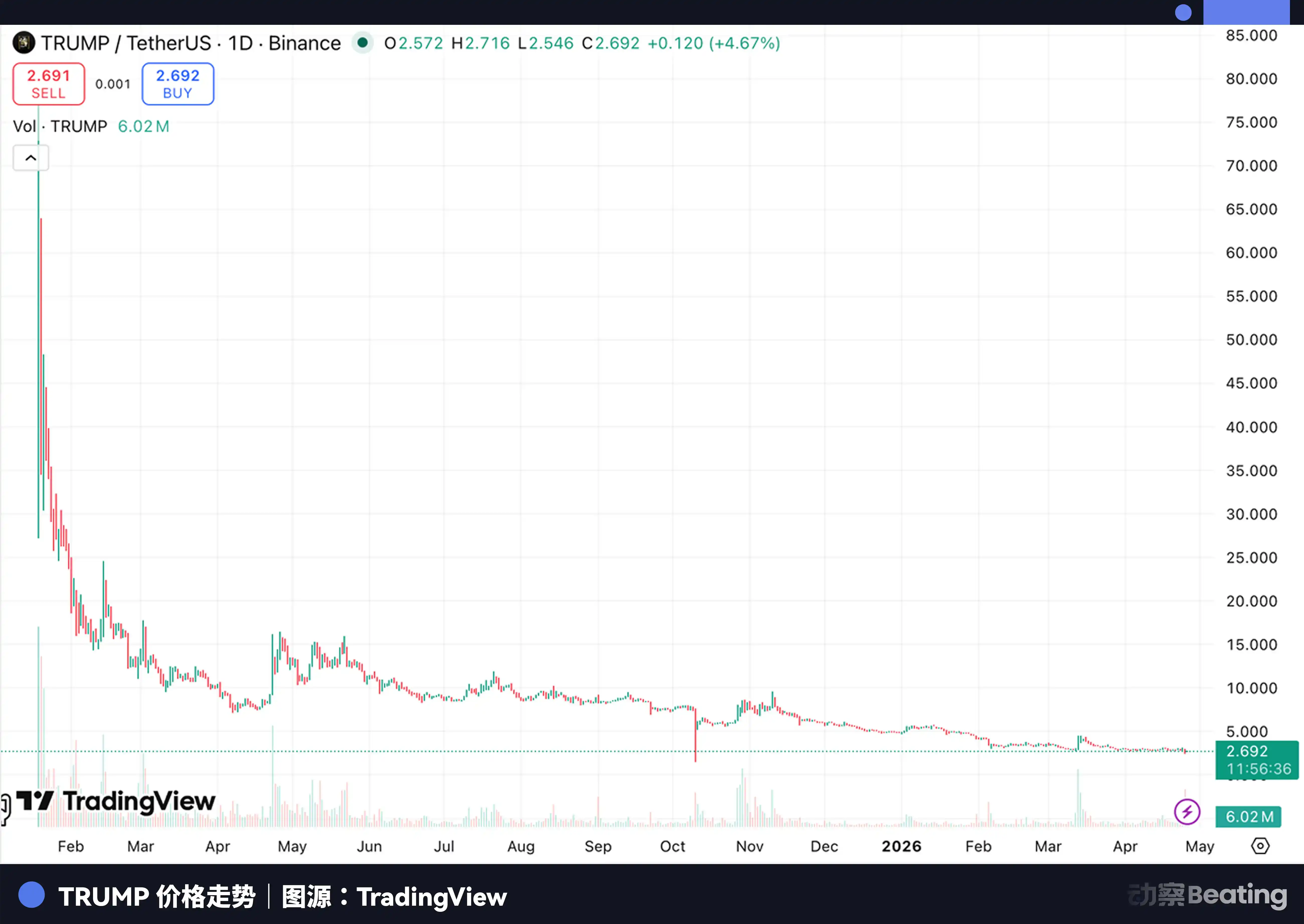
"Buyers in 2025 held after purchase, driving continued upward price movement," the Nansen report stated. The 2026 points ranking created a temporary price spike, but this demand was unsustainable.
Buyers are becoming savvier. They aren't investing in a coin; they are buying an entry ticket.
Back to bigsong's business: He used a quantitative trading methodology, grafted onto a traditional scalping distribution network, turning "meeting the US President" into a standardized, deliverable product.
If you were someone from a traditional industry, how could you get to meet the US President?
"Either you're a figure with political influence who qualifies to meet him anyway, or you're an industry giant in a top-tier field who gets a face-to-face opportunity through business relationships, charity galas, or policy lobbying channels. Or, you attend a campaign rally; the President stands on a distant stage giving a speech, the crowd below is a seething mass, and you are one of them. You do see him,


