屁股决定脑袋:Nikita 为什么必须把商业灰产定性为“国家攻击”?


- 核心观点:X平台产品负责人Nikita Bier将中文机器人泛滥定性为“中国国家级攻击”,并非单纯种族歧视,而是其个人所处的硅谷精英身份、平台KPI压力及中美地缘政治利益链共同驱动的结果,反映出平台治理成本转嫁与认知错位的结构性矛盾。
- 关键要素:
- Nikita Bier的认知模板:毕业于UC Berkeley政治经济学专业,长期从事美式增长黑客创业,缺乏对中文灰产商业逻辑的理解,使其将规模化异常行为自然归因于地缘威胁。
- X平台KPI生死链:中文机器人污染时间线与算法,导致用户流失与广告主顾虑。甩锅“国家攻击”可免责、立人设、示好监管,避免承担技术改进成本。
- 硅谷风投地缘政治利益链:Nikita兼任Lightspeed合伙人及Solana顾问。硅谷主流叙事将中国视为系统性对手,其言论符合政治正确,有助于巩固个人声誉与VC圈层利益。
- 中国灰黑产流量收割链:国内灰产市场规模超2800亿元,从业人员超800万,以ROI为驱动在X平台引流诈骗。这与国家行为无关,但Nikita因认知盲区将其误判为组织性攻击。
- 结构性矛盾后果:X想吃全球流量红利却逃避多语言治理成本,中国灰产将平台当免费流量池,导致普通用户成为最终受害者,问题陷入互相甩锅的僵局。
On April 26, X's product lead Nikita Bier directly labeled the rampant Chinese-language porn bots and spam on the platform as a "Chinese state-sponsored bot attack," which sparked extreme dissatisfaction among many Chinese-speaking users. Many criticized him for being racist and arrogantly shifting blame, accusing him of not even distinguishing basic facts.
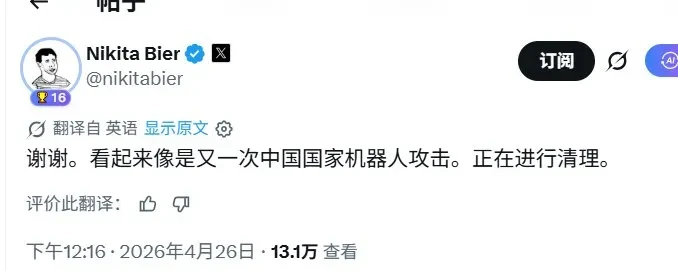
Of course, I think we shouldn't rush to moral judgment but should first return to rationality. If we break this down into several chains of interest, you'll find that Nikita's attitude toward this fact isn't a thoughtless, off-the-cuff remark. It's more a result determined by his position, the resources he holds, and the cognitive framework in his mind. So, rather than attributing it to his personal moral failings, it's better seen as the natural extension of his interest chains.
Who is Nikita Bier? A "Political-Economic Man" Forged by American Growth Logic
To understand why he said this, I think we first need to understand who he is. Nikita is essentially a quintessential Silicon Valley elite. He carries three labels: political correctness, viral growth, and rapid monetization.
"Political correctness" stems from Nikita being a UC Berkeley graduate with a double major in Political Economy and Business. These fields fundamentally teach you to view the world through the lens of national interests and power struggles. From his schooldays, his mind was conditioned to think politically first. This laid the foundational logic for how he perceives many things—his values and worldview.
The labels "viral growth" and "rapid monetization" come from his entrepreneurial journey, where he mastered "American-style growth hacking."
- In 2012, he built Politify, a policy simulation tool that went viral, teaching him "low-cost user acquisition."
- In 2017, he created tbh, an anonymous compliment app for high schoolers, which he sold to Facebook/Meta a few years later for about $30 million, securing his first fortune.
- In 2022, he launched Gas, an upgraded version of tbh with paid reveals and gamification, sold it to Discord for another profit, becoming a well-known "serial successful entrepreneur" in Silicon Valley.
- In July 2025, he secured the role of X's product lead through "posting his way up," while also serving as a Lightspeed venture partner and a Solana advisor.
So, all of Nikita's success is built on a closed loop targeting the Western youth market, psychological drivers, viral growth, and rapid cash-outs. This means he has never deeply engaged with the Chinese market or had direct encounters with China's gray and black industries. In his view, any scaled and abnormal user behavior isn't commercial profit-seeking but an organized external force—a cognitive template formed over his decade-plus journey from school to entrepreneurship. It's ingrained in him. So that's why, when it comes to the Chinese crypto community on X, many users get verified after slightly unusual interactions, or face large-scale bans during certain periods.
The Three Interest Chains I See
To get to the root of the issue, we can break down Nikita's statements into three interest chains for analysis.
First Chain: X Platform's KPI Lifeline—His Job, Easier to Keep by Blaming Others
X's core revenue currently comes from three sources: advertising (the bulk), Premium subscriptions (likely covering Blue checks), and Grok AI monetization. As product lead, Nikita's job is to drive platform growth—user and revenue growth. I think his KPI boils down to one thing: making all three revenue streams grow impressively. But Chinese spam bots are X's "cancer." Their typical features include:
- Large Scale: Nikita himself mentioned a pool of 5-10 million accounts, batch-posting spam every minute.
- Low Cost: Chinese black ops use cheap servers, SIM cards, and VPNs, costing next to nothing to register unlimited accounts.
- High Damage: These bots don't attack X; they leech off it to harvest traffic, funneling users to Telegram groups, scams, and live porn streams, directly polluting timelines, search results, and recommendation algorithms. This drives away real users and makes advertisers hesitant to spend.
So, if Nikita admitted that X's risk control model had failed, that the algorithm was insensitive to non-English traffic, or that technical debt had accumulated, he'd have to take the blame. He'd need real money to fix the system, potentially affecting growth metrics—a tough situation where one move affects the whole system. Think about it: could Elon Musk tolerate a product lead saying "our tech isn't good enough"? So, the optimal solution is clear: blame "Chinese state-sponsored bots." This has several benefits:
Deflection: It's not our weak tech; it's an overpowering, state-level adversary.
Persona Building: X is defending global free speech, aligning with Musk's narrative and earning goodwill.
Favor Currying: Showing U.S. regulators/Congress that they're fighting foreign interference, potentially easing future policy troubles. Isn't this a win-win move?
Second Chain: Silicon Valley VC and Geopolitical Interest Chains—His Backers Need "Taking Sides" to Stay Strong
Nikita isn't just X's product lead; as mentioned, he's also a Lightspeed venture partner. Lightspeed is a typical Silicon Valley VC, investing in American consumer internet products like BeReal and Flo Health, with little overlap with Chinese tech companies. What's the mainstream narrative in Silicon Valley now? China is a systemic adversary. The TikTok ban, data security reviews, supply chain decoupling—all push China toward "enemy" status. In this atmosphere, any "scaled abnormal behavior" from China is defaulted to "state action." This is less about bias and more about survival strategy. X itself is caught in the crossfire of U.S.-China competition, wanting to be a "global digital town square" earning global traffic revenue while avoiding accusations from Congress of "enabling Chinese influence." So, Nikita's blame-shifting conveniently hits the politically correct mark: helping Musk take a stance without affecting X's Chinese gray traffic revenue (since those users won't pay for Premium anyway). For him personally, this also offers a hidden benefit: in Silicon Valley VC circles, "standing up to China" is a plus, boosting his personal reputation and making it easier to find deals and secure funding.
Third Chain: China's Gray and Black Industry Traffic Harvesting—The Real World He Doesn't Understand
China's internet gray industries are no small-time affair. I found some data from last year: according to Q1 2025 data, the domestic black-gray market surpassed 280 billion yuan, with over 8 million practitioners. It's a complete interest chain involving intermediary traffic generation, tech support, legal camouflage, and fund distribution. These operations have nothing to do with state action; they only care about one thing: ROI (Return on Investment). A click on a scam link earns a few cents, a referral to a live porn stream earns a few yuan, and one account can post hundreds of messages daily. As long as it's profitable, someone will do it. With relatively lax moderation and massive global traffic, X has become their new battlefield. They don't intend to attack X; they just want to make money on it. These black ops have no direct command relationship with officials; in fact, the Chinese government is cracking down on VPNs and fraud domestically. However, during "politically sensitive periods," these activities do amplify because user attention is higher, increasing scam success rates. Nikita doesn't understand this chain because he's never built a product in China and hasn't seen the underlying logic of "running scripts 24/7 for a 0.1 yuan click." He only sees "5-10 million accounts bursting on schedule" and assumes it's "state action." That's a classic cognitive blind spot.
So, based on this analysis, you can see that Nikita isn't simply a "racist." He's a person completely defined by his economic position: the triple identity of an American growth hacker, Silicon Valley VC, and U.S. platform executive naturally leads him to interpret "scaled Chinese anomalies" as a geopolitical threat rather than commercial gray operations. This is a classic case of "position determines cognition." Sitting where he sits, holding the resources he holds, and thinking with the cognition he has, the words he utters could only be what they were. So, this isn't just Nikita's problem. I think it's more the inevitable result of the mismatch between the U.S. and Chinese digital economy value chains and the shifting of platform governance costs. X wants to reap the benefits of global traffic but avoids spending real money on multi-language gray industry governance. Chinese gray industries want to make quick global money but treat platforms as free traffic pools. Neither side wants to pay for the "public good" (a clean digital square), so they end up blaming each other—"state-sponsored attacks" versus "incompetent tech"—neither willing to admit fault or solve the problem. Ultimately, it's the ordinary users who lose out—those who just want to see real information and communicate normally on X. That's the most frustrating part of this whole situation.