坚守一级市场的VC,手里还有多少钱?


Original | Odaily Planet Daily (@OdailyChina)
Author|Azuma (@azuma_eth)
Who knows the current state of the crypto primary market best? Naturally, it's the VCs still active in the market.
In recent days, several investors from Pantera Capital, Crucible Capital, Blockworks, and Varys Capital engaged in a small-scale discussion on X regarding the current state of the primary market. Although their views on the market situation differed somewhat, their debate may help us gain a closer understanding of the primary market landscape.
A Counter-Intuitive Reality: VCs Are Not Short on Capital, but Investment-Worthy Opportunities Are Scarce
On the evening of April 20, Crucible Capital partner and GP Meltem Demirors published a short post on X explaining why the number of financing deals in the crypto industry has significantly decreased.
Demirors believes that, overall, the "supply side" of early-stage founders and projects in the crypto industry is not as large as in other high-growth sectors. Over the past four years, this gap has become increasingly apparent, which is why this VC has begun shifting its focus outside the crypto market.
The venture capital business in the crypto market has been developing for 10 years, but the truly proven directions capable of generating "VC-grade returns" are actually quite limited – stablecoins/payments, exchanges, and financial products. For VC investors and frontline founders, there are fewer breakout hits in this industry today, and cycles are longer. This demands higher industry knowledge, greater resilience, and a more long-term orientation, so the bar from seed round to Series A is also rising.
While there are still some "generational" founders building category-defining companies (the job of VCs is to find them and win the opportunity to invest), the reality is that there is a significant gap between "the stories founders tell" and "what VCs can reasonably invest in."
After Demirors' post, several fellow VCs joined the discussion on the topic.
Multiple investors replied in agreement with Demirors. Among them, Blockworks co-founder Mippo summarized, agreeing with Demirors that the current primary market problem is a shortage of outstanding founders and projects. On the VC side, there is actually plenty of capital available for investment – but at the same time, early-stage VC capital is abundant, while VC capital focused on later-stage growth remains notably insufficient.
Partial Disagreement: Where Exactly Is the Capital Concentrated?
Regarding whether VC capital is concentrated in the early discovery phase or the later growth phase, Pantera Capital investor Mason Nystrom and Varys Capital venture head Tom Dunleavy held completely opposing views, leading to a heated debate between them.
Dunleavy first stated that he disagreed with Mippo's view of "abundant early-stage capital, insufficient later-stage capital": "I would take the completely opposite view. There is actually a lot of capital in mid-to-late-stage crypto VCs right now – mostly from recently raised or currently fundraising funds like Paradigm, Multicoin, Pantera, Dragonfly, etc., not to mention traditional VCs partially involved in crypto. Instead, it's the seed rounds and earlier-stage focused capital that are insufficient... As long as you haven't completely pivoted to AI, there are actually many interesting projects to invest in."
However, Nystrom, an insider at one of the later-stage VCs Dunleavy listed (Pantera), strongly refuted Dunleavy's claim. He argued that VC capital in the industry is now more concentrated in the early stage, rather than Series A, Series B, or beyond.
Nystrom did the math: if a fund wants to focus on Series A or Series B financing, they need to invest in at least 20-25 projects, each requiring a substantial amount – around $15 million for Series A and around $40 million for Series B. By this calculation, a Series A-focused fund needs at least $300 million in assets under management (AUM), while a Series B-focused fund needs at least $800 million. This doesn't even account for reserve capital, which typically requires holding 10% to 50% of cash on hand. How many funds in the industry meet this requirement?
So the reality is that there are likely at least 50 funds in the industry with AUM under $100 million, while there are probably only around 15 funds with AUM exceeding $400 million. There are very few major players in the industry that can genuinely participate in Series B rounds and beyond. There might indeed be more Series B and later-stage capital in areas like fintech (e.g., stablecoins), but these projects have essentially "graduated" into the traditional VC system and can no longer be simply considered crypto market projects.
But Dunleavy was not convinced. In his response, he cited Galaxy's Q1 primary market financing report, noting that while the total number of financing deals in Q1 of this year fell by 49% year-over-year, the average deal size rose by 76% (to about $36 million). Total financing for seed rounds and earlier stages was only $268 million; Series A reached $370 million; Series B reached $1.1 billion; and later stages reached as high as $2.72 billion (mainly from Kalshi and Polymarket).
Dunleavy countered, arguing that the data shows in 2025, over 50% of investment capital in the industry flowed to later stages (an all-time high), and in 2026, it has already reached over 80%.
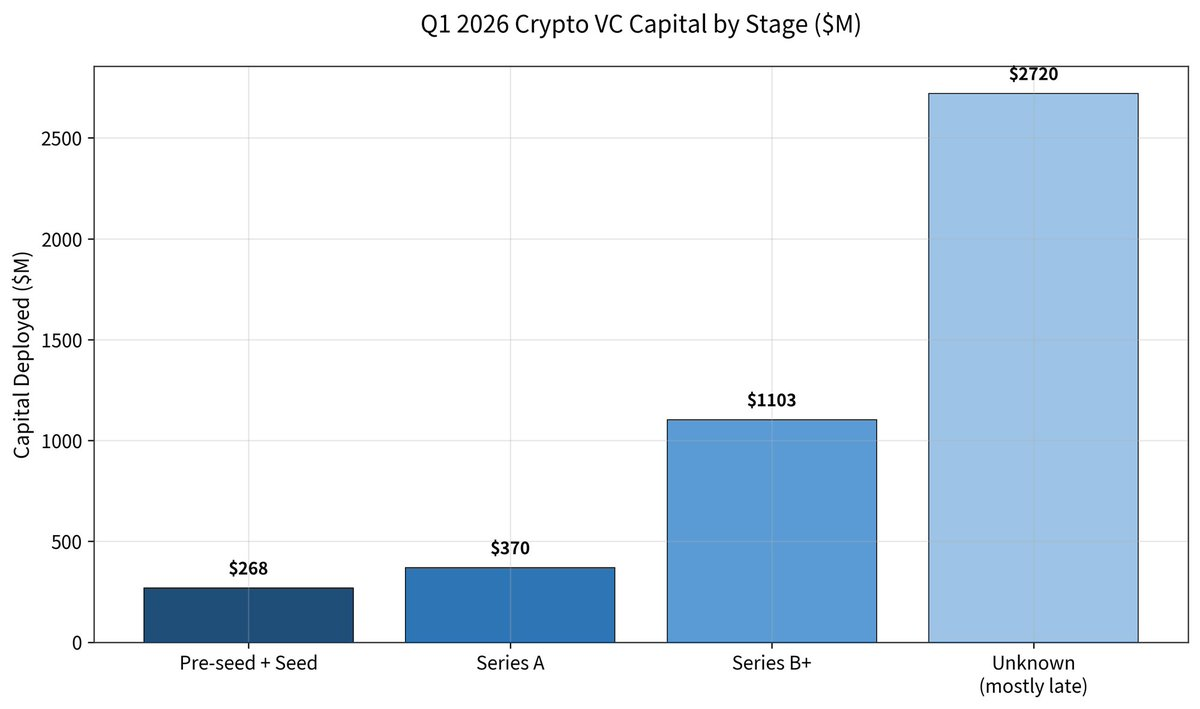
Dunleavy finally estimated the current capital situation in the primary market: Available capital for Series A and later stages is approximately $6 billion to $7 billion, concentrated in the hands of 5 to 6 large institutions; available capital for seed rounds and earlier stages is approximately $1 billion to $2 billion, dispersed across dozens of smaller, more fragmented funds.
Nystrom responded again, stating that in the data Dunleavy presented, most of the later-stage investments actually came from fintech-related projects that had already "graduated." However, such projects have long entered the purview of traditional VCs and secured their investments, so they should no longer be counted within the crypto industry.
Nystrom then continued his rebuttal based on Dunleavy's conclusion that "only 5-6 funds can invest in Series A and beyond, but there are dozens of funds that can invest in seed rounds": "This means if you can't convince one of those 6 funds, you're basically out of luck; but in the early stage, as long as one of those dozens of funds is willing to invest, you can survive. The 'accessibility' of these two is completely unequal."
Furthermore, funds like Pantera Capital, which have the capacity to invest in mid-to-late stages, also invest in seed rounds, but the reverse is not true. Coupled with the fact that more VCs are now shifting to liquidity funds, the actual scale of capital truly available for mid-to-late-stage investments in the industry is much smaller than the numbers suggest.
More Than "Is There Money," the Real Question Is "Where Is the Money, and Can You Get It"
In conclusion, neither side managed to convince the other. However, based on this direct confrontation between two front-line investors, we can gain a deeper glimpse into the reality of the crypto primary market – "whether there is money" does not seem to be the core issue of the primary market; "where the money is and whether you can get it" is the real problem.
From the surface data, industry capital remains abundant, even showing a high concentration in later-stage rounds. But from a practical standpoint, both VCs and entrepreneurs are facing a market that is becoming "structurally tighter" – early-stage capital appears dispersed but is fiercely competitive, while mid-to-late-stage capital seems plentiful but has extremely high barriers to entry. This also means that the rules of the game in the primary market are changing. The era of relying on narratives, traffic, and short-cycle execution to complete the financing loop is rapidly fading. It is being replaced by a financing environment that increasingly depends on real business progress, long-term capability, and a clear path to growth.
For VCs, this is a cycle of "fewer moves, heavier judgment"; for entrepreneurs, it is a survival test that requires crossing longer cycles and higher hurdles.