Penetrating the “Statistical Significance” of Halving: Is Bitcoin Bullish a Tradeable Event?
Original translation: Frank, Foresight News
Summarize:
On the surface, the much-anticipated event of Bitcoin’s halving is generally bullish historically;
However, given the small number of halving events that can be studied, and a closer look at Bitcoin’s performance in the overall market environment, it is difficult to make any high-definition judgments based solely on the halving event itself;
Overall, the Bitcoin halving may not be a tradable event from a supply perspective, but it has structural bullish factors, and if there is appropriate macro support, Bitcoin may rebound again after the halving;
The consensus regarding the Bitcoin halving is bullish and widely considered to be a tradable event, but is this really the case? In this report, we delve into past halving events and perform a supply and macro data analysis for the 2024 halving to gain more comprehensive information on what this widely predicted event means for investors.
What is Bitcoin Halving?
Halving is a pre-programmed event in the Bitcoin network that cuts the reward for Bitcoin miners in half. This is an important mechanism in Bitcoin's monetary policy, which ensures that only 21 million BTC will eventually enter circulation to prevent inflation and reduce the speed of subsequent issuance of new BTC.
This program update is performed every 210,000 blocks, which is roughly equivalent to once every four years. When Bitcoin was launched in 2009, the mining reward was set at 50 BTC. Since today's halving is the fourth time, plus the previous three halvings (2012, 2016 and 2020), the reward has dropped to 3.125 BTC per block.
As we all know, Bitcoin uses the Proof of Work (PoW) consensus mechanism to verify and protect transactions on the blockchain. In PoW, miners need to compete with each other to solve complex mathematical problems, and the first miner to solve it correctly can add the next transaction block to the blockchain.
As compensation for verifying transactions and adding blocks to the blockchain, the winning miners will receive newly created Bitcoins as a reward - it is this reward that is "halved" in today's halving event.
The Cold Reality of “Halving” in History
On the surface, halvings have historically proven to be very beneficial for BTC.

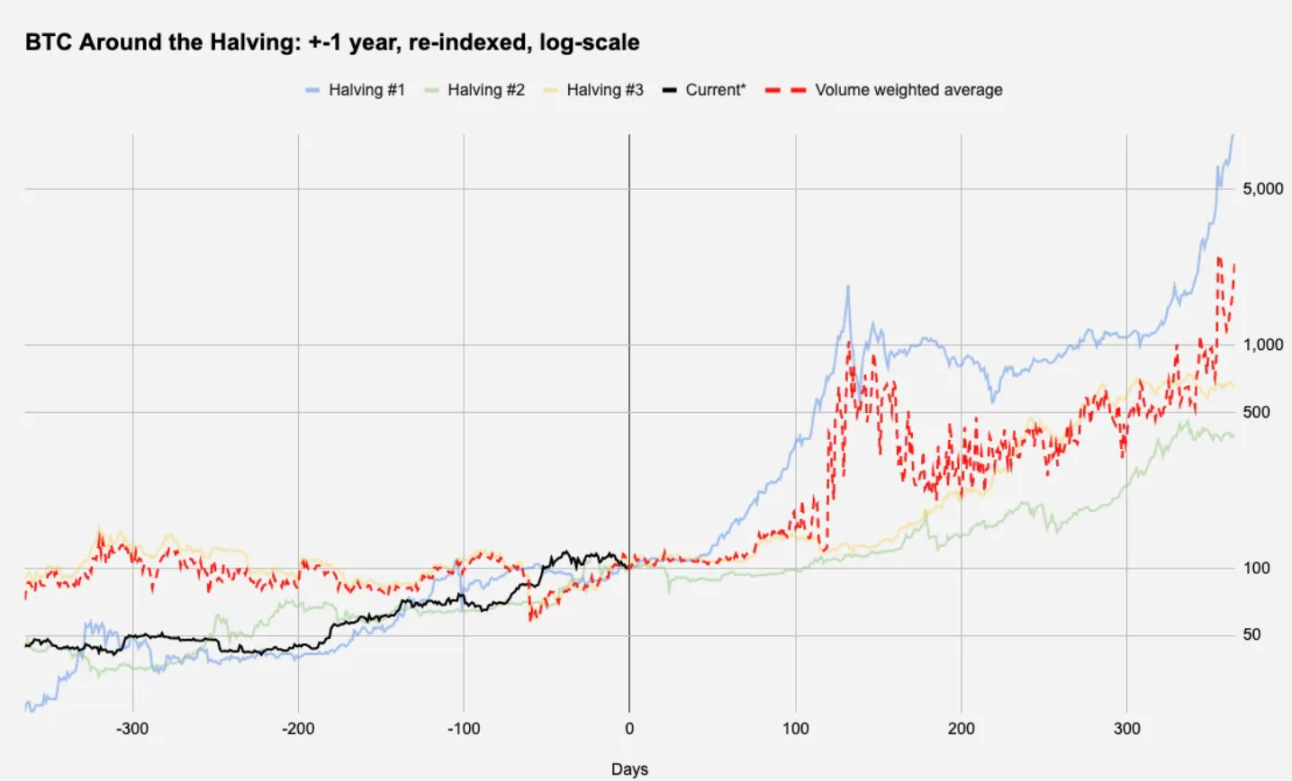
The above picture shows the historical price trend of BTC before and after each halving day (ranging from 1 year before halving to 1 year after halving). The red dotted line shows the volume-weighted average of each past halving, while the black line shows the current BTC data.
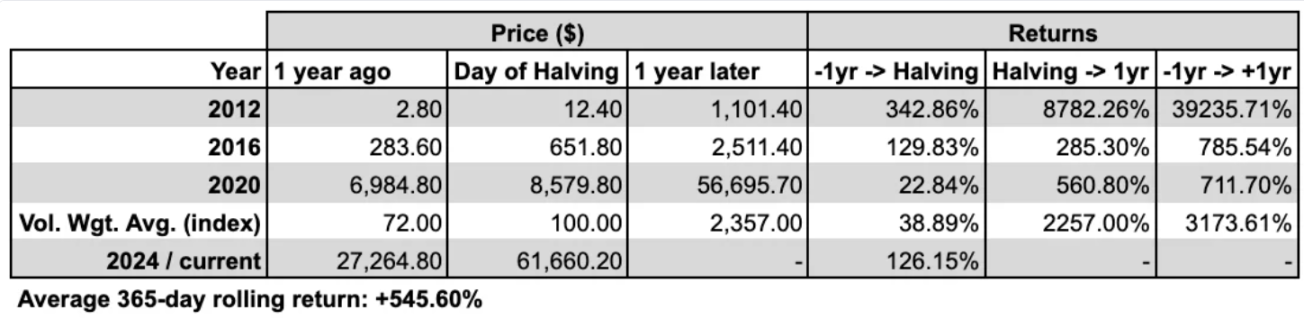
The figure below summarizes the relevant data in tabular form. Note: Day 0 on the horizontal axis = halving date, Day 0 on the vertical axis = 100. In addition, this article uses price data from April 17 for inference.

The logarithmic-scaled Y-axis of the first chart suggests that the halving is a bullish catalyst, but given that we only have three observations, and the first was when BTC was just $12.80; the third occurred in May 2020 — when all risk assets rallied sharply in the Covid rally — it seems that any interpretation of the data needs to be treated with skepticism.
Furthermore, when we look at BTC’s average 1-year return since mid-2011, we see that, with the exception of the first halving in 2012, the 1-year returns after each of the other halvings do not look very satisfactory.
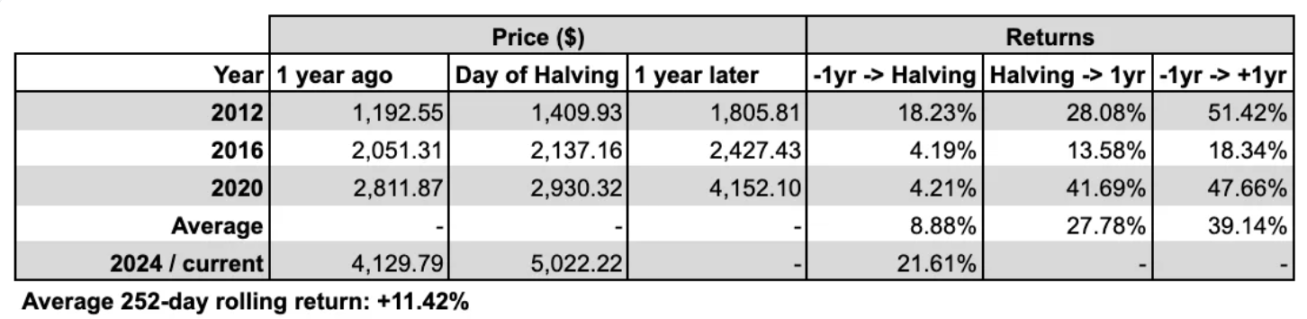
At the same time, the 2020 halving raises an interesting question about how global markets in general performed at that time. In the chart below, we compare using stocks (specifically the S&P 500) as a benchmark for risk assets.

While the SPX’s 1-year rolling average return since mid-July 2011 is +11.42% (matching BTC historical price data), its 1-year average performance since the Bitcoin halving is over +27% — more than double the average!
This highlights an important reality that the common narrative often ignores. For the same reason we can’t conclude “So a program update in the Bitcoin network that cut the reward miners receive in half is very good for the S&P 500,” we also probably can’t draw truly conclusive statements from BTC’s past performance.
Otherwise, by certain metrics, such as the hit rate of better-than-average performance, you could even conclude that the Bitcoin halving is more bullish for the S&P 500 than it is for Bitcoin itself!
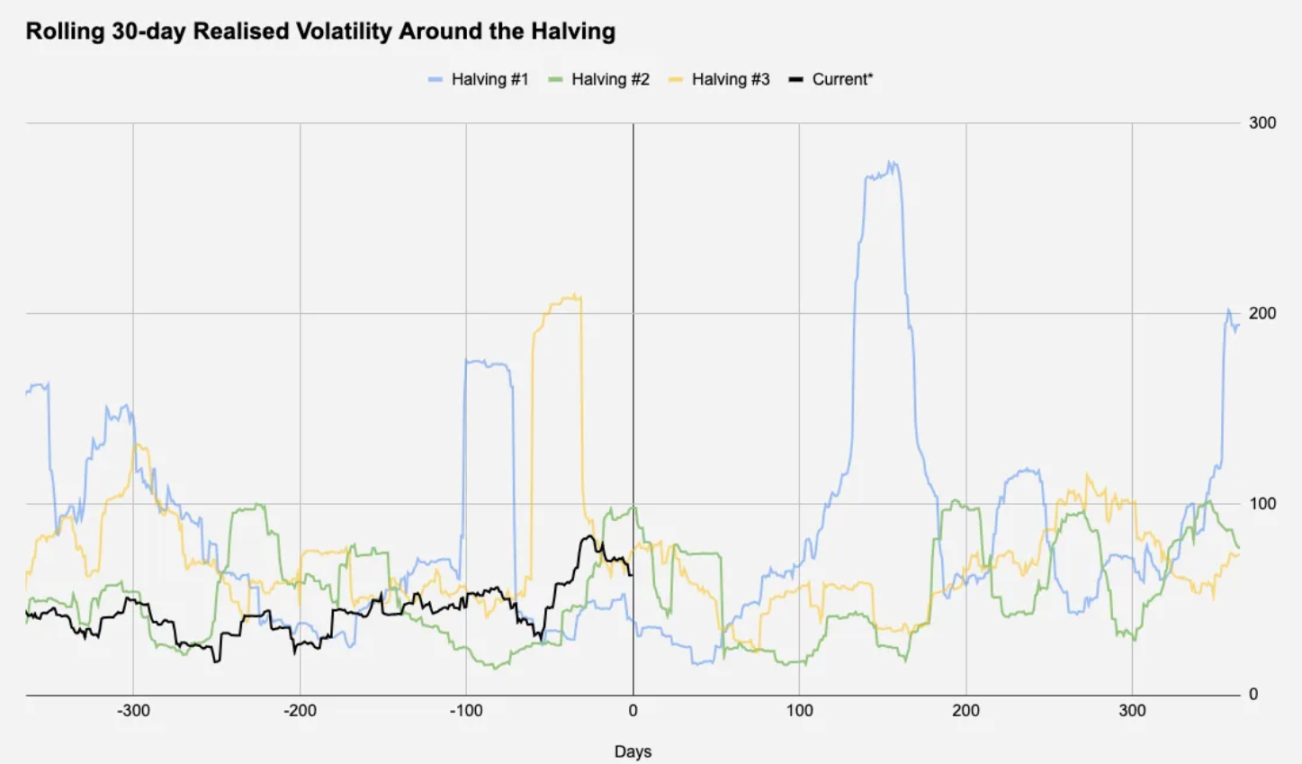
Meanwhile, for those interested in volatility, the data shows that volatility does not seem to have a clear relationship with the halving date or period. The following chart shows the actual volatility 30 days before and after the halving date (+-365 days):

2024 Halving Theme #1: Long-term Holders
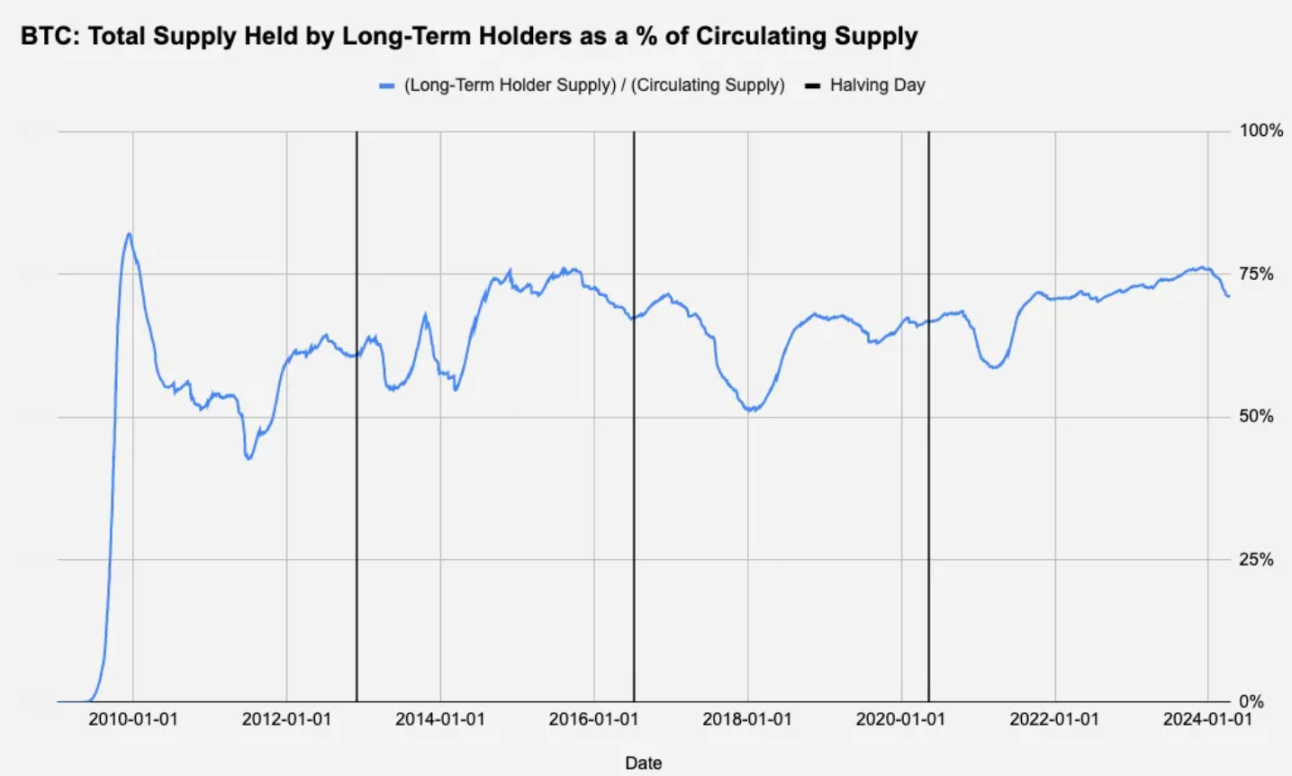
Here we look at the total amount of BTC held by long term holders and adjust it for the supply of BTC.
Considering that the circulating supply of Bitcoin will continue to increase until it reaches the hard cap of 21 million Bitcoins, we divide the number of long-term holders by the circulating supply at the time to view the holdings as a percentage:

While the situation in 2020 is nuanced, Figure 5 suggests that long-term holders may be taking profits ahead of the halving, with a decline also expected in 2024. This selling dynamic is often attributed to miners; since the halving essentially reduces revenue per block by 50%, miners typically sell part of their treasury when rewards are reduced to upgrade their hardware for more efficient mining. This structural selling pressure may be happening now as we are days away from the 2024 halving.
Although the situation in 2020 is subtle, the above chart suggests that long-term holders may cash out before the halving, which is also the case in 2024.
This selling option is often attributed to miners - since the halving essentially reduces the revenue per block by 50%, miners typically sell part of their stored BTC to upgrade their hardware for more efficient mining when rewards are reduced, and this structural selling pressure may also be happening currently.
2024 Halving Topic #2: Exchange BTC Balances
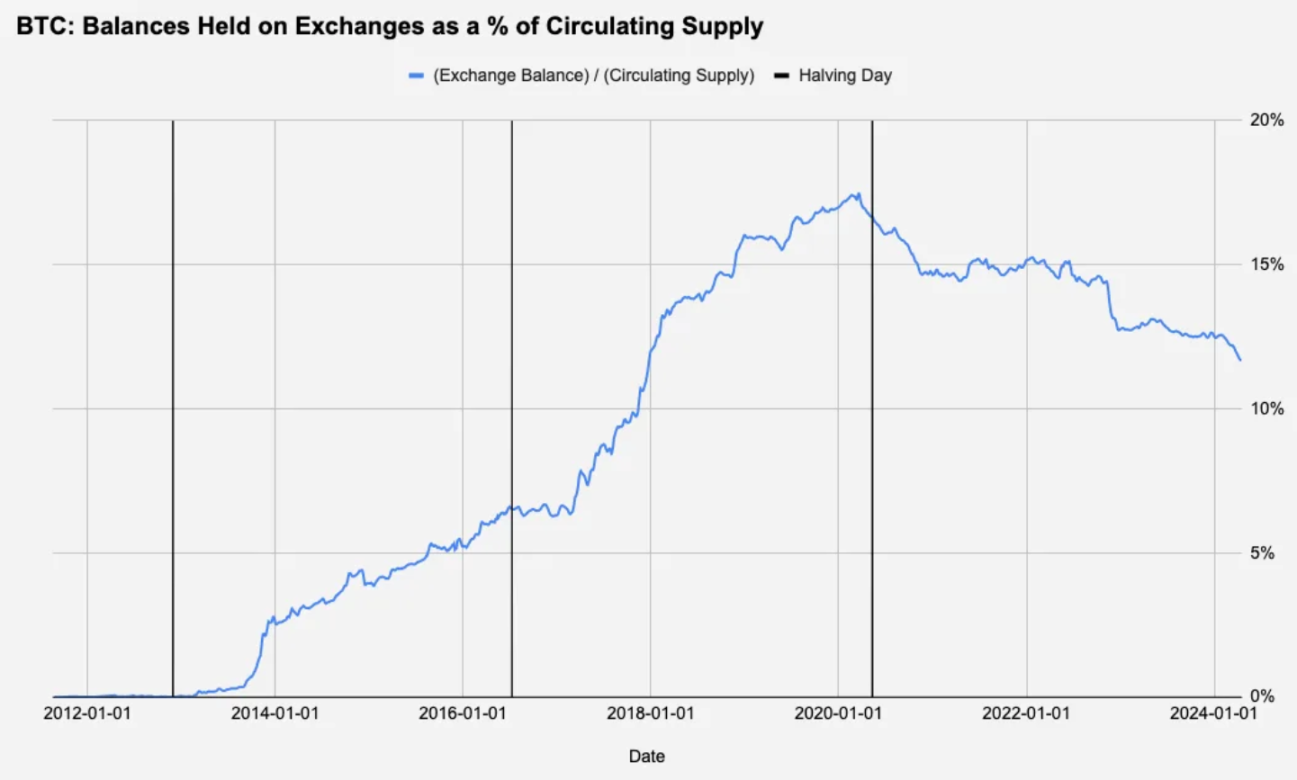
While exchanges don’t make directional bets, we still look at the BTC reserve holdings of exchanges (and, by extension, their internal market makers) to see if there is a pattern to follow around halving dates:

The above chart, which divides the total supply of Bitcoin held by cryptocurrency exchanges by the circulating supply at the time, does not seem to have anything interesting to look at. The only observable trend is the long-term trend - after an accumulation phase of about 6 years on exchanges, BTC holdings began to steadily decline as the last bull run began.
2024 Halving Theme #3: Macro Background
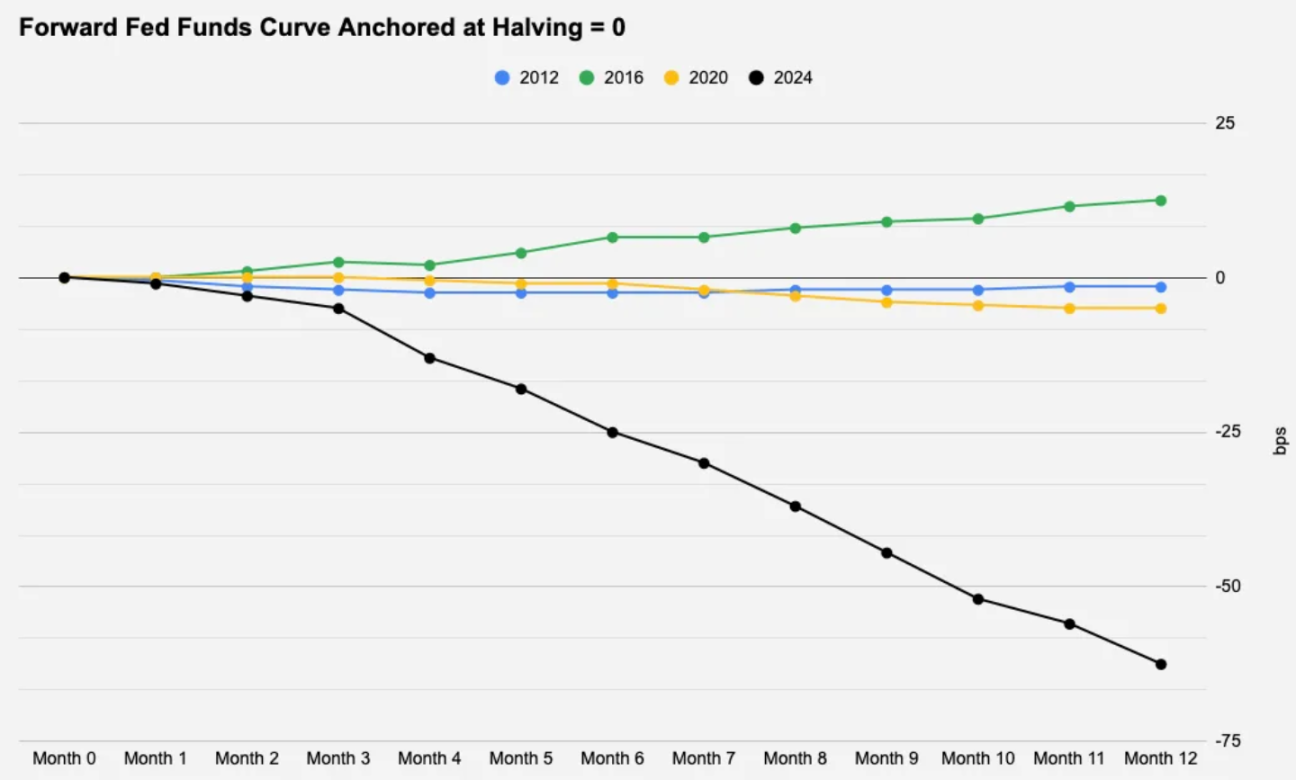
The relevance of macro conditions to Bitcoin is often debated, but macro cycles, especially USD liquidity (as a function of monetary policy/interest rates, risk appetite, etc.) remain the main drivers of asset prices in the medium to long term. With this in mind, we take a closer look at the market pricing for the Fed Funds rate over the next 12 months after the halving date in the chart below.

It is clear that the 2024 halving is an outlier, with almost 3 rate cuts priced in, or more simply put, the market has already anticipated any form of interest rate change.
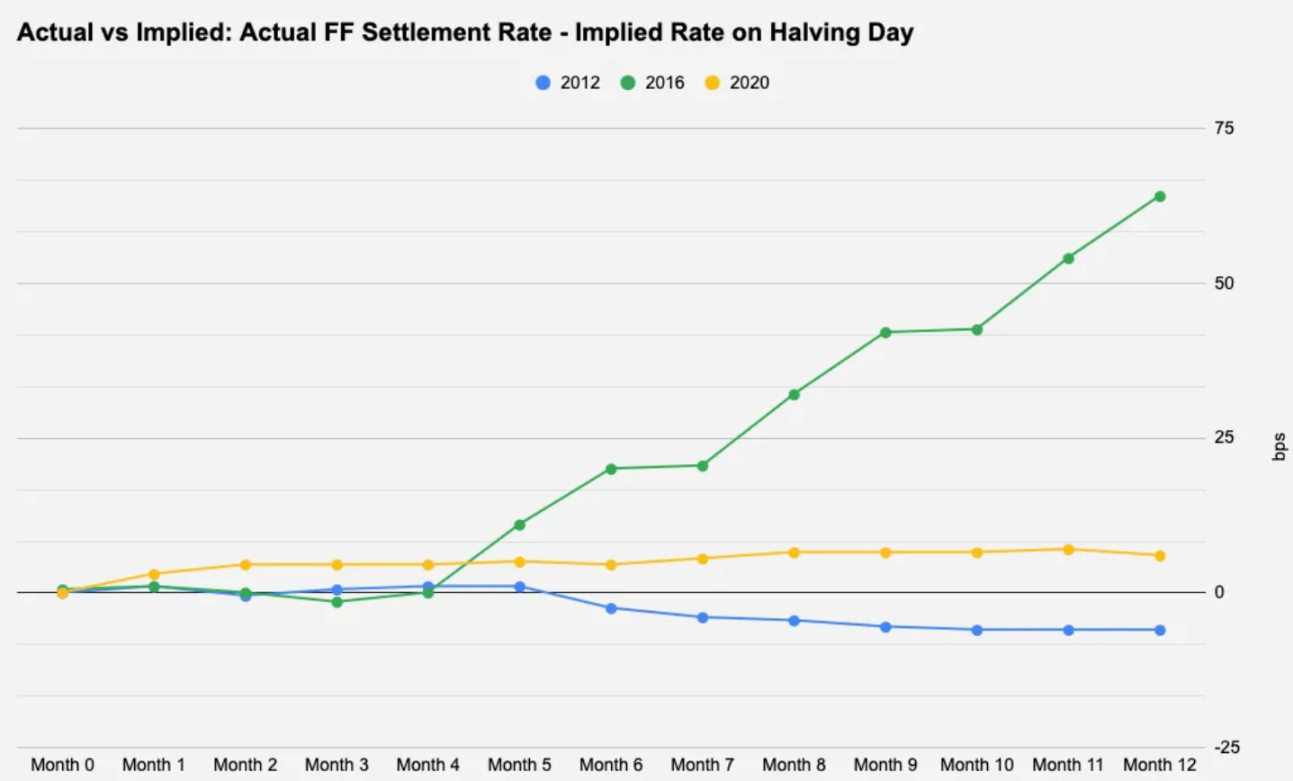
Rate cuts are generally good for risk assets, but what matters to price action is often not what is already priced in, but the degree of deviation from market expectations - whether it is inflation data or the Fed Chairman's statement. In the figure below, we compare the difference between the actual settlement implied interest rate and market expectations on each halving date to see the accuracy of the forward-looking pricing in the figure above.

The data for 2012 and 2020 were fairly lackluster, with a deviation of +-10 basis points from initial expectations, but 2016 is worth studying because the Fed raised rates twice at that time, which was not priced in by the market at the time.
Interestingly, Figures 1 and 2 above show that the 12 months following the 2016 halving was BTC’s worst month of the three previous halvings, and the only month that performed below its 1-year average return. Therefore, with more than two rate cuts already priced in for the next 12 months today, the more important driver for BTC post-halving this time may be continued US inflation or anything else that might encourage the Fed to continue to sit on its hands and not cut rates.
in conclusion
We briefly explored the unique macro context of this halving, but there are other considerations not mentioned in this report - the recently launched spot BTC ETF, etc. With all the attention BTC has received recently, this is definitely the most anticipated halving to date, and the general institutionalization of BTC introduces new players that may change the supply, demand and price action dynamics. It is worth noting that the newly launched ETF holds more than 4.1% of the BTC circulating supply, and MicroStrategy holds more than 1% of the supply.
Given that there have only been three halvings before, it is difficult to draw statistically significant conclusions from past performance to determine whether this is a tradable event. However, structurally, it is undoubtedly a bullish event from a supply perspective.

![Axe Compute [NASDAQ: AGPU] completes corporate restructuring (formerly POAI), and Aethir, an enterprise-grade decentralized GPU computing power, officially enters the mainstream market.](https://oss.odaily.top/image/2025/12/12/ff08e068a361495da15f80b89405441e.jpeg)