BTC
ETH
HTX
SOL
BNB
View Market
简中
繁中
English
日本語
한국어
ภาษาไทย
Tiếng Việt

The five most noteworthy Layer 1 blockchains in 2022

TinTinland
特邀专栏作者
2022-12-07 08:41
This article is about 3812 words, reading the full article takes about 6 minutes
Learn about the recent development of new public chains Aptos, Sui, Celestia, Sei and Berachain.
AI Summary
Expand
Learn about the recent development of new public chains Aptos, Sui, Celestia, Sei and Berachain.

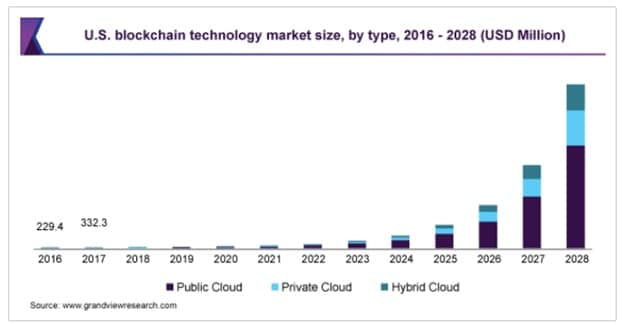
Compared with the private chain, the public chain with read and write permissions open to everyone occupies a larger market share, and at the same time, it also gives more developers a lower threshold to enter the blockchain industry to deploy and start projects. According to the data presented by Coin Ideology Digital, as early as 2020, the global blockchain technology market size has reached 3.67 billion US dollars. According to forecasts, until the end of 2028,The compound annual growth rate of blockchain technology market size will reach 82.4%. Among them, the proportion and growth of the public chain are unmatched.

In the fiery bull market in 2021, Web3 has entered the mainstream market strongly, bringing the peak of the outbreak of the public chain, forming a"Ethereum occupies half of the country, and other public chains are blooming everywhere"we are at

we are at"Interpretation of the development pattern of the public chain, "a hundred chains contend" may be the general trend"In this article, some important projects of the public chain track in 2022 are sorted out, including Layer 2 public chains, functional public chains and many other representative public chains, and it is found that they have escaped from the implementation of "being the next Ethereum". It has achieved brilliant results in different innovation directions and promoted the prosperity of the public chain field again.first level title

What is Layer 1 public chain

Layer 1 blockchain is the basic layer of blockchain architecture. Layer 1 is also called the bottom layer, which is the rules that all miners must abide by. It is designed to allow the blockchain to maintain the "book consistency" and "transaction finality" of the state, allowing nodes to anchor in an unchangeable way. Determining data transactions and cryptographically reaching consensus without central review.To put it simply, Layer 1 is the protocol of the blockchain. The consensus mechanism, block, private key or address that you often hear, etc., are all Layer 1 categories.

From the perspective of Layer division, Layer 1 assumes the part of the underlying consensus. Since the blockchain is an open network system, anyone has the right to act as a node to participate in bookkeeping. How to formulate a set of game rules for all nodes to abide by, so that the blockchain can operate smoothly is a very important issue.

first level title

2022 Top Five Layer 1 Public Chains

After the second-generation representative public chain Ethereum has become a "public chain giant", the third-generation new public chain represented by Solana, Avalanche, etc. can hardly escape the topic of catching up with Ethereum. After the thunderstorm of the FTX exchange, Solana, which has a close relationship with it, was also greatly affected. It is being discussed that venture capital capital such as a16z, Polychain, FTX Venture, and Jump Crypto are investing a lot of money in new smart contract platforms, trying to pick the "next Solana". It has to be said that the new public chains that have gained attention at this time can also receive the favor of big VCs more quickly. then, let's watch it together,secondary title

Aptos

Aptos is composed of former Meta employees who have previously participated in Facebook's diem stablecoin project. It raised US$200 million in March, led by a16z, with participation from Tiger and Multicoin. This was followed by a $150 million Series A round in July, with participation from firms such as FTX Ventures and Jump Crypto. Before 2022 is over, Aptos has raised $350 million.

Although Aptos has been around for a while,However, with the rapid development of its ecosystem, developers' enthusiasm for Move has also increased, and the future ecological prosperity of Aptos can be glimpsed. At present, there are many DeFi projects in the ecology, covering DEX, lending, derivatives, aggregators and other categories; the wallet project in the infrastructure is the first to explode, and more than 10 projects have emerged. Seeing the clues; other tracks followed closely, including domain name, DAO, payment, etc.; in the field of NFT/games, at least 2 malls and multiple NFT/game projects that can be tested publicly have also been produced.

secondary title

Sui

When it comes to Aptos, it is comparable to Sui, which also belongs to the Move series. The official introduction of Sui is: Sui is the first permissionless Layer 1 blockchain designed from the ground up to enable creators and developers to build experiences that meet the next billion users in Web3. From its official introduction, it can be seen that Sui has the ideal of attracting mainstream users. This can also be seen from the four key tracks conceived by the team. The four tracks are: games, DeFi, business and social. But at present, Sui's ecological progress is slightly slower than that of Aptos. At present, many independent browser extension wallets have appeared in the Sui ecosystem, and the infrastructure and ecology are gradually developing. we are at"Interpretation of the development pattern of the public chain, "a hundred chains contend" may be the general trend"It is also analyzed in the article thatThe high throughput and low latency performance of Sui will be more suitable for the deployment and development of Metaverse, games and social applications.

The development team of the public chain Sui and the Web3 infrastructure company Mysten Labs completed a $300 million Series B round of financing in September this year, with a valuation of more than $2 billion. It is worth mentioning that this round of financing was led by FTX Ventures, the venture capital arm of Sam Bankman-Fried’s cryptocurrency exchange. Other investors in the round include a16z (which invested $36 million in Mysten last December).

To learn more about the comparison of Move's public chain Sui and Aptos, please see:"Aptos VS Sui, Inventory of the Innovation Similarities and Differences of the Two New Move-based Public Chains"

secondary title

Sei

In addition to the Layer 1 public chain of the Move series that has received much attention, Sei has also gained market attention this year with the reputation of "born for DeFi".Sei is the first parallelized Cosmos chain, allowing simultaneous processing of independent transactions, and is also a Layer 1 blockchain designed for transactions, has raised $5 million so far.

Why is Sei said to be a DeFi professional chain? From the perspective of its underlying technology, Sei supports the order book model by optimizing the design of the chain, and the overall throughput and delay are improved. That is, Sei is able to aggregate each order at the end of the block and execute them at the same price to prevent front-running. This will greatly reduce the trouble caused by Gas fee, and Sei will also support different tokens to pay Gas fee.

High throughput, MEV resistant,These key technical features give Sei a natural DeFi ecological advantage. Sei has launched a $50 million ecosystem and liquidity fund to support new DeFi applications on the platform, according to co-founders Jeff Feng and Jay Jog on TechCrunch.

secondary title

Berachain

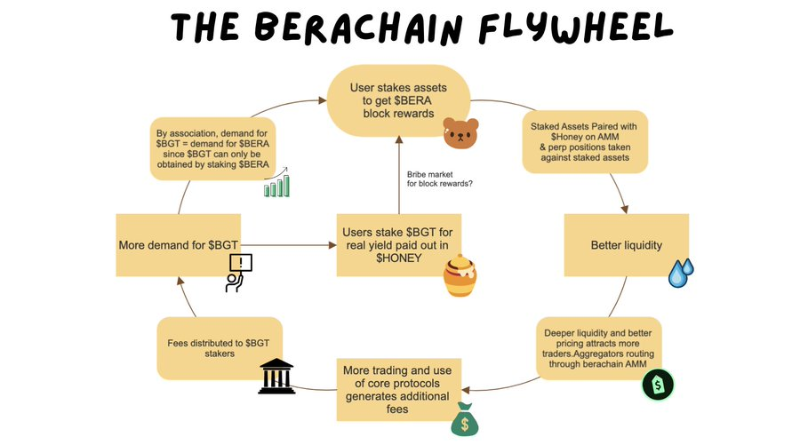
Berachain also has a similar evaluation of "DeFi proto-chain" with Sei. In addition to the pair of public chains of the Move series analyzed above, we can’t help but sigh that the new public chains are also “fighting against each other” and building their own competitive advantages through technology and ecology in the same direction of innovation. Berachain is also an EVM-compatible chain built using the Cosmos SDK. It combines Tendermint, the native consensus mechanism of Cosmos, with its own liquidity proof consensus, so as to provide faster transaction speed, lower transaction cost and instant finality. Not only the liquidity consensus, Berachain's "Tri-Token System", the economic model of the three native currencies is also very technical.

Liquidity can be described as a Layer 1 problem, and it is also the source of living water for DeFi. As the technical information disclosed by Berachain,If it combines the three-token model and the customized application layer of the Cosmos SDK, it can truly realize the "flywheel effect" of DeFi assets, solve the liquidity problem, and form the most capital-efficient liquidity pool in DeFi.Perhaps the next DeFi Summer will break out on Berachain and it is unknown. At present, the Berachain ecology is in an absolute early stage, the white paper has not yet been published, and the ecological news can only be traced back to the NFT released in 2021.

secondary title

Celestia

Celestia is a modular Layer 1 public chain. Celestia's modular blockchain architecture aims to increase the scale and velocity of Web3 innovation over the next decade,Allows developers to easily deploy their own blockchains at minimal cost"Modular blockchains will define the next decade of Web3 innovation"

"Modular blockchains will define the next decade of Web3 innovation", a modular blockchain is one that enables a blockchain to scale throughput through modular execution and data availability layers, while maintaining properties that make the network untrustworthy and decentralized by breaking the correlation between computation and verification costs . Celestia is the first truly modular blockchain whose vision is to combine the sovereign interoperability zones (zones) of the Cosmos with the rollup-centric Ethereum, sharing security.

In fact, the exploration of "modularization" has already begun, but the scalability, shared security and autonomy demonstrated by Celestia are no different from making it have the core advantages of modular solutions, and will also provide key advantages for Web3 developers. Its ecology is still in its early stages, but there are differences in the paths of developer ecology and user ecology. For Celestia, building a developer ecology through modularization will surely happen in the near future.

first level title

epilogue

A bear market should settle down, and it should be silently engaged in innovation and technology. In addition to Aptos and Sui, there are also Linera, the Move public chain that has emerged. The strong Cosmos ecology also allows us to see the DeFi native chain Sei and Berachain. The key projects of the modular blockchain are not only Celestia, but also Fuel. Many new public chains are sprouting and developing, waiting for a suitable time to spring up like bamboo shoots and soar into the sky. When the industry raises the question "Is the story of the new public chain finished?", we believe that the new public chain has already got rid of Ethereum and found its own direction.Let's look forward to the multi-chain future of "Hundred Chains Unlocking Together"!

Web3.0
public chain
Welcome to Join Odaily Official Community