Matter Labs announced the launch of zksync 2.0 test application UniSync, zkEVM is fully compatible with Solidity
News on October 13th, Ethereum Layer 2 network developer Matter Labs announced the launch of the first migrated zksync 2.0 test application UniSync, which marks that zkEVM has achieved full compatibility with Solidity, and existing Ethereum applications will be seamlessly migrated To zksync 2.0 Layer 2 network.
To use UniSync, you can access their Uniswap V2 smart contract and front-end port:
https://uni.zksync.io/
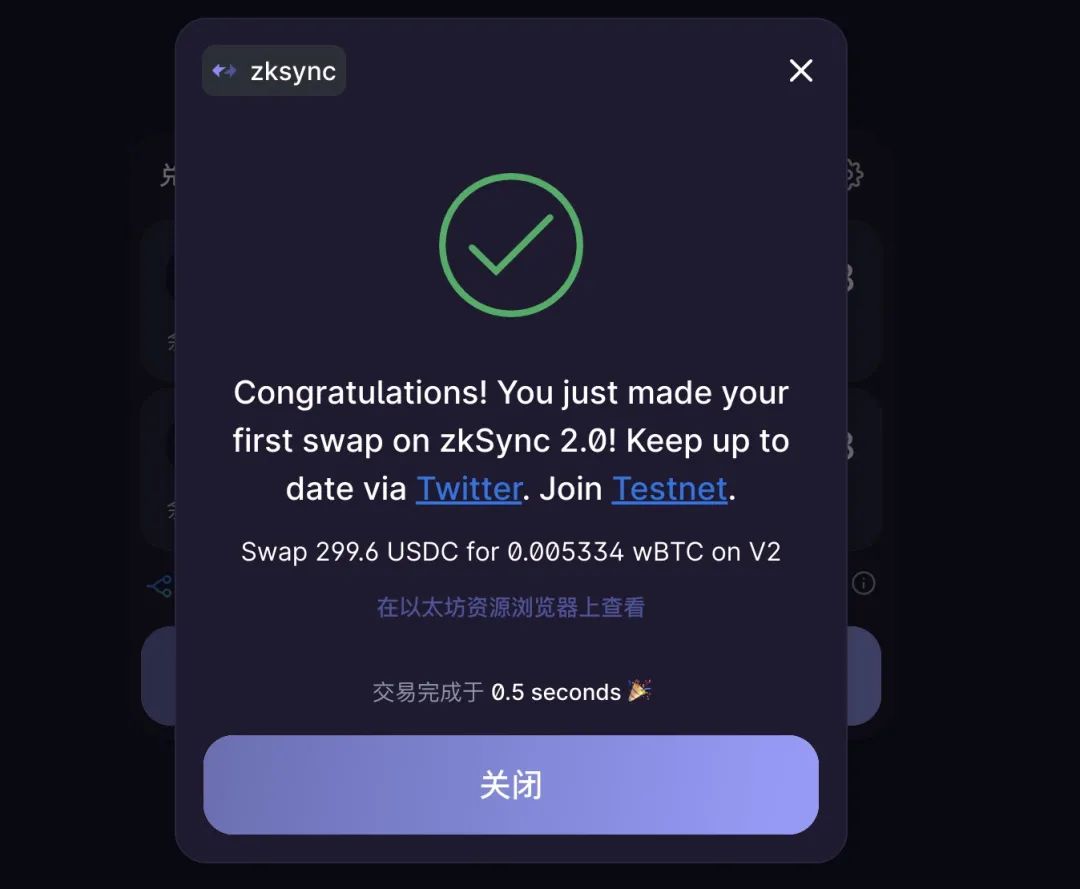
After connecting the wallet and forwarding twitter, the user can receive 300 USDC test token, and then can carry out related tests.

(The test experience is still quite good)
The following are some knowledge points about zkEVM and zkSync 2.0:
1
zkEVM Frequently Asked Questions
1. What is zkEVM and what does it mean?
zkEVM is a virtual machine that executes smart contracts in a manner compatible with zero-knowledge proof calculations. This is the key to building an EVM-compatible ZK rollup layer-2 network while retaining battle-tested code and related knowledge. zkEVM retains the EVM semantics, but it is also friendly to ZK, and it also adopts the traditional CPU architecture.
The introduction of zkEVM represents an important turning point in encryption technology. Over the past year, the development of the entire zero-knowledge proof ecosystem has exceeded the expectations of many experts. Solidity programmers can now access zero-knowledge proofs as first-class citizens. Unmatched scalability, security and UX benefits.
2. What is zkSync 2.0?
We know that the zkSync 1.0 Layer 2 network has been online for nearly a year and a half. The following are some important data of the network:
The transfer cost is about 1/50 of the Ethereum mainnet;
Achieved nearly 4 million transactions;
98% of transactions in the last 4 rounds of Gitcoin grants used zkSync 1.0;
And zkSync 2.0 is an EVM-compatible ZK Rollup layer-2 network built by Matter Labs and supported by zkEVM, which means that applications on the existing Ethereum mainnet can seamlessly migrate to zkSync 2.0 and enjoy ZK Rollup technology extended advantage.
3. How is zkSync 2.0 different from Arbitrum and Optimism?
(1) Higher security: ZK rollup eliminates the dependence on observers, replaces the economic security of game theory with cryptographic security, and users trust pure mathematics instead of motivating participants.
(2) Higher capital efficiency: In the OR scheme, the withdrawal of any asset takes a long time (best case: 1 week), which is a security parameter, shortening it will have an impact on security, and ZK rollup The waiting time is very short. There are currently some cross-chain bridges that can help OR solve the withdrawal problem, but it is still impossible to achieve large-scale transfers, because liquidity providers (LPs) are unlikely to leave so much funds idle.
(3) NFT user experience will be better: in the OR scheme, the extraction of NFT cannot be accelerated (the LP solution is not applicable because NFT is unique), therefore, to extract NFT, OR users actually have to wait for 1 week or longer time.
(4) Lower transaction costs: ZK Rollup is cheaper for most popular crypto use cases because it requires the least amount of data to be published on-chain (no signatures and no transaction parameters). In addition, ZKSync 2.0 will have an extension called zkPorter, which provides a fixed transaction fee of 1-3 cents by moving data off the blockchain.
2
Solidity becomes a first-class citizen of the ZK Rollup universe
In the past, developers had to switch to the ZK language in order to take advantage of the unparalleled scalability, security, and UX advantages of zero-knowledge proofs. Now the situation has changed. After several research and development breakthroughs, zkEVM has the possibility to promote Solidity to a first-class citizen of the ZK Rollup universe.
Using Solidity, Web3 API, Ethers SDK, and native Ethereum signatures, developing on zkSync feels natural and familiar to developers. Audited codebases tested on Ethereum are as secure on zkSync as they are on mainnet. From code to developer tools, from user to developer experience, everything will be compatible.
By making Solidity the native language of ZK Rollups, zkSync preserves many important features of Ethereum:
1. Security
The Solidity language currently protects more than $100 billion in funds, and as of now, more than $1 billion in funds have been hacked. Every lesson learned in security is not free. Auditing companies formed around Solidity and more has spent more than 5 years in the security-focused community, and retaining this expertise is critical.
2. Composability
Most dApps on Ethereum are tightly coupled, and by preserving the Solidity language, zkSync keeps the composability stack intact.
While dApps written in different languages can remain composable, it is not easy. Suppose Uniswap or Aave switch to a new language, which will force many related protocols to adjust, resulting in a huge wave effect!
3. Labor saving
Support for the Solidity language saves you a lot of implementation work and makes it easier to find developers and auditors.
Some people may worry that Solidity is less efficient than the native ZK language, but computational efficiency is no longer the bottleneck. Whether in the past, present, or future, the most scarce resource is programmers. Hiring developers and auditors for Solidity is hard enough, but recruiting for ZK, which has been in development for less than a year, will be even harder! If each ZK protocol has its own language, choosing a language means being locked into a system whose success depends on the entire ecosystem shifting away from Solidity. Also, supporting Solidity through a transpiler may lead to more bugs and lead to inefficient code.
All in all, transitioning to a new programming language is now too costly as an ecosystem.
This article comes from Tao of Yuan Universe, reproduced with authorization.