






SpaceX IPO 첫날 공략: 일반 인기 주식처럼 사지 마세요


- 핵심 의견: SpaceX IPO 첫날은 일반 주식 거래와 다릅니다. 유통 물량이 적고(약 3%) 개인 배정 비율이 높아(약 30%) 양방향 변동성이 극심할 것입니다. 투자자는 전통적인 기술적 분석을 포기하고 오더 플로우(주문 흐름) 거래에 집중하며, 시장이 가격 구조를 형성할 때까지 기다렸다가 행동해야 합니다. 장기적인 판단은 추후 공급 테스트에 의존해야 합니다.
- 핵심 요소:
- SpaceX IPO 가격은 135달러, 조달 자금은 750억 달러, 기업 가치는 1조 7천억 달러이지만, 초기 유통 물량은 약 3%에 불과하여 가격 변동성을 증폭시킵니다. 적당한 매수세만으로도 상당한 충격을 줄 수 있습니다.
- 개인 배정 비율은 약 30%로, 정상 수준의 3~4배입니다. 이는 첫날의 불확실성을 높입니다. 개인 투자자는 추가 매수에 나설 수도 있고, 차익 실현에 나서 첫 번째 공급 물량을 형성할 수도 있습니다.
- 상장 후 15번째 거래일에 나스닥 100 지수에 편입될 가능성이 있습니다. 이는 가격에 민감하지 않은 패시브 매수세를 유입시켜 자금의 성격을 바꾸고, 액티브 자금이 이를 앞서 매수하려는 움직임을 촉발할 수 있습니다.
- 역사적인 인기 IPO(예: Coinbase, Airbnb)는 높은 관심도가 단순 상승을 의미하지 않음을 보여줍니다. 이들은 초기에 극심한 양방향 변동성을 겪는 경우가 많았으며, 추세 추종자보다는 오더 플로우 트레이더에게 더 적합했습니다.
- 첫 실적 발표 후 주식 락업이 해제되며, 이후 70일, 90일, 120일, 180일 및 1년 후에도 단계적으로 해제됩니다. 장기 투자자는 새로운 공급 물량을 시장이 소화할 수 있을지 반드시 주시해야 합니다.
Original Title: SpaceX IPO Day: What Retail Traders Don't See (The Orderflow Read)
Original Author: The Flow Horse
Original Compilation: Peggy, BlockBeats
Editor's Note: Against the backdrop of a mega-IPO, AI narratives, and the repricing of risk assets, the market discussion surrounding SpaceX's listing is shifting from "how much is this company worth" to "how will it trade once listed." But as SpaceX becomes one of the most anticipated tech assets, a more critical question emerges: On the first day of a new stock with no price history, no established options structure, and no clear distribution of holdings, should investors frame their understanding through valuation or market microstructure?
This article is a compilation of The Flow Horse's video content discussing trading strategies for SpaceX's IPO day. The focus is not on SpaceX's long-term fundamentals but on dissecting the capital flows, float, index inclusion, and lock-up expiration rhythm it may face in its early listing stages. The video's author is a market trader with a long-term focus on IPOs and order flow, whose perspective is closer to the order book and trade execution than traditional company valuation analysis.
In this content, the SpaceX IPO is broken down into a set of more fundamental structural issues: It's not a simple "should I buy or not" question, but a process where traders, retail investors, passive capital, and internal shareholders reprice a limited supply of liquidity over different time windows.
First, retail investors are most prone to misjudging the first-day trading environment. In the past, when retail investors traded hot stocks, they typically relied on trend lines, support and resistance levels, prior highs and lows, and opening momentum. But on SpaceX's IPO day, there is no historical chart, no volume profile, no mature options structure. Before the first candlestick forms, the market has no reusable price memory. What truly determines short-term direction now is the order book, volume, VWAP, the opening range, and where buyers and sellers actually exchange hands. This means that if retail investors chase the initial surge in the opening minutes or prematurely use technical analysis to find so-called trends, they are likely taking on the highest risk before a structure has formed.
Second, past hot IPOs do not support the imagination of an "inevitable one-way rally" in the early stages of listing. Coinbase, Airbnb, and ARM all commanded extremely high attention, but they did not immediately establish a stable trend early in their listings; they first experienced violent two-way volatility. In the past, the market easily interpreted hot IPOs as the realization of a consensus sentiment. Now, a more accurate understanding is that they often first become a venue for short-term capital, profit-taking positions, and new buying orders to change hands repeatedly. This means that even with a strong narrative and high oversubscription, SpaceX may not be suitable for trend followers in the first week. Those truly suited for first-day participation are often traders who can quickly read order flow, control position sizes, and accept two-way volatility.
Third, the first-day strategy should shift from "predicting direction" to "waiting for structure." In the past, many traders habitually set a bullish or bearish view before the market opened, then used the first wave of price action to validate their judgment. But for an IPO with a low float like SpaceX, it's more necessary to let the market draw the structure first: Is there support near the $135 level? Is the 5-minute opening range effectively broken? Does a pullback to VWAP hold? Are there recurring hidden buying or selling forces in Level 2 data? The core of trading now is not to rush to a conclusion ahead of everyone else, but to determine who holds the initiative after the market generates its first set of price coordinates. This means the most important thing is not entering the trade at the very first moment, but avoiding being forced into a passive trade at the most chaotic, widest-spread, and most emotionally charged position.
Fourth, investors must understand that different stages are dominated by different capital flows. For the first 15 trading days, SpaceX is more like a short-term trade dominated by low float, emotional capital, and order flow. Around the 15th trading day, the expectation of Nasdaq 100 index inclusion could introduce a second phase of price-insensitive buying. After the first earnings report, unlock supply begins to test the market's ability to absorb. Further out, the lock-up expirations for major shareholders at 70, 90, 120, 180 days, and one year will gradually provide more reliable long-term signals. In the past, IPOs were often judged a success or failure based on the first-day price move. Now, SpaceX seems more like a series of consecutive liquidity tests. This means that long-term judgments should not be based on first-day sentiment, but on whether the price can form a stable bottom after new supply enters the market.
Fifth, trading SpaceX may not only happen in SpaceX itself. Related aerospace and space economy names like Rocket Lab and LUNR could become proxy stocks for the same theme during the listing period. In the past, IPO trading typically revolved around the primary stock. Now, when the primary stock's float is too low, volatility too high, and spreads too wide, related assets might actually provide a clearer trading structure. This means the market isn't just trading SpaceX's stock; it's also trading the industry narrative and liquidity spillover it activates.
If this article were compressed into one judgment, it would be: SpaceX's IPO day belongs to traders; long-term judgments require waiting for supply tests. For a trader, the first day could be the "Super Bowl" of order flow trading. For an investor, the first day's price move shouldn't be over-interpreted. In this sense, the core question of the SpaceX IPO has moved beyond just "should I buy on day one?" It's whether participants can first determine which game they are entering: Day one is about order flow, long-term is about supply absorption capacity. Mixing these two up is exactly why most retail investors are most likely to lose money.
Below is the video content (edited for clarity and readability):
Why Most Retail Investors Could Lose Money in the SpaceX IPO
The most dangerous aspect of SpaceX's IPO day is that many people will trade it like any other ordinary hot stock.
Ordinary stocks have a historical price range, prior highs and lows, volume profiles, and ample market memory. Traders can refer to past support and resistance levels, moving averages, options open interest, and cost basis. But the IPO day is a blank chart. Before the first candlestick appears, the market has no real trading history.
This means drawing trend lines too early is meaningless, and chasing the first surge after the open is easily stopped out by a counter-move. Especially in a low-float environment, prices can spike sharply on temporary buying or drop suddenly due to profit-taking or institutional supply. Retail investors looking only at price appreciation and sentiment can easily enter at the most noisy levels.
The true trading logic on SpaceX's first day is the real-time formation of the auction mechanism (where buyers and sellers seek a balance at different prices). A trader needs to observe: Who is willing to bid up the price? Where are sellers constantly replenishing? Which price levels see high volume but fail to push the price? This order book information is far more important than any pre-drawn technical pattern.
Trading Details: $75 Billion Raise, 3% Float, and High Retail Allocation
SpaceX plans to issue approximately 555 million shares in this IPO, raising about $75 billion at a price of $135 per share, giving it a total valuation of roughly $1.7 trillion. This scale alone makes it a market-defining event.
But what truly determines first-day volatility isn't just the raise size; it's the float. The freely tradable shares in the initial listing period are only about 3%. This means that even modest buying demand can have a significant impact on the price. Chasing by retail investors, position-building by active funds, and small-scale institutional buying can all cause the price to detach from fundamentals in a short time.
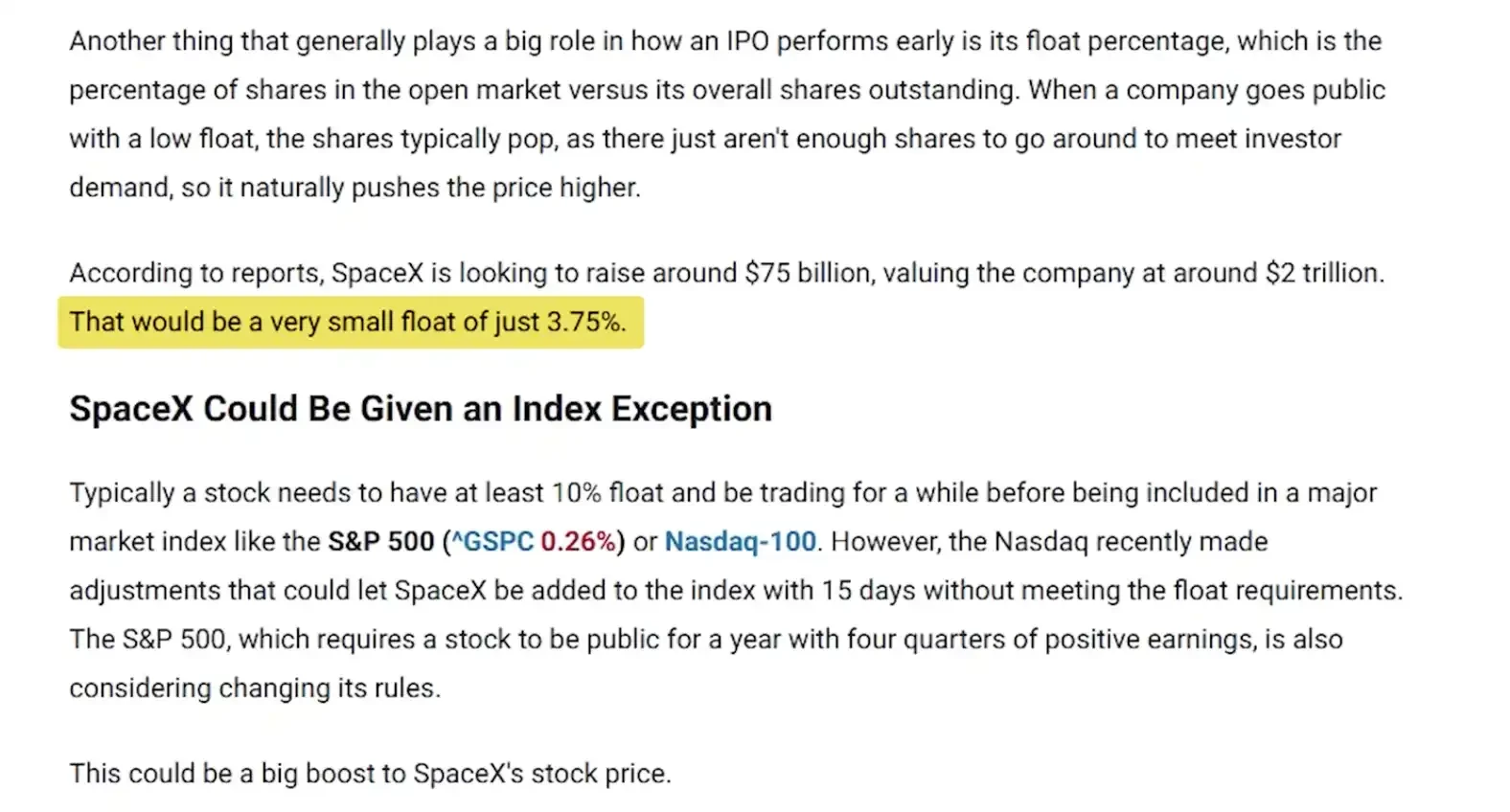
Another special variable is the retail allocation. The retail allocation ratio for this IPO could be around 30%, roughly 3 to 4 times that of a typical IPO. This makes post-open trading even harder to read. On one hand, more retail investors obtaining shares early might reduce the FOMO-driven buying pressure of "not being able to buy" on the first day. On the other hand, these early recipients might also take profits after the open, creating the first wave of supply.
Therefore, the core of the SpaceX IPO isn't simply judging "oversubscription is bullish." It's about understanding the capital structure: an extremely low float amplifies both upside and downside moves, while a high retail allocation could make both buying and selling more aggressive on the first day.
Day 15: Nasdaq Index Inclusion Could Change the Nature of Capital
Another key timeline is the 15th trading day post-listing. According to its setup, SpaceX could be added to the Nasdaq 100 Index (NDX). This arrangement is still subject to final rules and actual results, but the corresponding trading logic is very important.
In the early listing period, the dominant price drivers are fast money, retail investors, active funds, and emotional capital. These funds are price-sensitive and will enter and exit rapidly based on volatility. However, after index inclusion, another type of capital enters the market: passive capital.
The characteristic of passive capital is that it is price-insensitive (it must buy due to index rules or portfolio requirements, not because the price is cheap). Index funds, ETFs, and related tracking products need to allocate constituent stocks according to rules. This buying is often more mechanical and easier for the market to front-run.
Therefore, before the 15th trading day, active funds might try to front-run the expected passive buying. If SpaceX has already built upward momentum in the early listing period, the mechanical buying from index inclusion could further amplify the trend. However, if the first two weeks are weak, this buying alone may not be sufficient to reverse the market picture.
This is another aspect that differentiates the SpaceX IPO from a regular first-day trade: it's not a single point event, but a series of capital flow nodes.
Day One is Order Flow Trading, Not Chart Trading
The most important judgment for SpaceX's first day is: don't treat it as chart trading.
Ordinary traders habitually ask: where is support? Where is resistance? Where is the prior high? Where is the volume profile? Where is the options max pain? But most of these questions have no answers on IPO day. No historical chart means no reliable technical structure; no mature options market means no reference for open interest.
The real questions on the first day are: Where do buyers and sellers agree? Where is there a high volume of turnover? Does buying support appear when the price breaks below the offer price? Do sellers continuously supply when it rallies? This is the core of order flow trading.
The first few critical price levels must be drawn by the market itself on the day. First is $135, the offer price in this context. A trader observes price action relative to $135: Does it quickly recover after breaking below? Does it hold after rallying above? If buying support consistently appears below $135, it suggests this level could become an early cost anchor. If selling consistently appears above $135, it suggests stronger supply overhead.
Second is VWAP (Volume Weighted Average Price, representing the market's average cost for the day). An hour into trading, whether the price is above or below VWAP, and whether it finds support when pulling back to VWAP, directly reflects whether buyers or sellers are in control.
Finally are the first day's high and low. After the close, these levels become the most important structural references for the following days. For a new stock with no historical chart, the first day's price range is the coordinate system the market creates for the first time.
Four Types of Capital Flows Driving the Price
The price volatility in the early stages of the SpaceX IPO can be broken down into four types of capital flows.
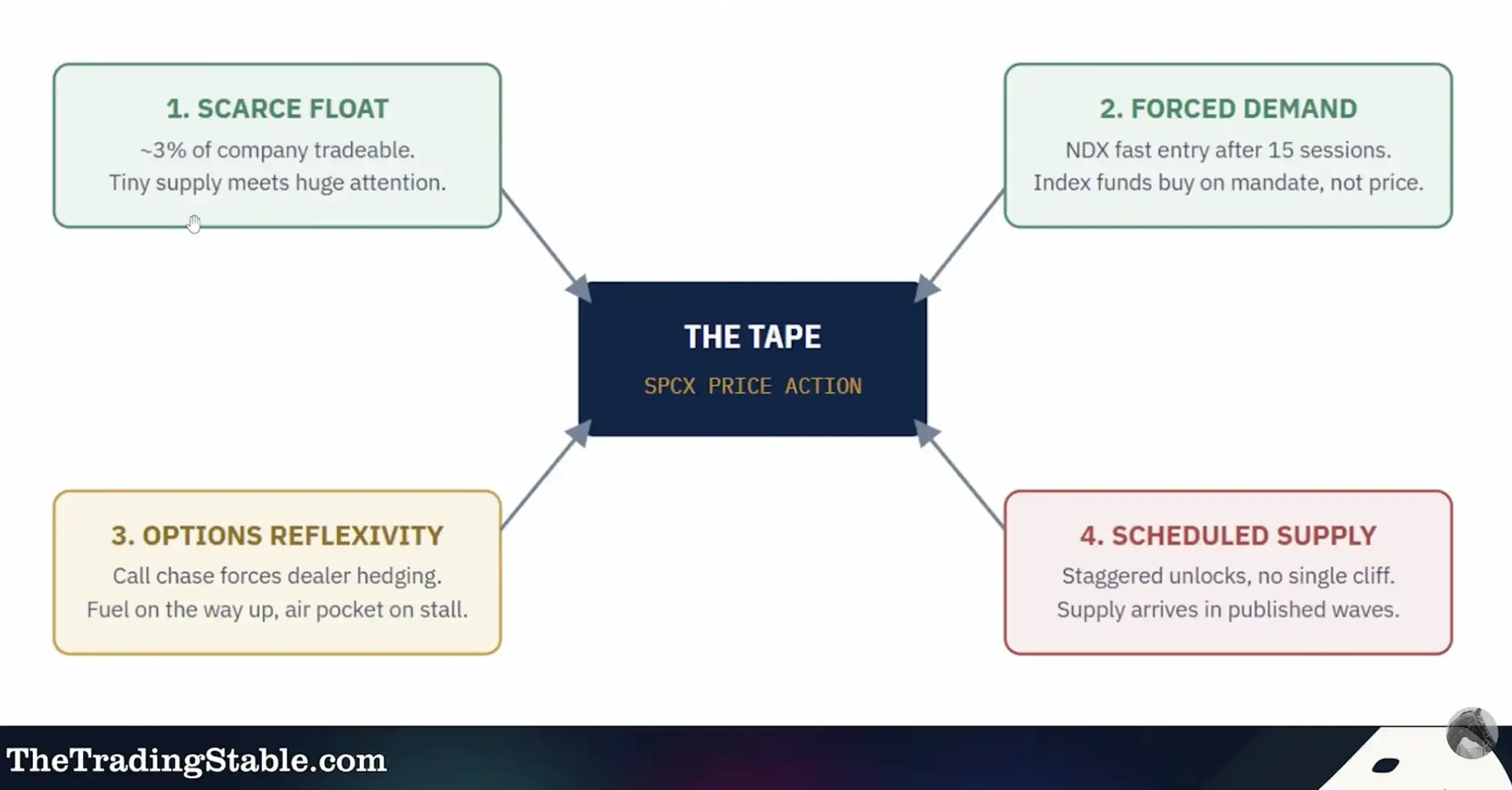
The first type is scarcity buying driven by an extremely low float. A 3% float means very few shares are available for trading. If demand concentrates even slightly, it can push the stock price up rapidly. This is why shorting blindly on the first day is very dangerous. Low-float stocks don't always go up, but they are most prone to squeezing short sellers in a short period.
The second type is passive buying from Nasdaq index inclusion. If included in the NDX on the 15th trading day, index funds and related products must buy according to rules. This capital is not deployed based on valuation but on index weight. For a bull, this is an ideal source of mechanical demand. For a short-term trader, this is a time window that can be traded in advance.
The third type is options reflexivity (where the options market feeds back into the underlying stock price). Once options begin trading, retail investors buying large numbers of call options can force market makers to buy the underlying stock to hedge, creating a gamma cycle (call buying -> market maker hedging -> stock price increase -> more call buying). However, this mechanism usually doesn't appear immediately on the first day and may not mature in the first week.
The fourth type is share unlocks (shares previously restricted from trading gradually entering the market). This introduces new supply and is a risk point all long-term investors must monitor. SpaceX's special aspect is that it's not simply a single lock-up expiration after 180 days; it's likely a phased release of shares.
Lock-up Expiration Schedule: Not a Single Cliff at 180 Days
A common risk point in traditional IPOs is the 180-day lock-up expiration when early investors and employee shares are unlocked en masse, suddenly flooding the market with supply. But the SpaceX unlock structure presented in the video is more complex: it may not be a single cliff, but a series of phased liquidity events.
First, up to 20% of eligible shares could be unlocked 2 days after the first earnings report. This means the earnings report itself is not just a performance event but also a supply event. If the price is driven up by sentiment before earnings, the new supply post-earnings could dampen the momentum.
Second, unlocks may also be tied to price performance. If the stock price stays 30% above the $135 level for 5 out of the 10 trading days before the earnings report, an additional 10% of shares could be unlocked. This type of arrangement causes an upward price move to trigger more supply, creating a dynamic equilibrium: the steeper the rally, the more shares potentially become available for sale.
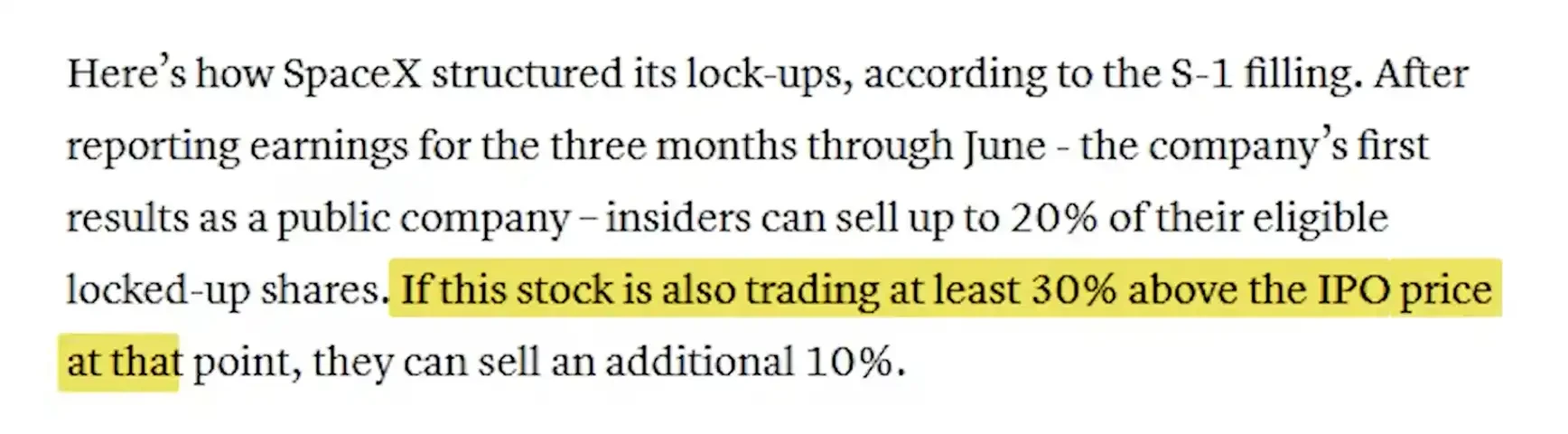
Subsequent milestones are equally important. The video mentions that approximately 7% of shares could unlock around Day 70, Day 90, and Day 120, with full unlocking further out after 180 days. Regarding employee shares, about 5% of employee holdings could be sold immediately after the first earnings report, without needing additional performance or price conditions. Elon Musk and the largest holders likely need to wait over a year, approximately 366 days.
These dates are particularly important for long-term investors. Judging whether SpaceX is forming a true bottom cannot be based solely on the first day's price move. It requires observing whether buying demand can absorb each wave of new supply as it enters the market.
Lessons from Past IPOs: Coinbase, Airbnb, ARM Didn't Start with One-Way Trends
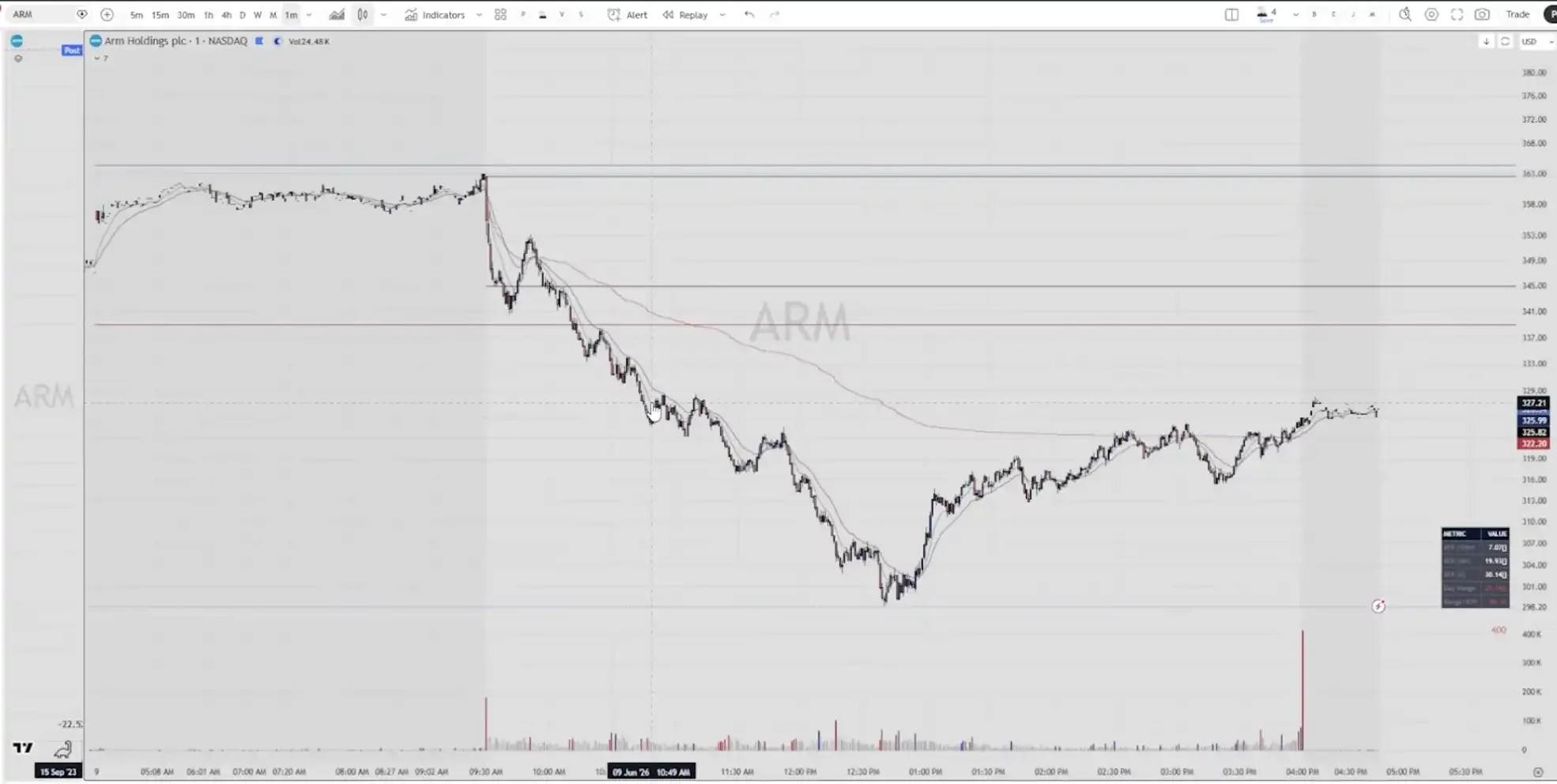
Hot IPOs easily create an illusion: since market attention is high, the price should rally straight after listing. But the early trading of Coinbase, Airbnb, and ARM all demonstrate that hype does not equal a one-way trend.
The video mentions that these hot IPOs experienced massive volatility in their early days. Coinbase had an early trading range of about 119 points, Airbnb about 53 points, and ARM about 22 points. The specific numbers are less important than the point they illustrate: the first few days and weeks of a hot IPO are often characterized by violent two-way trading, not a stable trend.
This environment is more suitable for intraday scalpers and order flow traders than for ordinary trend followers. Trend traders need structure, but the IPO's early stage is precisely when structure is most lacking.
SpaceX could be even more extreme. It is heavily oversubscribed and may allocate a larger proportion of shares to retail investors. This means that after the open, there will be both chasing capital and profit-taking capital. Some will want to buy the Day 15 index inclusion expectation, while others will see the high hype itself as a selling opportunity. When long and short forces are simultaneously crowded, the result is often not a clean trend, but high turnover, high volatility, and high noise.
First Day Trading Strategy: Wait for the Market to Draw Structure, Then Act
The first rule of trading SpaceX on its first day is: do not chase the opening wave.
The opening moments are typically when noise is highest, spreads are widest, and emotions are most extreme. Especially in a low-float environment, the first rally might just be a brief sweep of orders, and the first drop might just be a sharp decline due to a lack of liquidity. A truly tradeable structure requires waiting for the market to form.
The first observation point is $135. If the price breaks below $135 but quickly recovers and reclaims the opening range and VWAP, it suggests genuine support underneath. Conversely, if the price repeatedly tries to rally above $135 but gets sold back down, it suggests the sellers might be in control.
The second observation point is the 5


