






Hyperliquid 선물 계약 논란: 약속했던 SpaceX 주식 총수, 왜 계산이 안 되는 거야?


- 핵심 의견: Hyperliquid 생태계 내 시장 TradeXYZ가 자사 SpaceX 선물 계약 SPCX에 대해 주식 총수(Equity Rebase)를 적용하지 않을 것을 공식 확인했다. 해당 계약의 가격 책정은 오직 시장의 A类 보통주 1주당 가격 예상에만 기반하며, 회사의 총 주식수나 시가총액과는 무관하다. 이전 문서에 명시된 "118.7억 주"는 단순한 교육용 예시였다.
- 핵심 요소:
- TradeXYZ는 자사 선물 계약이 암시적 주당 가격을 추적하는 무기한 계약이며, 총 주식수와 시가총액은 모두 입력 변수가 아니라고 명확히 했다.
- 이전 문서에 등장한 "118.7억 주"라는 숫자는 공식적으로 교육용 예시로 해석되었으며, 오해를 불러일으켰기에 제거되었다.
- TradeXYZ는 향후 SPCX 및 모든 시장에서 총 주식수나 시가총액에 기반한 계산 기준을 사용, 공개 또는 의존하지 않을 것이라고 확인했다.
- SPCX는 SpaceX IPO 후 표준 외부 오라클 가격 책정으로 전환될 예정이며, 가격은 점차 공개 시장 거래 가격에 수렴할 것이다.
- 커뮤니티 논쟁의 핵심은 사용자들이 이미 "118.7억 주"를 제품 규칙으로 받아들였으나, 공식의 해석 변경으로 인해 투명성과 기대 관리에 대한 의문이 제기된 데 있다.
- 바이낸스 등 경쟁 플랫폼은 유사한 계약에 대해 리베이스를 적용하여 총 주식수를 130.8억 주로 조정한 바 있으며, 이는 플랫폼 간 상품 로직의 차이를 부각시킨다.
Original | Odaily Planet Daily (@OdailyChina)
Author | Azuma (@Azuma_eth)

Yesterday, Odaily Planet Daily published an article analyzing the reasons for the huge price differences in SpaceX pre-market contracts on platforms such as Binance, OKX, and Hyperliquid — it is recommended to read "Why Are the SpaceX Pre-Market Contracts So Different in Price Across Exchanges?" first.
The article mentioned that when Hyperliquid previously listed the SpaceX pre-market contract SPCX through the ecosystem's HIP-3 market TradeXYZ, its documentation disclosed a share count of approximately 11.87 billion shares. However, this reference was later deleted, sparking community speculation about whether the market would undergo a Rebase.
- Odaily Note: Rebase refers to correcting share data and corresponding position status based on real-world conditions. For example, on the evening of June 8, Binance announced a Rebase for its pre-market contract SPCX, adjusting the share count from the estimated 11.87 billion to the 13.08 billion shares disclosed in the latest IPO plan.
TradeXYZ Confirms: No Rebase!
Today, TradeXYZ officially responded to this matter.
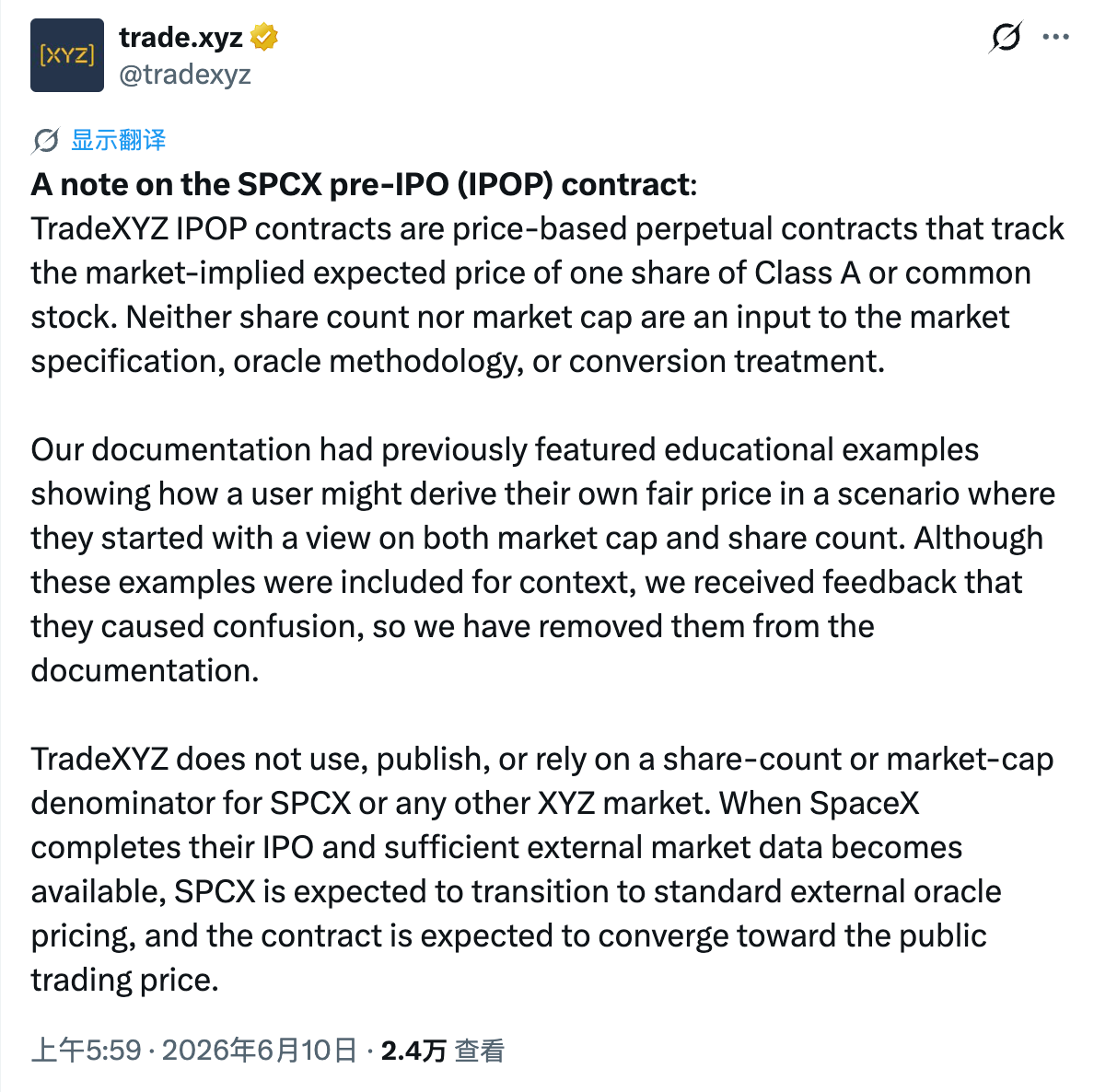
TradeXYZ stated that its pre-market contracts, including SPCX, are price-based perpetual contracts that track the market's implied expected price per share of Class A common stock (or common stock). The total share count and company market cap are not input parameters in the market rules, oracle pricing method, or final conversion mechanism.
Regarding the "11.87 billion shares" figure previously included in the documentation, TradeXYZ explained that the official documents previously contained some educational examples illustrating how users could derive a "reasonable stock price" if they had expectations about the company's market cap and total shares. These examples were intended solely to help with background understanding, but the team received feedback that they could cause confusion, so they have now been removed from the documents.

To clarify, TradeXYZ confirms that it will not use, publish, or rely on any calculation benchmark based on total shares or market cap for SPCX or any other XYZ markets in the future. Once SpaceX completes its IPO and sufficient external price data is available in the market, SPCX is expected to transition to a standard external oracle pricing mechanism. At that time, the contract price is expected to gradually converge with SpaceX's public market trading price after listing.
In simpler terms, TradeXYZ has confirmed it will not correct share data through a Rebase. As for the previously mentioned "11.87 billion shares," that was just an example — don't take it seriously... Going forward, TradeXYZ's pre-market contracts will not mention share data either; whatever the actual share count of the company is in reality, that's what TradeXYZ will track by default...
Community Controversy: The Promised Numbers Are No Longer Valid?
Unsurprisingly, TradeXYZ's statement has sparked significant controversy within the community. The core reason is that for participants in SPCX (especially those who only opened positions on Hyperliquid), the general expectation was that SPCX's pricing logic was directly tied to SpaceX's share count.
The "11.87 billion shares" figure was explicitly written in the official documentation. TradeXYZ had previously explained that if an investor expected a certain valuation for SpaceX and assumed a total share count of approximately 11.87 billion, they could derive a corresponding reasonable price range. Therefore, many users had already regarded this as part of the product's rules.
Now that the official source has deleted the data and described it as merely an "educational example," this naturally gives some users a sense of being "backstabbed."
Although from today's statement, TradeXYZ is trying to emphasize a different product logic — i.e., unlike platforms such as Binance and OKX, which map stock prices through market cap and shares, TradeXYZ prefers to view SPCX as an independent trading market where the price directly reflects market participants' expectations for SpaceX's future stock price, rather than a theoretical result calculated through share data.
However, for the vast majority of users, it is not easy to meticulously understand the product rules and design differences across different markets. Meanwhile, within the same period, platforms like Binance and OKX were all publicly discussing share counts, valuation mapping, and Rebase mechanisms. Naturally, the market used the same logic to evaluate TradeXYZ and Hyperliquid...
The discrepancy between user perception and product design ultimately evolved into this debate over product transparency and expectation management.
Pre-Market Contract Market: Will the Landscape Change?
No matter how this controversy ultimately ends, the SpaceX pre-market contract has already become the largest and most closely watched "IPO preview" in crypto market history.
More notably, as more and more unlisted star companies like Anthropic and OpenAI are tokenized for on-chain trading, the pre-market contract track itself is entering a new phase of competition.
In the past, the competition between exchanges focused more on who could list hot targets first. However, after the SPCX incident, the market may begin to pay more attention to another aspect — whose rules are clearer, whose pricing logic is more transparent, and who can provide users with a more stable and predictable product framework.


