






Departing from traditional bull and bear cycles, the market has entered an era of rotating bubbles.


- Core Viewpoint: The current financial market has shifted from the slow, sustained bull and bear market cycles of the past to a "chain-storm" market composed of a series of rapidly rotating, interconnected hot sectors. Investors need to let go of their obsession with single trend themes and instead identify structural changes and cyclical logic from a higher dimension.
- Key Elements:
- Fundamental Change in Market Structure: Compared to the past few decades, eight major changes, including the universalization of the speculative crowd, the formation of permanent buying pressure, the rise of passive investing, and the dominance of multi-strategy funds and high-frequency trading, have collectively shaped the current market environment, and this trend is irreversible.
- Market Pattern Formation: Market hotspots are like summer thunderstorms, triggered by specific catalysts and going through stages of "dormancy - ignition - narrative - divergence - collapse." Capital flows out of a fading hotspot, acting like a wedge of cold air that ignites a new wave of activity in an adjacent sector.
- Key Structural Factors: Low transaction costs, price-insensitive passive index investing, converging risk management in multi-strategy funds leading to concentrated market fragility, and zero-delay information dissemination all amplify sentiment and trends.
- Investor Group Divergence: The market primarily favors two types of investors: industry experts with a deep understanding of technological barriers and profit logic, and trend observers who can perceive mainstream capital flow patterns and market sentiment.
- Continuous Abundance of Future Themes: Upstream and downstream links in areas such as AI infrastructure, robotics, cryptocurrency, nuclear fusion, and quantum technology will continue to serve as potential hotspots, providing ample fuel for rotation.
Original Author: Smac, Partner at Compound VC
Original Translation Compiled by: Saoirse, Foresight News
Editor's Note: The current market is witnessing a rapid succession of hotspots, with the AI frenzy sweeping the scene, leading some to question whether it will repeat the fate of the metaverse craze. Amidst the noisy market, people are often swept up by immediate trends, losing sight of long-term trajectories. To make rational judgments, one must learn to zoom out. In this article, Compound VC partner Smac uses a meteorological analogy to dissect the market logic behind these successive bubbles.
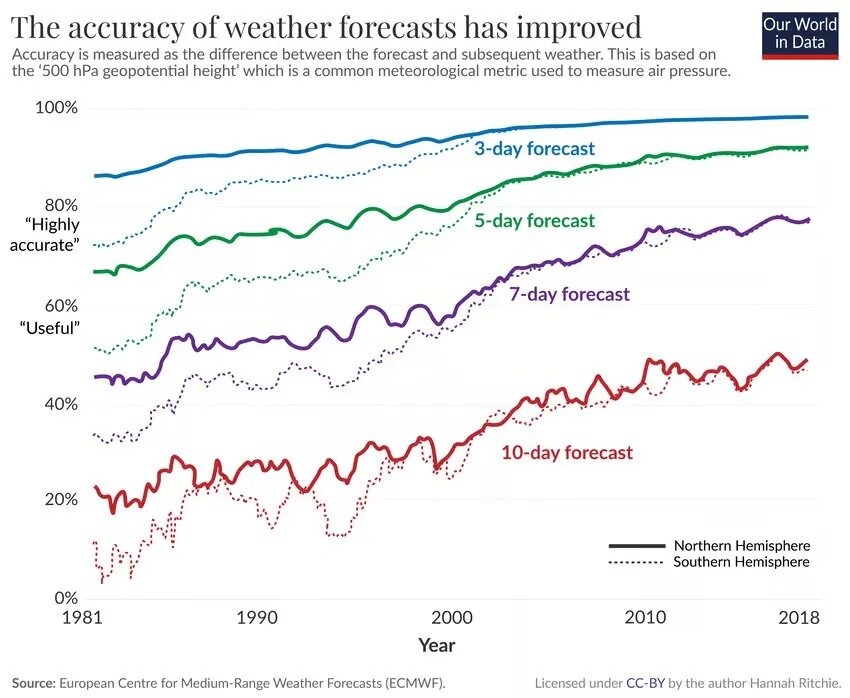
Meteorology is a fascinating field. Over the past fifty years, various weather prediction tools have continuously evolved, and the accuracy of weather forecasts has correspondingly improved. Today's five-day forecast is as precise as the single-day forecast from thirty years ago.
To most people, weather is a single, coherent moving system: clouds roll in, rain falls, the rain stops, and it clears up. Imagine a winter cold front approaching; the image that likely comes to mind is a vast gray cloud cover blanketing hundreds of miles, dumping heavy snow. Meteorologists call this type of weather stratiform, simply put, it's like a layered cake – any area under the cloud cover experiences the same weather changes.
But weather isn't just one form. If you've ever seen a summer thunderstorm over the plains, you know it operates very differently. First, a single convective cloud forms: warm, moist air near the ground rises, meets cold air aloft, water vapor condenses, and towering local cumulonimbus clouds develop. Within an hour, hail, lightning, and torrential rain arrive, reducing visibility to less than a hundred meters.
When the cloud reaches its peak, its energy is fully released, and it begins to dissipate. The storm's downdraft of cold air spreads outwards at speeds up to 40 miles per hour. When this cold air hits the surrounding warm, moist air that hasn't yet formed a storm, it acts like a wedge, pushing the warm air upwards again.
As long as there is sufficient instability in the atmosphere, this "cold air wedge" will spawn a new convective cloud cluster about a dozen miles from the original storm.
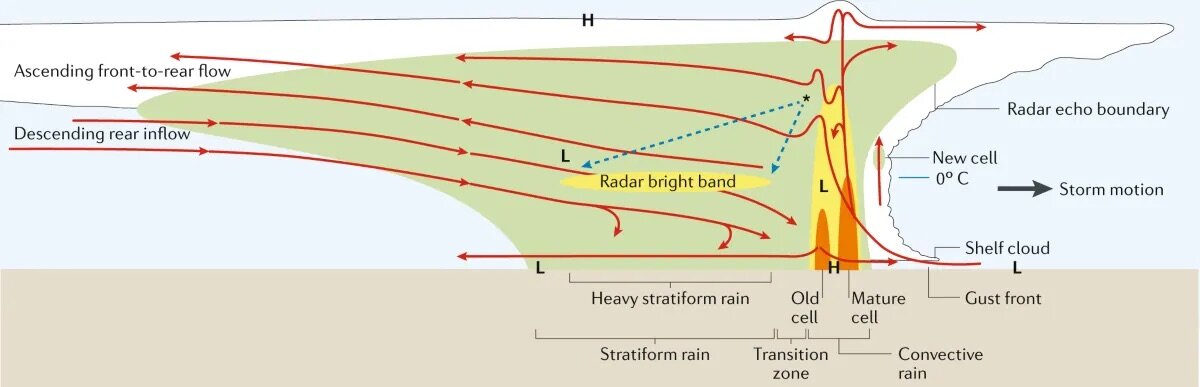
This new cloud cluster couldn't form on its own. The energy was already stored in the atmosphere, but lacked a trigger. The dissipating storm provided just that. Then, the new cluster repeats the evolution process of the previous storm.
When multiple convective cloud clusters form in succession, they constitute a mesoscale convective system. Someone on the ground only experiences each storm individually, each one feeling like the entire weather system. On one side, it's calm, people oblivious to the approaching rain and wind; on the other side, the rain has already cleared. But from a satellite perspective, you can see a line of independent cloud clusters, each at a different stage of development, moving forward until they deplete the warm, moist air along their path.

A supercell thunderstorm near sunset near Amistad, New Mexico
This kind of successive storm system has different formation conditions compared to a single frontal weather system. It relies on a specific atmospheric environment:
- Warm, moist air near the surface, acting as the storm's "fuel";
- Dry, cold air aloft, encouraging warm air to rise continuously, creating atmospheric instability;
- Varying wind directions at different altitudes, causing storms to rotate and move laterally, known as wind shear.
When these three conditions are met simultaneously, successive storms occur.
Enough meteorology; back to the main point: the meteorological phenomenon described above is almost identical to the current state of financial markets.
The past market was like a stratiform weather system: a bull market and a bear market alternating, with slow sector rotations, each cycle lasting for years. The period from 1982 to 2000 was a long bull market, followed by the dot-com bubble, and then the real estate and credit cycle from 2003 to 2007. These cycles were long and clear. Even if an investor misjudged the timing by a few years, understanding the major trend would still allow them to profit in the end.
But today's market is nothing like that. We are in a chain reaction of convective storms: each hot sector hits like a successive storm, and those within it feel that this particular wave is unstoppable and defines the entire landscape.
Capital flows out of waning themes, in turn spawning new booms in adjacent fields. The pace of market focus shifts has accelerated dramatically. AI infrastructure, GLP-1s (a class of diabetes drugs popular for weight loss effects, now a hot investment track), stablecoins, quantum technology, nuclear energy, distributed autonomous technology, robotics, aerospace... Each sector experiences a complete boom cycle, gathers a group of loyal participants, runs through a full narrative lifecycle, and inevitably faces a downturn. The "cold air" spreading from the dissipation of the previous boom ignites the next hotspot in a new area.
Refusing to admit that the current market has fundamentally changed is self-deception. People love to joke about "this time is different," but willfully ignoring the permanent transformation of the financial market environment is either intellectual laziness or stubbornly living in a fantasy of the old market.
A Market Landscape Unlike the Past
For a long time after World War II, the rhythm of financial markets resembled a slow-moving weather system. A bull market could last ten, fifteen, or even twenty years, and sector rotations always revolved around long-term, overarching trends.
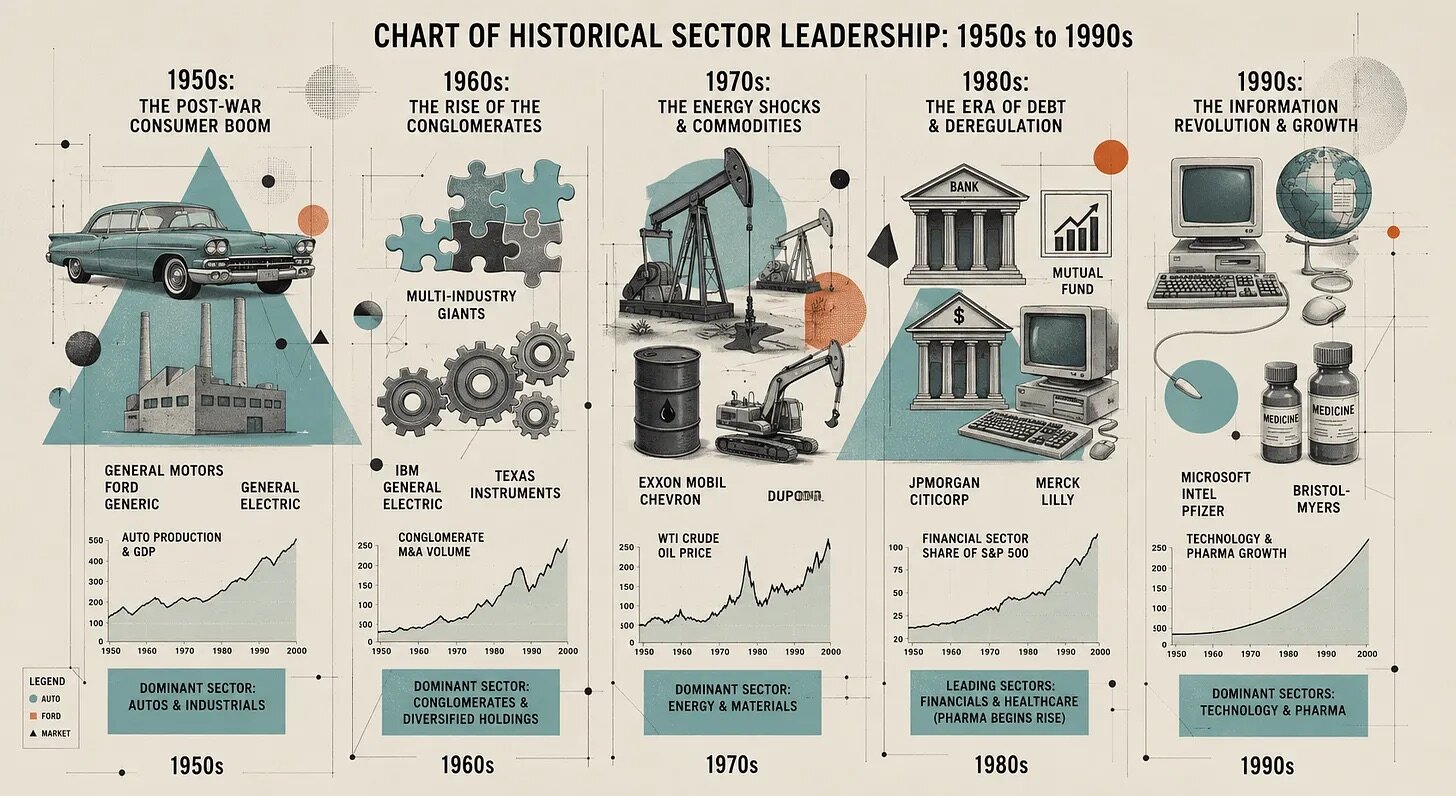
Approximate Timeline of Industry Themes and Leading Sectors
Back then, sector shifts occurred within a unified macro environment. Only at landmark turning points in history was the overall market landscape completely overhauled, such as the collapse of the Bretton Woods system, Volcker's anti-inflation policies, the peak of the dot-com bubble, and the global financial crisis.
This market structure was formed by numerous structural factors: high trading costs in the past, extremely low retail participation, which forced long-term holding habits; pensions as the primary vehicle for retirement assets; the S&P 500 index dominated by manufacturing, energy, banking, and retail companies, with profit growth for top companies roughly synchronized with overall economic growth, leading to stable and predictable trends. Simultaneously, information traveled slowly; after a company's annual report was released, most investors often wouldn't get the details for weeks.
Market volatility was also relatively balanced in the past. Bull markets were followed by deep corrections, with market leverage gradually clearing out over long adjustment periods; rebounds in bear markets were similarly gradual. The market lingered in different emotional ranges for extended periods, and overall shifts happened on a quarterly or yearly basis.
To continue the meteorological analogy: the past market had moderate fuel, high atmospheric stability, and weak wind shear. Trends were long and stable, allowing investors to plan calmly. Today, all environmental conditions have changed, some completely reversed, leading to a fundamental transformation of the market structure.
Where Did the Change Come From?
Numerous changes are intertwined, amplifying each other, and each individual change is enough to reshape the entire market. In summary, there are eight core transformations:
- Democratization of Speculation
- Formation of Permanent Bid
- Passive Investing Creates Inelastic Counterparties
- Rise of Multi-Strategy Funds and HFT, Disappearance of Middle-of-the-Road Forces
- Volatility Artificially Suppressed
- Complete Change in Index Composition Structure
- Elimination of Information Lag
- Shift in Fiscal and Monetary Environment
Democratization of Speculation
The participants in today's market have visibly changed. In the 1990s, retail trading accounted for only 10% of total US stock market volume. Due to high commissions, retail investors were mostly long-term holders of individual stocks, with very little active speculation.
Robinhood pioneered zero-commission trading and the payment for order flow model; in the fall of 2019, Schwab followed suit by eliminating trading commissions, with Fidelity, TD Ameritrade, E*Trade and others quickly copying, completely rewriting the industry rules.
The COVID-19 pandemic accelerated this trend: fiscal stimulus checks, people stuck at home, and mobile trading apps deliberately gamifying trading. From 2020 to 2021, retail trading volume share surged to 25%. Many thought it was a short-term phenomenon, but high retail participation has persisted. On April 29, 2025, amid sharp market volatility caused by tariff policies, JPMorgan data showed that retail order flow accounted for a record high of 48% of the market. On regular trading days, retail volume is also more than double pre-pandemic levels; during major market swings, this share can reach up to 35%.
A deeper change lies in what retail investors are trading. Single-stock options have become a mainstream choice for retail, with 0DTE (zero days to expiration) options exploding in popularity. Newer participants are predominantly young, hold highly concentrated positions, and trade following market themes. Crucially, these investors often use special methods to leverage their bets (leverage that doesn't show up in standard margin data), make trading decisions based more on price action than corporate fundamentals, and are highly susceptible to following others' actions.
In meteorology terms: today's market has more abundant "warm, moist air" near the surface than ever before, with stored potential energy at historic highs.
Formation of Permanent Bid
I've written about this before. Simply put, the US retirement security system has shifted from defined-benefit pensions to defined-contribution plans. Now, individuals must plan their own retirement finances. This manifests in the market as a large, price-insensitive, passive flow of capital buying stocks every pay cycle, creating an automated permanent bid.
The logic of traditional pensions was completely different: defined-benefit plans needed to manage duration risk against liabilities. Managers would actively judge market valuations; if they thought stocks were too expensive, they would adjust asset allocation and buy more bonds. Even if the pace of rebalancing was slow, it was far more active than today's purely passive permanent bid.
This is crucial: the marginal trading capital in the market, the money that sets prices, now has far more influence than in the past.
Passive Investing Creates Inelastic Counterparties
The essence of passive index investing is to buy and sell strictly according to constituent weights, regardless of price. The higher a stock's market cap, the more passive capital flows into it, and vice versa. This mechanism inherently embeds momentum into the market's underlying logic: the stronger a holding performs, the more passive money it attracts. The strong performance of the "Magnificent Seven" tech stocks stems significantly from this.
For years, there have been countless articles analyzing the concentration of index weights towards top companies. Of course, these top companies also have strong earnings and growth power, so this concentration isn't wholly unreasonable. But the core problem is: passive capital has no natural "take-profit switch."
Rise of Multi-Strategy Funds and HFT, Disappearance of Middle-of-the-Road Forces
Alongside the formation of passive permanent bids, the active trading space has also undergone immense change, marked by the rise of multi-strategy platform trading firms. Firms like Citadel, Millennium, Point72, and Balyasny gather hundreds of independent portfolio managers, each running a specific trading strategy while being tightly constrained by risk limits. The assets under management of these platforms have exploded, with funds concentrating towards the top, mirroring the concentration in stock index constituents.
Simultaneously, high-frequency trading now accounts for 50-60% of US equity volume and up to 75% in futures markets. This combination has created a highly fragile market environment: these trading firms are often each other's counterparties, and the market's price discovery function is weakened. A large portion of the volume on the screen is just capital circulating within this ecosystem.
Under normal conditions, bid-ask spreads are very tight, which is good. But when a thematic narrative breaks, market positioning becomes extremely unbalanced, or multiple firms' risk limits are triggered simultaneously, the market microstructure breaks down instantly. The risk exposures of all these portfolio managers are highly correlated, and their stop-loss rules are similar. If one firm is forced to deleverage, others will follow suit. The market crashes in February 2018, August 2019, March 2020, and August 2024 are classic examples. The market structure that drives these events is now deeply entrenched and will recur.
Traditional fundamental long/short hedge funds are being squeezed out: these funds relied on deep research for stock selection, holding 20-40 stocks over investment periods spanning several quarters. Today, such funds are either being absorbed by large asset management platforms or moving into private markets, family offices, or single-strategy funds. In my view, significant alpha can still be found by understanding thematic rotations and having patience amidst the churn of short-term capital.
Volatility Artificially Suppressed
Combining the points above, the current behavior of volatility makes sense. Data shows that since 1990, the VIX (fear index) closed below 20 on two-thirds of trading days. The daily correlation of volatility is around 85%, meaning today's volatility level tends to persist from yesterday.
However, the way market volatility switches regimes has become extreme and unbalanced: extensive research shows that once suppressed volatility breaks through a critical point, it erupts violently in just a few days. Conversely, the process of volatility declining is very slow, often taking weeks.
There are multiple structural reasons behind this: a massive "short volatility" industry has been born. The proliferation of 0DTE options forces market makers' hedging activity to further suppress intraday volatility. The market remains quiet for long periods, with risk accumulating; when tail risk hits, all participants flee simultaneously.
Simply put, the distribution of market volatility has become distorted: long periods of low volatility accumulation, eventually leading to a more violent release of risk.
Complete Change in Index Composition Structure
The sixth change is the composition of the stock indices themselves. In 1980, the S&P 500 was dominated by manufacturing companies, with industrials, materials, energy, financials, and consumer staples leading. The earnings growth of these companies roughly tracked GDP, with smooth growth curves, and valuation multiples would mean-revert around a reasonable center. Even forecasting Procter & Gamble's earnings five years out wouldn't lead to huge errors.
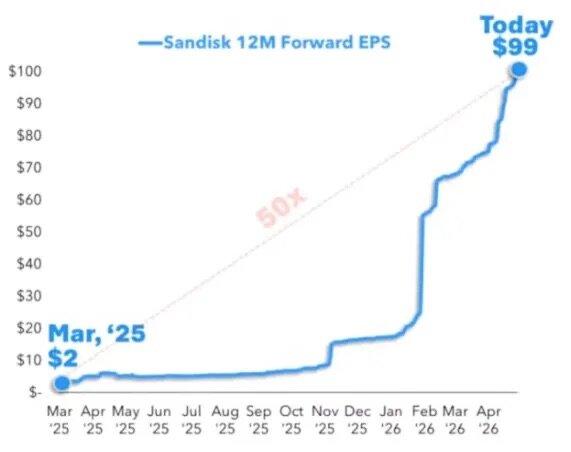
Today's landscape is entirely different. Information technology, communication services, plus tech-heavy consumer discretionary names like Amazon and Tesla, together account for over 40% of the S&P 500 weight. The earnings models of these companies are no longer linear: the marginal distribution cost of software products is nearly zero. And the AI sector is particularly uncertain – will AI labs become the core infrastructure for the next half-century, or just a money-burning black hole? Market opinions are polarized.
For these companies, forecasting short-term earnings is difficult enough, long-term value is highly variable, causing valuations to swing wildly. Corporate valuations no longer rely solely on financial statements; market narrative has become a core influence. For investors who can anticipate the direction of frontier technology, identify competitive moats, and map out future emerging markets, there are tons of alpha opportunities here.
Traditional manufacturing companies expanded capacity gradually, DCF model outputs were relatively stable, and valuation multiples more easily reverted to reasonable levels. Today, a company's valuation depends heavily on the market's acceptance of its story. I'm not saying traditional valuation frameworks are obsolete; this is just the objective reality of today's new economy companies.
Today's mainstream indices are full of these long-duration, narrative-driven companies. The steeper the atmospheric temperature gradient, the more energy stored. Similarly, the more of these companies exist, the greater the potential energy embedded in the market, and once a trigger occurs, price swings will be more violent.
Elimination of Information Lag
Everyone can see this intuitively, but its impact is often underestimated. For most of financial history, the dissemination of market-relevant information was constrained by distribution channels. Today, information travels with almost zero lag.
Position data, especially, spreads faster than ever. Investors can see industry-renowned figures reacting to news in real-time, and more and more people proactively disclose their holdings. This torrent of real-time information constantly fuels comparisons. Screenshots of profits are everywhere, stories of small amounts turning into millions go viral, and FOMO (fear of missing out) is continuously stoked.
Shift in Fiscal and Monetary Environment
This point needs little elaboration, summarized as follows:
- US monetary policy has been persistently loose, with low real interest rates;
- Quantitative easing continuously expanded the Fed's balance sheet;
- Low discount rates pushed up the prices of all long-duration assets;
- Fiscal policy intensified, with various subsidies and industrial bills being enacted;
- Fiscal deficits reached wartime levels despite full employment;
- The economy exhibits a K-shaped divergence, with financial markets decoupling from the real economy.
How Do the St


