






If Hyperliquid is the new Nasdaq, which projects are acting as brokerages?


- Core Insight: In the current bearish crypto market environment, entrepreneurial teams are turning to the Hyperliquid ecosystem to find a breakthrough. By building upper-layer applications such as trading frontends, strategy platforms, and HIP-3 custom markets, they are playing the role of on-chain "brokerages," thereby capturing traffic and value, and driving Hyperliquid's evolution towards an "on-chain Nasdaq."
- Key Elements:
- Within the Hyperliquid ecosystem, third-party teams can deploy customized perpetual contract markets based on Hyperliquid's underlying liquidity via HIP-3. This is similar to how Nasdaq allows brokerages to operate, opening up the upper-layer "brokerage" market space.
- These "brokerage" projects primarily generate revenue through fee sharing (correlated with trading volume) and the expectation of HYPE token appreciation. Some projects also generate income through derivative services.
- A typical project, Trade.xyz, has captured over 90% of the HIP-3 market share. By bringing traditional assets like the Nasdaq index and gold onto the chain, it expands Hyperliquid's asset boundaries.
- Dreamcash focuses on mobile experience and lightweight design to lower the barrier for users. With over 100,000 total downloads across two platforms, it aims to capture Hyperliquid's user base boundaries.
- Ventuals leverages the flexible settlement rules of HIP-3 to package Pre-IPO equity of unlisted companies as on-chain perpetual contracts, providing future price discovery for these assets within the on-chain market.
- The symbiotic relationship between Hyperliquid and its upper-layer applications forms a moat: every new application brings in fresh traffic and trading scenarios, while the protocol shares fees and expands its liquidity network.
Original | Odaily Planet Daily (@OdailyChina)
Author | Azuma (@azuma_eth)

As the cryptocurrency market continues to struggle with sluggish conditions and shrinking liquidity, entrepreneurs in the industry are facing unprecedented pressure to break through.
However, Odaily has recently learned that several startup teams have begun to view the Hyperliquid ecosystem as a path forward. They hope to attract users to Hyperliquid while capturing their own value by building trading frontends, strategy platforms, AI agents, and HIP-3 custom markets (which allow customization of oracles, leverage limits, and settlement rules).
In the past, building a frontend to drive traffic to a DEX might have seemed unimaginative. The market has always held the inertial belief that the real value is captured by the liquidity, matching engine, and the underlying protocol itself, not by the frontend windows attached to them.
However, as the market's perception of Hyperliquid has elevated it to the level of an "on-chain Nasdaq," the value and potential of this business are also changing.
Odaily Note: Refer to "220 Days After Trade.xyz Launch, Hyperliquid is Becoming the 'New Nasdaq'"
Analogous to the traditional stock market, retail investors don't trade directly on the Nasdaq or NYSE. The platforms that truly build relationships with users are brokerage firms like Robinhood, Interactive Brokers, and Charles Schwab. The exchange provides the underlying market, liquidity, and matching engine; the broker handles the user interface, product design, and experience optimization.
If the hypothesis of Hyperliquid becoming the new generation of Nasdaq holds true, then applications built on Hyperliquid, responsible for directly interfacing with users and optimizing the trading experience, are no longer simple frontends. Instead, they are more akin to "brokerage firms" in the traditional financial system.
Starting with HIP-3: How Do These "Brokers" Profit?
Before delving into the specific "broker" platforms, we need to briefly address two questions. First, what is HIP-3? Second, how can projects based on HIP-3 generate revenue?
Firstly, it's important to clarify that not only HIP-3 projects can "entrepreneur" around Hyperliquid. Theoretically, any team can build its own product based on Hyperliquid's underlying liquidity and trading capabilities. Some choose to build trading frontends, others focus on mobile applications, and still others create strategy platforms, AI agents, or asset management tools. They collectively share the responsibility of driving traffic to Hyperliquid and expanding its user base.
Among all these directions, HIP-3 is arguably the track with the highest imagination and some proven success cases. Simply put, HIP-3 allows third-party teams (Builders) to deploy their own perpetual contracts and operate their own trading markets based on Hyperliquid's underlying liquidity and matching engine.
This means that startup teams no longer need to reinvent the wheel by building their own chain or matching engine, nor do they have to bear the R&D and security costs of high-performance trading infrastructure. Instead, they can directly leverage Hyperliquid's mature infrastructure to build the layer closest to the user.
In a sense, this is highly similar to the brokerage system in traditional finance. Nasdaq itself doesn't handle investment advisory, UI design, community management, or strategy products for users; these tasks are ultimately completed by brokers like Robinhood. Therefore, the significance of HIP-3 can be understood as further opening up the "broker" market space on top of Hyperliquid.
Regarding the profit models of these "brokers," while some projects may generate revenue through derivative services (like performance fees from asset management and strategies), the most direct source of income for these "broker" projects currently remains fee rebates and the appreciation expectation of HYPE.
According to Hyperliquid's current mechanism, third-party deployed markets adopt higher fee standards than the native market, with a significant portion being returned to the deployer or frontend operator. This means that once a frontend successfully captures the user entry point, it unlocks a real, continuous cash flow directly tied to trading volume. If a frontend can achieve tens of billions of dollars in daily trading volume, relying solely on fee rebates can create a highly scalable revenue stream.
Furthermore, Hyperliquid requires third parties to stake at least 500,000 HYPE (the team has indicated this threshold will be gradually lowered) when deploying custom trading applications, primarily to ensure commitment and quality. Given the strong recent performance and fundamentals of HYPE, its appreciation potential is also a core revenue source for such projects.
Looking ahead, the eventual token issuance by the upper-layer "broker" projects themselves could also become a potential source of revenue, a point that needs no further elaboration.
Breakdown of Representative Projects
Trade.xyz: Bringing US Stocks, Commodities, and Indices onto Hyperliquid
The first choice to showcase Hyperliquid ecosystem's potential is undoubtedly Trade.xyz.
To summarize Trade.xyz in one sentence: "Bringing assets from traditional financial markets onto Hyperliquid." Currently, Trade.xyz has successively listed perpetual contract products including the Nasdaq Index, S&P 500 Index, Gold, Crude Oil, and certain US stocks. For crypto users, this means they can directly participate in the price fluctuations of traditional financial markets through Hyperliquid's liquidity system without leaving the on-chain environment.
As of now, Trade.xyz holds a dominant share in both open interest (OI) and daily trading volume. Real-time data from Artemis and The Block indicates it has monopolized over 90% of the current HIP-3 market share.
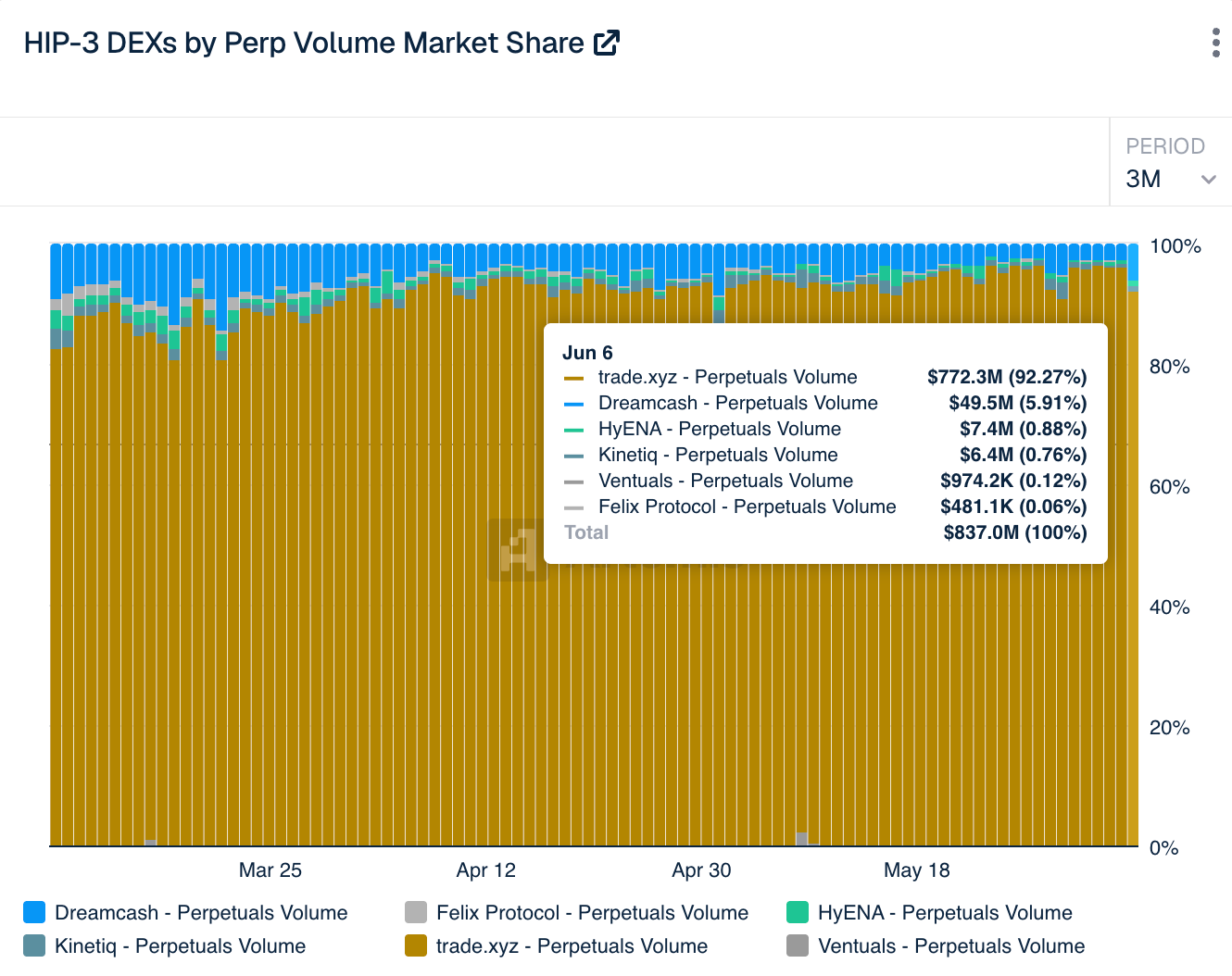
For Hyperliquid, Trade.xyz's significance lies in expanding the ecosystem's asset boundaries. In many eyes, the key to Hyperliquid eventually becoming the "on-chain Nasdaq" is not just about generating volume, but about becoming a unified trading network covering diverse asset classes, thereby attracting new user groups and market demands.
For Trade.xyz itself, its value comes from being the first mover in the promising niche of on-chain traditional financial asset trading. Today, Trade.xyz's explosive trading volume and revenue data have proven the platform's strategic success.
Dreamcash: Capturing Mobile Traffic
If Trade.xyz's goal is to expand Hyperliquid's asset boundaries, Dreamcash focuses on user boundaries.
For a long time, cryptocurrency trading products have shared a common problem: they are often designed for professional traders. Complex on-chain operations, obscure jargon, and high barriers to capital management have kept a large pool of potential users out. Even platforms with excellent trading experiences like Hyperliquid primarily serve native crypto traders.
Dreamcash aims to solve this problem. Unlike many products emphasizing trading functions, Dreamcash resembles a mobile internet-era trading app. The team has invested heavily in mobile experience, gamified reward systems, and user growth mechanisms, aiming to lower the barrier for ordinary users to engage in on-chain trading through a lighter, more game-like design. Users can log in with just an email or social account and, within seconds, leverage cryptocurrencies or global macro assets with a single click, similar to buying stocks.
As of writing, Dreamcash's total downloads on both iOS and Android platforms have exceeded 100,000.
Ventuals: Pioneer in the Pre-IPO Market
Ventuals didn't choose to focus on existing mainstream assets in the market. Instead, it extended its reach into an area within traditional finance with the highest barriers and most inaccessible for ordinary investors: the primary market, specifically private equity.
In traditional financial markets, equity subscriptions for visionary tech unicorns like OpenAI, SpaceX, and Anthropic are often monopolized by top-tier investment banks and multi-billion dollar funds. Retail investors face not only high entry barriers but also extremely long lock-up periods and poor liquidity. Ventuals' core logic is to utilize HIP-3's allowance for custom liquidation and settlement rules to package the Pre-IPO equity of these unlisted companies into on-chain perpetual contracts, allowing global retail investors to directly participate in long/short speculation on their valuations before their official IPO.
A critical reason Nasdaq became one of the world's most important capital markets is its continuous role in financing and price discovery for new economy companies. What Ventuals attempts is, in a way, similar – enabling the on-chain market to trade not only existing assets but also provide a price discovery mechanism for future assets.
Of course, this direction is still far from maturity, but it represents one of the most noteworthy evolutionary paths for on-chain capital markets.
Based: The Next Step, a "Super App"
Based aims to build a crypto "super app" covering trading, prediction markets, payments, and spending scenarios.
Currently, Based provides trading terminal products on the web, desktop, and mobile (iOS, Android). Through Based, users can trade spot and perpetual futures on Hyperliquid, access prediction markets via Polymarket, and use the Based Visa card for cryptocurrency spending in the real world.
After the implementation of HIP-3, Based took a step further from being a mere Hyperliquid frontend aggregator. It partnered with Ethena to launch HyENA, a custom trading protocol built on Hyperliquid. Unlike other HIP-3 projects primarily innovating around trading instruments, HyENA focuses on the collateral itself. The protocol introduces a collateral system centered around a yield-bearing stablecoin (USDe), aiming to allow users' idle collateral to continuously generate yields while they trade.
In a sense, this is analogous to introducing the logic of money market funds from traditional finance into the on-chain trading scenario. In the traditional brokerage system, idle funds in client accounts are often automatically allocated to money market funds to improve capital efficiency. HyENA attempts to recreate this experience in an on-chain environment.
Minara AI: When Agents Become Users
If projects like Trade.xyz, Dreamcash, and Based are still competing for human user interfaces, Minara AI represents a more futuristic direction: the Agent interface.
Minara's core product is a financial execution layer designed for AI. Users can issue trading commands to AI tools like Claude or Cursor directly through natural language. Minara then utilizes Hyperliquid's underlying trading capabilities to execute opening/closing positions, leverage management, and other operations. In other words, in Minara's vision, the entity directly using the trading interface in the future might not be humans, but user-deployed AI Agents.
In a way, this isn't limited to the Hyperliquid ecosystem; it's one of the most noteworthy trends across the entire internet.
Open Compositional Relationships Create Hyperliquid's Strongest Moat
As more teams choose to build upper-layer applications on Hyperliquid, an industry-wide question is increasingly being pondered: What does this compositional relationship between Hyperliquid and these on-chain "brokers" mean for competition in the exchange space?
Historically, most people's understanding of exchanges was stuck in the "product competition" phase. The competition was about who has a better UI, who lists more coins, who has lower fees, and who can grab more users.
But Hyperliquid is driving a completely different competitive direction. More and more market participants realize that what Hyperliquid wants to build is not a user-facing trading platform as we know it, but a set of financial infrastructure that can be directly called by APIs, programs, and even AI systems, with the upper-layer "brokers" built on top of it to interface with end-users.
In a way, this is very similar to the evolution of software in the wave of AI. In the traditional internet era, products competed on UI, entry points, and user time. But in the AI era, more and more products are retreating to the "capability layer" – the API itself is becoming the new traffic entry point.
This is the new evolutionary direction Hyperliquid is leading. As a result, more and more industry professionals are starting to understand Hyperliquid as a "Financial OS." It only needs to be responsible for unifying capabilities at the base layer, while the upper-layer "brokers" will be responsible for creating specific scenarios.
Once this structure forms, a strongly bound symbiotic relationship will emerge between Hyperliquid and these upper-layer "brokers." For Hyperliquid, each additional upper-layer application means one more traffic entry point, user channel, and trading scenario. The protocol itself doesn't need to operate these products but continuously shares in trading fees and expands the entire network's liquidity depth. For these upper-layer applications, they are highly dependent on the liquidity, matching efficiency, and on-chain trading experience that Hyperliquid has already established. They don't need to reinvent chain technology, rebuild order books, or reboot liquidity from scratch. They just need to do two things: bring users in and keep them coming back.
This means that the future logic of competition might no longer be between one exchange and another but might gradually evolve into competition between different financial networks. When more and more applications, agents, and trading entry points choose to be built on the same liquidity network, the network itself will form an increasingly strong gravitational effect. Platforms that successfully aggregate the most developers, applications, and user entry points will also possess the deepest liquidity and widest market coverage.
Perhaps this is Hyperliquid's strongest moat and the most imaginative aspect of the new Nasdaq.


