熊市 속의 "군비 경쟁", 여섯 VC가 왜 60억 달러 넘게 자금을 조달했을까?


- 핵심 관점: 암호화폐 약세장이 지속되고 있음에도 불구하고, Haun Ventures, a16z 등 주요 벤처 캐피탈들은 역발상 투자를 위해 누적 60억 달러가 넘는 자금을 조달했습니다. 이들은 스테이블코인, 자산 토큰화 등 차세대 온체인 금융 인프라에 주력하고, 동시에 AI 관련 분야에 대한 투자를 강화하고 있습니다. 반면, 중소형 VC들은 자금 조달난과 투자 회수 장애라는 양극화된 어려움에 직면하며 시장의 승자독식 현상이 심화되고 있습니다.
- 핵심 요소:
- Haun Ventures와 a16z는 5월 한 달 동안 각각 10억 달러와 22억 달러 규모의 자금 조달 완료를 발표했으며, 후자는 다섯 번째 암호화폐 펀드를 설립했습니다. Dragonfly, Paradigm 등 기관은 최근 3개월간 합계 60억 달러가 넘는 자금을 모금했습니다.
- 주요 VC들의 역발상 투자 핵심은 스테이블코인, RWA, 예측 시장, 온체인 결제 등 이미 실질적 수요가 입증된 금융 인프라에 있으며, 투자 논리는 감정 기반에서 장기 인프라 구축으로 전환되고 있습니다.
- 중소형 VC들은 알트코인 유동성 고갈, 밸류에이션 하락 및 투자 회수 어려움으로 인해 생존 압박이 가중되고 있으며, 대부분 규모 축소, 사업 전환 또는 시장 철수를 선택하여 주요 기관과의 차별화가 뚜렷해지고 있습니다.
- 주요 VC들의 구조적 강점에는 자원 독점, 완전한 투자 주기 포괄, 더 큰 시행착오 여유 및 브랜드 협상력이 포함되며, 이는 1차 시장에 대한 그들의 지배적 역할을 더욱 강화하고 있습니다.
- 암호화폐 금융 외에도 Paradigm, Haun Ventures 등은 AI 및 로봇 분야에 대한 투자를 명확히 강화하고 있으며, 암호화폐 네트워크의 특성이 에이전트 경제에서 기반 인프라로서 가치를 재발견할 수 있다고 보고 있습니다.
Original | Odaily Planet Daily (@OdailyChina)
Author|Azuma (@azuma_eth)

The cryptocurrency bear market persists, but the primary market has already seen some highly significant moves.
On May 4th, Haun Ventures, a venture capital firm founded by former US federal prosecutor Katie Haun, announced the completion of a $1 billion fundraising round. Early and late-stage funds will each be allocated $500 million, primarily targeting cryptocurrency and blockchain startups over the next 2 to 3 years, while also expanding into intersecting sectors like AI Agents, fintech, and alternative assets.
Just one day later, a16z officially announced that its fifth crypto fund, Crypto Fund 5, had completed fundraising, securing $2.2 billion in committed capital. The fund will continue to delve deep into the cryptocurrency market, focusing on parts that are most easily overlooked during cycle rotations but have the greatest potential to create long-term value, transforming new-generation infrastructure into products people use every day.
If we look further back, this doesn't seem like a coincidence but rather a "collective consensus" among top-tier VCs.
In February this year, Dragonfly's Fund IV completed a $650 million raise; late February, multiple media outlets reported that Paradigm is seeking to raise up to $1.5 billion for its next fund; March, ParaFi officially announced completing a $125 million raise; late April, sources revealed that Blockchain Capital is raising $700 million for two of its funds...within less than three months, the aforementioned six VCs alone have quietly amassed over $6 billion in dry powder.
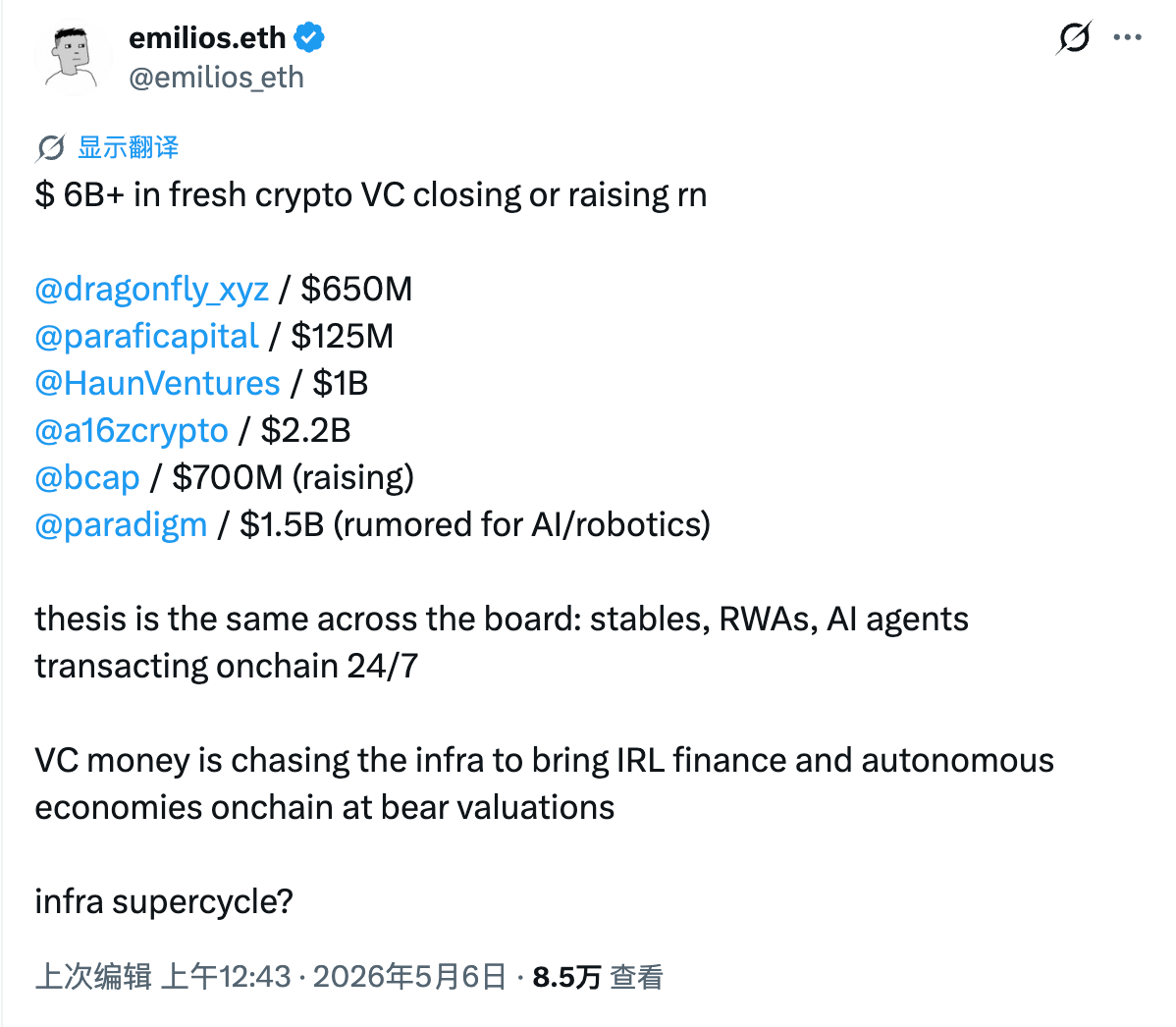
More critically, this capital wasn't raised during the market's peak heat, but during a bear market phase characterized by altcoin liquidity drought, declining primary market valuations, and persistently low industry sentiment. As a16z partner Chris Dixon remarked, "We are in a relatively quiet phase,"this isn't a follow-up charge driven by bullish sentiment, but a textbook counter-cyclical deployment.
The Primary Market is Diverging
Focusing solely on the $6 billion fundraising figure can easily create the illusion that "the primary market is recovering," but the reality is far more complex.Looking at the current survival landscape of top-tier VCs versus smaller firms, the primary market is showing clear signs of divergence.
For most small to mid-sized VCs, this cycle has been tougher than expected. Due to the persistent weakness of altcoins (almost missing the entire bull run), coupled with tightening liquidity in the secondary market, exit channels for funds are severely blocked. Book gains often gradually shrink or even turn negative over long unlock periods.Below-expected returns on investment directly lead to decreased LP confidence, making fundraising for new funds increasingly difficult.
Consequently, we see that most small to mid-sized VCs are forced into a passive contraction during the bear market: Some have chosen to reduce fund sizes and decrease deal frequency; others have pivoted to pure secondary funds; and some have completely exited the market. Many small to mid-sized VCs with high visibility during the last bull run have now disappeared from the scene.
In stark contrast are the top-tier VCs still aggressively raising capital.Although their investment pace has slowed with the market downturn, their dominant role in the primary market is actually strengthening thanks to structural advantages.
These structural advantages include: First, top-tier VCs often have stronger resource monopolization capabilities, allowing them to more effectively capture the few high-quality projects (typical examples: Kalshi backed by a16z and Paradigm, Polymarket backed by Dragonfly and ParaFi, Blockchain Capital invested in Coinbase and Circle); Second, top-tier VCs can cover a more complete investment cycle, with more opportunities for follow-on investments or amplifying returns from pre-seed and seed stages to later Series A and B rounds; Third, top-tier VCs have a larger margin for error, meaning they can tolerate relatively higher failure rates and bet on longer-term narratives; Fourth, the brand effect of top-tier VCs implies stronger bargaining power, allowing them to often secure better deal terms compared to smaller VCs, even in the same funding round.
This structural disparity in advantages and disadvantages ultimately drives market divergence, with the Matthew Effect becoming increasingly prominent. While small to mid-sized VCs could achieve turnaround success through a few lottery-like bets in a bull market, this trend only becomes more pronounced during a bear cycle.
What Are These $6 Billion Looking At?
According to disclosures from these six VCs, the newly raised $6 billion will be deployed across the following sectors and directions.
- Dragonfly: Bullish on the trend of crypto financialization, specifically highlighting stablecoins, prediction markets, Agent payments, on-chain privacy, and real-world asset tokenization.
- Paradigm: In addition to crypto, expanding into AI, robotics, and other frontier technology fields.
- ParaFi: Stablecoins, asset tokenization, and institutional-grade on-chain financial products.
- Blockchain Capital: Focused on early and growth-stage cryptocurrency startups.
- Haun Ventures: Bullish on new-generation financial infrastructure, including stablecoins, asset tokenization, prediction markets, and the Agent economy.
- a16z: Mentioned financial infrastructure like stablecoins, DeFi, prediction markets, and asset tokenization. Also believes that in the era of the AI explosion, the original characteristics of crypto networks can still solve software transparency and verifiability issues.
Putting the public statements of these six VCs together, while there are still some differences in emphasis, they have overall converged significantly.
The most core consensus is undoubtedly the new generation of on-chain financial infrastructure represented by stablecoins, real-world asset (RWA) tokenization, prediction markets, and on-chain payments. Whether it's Haun Ventures, a16z, Dragonfly, or ParaFi, these keywords are repeatedly mentioned in the directions of their new funds. To some extent, this signals a shift in the investment logic of the crypto industry. Compared to the sentiment-driven bets of the previous cycle,this cycle, top-tier VCs place greater value on infrastructure projects that have already preliminarily proven real demand and have the opportunity to long-term channel traditional financial flows.
Furthermore, top-tier VCs are also significantly increasing their bets on AI-related areas. Paradigm has explicitly stated it will allocate some funds towards AI and robotics, while Haun Ventures and Dragonfly have also mentioned Agent-related directions. The reason behind this trend is not complex. On one hand, AI has become the most deterministic theme in the global tech industry, which top-tier VCs cannot afford to miss. On the other hand,the crypto industry is trying to prove that it's not just an old narrative marginalized by the AI hype, but can serve as part of the underlying infrastructure for the AI era. Especially as the Agent economy gradually emerges, the original openness, composability, and permissionless nature of crypto networks are starting to regain value.
Raising Funds in a Bear Market is Essentially Betting on the Next Cycle
For VCs, the bear market is often the period that truly determines the future landscape.
While capital is easiest to raise during a bull market, project valuations and entry barriers are also typically higher.Only when market sentiment is low, liquidity is scarce, and industry narratives fail, do VCs truly have amplified opportunities to capture excess returns through judgment.
Looking back at past cycles, bear markets don't kill truly high-quality projects; instead, they accelerate market shakeouts, making "gold shine faster." This is precisely why, even though market sentiment remains low, top-tier VCs are still raising funds aggressively against the cycle.
Because what they are truly betting on is never the "present," but rather who will become the next Circle, the next Hyperliquid, or the next Polymarket once the next cycle begins.